Posts tagged as:

Christopher Wolf, director of the law firm Hogan Lovells’ Privacy and Information Management group, addresses his new book with co-author Abraham Foxman, Viral Hate: Containing Its Spread on the Internet. To what extent do hateful or mean-spirited Internet users hide behind anonymity? How do we balance the protection of the First Amendment online while addressing the spread of hate speech? Wolf discusses how to define hate speech on the Internet; whether online hate speech leads to real-world violence; how news sites like the Huffington Post and New York Times have dealt with anonymity; lessons we should impart on the next generation of Internet users to discourage hate speech; and cases where anonymity has proved particularly beneficial or valuable.

Download

Related Links

Free Press is holding its National Conference for Media Reform next week. The conference agenda describes the Internet as “central” to freedom of expression, which is how all mass media technologies have been described since the invention of the printing press ushered in the mass communications era. Despite recognizing that the Internet is a mass media technology, Free Press does not believe the Internet should be accorded the same constitutional protections as other mass media technologies. Like so many others, Free Press has forgotten that the dangers posed by government control of the Internet are similar to those posed by earlier mass media technologies. In a stunning reversal of the concepts embodied in the Bill of Rights, Free Press believes the executive and legislative branches of government are the source of protection for the freedom of expression. In their view, “Internet freedom means net neutrality.Continue reading →

Susan W. Brenner, associate dean and professor of law at the University of Dayton School of Law,  discusses her new paper published in the Minnesota Journal of Law, Science & Technology entitled “Cyber-threats and the Limits of Bureaucratic Control.”

Brenner argues that the approach the United States, like other countries, uses to control threats in real-space is ill-suited for controlling cyberthreats. She explains that because this approach evolved to deal with threat activity in a physical environment, it is predicated on a bureaucratic organizations. This is not an effective way of approaching cyber-threat control, she argues. 

Brenner also explains why congressional efforts at cybersecurity legislation are flawed and why U.S. authorities persist in pursuing antiquated strategies that cannot provide an effective cyberthreats defense system. She outlines an alternative approach to the task of protecting the country from cyberthreats, and approach that is predicated on older, more fluid threat control strategies.

Download

Related Links

Gabriella Coleman, the Wolfe Chair in Scientific and Technological Literacy in the Art History and Communication Studies Department at McGill University, discusses her new book, “Coding Freedom: The Ethics and Aesthetics of Hacking,” which has been released under a Creative Commons license.

Coleman, whose background is in anthropology, shares the results of her cultural survey of free and open source software (F/OSS) developers, the majority of whom, she found, shared similar backgrounds and world views. Among these similarities were an early introduction to technology and a passion for civil liberties, specifically free speech.

Coleman explains the ethics behind hackers’ devotion to F/OSS, the social codes that guide its production, and the political struggles through which hackers question the scope and direction of copyright and patent law. She also discusses the tension between the overtly political free software movement and the “politically agnostic” open source movement, as well as what the future of the hacker movement may look like.

Download

Related Links

Three rings for the broadcast-kings filling the sky,
Seven for the cable-lords in their head-end halls,
Nine for the telco-men doomed to die,
One for the White House to make its calls
On Capitol Hill where the powers lie,
One ring to rule them all, one ring to find them,
One ring to bring them all and without the Court bind them,
On Capitol Hill where the powers lie.

Myths resonate because they illustrate existential truths. In J.R.R. Tolkien’s mythical tale, the Lord of the Rings, the evil Lord Sauron imbued an otherwise very ordinary ring – the “One Ring”– with an extraordinary power: It could influence thought. When Sauron wore the One Ring, he could control the lords of the free peoples of Middle Earth through lesser “rings of power” he helped create. The extraordinary power of the One Ring was also its weakness: It eventually corrupted all who wore it, even those with good intentions. This duality is the central truth in Tolkien’s tale.

It is also central to current debates about freedom of expression and the Internet.

Since the invention of the printing press, those who control the means of mass communication have had the ability to influence thought. The printing press enabled the rapid and widespread circulation of ideas and information for the first time in history, including ideas that challenged the status quo (e.g., sedition and heresy). Governments viewed this new technology as a threat and responded by establishing control over the machinery of the printing press through state monopolies, press licenses, and special taxation.

The right to think is the beginning of freedom, and speech must be protected from the government because speech is the beginning of thought.”

The Framers knew that freedom of expression is the foundation of freedom. They also recognized that governments could control thought by controlling the printing press, and included a clause in the First Amendment prohibiting government interference with the “freedom of the press.” Though this clause was aimed at the printing press, its protection is not limited to the mass communications media of the Eighteenth Century. The courts have held that the First Amendment encompasses new mass media technologies, including broadcast television and cable.

Several public interest groups, academics, and pundits across the political spectrum nevertheless argue that the latest mass communications technology – the Internet – does not merit protection from government interference on First Amendment grounds. They assert that neither the dissemination of speech by Internet service providers (ISPs) nor the results of Internet search engines (e.g., Google) are entitled to First Amendment protection. They fear that Internet companies will use the First Amendment to justify the exercise of editorial control over the free expression of their consumers.

Others (including the Competitive Enterprise Institute) argue that the First Amendment applies to bothISPs and search engines. They believe a government with unrestrained control over the means of mass communications has the incentive and the ability to use that power to control the thoughts of its people, which inevitably leads to authoritarianism. They point to Internet censorship by ChinaSyria, and other authoritarian governments as current proof of this principle.

Both sides in the Internet debate raise legitimate concerns. I suspect many consumers do not want ISPs and search engines to exercise unfettered control over the Internet. I suspect that just as many consumers do not want government to exercise unfettered control over the Internet either. How can we resolve these dual concerns?

The free peoples of Middle Earth struggled with a similar duality at the Council of Elrond, where they decided what should be done with the One Ring. “Why not use this ring?” wondered Boromir, a bold hero who had long fought the forces of Sauron and believed the ring could save his people. Aragorn, a cautious but no less valiant hero, abruptly answered that no one on the Council could safely wield it. When Elrond suggested that the ring must be destroyed, mutual distrust drove the Council to chaos. Order was restored only when Frodo, a hobbit with no armies to command and no physical power, volunteered for the dangerous task of destroying the ring.

The judicial branch is our Frodo. It has no armies to command and no physical power. It must rely on the willingness of others to abide by its decisions and their strength to enforce them. Like the peoples of Middle Earth who relied on Frodo, we rely on the courts to protect us from abuse of government power because the judicial branch is the least threatening to our liberty.

This is as true today as it was when the Constitution was signed. Changes in technology do not change the balance of power among our branches of government. As we have in the earlier eras of the printing press, broadcast television, and cable, we must trust the courts to apply the First Amendment to mass communications in the Internet era.

Providing ISPs and search engines with First Amendment rights would prevent dangerous and unnecessary government interference with the Internet while permitting the government to protect Internet consumers within Constitutional bounds. Although some advocates imply otherwise, application of the First Amendment to Internet companies would not preclude the government from regulating the Internet. The courts uphold regulations that limit freedom of expression so long as they are narrowly tailored to advance a compelling or substantial government interest.

We have always trusted the courts to balance the right to freedom of expression with other rights and governmental interests, and there is no reason to believe they cannot appropriately balance competing concerns involving the Internet. If the courts cannot be trusted with this task, no one can.

Would you pay good money for accurate predictions about important events, such as election results or military campaigns? Not if the U.S. Commodity Futures Trading Commission (CFTC) has its way. It recently took enforcement action against overseas prediction markets run by InTrade and TEN. The alleged offense? Allowing Americans to trade on claims about future events.

The blunt version: If you want to put your money where your mouth is, the CFTC wants to shut you up.

A prediction market allows its participants to buy and sell claims payable upon the occurrence of some future event, such as an election or Supreme Court opinion. Because they align incentives with accuracy and tap the wisdom of crowds, prediction markets offer useful information about future events. InTrade, for instance, accurately called the recent U.S. presidential vote in all but one state.

As far as the CFTC is concerned, people buying and selling claims about political futures deserve the same treatment as people buying and selling claims about pork futures: Heavy regulations, enforcement actions, and bans. Co-authors Josh Blackman, Miriam A. Cherry, and I described in this recent op-ed why the CFTC’s animosity to prediction markets threatens the First Amendment.

The CFTC has already managed to scare would-be entrepreneurs away from trying to run real-money prediction markets in the U.S. Now it threatens overseas markets. With luck, the Internet will render the CFTC’s censorship futile, saving the marketplace in ideas from the politics of ignorance.

Why take chances, though? I suggest two policies to protect prediction markets and the honest talk they host. First, the CFTC should implement the policies described in the jointly authored Comment on CFTC Concept Release on the Appropriate Regulatory Treatment of Event Contracts, July 6, 2008. (Aside to CFTC: Your web-based copy appears to have disappeared. Ask me for a copy.)

Second, real-money public prediction markets should make clear that they fall outside the CFTC’s jurisdiction by deploying notices, setting up independent contractor relations with traders, and dealing in negotiable conditional notes. For details, see these papers starting with this one.

[Aside to Jerry and Adam: per my promise.]

[Crossposted at Technology Liberation Front, and Agoraphilia.]

In a New York Times op-ed this weekend entitled “You Can’t Say That on the Internet,” Evgeny Morozov, author of The Net Delusion, worries that Silicon Valley is imposing a “deeply conservative” “new prudishness” on modern society. The cause, he says, are “dour, one-dimensional algorithms, the mathematical constructs that automatically determine the limits of what is culturally acceptable.” He proposes that some form of external algorithmic auditing be undertaken to counter this supposed problem. Here’s how he puts it in the conclusion of his essay:

Quaint prudishness, excessive enforcement of copyright, unneeded damage to our reputations: algorithmic gatekeeping is exacting a high toll on our public life. Instead of treating algorithms as a natural, objective reflection of reality, we must take them apart and closely examine each line of code. Can we do it without hurting Silicon Valley’s business model? The world of finance, facing a similar problem, offers a clue. After several disasters caused by algorithmic trading earlier this year, authorities in Hong Kong and Australia drafted proposals to establish regular independent audits of the design, development and modifications of computer systems used in such trades. Why couldn’t auditors do the same to Google? Silicon Valley wouldn’t have to disclose its proprietary algorithms, only share them with the auditors. A drastic measure? Perhaps. But it’s one that is proportional to the growing clout technology companies have in reshaping not only our economy but also our culture.

It should be noted that in a Slate essay this past January, Morozov had also proposed that steps be taken to root out lies, deceptions, and conspiracy theories on the Internet.  Morozov was particularly worried about “denialists of global warming or benefits of vaccination,” but he also wondered how we might deal with 9/11 conspiracy theorists, the anti-Darwinian intelligent design movement, and those that refuse to accept the link between HIV and AIDS.

To deal with that supposed problem, he recommended that Google “come up with a database of disputed claims” or “exercise a heavier curatorial control in presenting search results,” to weed out such things. He suggested that the other option “is to nudge search engines to take more responsibility for their index and exercise a heavier curatorial control in presenting search results for issues” that someone (he never says who) determines to be conspiratorial or anti-scientific in nature.

Taken together, these essays can be viewed as a preliminary sketch of what could become a comprehensive information control apparatus instituted at the code layer of the Internet. Continue reading →

I thought Todd Zywicki, a senior scholar with the Mercatus Center at George Mason University, did a nice job on Judge Napolitano’s “Freedom Watch” show addressing the contentious question of whether government should be regulating food advertising in order to somehow make American kids healthier. Todd pointed out how the advertising guidelines currently being developed are anything but “voluntary” and noted that there are many causes of childhood obesity. Watch the clip here:

Continue reading →

Yes, we pretty much have. That’s the inescapable conclusion following the U.S. Supreme Court’s historic First Amendment decision in Brown v. EMA back in June, which struck down a California law governing the sale of “violent video games” to minors.  By a 7-2 margin, the court held that video games have First Amendment protections on par with books, film, music and other forms of entertainment.

The folks over at ALEC asked me to explore what happens next and what steps state and local lawmakers can take in a post-Brown world if they wish to address concerns about video game content. My essay appears in the Nov/Dec Inside ALEC newsletter. You can read the entire thing here or via the Scribd embed I have placed down below the fold.

I argue that, going forward, this ruling will force state and local governments to change their approach to regulating all modern media content. Education and awareness-building efforts will be the more fruitful alternative since censorship has now been largely foreclosed. Continue reading →

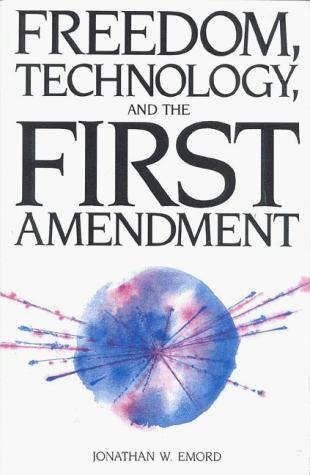
Twenty years ago, one of the best books ever penned about freedom of speech was released. Sadly, many people still haven’t heard of it. That book was Freedom, Technology and the First Amendment, by Jonathan Emord. With the exception of Ithiel de Sola Pool’s 1983 masterpiece Technologies of Freedom: On Free Speech in an Electronic Age, no book has a more profound impact on my thinking about free speech and technology policy than Emord’s 1991 classic. Emord’s book is, at once, a magisterial history and a polemical paean. This is no wishy-washy apologia for free speech, rather, it is a celebration of the amazing gift of freedom that the Founding Fathers gave us with the very first amendment to our constitution.

Unlike most people, Emord assumes nothing about the nature and purpose of the First Amendment; instead, he starts in pre-colonial times and explains how our rich heritage of freedom of speech and expression came about. Like Pool, Emord also makes the case for equality of all press providers and debunks the twisted logic behind much of this century’s corrupt jurisprudence governing speech transmitted via electronic media. Pool and Emord make it clear that if the First Amendment is retain its true meaning and purpose as a bulwark against government control of speech and expression, electronic media providers (TV, radio, cable, the Internet) must be accorded full First Amendment freedoms on par with traditional print media (newspapers, magazines, books and journals). Continue reading →