Facing threats of legal action from New York Attorney General Andrew Cuomo, many ISPs have curbed newsgroup access in the name of fighting child porn. Now, it looks like a big fish is holding out: Comcast.
Good for them. While it’s understandable that other ISPs elected to fold under intense pressure from an overzealous AG with a powerful bully pulpit, Comcast is entirely justified in standing its ground.
It’s not the responsibility of network providers to police their servers for potentially illegal files, as the Communications Decency Act makes clear. The only legal obligation of an ISP is to remove illegal content upon gaining knowledge of its existence on their network. But that hasn’t stopped Cuomo from sending a harsh letter to Comcast threatening to pursue “legal remedies to stop child pornography” if the cable giant doesn’t comply with his terms.
Cuomo wants ISPs to go far beyond merely removing illegal content as it’s discovered. The “voluntary agreement” that New York is pushing on ISPs has already resulted in many providers dropping newsgroup access completely, causing millions of subscribers to lose access to Usenet. Even among users who haven’t been completely cut off from newsgroups, the popular alt.* hierarchy has been disabled, making it nearly impossible to acquire anything larger than text files. The worst part is that the “bad guys” are unaffected by the crackdown on child porn—third-party Usenet servers with uncensored newsgroup access are a dime a dozen these days.
A legal battle with Cuomo might not be cheap, but it’d be worth fighting nevertheless. As I pointed out last month, suppressing speech through so-called “voluntary agreements” likely runs afoul of the First Amendment, and ISPs enjoy immunity under the Safe Harbor provisions of the Communications Decency Act.
Like his notorious predecessor, Andrew Cuomo seems bent on building his image as a crime-fighter through meaningless publicity stunts, even if it means extorting legitimate businesses to the detriment of consumers.
Let’s hope Comcast forces Cuomo to put his money where his mouth is—the future of free speech online may hang in the balance.
The Federal Communications Commission (FCC) lost another major First Amendment-related case today involving its recent efforts to expand the parameters of “indecency” enforcement for broadcast programming. The case involves the now infamous “wardrobe malfunction” that occurred during an unscripted 2004 Super Bowl halftime performance involving singers Justin Timberlake and Janet Jackson. When Ms. Jackson’s breast was exposed on camera for nine-sixteenths of one second, the FCC immediately launched an investigation into the incident and fines were eventually levied on the grounds that the fleeting exposure of Ms. Jackson’s breast was a violation of broadcast decency standards. CBS challenged the FCC’s decision, leading to a legal showdown in the U.S. Court of Appeals for the Third Circuit.
In today’s decision,
CBS Corp. v. FCC, the three-judge panel of the 3rd Circuit ruled that the Federal Communications Commission “acted arbitrarily and capriciously” when it imposed a $550,000 fine on CBS for the incident. The court’s 102-page decision, which can be found here, was decided squarely on procedural grounds. That is, it didn’t touch the more substantive speech-related issues or precedents such as the Pacifica or Red Lion decisions that constitute the foundations of all modern FCC broadcast regulation.
The case is important because it now joins the June 2007 decision handed down by the Second Circuit Court of Appeals in the case of Fox Television Stations v. FCC. That was the indecency case involving the FCC’s new policy for “fleeting expletives.” In that 2-1 decision, the Second Circuit ruled that “the FCC’s new policy sanctioning ‘fleeting expletives’ is arbitrary and capricious under the Administrative Procedure Act for failing to articulate a reasoned basis for its change in policy.” As a result, the FCC’s order was vacated and remanded to the agency. [And the FCC is now challenging the decision in the Supreme Court.]
This is very similar to what the 3rd Circuit said today in the
CBS case.
Continue reading →
To: Hon. David Patterson, Governor, State of New York
From: Adam Thierer, life-long gamer and Senior Fellow at the Progress & Freedom Foundation
Date: July 17, 2008
Re: That video game bill (A. 11717/ S. 6401) you have been asked to sign
Dear Gov. Patterson:
I write today to ask a few questions about a measure that is currently sitting on your desk awaiting your signature. The measure (A. 11717/ S. 6401), which recently passed through the New York legislature, proposes a new regulatory regime for video games. It would include greater state-based oversight of video game labels and console controls as well as an advisory board to monitor the industry.
As a life-long gamer—and now the parent of two young gamers—this is a subject I care deeply about. I also come at this topic from an academic perspective as someone who analyzes the intersection of child safety concerns and free speech issues surrounding various types of media and communications technologies. I am the author of a frequently-updated book,
Parental Controls & Online Child Safety: A Survey of Tools & Methods, which provides a comprehensive look at the many tools and methods on the market today that can help parents deal with concerns about objectionable media content.
But mostly I write you today from the perspective of someone who just enjoys games. Actually, let me clarify that: I am utterly infatuated with video games. Gaming has been a life-long passion of mine and something I have enjoyed with friends and family since I owned my very first PONG and Atari 2600 systems in the 1970s. Since then, I have owned virtually every major video game console sold in the United States. Even today, as I approach 40 years of age, I find myself sitting down many nights to enjoy games with my son and daughter on the Xbox 360 and Sony PS3 consoles that we have in our home.
Like millions of other Americans, gaming is now fully integrated into the fabric of my life and the lives of my children. It has become one of the most enjoyable media experiences for my generation and the generation of kids that we are raising. And, although I am certain that the New York legislature had the best of intentions in mind when passing this bill, I believe I speak for a great number of those other American gamers when I say that the measure on your desk is somewhat of an insult to our intelligence. Let me explain by raising a few questions about this bill, which I will argue is unnecessary, unworkable, and unconstitutional:
Continue reading →
Jeff Eisenach, Chairman of Criterion Economics, and I have just released a new article about the perils of a la carte regulation in the Federalist Society’s journal Engage. In “A La Carte Regulation of Pay TV: Good Intentions vs. Good Economics,” we argue that: “From a policy perspective, a la carte regulation is worse than a solution in search of a problem; it is a problem waiting to happen.” We show that the pay TV marketplace is functioning quite efficiently and that consumers have more choices and content diversity at their disposal than ever. A la carte mandates, we argue, would destroy that diversity and likely put pressure on prices to go up, contrary to the goals of the backers of a la carte.
We also discuss how a la carte is being proposed a tool of social regulation / speech control, with backers labeling it a way of “cleaning up cable.” We explain why that is not going to work and why, even if it did, it would be a betrayal of the First Amendment.
This new article can be found online here.
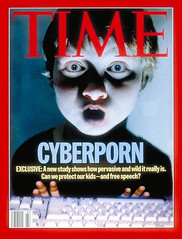
Sean Garrett of the 463 Blog posted an excellent essay this week about the great moral panic of 1995, when Time magazine ran its famous cover “Cyberporn” story that included this unforgettable image. Unfortunately for Time, the article also included a great deal of erroneous information about online pornography that was pulled from a bogus study that found 83.5 percent of all online images were pornographic! The study was immediately debunked by scholars, but not before Congress rushed to judgment and passed the Communications Decency Act, which sought to ban all “indecent” online content. It was later struck down as unconstitutional, of course.
Anyway, Sean’s essay also brought to my attention this amazing new article by Alice Marwick, a PhD Candidate in the Department of Media, Culture, and Communication at New York University: “To Catch a Predator? The MySpace Moral Panic“. The topic of “moral panics” is something I have done quite a bit of work on, but Marwick’s paper is absolute must-reading on the topic, especially as it pertains to the recent moral panic of MySpace and social networking sites.
Continue reading →
[Note: This is the fourth in a series of essays about the legacy of the Supreme Court’s FCC v. Pacifica Foundation decision, which celebrates its 30th anniversary on July 3rd. Part 1, presented a general overview of the issue. Part 2 sketched a short history of FCC indecency regulation. Part 3 discussed the misguided logic of the Court’s reasoning in Pacifica as it stood in 1978. This installment will examine why that logic is even more misguided in light of modern developments.]
Whatever legitimacy
Pacifica’s “pervasiveness rationale” might have once had, it has been largely eroded by modern media developments.
First, the pervasiveness rationale for media regulation fails today because new content tailoring technologies make it easier than ever before for parents to manage media in their homes and in their lives of their children. It is impossible to consider video programming an “intruder” in the home when tools exist that can help parents almost perfectly tailor viewing experiences to individual household preferences.
When Justice Stevens argued in
Pacifica that broadcast signals represented an “intruder” in the home, he supported that claim by noting that: “Because the broadcast audience is constantly tuning in and out, prior warnings cannot completely protect the listener or viewer from unexpected program content.” While that may have reflected the state of technology and TV viewing at the time, it is completely at odds with modern realities. In 1978, the viewing experience was a more passive affair and consumers had very few ways to control that experience unless they turned off the television altogether. Today, by contrast, viewers (including parents) have the tools to “tune in and out” at will, and they have abundant “prior warnings” about program content thanks to the existence of ratings, program information, and electronic program guides. These tools help parents restrict or tailor the viewing experience in advance according to their values and preferences.
Continue reading →
[Note: This is the third in a series of essays about the legacy of the Supreme Court’s FCC v. Pacifica Foundation decision, which celebrates its 30th anniversary on July 3rd. Part 1, presented a general overview of the issue. Part 2 sketched a short history of FCC indecency regulation. This installment will examine the misguided logic of the Court’s reasoning in Pacifica as it stood in 1978. Part 4 will then examine why that logic is even more misguided in light of modern developments.]
For the past three decades, regulation of television programming has been premised on the “pervasiveness rationale” as articulated in the landmark Supreme Court case
FCC v. Pacifica Foundation. In Pacifica, in a 5-4 plurality decision, the Court held:
Of all forms of communication, broadcasting has the most limited First Amendment protection. Among the reasons for specially treating indecent broadcasting is the uniquely pervasive presence that medium of expression occupies in the lives of our people. Broadcasts extend into the privacy of the home and it is impossible completely to avoid those that are patently offensive. Broadcasting, moreover, is uniquely accessible to children.
In one portion of the decision, Justice John Paul Stevens, who authored the majority opinion, even referred to broadcast signals as an “intruder” into the home.
There were always serious problems with the “media-as-invader” logic of Pacifica.
Continue reading →
Next Thursday, July 3rd will mark the 30th anniversary of the Supreme Court’s landmark First Amendment decision, FCC v. Pacifica Foundation. Sadly, but somewhat ironically, the anniversary of this decision comes just a few days after we lost America’s greatest modern social satirist George Carlin, whose infamous “seven dirty words” monologue prompted the Supreme Court’s Pacifica decision. After a Pacifica Foundation radio station aired Carlin’s monologue and the FCC took action against that station, a court battle ensued regarding whether the agency had the authority to censor “indecent” content on broadcast radio and television stations.
Unfortunately, when the Supreme Court handed down its
Pacifica decision 30 years ago, the First Amendment lost. By a narrow 5-4 vote, the court held that the FCC could impose fines on broadcasters who aired indecent content during daytime and early evening hours. The Court used some rather tortured reasoning to defend the proposition that broadcast platforms deserved lesser First Amendment treatment than all other media platforms. The lynchpin of the decision was the so-called “pervasiveness theory,” which held that broadcast speech was “uniquely pervasive” and an “intruder” in the home, and therefore demanded special, artificial content restrictions.
Over the course of the next week, I plan on posting some thoughts about that twisted logic and the legacy of the
Pacifica decision in general. In part 2, I’ll sketch out the broad outlines of FCC indecency enforcement over the past 70 years. In part 3, I’ll be highlighting some of the original deficiencies of the “pervasiveness doctrine.” Part 4 will highlight the irrelevancy of Pacifica and the pervasiveness doctrine in light of recent technological developments. These (and potentially other) installments will highlight why Pacifica was always bad law and is even more misguided and unjust in light of recent marketplace developments.

 The Technology Liberation Front is the tech policy blog dedicated to keeping politicians' hands off the 'net and everything else related to technology.