 The Washington Post reports today on a trend that I thought we all knew about, but one I’m glad the mainstream media is finally realizing. It turns out that people who play video games are not just virginal teenage boys with acne problems. No, even 20-something, attractive women play video games.
The
Post’s
Mike Musgrove reports on the mother and daughters of the Burguieres family of Bethesda, Maryland. Of course in good journalist fashion Musgrove uses the Burguiereses to illustrate a larger point, he even points to the relevant stats:
It used to be that this all-woman crew wouldn’t fit the standard image of the video game consumer. But the perception of gamers as being mostly young guys isn’t so true anymore. Women and girls make up 40 percent of the gamer population, according to the Entertainment Software Association.
The most interesting point brought up in the article on this demographic trend—one that most gamers realize has been happening for quite some time—is Musgrove’s observation that women once were not naturally accepted members of the gaming community. It’s a great point, but one that can be extended to tech community in general.
Continue reading →
I posted an essay last month about some possible non-regulatory solutions to the problem of porn on planes that I predicted might develop once airlines started rolling out in-flight Internet access. Some respondants to that essay argued this was likely a non-problem because few people would actually view porn in public. Unfortunately, a few incidents have apparently already created controversy.
Frankly, I am shocked that legislation hasn’t already been floated on this issue, but I am sure that someone in Congress will be firing off something soon. Again, like I said in that previous essay, before things get ugly and bills start flying up on the Hill, the airlines need to think about crafting some constructive solutions to this problem. We don’t want the FCC to become the censors of the sky, as some lawmakers will no doubt propose eventually.
John Markoff had an interesting article in the New York Times this weekend entitled “Internet Traffic Begins to Bypass the U.S..” In the piece, Markoff notes that “The era of the American Internet is ending” since “data is increasingly flowing around the United States,” instead of all flowing though our country, as it once did. Markoff focuses on how that “may have intelligence — and conceivably military — consequences.”
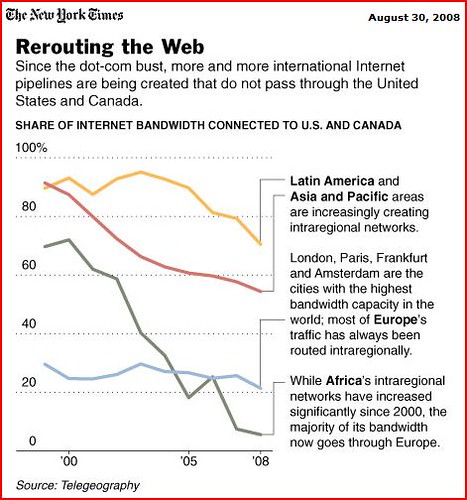 Indeed, it may. But what I also found interesting about this fact is the implications it will have for the future of content regulation. As Harvard’s Yochai Benkler told the
Times, “This is one of many dimensions on which we’ll have to adjust to a reduction in American ability to dictate terms of core interests of ours.” Content controls are one way that lawmakers enforce what they perceive to be a country’s “core interests.” As less and less Internet traffic flows through the U.S., it could become increasingly difficult for American lawmakers to impose their particular vision or morality on the Internet.
Indeed, it may. But what I also found interesting about this fact is the implications it will have for the future of content regulation. As Harvard’s Yochai Benkler told the
Times, “This is one of many dimensions on which we’ll have to adjust to a reduction in American ability to dictate terms of core interests of ours.” Content controls are one way that lawmakers enforce what they perceive to be a country’s “core interests.” As less and less Internet traffic flows through the U.S., it could become increasingly difficult for American lawmakers to impose their particular vision or morality on the Internet.
And that’s both good and bad news.
Continue reading →
 Having covered free speech and media policy issues for many years now, one of the arguments I hear a lot is that we moderns have an unnatural fascination with murder, mayhem, and violence as well as gossip and celebrities. Social critics and proponents of media content regulation often wax nostalgic about the supposed “good ol’ days” when all we thought and talked about was enlightened and enriching topics.
It’s all complete nonsense. Anyone who has seriously studied our nation’s history — or, for that matter, the history of any country or civilization — knows that we humans have
always been fascinated by the morbid and tales of debauchery, especially when those tales involve public officials or celebrities.
I was reminded of this again today when reading two articles in the
Washington Post.
Continue reading →
Over at Reason’s “Hit and Run” blog, Matt Welch has penned a piece pointing out how it is impossible to make the anti-media activists happy. Welch notes that radical activist groups like Free Press go around demonizing media moguls like Rupert Murdoch because he supposedly symbolizes the fact that will live in an age of media monopolists who puppeteer all our news and entertainment from on high. It’s all 100% B.S., of course, as we have shown here again and again.
But even when confronted by the rise of alternative owners and ownership models, the Free Press fanatics show their true colors by saying that won’t work for them either. Walsh notes, for example, that the skake-up of the old Tribune empire and the emergence of Sam Zell as an independent owner of the Trib — and an owner hellbent on downsizing the old empire, no less — should be exactly what Free Press wants:
Continue reading →
 Along with my friends John Morris and Sophia Cope of the Center for Democracy & Technology, I have just submitted an amicus brief to the Supreme Court in the potentially historic free speech case FCC v. Fox, which will be heard in November.
[Reminder: The
FCC v. Fox case is the indecency case involving the FCC’s new policy for “fleeting expletives.” I wrote about the Second Circuit Court of Appeals decision here. The full decision is here. By contrast, the so-called “Janet Jackson case” — CBS v. FCC — took place in the Third Circuit Court of Appeals and that court recently handed down a decision that also went against the FCC. I wrote about the Third Circuit’s decision here.]
The
FCC v. Fox case could become the most important First Amendment-related Supreme Court case since FCC v. Pacifica Foundation, which just turned 30 years old last month. Of course, it could be that the Supreme Court simply sticks to the procedural questions regarding whether the FCC moved too far, too fast in reversing it’s long-standing policy of restraint regarding “fleeting expletives.” That’s essentially what the Second Circuit did. On the other hand, the Supremes might reach the substantive First Amendment issues tied up in the Pacifica case. We just won’t know for sure until the case is handed down.
Regardless, in the joint CDT-PFF amicus brief filed today, we argue that the FCC has both gone too far procedurally and that “the time is rapidly approaching for this Court to find that broadcast, like the Internet and other means of mass communication, ‘is entitled to the highest protection from government intrusion’ and that there is no longer a factual ‘basis for qualifying the level of First Amendment scrutiny that should be applied to this medium.'” Citing
Reno v. ACLU, 521 U.S. at 863, 870.”
A more detailed summary of our argument follows below.
Continue reading →
In my July essay on “Understanding The True Cost of Video Game Censorship Efforts,” I pointed out how outrageous it was that politicians continue to burn money on fruitless regulatory measures that are destined to be struck down as unconstitutional. I argued that the nearly $2 million in legal fees and expenses recovered by the video game industry after winning its legal cases against various governments could have been spent much better by public policy makers:
That $2 million in recovered legal fees could have been plowed into educational efforts to help explain to parents how to use the excellent voluntary ratings systems or console-based parental control tools that are at their disposal. Moreover, that $2 million in recovered industry legal fees does not account for the resources that state and local officials put into these regulatory efforts. So, we are talking about a much greater deadweight loss for society and taxpayers.
Well, that opportunity cost / deadweight loss grew even higher today when the state of California reimbursed the Entertainment Software Association (ESA) $282,794 for attorney’s fees after losing a recent legal battle in the case
Video Software Dealers Association v. Schwarzenegger. The ESA sent out a press release about the case today that dramatically points out the opportunity cost of such regulation:
The ESA noted that this payment comes at an especially troubling time for the state, calling to mind other pressing budgetary and legislative priorities and issues, including:
* California is currently facing a $15-billion budget gap
* More than 10,000 California state employees were laid off last week in light of the budget crisis
* Governor Schwarzenegger is seeking to cut wages for nearly 200,000 state employees
* The state already cut 10 percent to its Medicaid reimbursement rate and deferred payments to vendors
“Caregivers are not well-served by court battles and legal fees. Rather, they would have been far better off if state officials worked together with our industry to raise awareness about video game ratings and the parental controls available on all new game consoles — both of which help ensure that the games children play are parent-approved.”
Indeed. And yet, the video game censorship bandwagon rolls on. Will it never end?
The Australian government has been running a trial of ISP-level filtering products to determine whether network-based filtering could be implemented by the government to censor certain forms of online content without a major degradation of overall network performance. The government’s report on the issue was released today: Closed-Environment Testing of ISP-Level Internet Content Filtering. It was produced by the Australian Communications & Media Authority (ACMA), which is the rough equivalent of the Federal Communications Commission here in the U.S., but with somewhat broader authority.
The Australian government has been investigating Internet filtering techniques for many years now and even gone so far to offered subsidized, government-approved PC-based filters through the Protecting Australian Families Online program. That experiment did not end well, however, as a 16-year old Australian youth cracked the filter within a half hour of its release. The Australian government next turned its attention to ISP-level filtering as a possible solution and began a test of 6 different network-based filters in Tasmania.
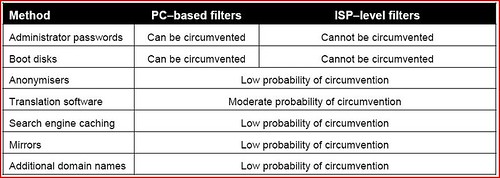
What makes ISP-level (network-based) filtering an attractive approach for many policymakers is that, at least in theory, it could solve the problem the Australian government faced with PC-based (client-side) filters: ISP-level filters are more difficult, if not impossible, to circumvent. That is, if you can somehow filter content and communications at the source–or within the network–then you have a much greater probability of stopping that content from getting through. Here’s a chart from the ACMA’s new report that illustrates what they see as the advantage of ISP-level filters:
 Continue reading →
A few days ago I posted an open letter to New York Gov. David Patterson about a measure that recently passed through the New York legislature and was awaiting his signature. The bill proposes a new regulatory regime for video games that would include greater state-based oversight of video game labels and console controls as well as an advisory board to monitor the industry. Unfortunately—but quite unsurprisingly—Gov. Patterson signed the bill last night. And so I am certain that another legal battle will ensue regarding the constitutionality of the measure, and it will likely be struck down like every other measure on this front because it violates the First Amendment. Regardless, let’s talk a little more about what animates this specific legislative effort, because I think it is very important and foreshadows the heated debate to come over video games and all media in coming years.
The New York measure is notable in that, unlike most of the other state or local measures that had been stuck down in recent years that proposed penalties for the sale of games to youngsters which were labeled by the ESRB to be intended for an older audience, it simply proposed more “oversight” of the ratings process and parental control technologies by the state. Specifically, it mandated that all games be rated and that all consoles contain screening controls. The response to that proposal has generally been: “So what?” After all, all video games are rated already and all game consoles contain parental controls. The measure also mandated a 16-member oversight board to monitor the industry and this process. Again, that proposal was not regarded by many as a serious threat to the video games or free speech.
But I fear that many are missing the big picture here. The New York bill is actually far more important that many people suspect because of what it foreshadows: A day when politicians will claim that we can make rating systems more “scientific” by putting public health bureaucrats or university social scientists in charge of them. Indeed, last night on Bloomberg TV, this became the focus of a debate between me and Dr. Michael Rich, Director of the Center for Media and Child Health at the Harvard Medical School. After you watch the clip, I’ll have much more to say about this issue down below the fold.
http://eplayer.clipsyndicate.com/cs_api/get_swf/2/&csEnv=p&wpid=0&va_id=649150
Continue reading →

 The Technology Liberation Front is the tech policy blog dedicated to keeping politicians' hands off the 'net and everything else related to technology.