Like many others, I have long been troubled by the fact that the Supreme Court does not allow TV cameras or live audio coverage of the cases it hears. I know all the arguments against live video or audio coverage and I find them all quite unconvincing when weighed against the public’s right to hear the oral arguments and decisions that will have such a direct bearing on their lives and liberty. We should be allowed to see, or at least hear, these arguments and decisions as they happen.
Anyway, as I was reading through an article today in
Broadcasting & Cable about how “C-SPAN Seeks Oral Argument Tapes in Fox Swearing Case,” I couldn’t help but think about how particularly ironic it was that our nation’s highest court would be considering one of the most important free speech cases in decades — FCC v. Fox — and it yet wouldn’t be allowing any of us to listen in live when it takes place on November 4th! If we are lucky, the Court might grant C-SPAN expedited access to the tapes of the arguments, but it may be that we have to wait many weeks to hear what was said.
Seems silly to me. Worse yet, it means I will have to camp out in front of the Supreme Court the night before and freeze my butt off in the hope of getting a seat in the courtroom to hear the live argument! Which brings up the final bit of irony I always like to point out about restricting cameras and microphones from courtrooms: Why are they letting
anyone in the courtroom at all if they so fear instantaneous public access to the arguments?
 The Progress & Freedom Foundation has just launched the new Center for Internet Freedom. CIF offers an alternative to the proliferation of advocacy groups calling for government intervention online by offering timely analyses and critiques of proposals that diminish the vital role of free markets, free speech and property rights. We aim to drive the Internet policy debate in new directions by emphasizing a layered approach of technological innovation, user education, user self-help, industry self-regulation, and the enforcement of existing laws consistent with the First Amendment. Such an approach is a less restrictive—and generally more effective—alternative to increased regulation.
Here are some of the issues I’ll be working on as CIF’s Director in conjunction with my esteemed colleagues Adam Thierer, Adam Marcus, and adjunct fellows:
- Defending online advertising as the lifeblood of online content & services, especially in the “Long Tail”;
- Emphasizing market solutions to problems of privacy protection, especially regarding the use of cookies and packet inspection data;
- Protecting online speech and expression both in the U.S. and abroad;
- Defending Section 230 immunity for Internet intermediaries;
- Opposing online taxation and legal barriers to e-commerce and digital payments, especially at the state and local levels; and
- Ensuring that Internet governance remains transparent and accountable without hampering the evolution of the Internet.
National Freedom of Speech Week is here again. As I point out each time it comes around, it’s good opportunity for those of us in America to remember how lucky we are to live in a country that respects freedom of the press, speech, and assembly. In my essay commemorating the first Freedom of Speech Week, I explained why I felt this way:
what speech critics consistently fail to appreciate is that in a free society different people will have different values and tolerance levels when it comes to speech and media content. It would be a grave mistake, therefore, for government to impose the will of some on all. To protect the First Amendment and our heritage of freedom of speech and expression from government encroachment, editorial discretion over content should always remain housed in private, not public, hands.
However, there will always be those who respond by arguing that speech regulation is important because “it’s for the children.” […] Personally, I think the most important thing I can do for my children is to preserve our nation’s free speech heritage and fight for their rights to enjoy the full benefits of the First Amendment when they become adults. Until then, I will focus on raising my children as best I can. And if because of the existence of the First Amendment they see or hear things I find troubling, offensive or rude, I will sit down with them and talk to them in the most open, understanding and loving fashion I can about the realities of the world around them.
I would hope that the critics of the First Amendment would do the same instead of seeking to undercut our nation’s rich history of freedom of speech and expression. It is one of our Founders’ enduring gifts to future generations and a precious freedom worth fighting for.
Happy Freedom of Speech Week everyone.
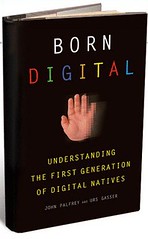 Earlier this year, I mentioned an outstanding book that John Palfrey of the Berkman Center for Internet & Society at Harvard Law School co-edited entitled Access Denied: The Practice and Policy of Global Internet Filtering. It’s an excellent resource for anyone studying the methods governments are (unfortunately) using to stifle online expression across the globe. It’s one of the most important technology policy books of the year.
Well, it looks like John Palfrey will have a second title on this year’s “Best Tech Books” list. I’ve just finished his new book with his Berkman Center colleague Urs Gasser, Born Digital: Understanding the First Generation of Digital Natives, and it is definitely worthy of your attention. In my book review posted today on the City Journal’s website, I argue that “Palfrey and Gasser’s fine early history of this generation serves as a starting point for any conversation about how to mentor the children of the Web.” It’s a comprehensive and very even-handed discussion about a variety of concerns or Internet pathologies, including: online safety, personal privacy, copyright piracy, offensive content, classroom learning, and much more.
My
City Journal review is down below, but in coming weeks I will be posting some additional thoughts about some specific things in the book worthy of more attention (including a few things I disagreed with). Overall, I’d say Born Digital is a close runner-up in the race for “Tech Book of the Year,” closely trailing Jonathan Zittrain’s Future of the Internet and How to Stop It (which I have reviewed multiple times) and Nick Carr’s The Big Switch. But I found far more to agree with in Born Digital than I did in those two books. Highly recommended.
Continue reading →
Over at CDT’s “Policy Beta” blog, my friends John Morris and Sophia Cope have penned two important essays about online free speech issues that are worthy of your attention. In the first, Sophia argues that the “Next President Must Preserve Free Speech on the Internet.” She argues:
It will be critical for the next President to do his part to uphold the Internet’s robust culture of free speech and innovation as we march further into the 21st Century. In stark contrast to the mass media of the last century, the Internet has provided, at very low cost, virtually unlimited forums for both creators and consumers of new content and technologies. This in turn has created a huge boost for participatory democracy and our economy. The next Administration must reject Congressional or agency efforts to censor content or stifle the fire of innovation on the Internet and other communications media.
Amen! Importantly, Sophia points to the essential role of Section 230 of the Telecommunications Act of 1996, which protects online service providers from crushing legal liability in a variety of circumstances. Sec. 230 is probably the most important — and most often forgotten — law dealing with online freedom. Unfortunately, however, it’s increasingly under attack and we need to be vigilant in defending it. (I’m working on a big paper about that right now with my PFF colleagues Berin Szoka and Adam Marcus).
Continue reading →

When I open the
Washington Post in the morning and find a headline like, “Banned Books, Chapter 2,” I assume that I will be reading about yet another attempt by certain conservative or religious groups to ban books from local libraries that they find objectionable, unethical, or sacrilegious. How ironic then that the debate over banning books that is currently unfolding in my home county of Fairfax County, Virginia, is being led by liberals. My ongoing series about “Liberals Abandoning the First Amendment” has been focusing on Lefties getting weak-kneed about free speech principles that they have traditionally supported, but this one takes the cake.
Here’s what is going on here in Fairfax according to Michael Alison Chandler of the
Post:
During a week that librarians nationwide are highlighting banned books, conservative Christian students and parents showcased their own collection outside a Fairfax County high school yesterday — a collection they say was banned by the librarians themselves.
More than 40 students, many wearing black T-shirts stamped with the words “Closing Books Shuts Out Ideas,” said they tried to donate more than 100 books about homosexuality to more than a dozen high school libraries in the past year. The initiative, organized by Colorado Springs-based Focus on the Family, was intended to add a conservative Christian perspective to shelves that the students said are stocked with “pro-gay” books.
Most of the books were turned down after school librarians said they did not meet school system standards. Titles include “Marriage on Trial: The Case Against Same-Sex Marriage and Parenting” and “Someone I Love Is Gay,” which argues that homosexuality is not “a hopeless condition.” “We put ourselves out there . . . and got rejected,” said Elizabeth Bognanno, 17, a senior at West Springfield High School, standing before a semicircle of television cameras outside her school. “Censoring books is not a good thing. . . . We believe our personal rights have been violated.”
Continue reading →
Yesterday, the Senate passed S. 602, “The Child Safe Viewing Act of 2007,” which was introduced by Sen. Mark Pryor (D-AR) in February 2007. The bill requires the Federal Communications Commission (FCC) to study the market for “advance blocking technologies” (i.e., parental controls and rating systems) that parents can use to protect their kids from inappropriate content from various sources and platforms. On the surface, the measure seems harmless enough, but in practice, it could have some troubling long-term free speech implications if it leads to more government meddling with parental controls and ratings systems.
The measure requires the FCC to initiate a notice of inquiry to consider measures to examine:
- the existence and availability of advanced blocking technologies that are compatible with various communications devices or platforms;
- methods of encouraging the development, deployment, and use of such technology by parents that do not affect the packaging or pricing of a content provider’s offering; and
- the existence, availability, and use of parental empowerment tools and initiatives already in the market.
That all sounds harmless enough. Indeed, such a study could produce some useful information about the state of the parental controls marketplace. (Of course, I could save them some taxpayer dollars and just send copies of my big
Parental Controls & Online Child Safety report to all FCC officials!)
But it’s what comes next in the bill that causes me some heartburn. As part of the review mandated by the bill, S. 602 commands the FCC to “consider advanced blocking technologies that”:
Continue reading →
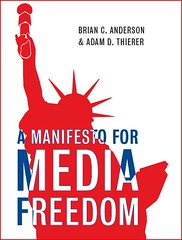 I’m pleased to announce the publication of A Manifesto for Media Freedom, which I co-authored with Brian C. Anderson of the Manhattan Institute. Brian serves as editor of Manhattan Institute’s excellent City Journal and he is the author of best-selling books like South Park Conservatives and Democratic Capitalism and Its Discontents.
In this little manifesto, we highlight one of the central ironies of the Information Age. Namely, that despite “the breathtaking abundance of new and old media outlets for obtaining news, information, and entertainment…”
many people hate this profusion, and never more than when it involves political speech. The current media market, they charge, doesn’t represent true diversity, or isn’t fair, or is subject to manipulation by a small and shrinking group of media barons. They want the government to regulate it into better shape, which just happens to be a shape that benefits them. Doing so… would be a disaster, a kind of soft or not-so-soft tyranny that would wipe out whole sectors of media, curtailing free speech and impoverishing our democracy.
In other words, instead of celebrating the unprecedented cornucopia of media choices at our collective disposal, many policymakers and media critics are calling for just as much media regulation as ever. We itemize these threats in our chapters and they include: efforts to revive the “Fairness Doctrine”, media ownership regulations, “localism” requirements, Net neutrality mandates, a la carte regulations, cable and satellite censorship, video game censorship, regulation of social networking sites, campaign finance-related speech restrictions, and so on.
In each case, we advance a pro-freedom paradigm to counter the advocates of media control. What do we mean by the “media freedom” that we advocate as the alternative to these new regulatory crusades? Here’s how we put it in the book:
Continue reading →
This week, I have been up at Harvard University participating in another meeting of the Internet Safety Technical Task Force (ISTTF), of which I am a member. The ISTTF was organized earlier this year pursuant to an agreement between 49 state attorneys general (AGs) and social networking giant MySpace.com. A group of experts from academia, non-profit organizations, and industry were appointed to the Task Force, which is charged with evaluating the market for online child safety tools and methods and issuing a report on the matter to the AGs at the end of this year. ISTTF members have been meeting privately and publicly in both Cambridge, MA and Washington, D.C. The Task Force has been very ably chaired by John Palfrey, co-director of Harvard’s Berkman Center for Internet & Society.
Although the ISTTF is looking at a wide variety of tools and methods associated with online child protection (ex: filters, monitoring tools, educational campaigns, etc.), many of the AGs who crafted the agreement with MySpace that led to the Task Force’s formation have made it clear that they are
most interested in having the ISTTF evaluate age verification / online verification technologies. In fact, at the start of this week’s session at Harvard Law School, AGs Martha Coakely of Massachusetts and Richard Blumenthal of Connecticut both spoke and made it abundantly clear they expect the Task Force to develop age and identify-verification tools for social networking sites (SNS). AG Blumenthal said we need to deal with “the dangers of anonymity” and repeated his standard line about online age verification: “If we can put a man on the moon, we can make the Internet safe.” [Of course, putting a man on the moon took hundreds of billions of dollars and a decade to accomplish, but never mind that fact! Moreover, one could also argue that if we can put a man on the moon we can cure hunger, AIDS, and the common cold, but some things are obviously easier said than done. Finally, putting a man on the moon didn’t require all Americans or their kids to give up their anonymity or privacy rights in order to accomplish the feat!]
On many occasions here before, I have outlined various questions and reservations about proposals to mandate online age verification. Last year, I also published a lengthy white paper on the issue and hosted a lively debate on Capitol Hill [transcript here] about this. I also have discussed age verification in my book on parental controls and online child safety. [Braden Cox also talked about his experiences up at Harvard this week here, and CNet’s Chris Soghoian had a brutal assessment of this week’s proposals on his “Surveillance State” blog.]
In this essay, I will discuss the new fault lines in the debate over online age verification and outline where I think we are heading next on this front. I will argue:
- There is now widespread understanding that it is extraordinarily difficult to verify the ages and identities of minors online using the methods we typically use to verify adults. Because of this, age verification proponents are increasingly proposing two alternative models of verifying kids before they go online or visit SNS…
- First, for those who continue to believe that we must do whatever we can to verify kids themselves, schools and school records are increasingly being viewed as the primary mechanism to facilitate that. This raises two serious questions: Do we want schools to serve as DMVs for our children? And, do we want more school records or information about our kids being accessed or put online?
- Second, for those who are uncomfortable with the idea of verifying kids or using schools, or school records, to accomplish that task, parental permission-based forms of authentication are becoming the preferred regulatory approach. Under this scheme, which might build upon the regulatory model found in the Children’s Online Privacy Protection Act of 1998 (COPPA), parents or guardians would be verified somehow and then would vouch for their children before they were allowed on a SNS, however defined. But how do we establish a clear link between parents and kids? And will parents be willing to surrender a great deal more information (about themselves and their kids) before their kids can go online? And, is it sensible to use a law that was meant to protect the privacy and personal information of children to potentially gather a great deal more information about them, and their parents?
- It remains very unclear how either of those two verification methods would make children safer online. Indeed, that could actually make kids less safe by compromising their personal information and creating a false sense of security online for them and their parents.
- It is highly unlikely the Internet Safety Technical Task Force will be able to reach consensus on this complicated, controversial issue. A small camp will likely flock to the sort of proposals mentioned above. Another, larger camp (including me) will flock to education-based approaches to child safety as well increased reliance on other parental empowerment tools and strategies, industry self-regulatory efforts, social norms, and better intervention strategies for troubled youth. But the age verification debate will go on and, as was the case over the past two years, the legal battleground will be state capitals across America, with AGs likely pushing for age verification mandates regardless of what the Task Force concludes.
Continue reading if you are interested in the details.
Continue reading →
By Berin Szoka & Adam Thierer
Progress Snapshot 4.19 (PDF)
Since the fall of 2008, a debate has raged in Washington over “targeted online advertising,” an ominous-sounding shorthand for the customization of Internet ads to match the interests of users. Not only are these ads more relevant and therefore less annoying to Internet users than untargeted ads, they are more cost-effective to advertisers and more profitable to websites that sell ad space. While such “smarter” online advertising scares some—prompting comparisons to a corporate “Big Brother” spying on Internet users—it is also expected to fuel the rapid growth of Internet advertising revenues from $21.7 billion in 2007 to $50.3 billion in 2011-an annual growth rate of more than 24%. Since this growing revenue stream ultimately funds the free content and services that Internet users increasingly take for granted, policymakers should think very carefully about what’s really best for consumers before rushing to regulate an industry that has thrived for over a decade under a layered approach that combines technological “self-help” by privacy-wary consumers, consumer education, industry self-regulation, existing state privacy tort laws, and Federal Trade Commission (FTC) enforcement of corporate privacy policies.
In an upcoming PFF
Special Report, we will address the many technical, economic, and legal aspects of this complicated policy issue-especially the possibility that regulation may unintentionally thwart market responses to the growing phenomenon of users blocking online ads.
We will also issue a three-part challenge to those who call for regulation of online advertising practices:
- Identify the harm or market failure that requires government intervention.
- Prove that there is no less restrictive alternative to regulation.
- Explain how the benefits of regulation outweigh its costs.
Continue reading →

 The Technology Liberation Front is the tech policy blog dedicated to keeping politicians' hands off the 'net and everything else related to technology.