 Chairman Mao–er… Martin–has canceled (WSJ) the FCC’s December 18 meeting, when the Commission was set to vote on Martin’s proposal to rig an auction to give away a valuable piece of spectrum (“AWS-3”) to M2Z networks. In exchange for a sweetheart deal on the spectrum, the company would have been required to use a quarter of it to provide a free (but very slow) wireless broadband service. Martin had initially proposed to require that the service be made porn-free, but eventually suggested that users over 18 would be able to opt-out of network-level filtering.
Two weeks ago, when it became clear that Martin would attempt to ram this proposal through while he still could, I asked how the ascendant Left would respond:
Will the defenders of free expression triumph over those who see ensuring free broadband as a social justice issue? Or will those on the Left who usually joining us in opposing censorship simply remain silent as the government extends the architecture of censoring the “public airways” onto the Net (where the underlying rationale of traditional broadcast regulation–that parents are powerless–does not apply)?
I’m glad to see that the deathblow to this unconstitutional proposal did indeed come from the political Left–specifically, from Sen. John Rockefeller, (D-W.Va.) and Rep. Henry Waxman, (D-Calif.), who will be responsible for overseeing the FCC in the new Congress. (The Bush administration had already opposed the proposal, as with so many of Martin’s abuses, had failed to stop it.)
With President-elect Obama having declared that, “Here in the country that invented the Internet, every child should have the chance to get online,” it seems almost certain that the Administration will press ahead with some kind of universal broadband proposal of its own. But what would such a proposal look like? If it’s another public broadband utility, would it include network-level filtration like Martin’s proposal? If so, will the Democratic opponents of government censorship stick by their principles and fight that, too?
I suspect we may find that what’s constitutional is politically impossible (unfiltered free Internet) and what’s politically possible (filtered free Internet) is unconstitutional. Continue reading →
Ken Ferree and I just filed an amicus brief with the D.C. Circuit in what could be among the most important First Amendment cases involving economic regulation in years: Comcast’s challenge to the FCC’s cap on the maximum size of a cable operator’s nationwide subscriber-audience. While few may feel righteous indignation at limitations targeted at large corporations such as Comcast or Time Warner, the larger principle at stake here is deeply important: Will the First Amendment provide a meaningful check on what USC law professor Chris Yoo has called “architectural censorship” (i.e., so-called “structural” regulations that “have the unintended consequence of reducing the quantity, quality, and diversity of media content”).
In a nutshell, we argue that that:
- The provisions of the 1992 Cable Act authorizing the FCC to impose a “cable cap” are outdated in world of media abundance and vibrant platform competition.
- Because cable is no longer the unique “bottleneck” or “gatekeeper” that it was in 1992, these statutory provisions (not just the FCC’s 30% rule) must be subject to strict scrutiny under the First Amendment as a limitation on free speech.
- Because there are “less restrictive means” of ensuring cable operators do not impede the flow of video programming to consumers, the court should strike down these provisions.
- Even if the court upholds the statute, it should nonetheless strike down the cap issued by the FCC in December 2007 (30% of all Multichannel Video Programming (MVPD) subscribers as based on an outdated model of the video marketplace.
I encourage you to read our brief (below). I’ve provided a summary below, along with some additional commentary we just couldn’t cover under our 3500 word limit.
Strict Scrutiny. Yoo’s article Architectural Censorship and the FCC is essential reading for anyone who believes that government regulations on the size and shape of the “soapbox” can have huge effects on speech itself. Yoo argues that the First Amendment should check this kind of regulation–however “content-neutral” it might seem–under “strict scrutiny”, which requires that the government show that a regulation is the “least restrictive means” available for advancing a “compelling government interest.” But Yoo ultimately concludes (pp. 713-718, PDF pp. 45-50) that, under existing precedent, most “architectural censorship will be effectively insulated from meaningful judicial review.” Continue reading →
George Will’s weekly Washington Post column focuses on the Fairness Doctrine and calls out those on the Left who would support its reinstatement:
Because liberals have been even less successful in competing with conservatives on talk radio than Detroit has been in competing with its rivals, liberals are seeking intellectual protectionism in the form of regulations that suppress ideological rivals. If liberals advertise their illiberalism by reimposing the fairness doctrine, the Supreme Court might revisit its 1969 ruling that the fairness doctrine is constitutional. The court probably would dismay reactionary liberals by reversing that decision on the ground that the world has changed vastly, pertinently and for the better.
Mr. Will was kind enough to cite my new book with Brian Anderson, A Manifesto for Media Freedom [more info here] on the explosion of media outlets and options since the Supreme Court’s disastrous 1969 Red Lion decision, which blessed the Fairness Doctrine. Some of those stats: today there are about 14,000 radio stations, twice as many as in 1969; 18.9 million subscribers to satellite radio, up 17 percent in 12 months; and that 86 percent of households with either cable or satellite television receive an average of 102 of the 500 available channels.
No need to be putting the “Unfairness Doctrine” back on the books with unprecedented abundance like that.
I was about post something more regarding why Kevin Martin’s AWS-3 spectrum filtering plan will fail, but I can’t say it any better than Steve Schultze does here:
Martin also recently leaked the fact that he is proposing that adults can verify their identity to avoid the porn filter initially mandated for all users of of the no-fee service. I helped author some comments to the FCC explaining why this filter was a bad idea, so an opt-out mechanism could theoretically be a good development… if age verification were viable, and if you thought that adults were eager to identify themselves as possible porn-lovers, and if we assumed that all adults had credit cards. In short, filtering is not a great option even with those caveats.
Exactly. Also, don’t forget about that little thing called the First Amendment! This plan would almost certainly be challenged on 1A grounds. (Also, here’s a filing I signed on to that critiques the filtering plan).
So, while the rest of you are still watching your Saturday morning cartoons this weekend, I’ll be working hard to defend the First Amendment at the Federal Society’s 2008 “National Lawyers Convention.” I am speaking on a panel there on Saturday morning entitled “The FCC and the First Amendment” and will be going up against Federal Communications Commission Chairman Kevin Martin and Gregory Garre, the Solicitor General of the United States. The primary focus of our discussion will be the FCC v. Fox case that was recently heard by the Supreme Court. It should be an interesting conversation.
It looks like registration for the event is now closed, but I’ll try to blog about it afterwords. Not sure if they are taping it or not, but if I find a video or transcript I’ll post it later.
“The FCC and the First Amendment”
Saturday, November 22nd / 10:45 a.m. – 12:15 p.m. / East Room
- Mr. Miguel A. Estrada, Gibson, Dunn & Crutcher, and Former Assistant to the United States Solicitior General
- Hon. Gregory G. Garre, United States Solicitor General
- Hon. Kevin J. Martin, Federal Communications Commission
- Mr. Adam D. Thierer, The Progress and Freedom Foundation
- Moderator: Hon. Brett M. Kavanaugh, United States Court of Appeals, District of Columbia
Tim Lee has been taking some heat here from Richard Bennett and Steve Schultze about various aspects of his new Net neutrality paper. I haven’t had much time this week to jump into these debates, but I did want to mention one important portion of Tim’s paper that is being overlooked. Specifically, I like the way Tim took head-on some of the silly free speech arguments being put forth as a rationale for net neutrality regulation. As Tim notes in the introduction of the paper:
Concerns that network owners will undermine free speech online are particularly misguided. Network owners have neither the technology nor the manpower to effectively filter online content based on the viewpoints being expressed, nor do profit-making businesses have any real incentive to do so. Should a network owner be foolish enough to attempt large-scale censorship of its customers, it would not only fail to suppress the disfavored speech, but the network would actually increase the visibility of the content as the effort at censorship attracted additional coverage of the material being censored.
I think that’s exactly right and, later in his paper (between pgs 22-3), Tim nicely elaborates about the “Herculean task” associated with any attempt by a broadband provider to “manipulate human communication.” Not only is it true, as Tim argues, that “no widescale manipulation would go unnoticed for very long,” but he is also correct in noting that the public and press backlash would be enormous.
Again, I agree wholeheartedly with all these sentiments, but I think Tim missed another important angle here when discussing the unfounded fears about corporate censorship and the misguided attempts to use free speech as a justification for imposing net neutrality regulations.
Continue reading →
 With the publication of Understanding Privacy (Harvard University Press 2008), George Washington University Law School professor Daniel J. Solove has firmly established himself as one of America’s leading intellectuals in the field of information policy and cyberlaw. Solove had already made himself a force to be reckoned with in this field with the publication of important books like The Future of Reputation: Gossip, Rumor, and Privacy on the Internet (Yale University Press 2007), The Digital Person: Technology and Privacy in the Information Age (NYU Press 2004) and his treatise on Information Privacy Law with Paul M. Schwartz of the Berkeley School of Law (Aspen Publishing, 2d ed. 2006). But with Understanding Privacy, Solove has now elevated himself to that rarefied air of “people worth watching” in the cyberlaw field; an intellectual — like Lawrence Lessig or Jonathan Zittrain — whose every publication becomes something of an event in the field to which all eyes turn upon release.
Like those other intellectuals, however, my respect for their stature should not be confused with agreement with their positions. In fact, my disagreements with Lessig and Zittrain are frequently on display here and, we have been critical of Solove here in the past as well. [Here’s Jim Harper’s review of Solove’s last book, with which I am in wholehearted agreement.] In a similar vein, although I greatly appreciate what Prof. Solove attempts to accomplish in Understanding Privacy — and I am sure it will change the way we conceptualize and debate privacy policy in the future — I found his approach and conclusions highly problematic.
Continue reading →
Today was a big day — and not just because there was an election going on! As I mentioned yesterday, the other big news was that the U.S. Supreme Court was hearing oral arguments in the potentially historic free speech case of Federal Communications Commission v. Fox Television Stations, Inc. Again, all the background you need can be found in my post yesterday, so here I will just be summarizing my general thoughts about how the oral arguments played out this morning.
Unfortunately, because no electronic devices or even notepads are allowed in the courtroom, much of what I am relaying here is from memory or from the notes that I surreptitiously scribbled on a tiny piece of scrap paper when the guards weren’t looking. (And yes, I have been reprimanded before for taking notes in the Court!) The transcript has just been released, however, so you can read it through and judge for yourself. Anyway, here are some general thoughts:
Continue reading →
A new study (which is actually based on an old study) by Dr. Craig Anderson of Iowa State University and two other researchers is making news today because it suggests a link between violent video games and real-world aggression. I have written extensively about such studies here in the past, and have included a list of relevant links down below. But let me just use the opportunity to restate the fundamental problem with the way the press reports these things.
- First, the press typically accepts the assertion made by authors of studies like these that the social “science” is unanimous in support of such a link between exposure to violent video games and real-world aggression. there is another side the story, but the press usually doesn’t report on it.
- Second, reporters almost always fail to ask about how the researchers define “violent” games and the resulting “aggression” found in these studies.
- Third, reporters almost never ask about how strong the correlation is or, more importantly, what other variables might have had an influence on the the subjects who were studied. (For example, did they factor in real violence in the home or at school?)
- Finally, the reporters almost never query the researchers about the biases they bring to the task of studying this issue (namely, do these researchers have strong feelings about the content in the games they review such that they think they should be regulated in some fashion?).
Luckily, other social researchers are willing to point out these deficiencies. (See, for example, my reviews of the recent books by Drs. Kutner & Olson as well as Dr. Kourosh Dini.) With reference to the new study reported in the press today, Texas A&M researcher Dr. Christopher Ferguson has challenged the study on many of the grounds I listed above. Specifically, in a letter to the journal (Pediatrics) in which the Anderson study appeared, Dr. Ferguson argues:
Continue reading →
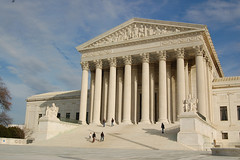 Tomorrow morning, the U.S. Supreme Court will hear oral arguments in the potentially historic free speech case of Federal Communications Commission v. Fox Television Stations, Inc. I plan on attending and will try to post some thoughts about how the arguments played out here later tomorrow afternoon or evening. [I won’t be able to live blog of Twitter it because no electronic devices are allowed in the courtroom, which I’ve always thought is outrageous.] In the meantime, here again is the background of the case.
The
FCC v. Fox case is the indecency case involving the FCC’s new policy for “fleeting expletives.” I wrote about the Second Circuit Court of Appeals decision here and the full 2nd Circuit decision is here. [By contrast, the so-called “Janet Jackson case” — CBS v. FCC — took place in the Third Circuit Court of Appeals and that court recently handed down a decision that also went against the FCC. I wrote about the Third Circuit’s decision here.]
In a 2-1 decision, the Second Circuit ruled that “the FCC’s new policy sanctioning “fleeting expletives” is arbitrary and capricious under the Administrative Procedure Act for failing to articulate a reasoned basis for its change in policy.” The decision demonstrates how, over just the past few years, the FCC has arbitrarily thrown out 30+ years worth of precedent and greatly expand the scope of its regulatory authority over speech on broadcast TV and radio. As a result, the FCC’s order was vacated and remanded to the agency. The agency appealed the decision, however, and the Supreme Court accepted it for review.
Continue reading →

 The Technology Liberation Front is the tech policy blog dedicated to keeping politicians' hands off the 'net and everything else related to technology.