Posts tagged as:

What a victory for privacy and personal responsibility is Chris Soghoian’s Targeted Advertising Cookie Opt-Out (or “TACO” – documented and downloadable here). It signals to the 27 ad networks with well-configured opt-out cookies that you don’t want them to track you.

It’s a technical solution that empowers (and places responsibility with) the user to exercise dominion over his or her personal information. No need for law and regulation. No need to go pleading to politicians and bureaucrats for help.

It’s also a little more efficient than my method of controlling tracking, which is to take a glance at cookies as Web sites ask to set them on my computer.

(The answer is usually “no,” but it’s very interesting to see who all wants to get a glance at me when I visit any site. It’s a lot more than just ad networks, btw. I have no idea why people think ad-network tracking is bad and tracking by others is a matter of indifference.)

Now, Chris and I always find something to disagree about, so for good measure I’ll note that I disagree with his goal of switching targeted advertising from opt-out to opt-in. Continue reading →

Firefox logoAs noted in the first installment of our “Privacy Solution Series,” we are outlining various user-empowerment or user “self-help” tools that allow Internet users to better protect their privacy online-and especially to defeat tracking for online behavioral advertising purposes. These tools and methods form an important part of a layered approach that we believe offers an effective alternative to government-mandated regulation of online privacy.

In the last installment, we covered the privacy features embedded in Microsoft’s Internet Explorer (IE) 8. This installment explores the privacy features in the Mozilla Foundation’s Firefox 3, both the current 3.0.7 version and the second beta for the next release, 3.5 (NOTE – The name for the next version of Firefox was just changed from 3.1 to 3.5 to reflect the large number of changes, but the beta is still named 3.1 Beta 2). We’ll make it clear which features are new to 3.1/3.5 and those which are shared with 3.0.7. Future installments will cover Google’s Chrome 1.0, Apple’s Safari 4, and some of the more useful privacy plug-ins for browsers . The availability and popularity of privacy plug-ins for Firefox such as AdBlock (which we discussed here), NoScript and Tor significantly augments the privacy management capabilities of Firefox beyond the capability currently baked into the browser.  In evaluating the Web browsers, we examine:

(1) cookie management; (2) private browsing; and (3) other privacy features

Continue reading →

I’ve already laid out my own reactions to Google’s roll-out of an “interest based advertising” (IBA) program here.  In a nutshell, I applauded Google setting a new “gold standard” in user empowerment by providing:

  • Notice in their IBA-targeted ads of who’s paying for the ad and the fact that Google is serving it; and 
  • A link to a powerful “Ad Preference Manager” that allows users to:
    • See and modify the “digital dossier” (to use the fearmonger’s term) of interests associated with the cookie on their computer; and 
    • Opt-out of tracking for IBA purposes.    

But as I predicted, despite these pro-privacy features (and despite the fact that other major companies such as Yahoo! and Microsoft already have IBA programs), a number of privacy advocacy organizations are attacking Google for daring to enter the IBA (or “online behavioral advertising”) business at all.   I’ll have much more to say about the criticism of Google’s new Ad Preference Manager soon, especially coming from Marc Rotenberg of EPIC (a “disaster“) and Jeff Chester of CDD—precisely the sort of the “paroxysms of privacy hysteria” I predicted.  

But first, the criticism from Ari Schwartz of the Center for Democracy & Technology requires a response today.  At its best, CDT plays a vital role in calling corporations to continually raise the bar on privacy.  My own think tank, the Progress & Freedom Foundation, works closely with CDT on many issues, such as advocating user empowerment through technological means as a constitutionally “less restrictive” way of protecting children than government censorship.

 Here’s what Ari had to say: Continue reading →

By Adam Thierer, Berin Szoka, & Adam Marcus

IE logoAs noted in the first installment of our “Privacy Solution Series,” we are outlining various user-empowerment or user “self-help” tools that allow Internet users to better protect their privacy online-and especially to defeat tracking for online behavioral advertising purposes.  These tools and methods form an important part of a layered approach that we believe offers an effective alternative to government-mandated regulation of online privacy.

In some of the upcoming installments we will be exploring the privacy controls embedded in the major web browsers consumers use today: Microsoft’s Internet Explorer (IE) 8, the Mozilla Foundation’s Firefox 3, Google’s Chrome 1.0, and Apple’s Safari 4. In evaluating these browsers, we will examine three types of privacy features:

(1) cookie management controls; (2) private browsing; and (3) other privacy features

We will first be focusing on the default features and functions embedded in the browsers. We plan to do subsequent installments on the various downloadable “add-ons” available for browsers, as we already did for AdBlock Plus in the second installment of this series. Continue reading →

Shame on Mozilla

by on February 10, 2009 · 11 comments

Over at Ars, Ryan Paul has an appropriately sharp-tongued response to the Mozilla Foundation’s troubling move to become a cheerleader for the European Commission’s ongoing antitrust efforts against Microsoft. Apparently Mozilla will assist the EC’s investigation “by offering expertise about the browser market.”

Paul focuses on what’s wrong with this in both a micro and macro sense. He rightly points out that the potential remedies here do not bode well for the future of this sector, since regulatory tinkering with high-tech product standards is bound to end badly and create a terrible precedent for future interventions. “It’s hard to find a rational argument in favor of mandatory standards enforcement,”  Paul says. “It would be punitive and unhelpful to the advancement of the web.” Moreover, Paul notes that things have never looked better on the browser front:

Claims that Microsoft’s monopoly status has eliminated competition in the browser market sound hollow in the face of the profoundly vibrant browser market that exists today. The record-setting launch of Firefox 3 added up to over 8 million downloads in the first 24 hours alone. Firefox’s global market share continues to climb every month and the browser has grabbed almost 30 percent of the European market.

And let’s not forget about those two little companies called Google and Apple who have competing products in the field! They’re making serious inroads in the browser wars. Moreover, Microsoft is struggling to hold on to whatever “dominance” they have left in their core market: OS. As Paul concludes:

To the observant tech enthusiast, all signs seem to indicate that Microsoft’s monopoly is on its way out. The Redmond giant is in no danger of annihilation, but it’s definitely not positioned to dictate terms to the rest of the industry anymore.

But what is perhaps most shocking about Mozilla’s call for intervention is the way that Mozilla Foundation chairperson Mitchell Baker minimizes the importance of not just Firefox, but the entire open source movement, when justifying EC intervention in this marketplace.

Continue reading →

When people ask me why I do what I do for a living — and, more specifically, why I focus all my attention on digital media and technology policy — I often respond by showing them the new gadgets or software I am playing with at any given time.  I just love digital technology.  I am swimming in a sea of digital gadgets, consumer electronics, online applications, computing software, video games, and all sorts of cyber-stuff.

Anyway, even though this is a technology policy blog, I sometimes highlight new digital toys or applications that have changed my life for the better. As the year winds down, therefore, I thought I would share with you five technologies that improved my life and productivity in 2008. I’d also love to hear from all of you about the technologies that you fell in love with this year in case I might have missed them. Here’s my list:

#1) Naturally Speaking 10:

Nat Speak boxThanks to Nate Anderson’s outstanding review over at Ars Technica, I finally made the plunge and bought Dragon Naturally Speaking 10 earlier this month.  Wow, what a life-changer. I had played around with an earlier version of this market-leading speech recognition technology and found it somewhat clunky and unreliable. But Ver. 10, has ironed out almost all the old problems and become an incredibly sophisticated piece of software in the process. I love the way I can use simple voice commands to navigate menus in Microsoft Word and in Firefox. Perhaps best of all, I can dictate random rants into a pocket recording device and then upload them to Naturally Speaking (via a USB connection) and have them instantly transcribed. I’m even composing blog entries like this using it! Only problem is inserting HTML code; that’s still a hassle. Also, I find that switching from one input device to another definitely affects the quality of the transcription. Once you “train” Naturally Speaking using one device, it makes sense to stick with it. It’s not just the quality of the microphone; it’s also the proximity to your mouth that makes a difference. Regardless, this is one great product and, best of all, it’s should help save my rapidly-aging hands from becoming prematurely arthritic! All those years of video games and keyboards have taken their toll. Continue reading →

By Adam Thierer & Berin Szoka

The goal of our “Privacy Solution Series,” as we noted in the first installment, is to detail the many “technologies of evasion” (i.e., user-empowerment or user “self-help” tools) that allow web surfers to better protect their privacy online—and especially to defeat tracking for online behavioral advertising purposes.  These tools and methods form an important part of a layered approach that, in our view, provides an effective alternative to government-mandated regulation of online privacy.

In this second installment in this series, we will highlight Adblock Plus (ABP), a free downloadable extension for the Firefox web browser (as well as for the Flock browser, though we focus on the Firefox version here).
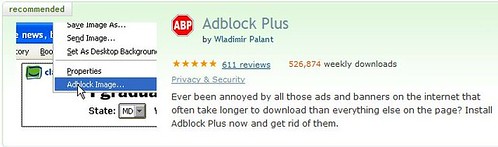
Adblock Plus

Purpose: The primary purpose of Adblock Plus is to block online ads from being downloaded and displayed on a user’s screen as they browse the Web.  In a broad sense, this functionality might be considered a “privacy” tool by those who consider it an intrusion upon, or violation of, their “privacy” to be “subjected” to seeing advertisements as they browse the web.  But if one thinks of privacy in terms of what others know about you, Adblocking is not so much about “privacy” as about user annoyance (measured in terms of distracting images cluttering webpages or simply in terms of long download times for webpages).  In this sense, ABP may not qualify as a “technology of evasion,” strictly speaking.  But, as explained below the fold, ABP does allow its users to “evade” some forms of online tracking by blocking the receipt of some, but not all, tracking cookies.

Cost: Like almost all other Firefox add-ons, both the ABP extensions and the filter subscriptions on which it relies (as described below) are free.

Popularity / Adoption: While there are a wide variety of ad-blocking tools available, Adblock Plus is far and away the leader.  ABP has proven enormously popular since its release in November 2005 as the successor to Adblock, which was first developed in 2002 and reached over 10,000,000 downloads before being abandoned by its developer and even today garners nearly 40,000 downloads a week.  This history of Adblock provides further details.

ABP was named one the 100 best products of 2007 by PC World magazine and is now the #1 most downloaded add-on for Firefox with over 500,000 weekly downloads, up significantly for just a few months.  In a blog post last month, ABP creator Wladimir Palant estimated that “no more than 5% of Firefox users have Adblock Plus installed,” but that percentage is bound to grow larger as more people discover Adblock.  As one indicator of ABP’s popularity, the number of Google searches for “Adblock” has nearly eclipsed the number of searches for “identity theft,” which seems like a far more serious concern than having to look at web ads. Continue reading →