[UPDATE Feb. 2012: This little essay eventually led to an 80-page working paper, “Technopanics, Threat Inflation, and the Danger of an Information Technology Precautionary Principle.”]
In this essay, I will suggest that (1) while “moral panics” and “techno-panics” are nothing new, their cycles seem to be accelerating as new communications and information networks and platforms proliferate; (2) new panics often “crowd-out” or displace old ones; and (3) the current scare over online privacy and “tracking” is just the latest episode in this ongoing cycle.
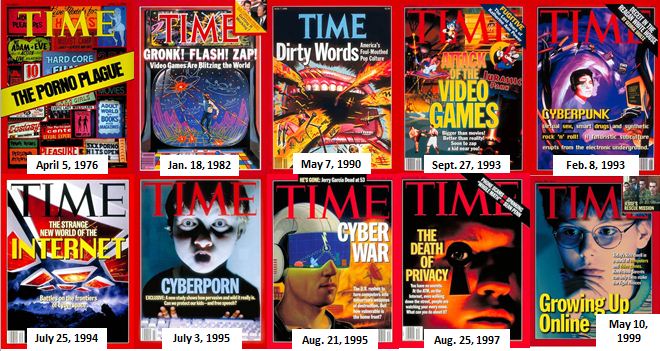
What Counts as a “Techno-Panic”?
First, let’s step back and define our terms. Christopher Ferguson, a professor at Texas A&M’s Department of Behavioral, Applied Sciences and Criminal Justice, offers the following definition: “A moral panic occurs when a segment of society believes that the behavior or moral choices of others within that society poses a significant risk to the society as a whole.” By extension, a “techno-panic” is simply a moral panic that centers around societal fears about a specific contemporary technology (or technological activity) instead of merely the content flowing over that technology or medium. In her brilliant 2008 essay on “The MySpace Moral Panic,” Alice Marwick noted: Continue reading →
Today the Mercatus Center has released a short new paper I have authored on “Unappreciated Benefits of Advertising and Commercial Speech.” I begin the piece by noting that:
Federal policy makers, state legislators, and state attorneys general have recently shown interest in regulating commercial advertising and marketing. Several new regulatory initiatives are being proposed, or are already underway, that could severely curtail or restrict advertising or marketing on a variety of platforms. The consequences of these stepped-up regulatory efforts will be profound and will hurt consumer welfare both directly and indirectly.
I go on to note that “advertising can be an easy target for politicians or regulatory activist groups who make a variety of (typically unsubstantiated) claims about its negative impact on society,” but then continue on to explain how “the role of commercial speech in a free-market economy is often misunderstood or taken for granted.” I outline how, despite regulators’ concerns, consumers actually derive three important types of benefits from advertising and marketing: (1) Informational / Educational Benefits; (2) Market Choice / Pro-Competitive Benefits; and (3) Media Promotion / Cross-Subsidization. After discussing each benefit, I conclude that:
For these reasons, a stepped-up regulatory crusade against advertising and marketing will hurt consumer welfare since it will raise prices, restrict choice, and diminish marketplace competition and innovation—both in ad-supported content and service markets, and throughout the economy at large. Simply stated, there is no free lunch.
Read the entire 1,800-word essay here. I have also embedded the document down below in a Scribd reader.
Continue reading →
Yesterday up on Capitol Hill, I hosted a very interesting discussion about “Next-Generation Parental Controls & Child Safety Efforts.” I thought I’d provide a quick recap here for those who couldn’t attend. [Note: audio of the event will be up shortly at the link above and transcript is in the works.] The event featured Steve Crown, Vice President and Deputy General Counsel of Microsoft Corporation’s Entertainment & Devices Division; Dane Snowden, Vice President of External & State Affairs of CTIA – The Wireless Association; and Stephen Balkam, Chief Executive Officer of Family Online Safety Institute.
Steve Crown of Microsoft kicked the show off with a terrific overview of some the current and next-generation parental control tools and awareness efforts that Microsoft is deploying to help empower parents and keep kids safer both online and in gaming environments. Crown outlined Microsoft’s 5-prong strategy regarding how they have approached these issues on the gaming front, and I think it represents an excellent model of how sensible industry self-regulation and “best practices” can go a long way toward addressing concerns that many parents and policymakers have. The five strategies Crown outlined were: (1) Respect both the freedom of game creators and freedom of choice for game consumers; (2) empower parents with ratings, tools, and information; (3) use independent ratings (like the ESRB) to label content; (4) require all games be rated before they can be used on a platform so that parents can implement blocking controls; and (5) respect regional laws and rating systems in different parts of the globe.
In my book on
Parental Controls & Online Child Safety: A Survey of Tools & Methods, I’ve documented many of the empowerment tools that Microsoft has deployed in recent years to make this empowerment vision a reality. One of the most important things MS does on its XBox 360 console is to provide an immediate “out-of-the-box” prompt for parents to set up parental controls and establish other limitations on online chat, spending, or Internet access. Microsoft announced another cool new feature in November 2007, the “Family Timer.” It lets parents limit how and when children play games on the console. This is similar to the time management tools Microsoft offers in its Vista operating system for PCs. Incidentally, my wife has asked me to start using the Family Timer on our XBox — not for our kids, but for me! This particular 40-year-old man is still a big kid at heart.
Continue reading →
My friend Anne Collier of Net Family News, one of America’s great sages on child safety issues, has produced a terrific list of reasons “Why Technopanics are Bad.” Technopanics and moral panics are topics I’ve spent quite a bit of time commenting on here. (See 1, 2, 3, 4.) Anne is a rare voice of sanity and sensible advice when it comes to online child safety issues and I encourage you to read all her excellent work on the subject, including her book with Larry Magid, MySpace Unraveled: A Parent’s Guide to Teen Social Networking. Anyway, here’s Anne’s list, and I encourage you to go over to her site and contribute your thoughts and suggestions about what else to add:
Technopanics are bad because they…
- Cause fear, which interferes with parent-child communication, which in turn puts kids at greater risk.
- Cause schools to fear and block digital media when they need to be teaching constructive use, employing social-technology devices and teaching new media literacy and citizenship classes throughout the curriculum.
- Turn schools into barriers rather than contributors to young people’s constructive use.
- Increase the irrelevancy of school to active young social-technology users via the sequestering or banning of educational technology and hamstring some of the most spirited and innovative educators.
- Distract parents, educators, policymakers from real risks – including, for example, child-pornography laws that do not cover situations where minors can simultaneously be victim and “perpetrator” and, tragically, become registered sex offenders in cases where there no criminal intent (e.g., see this).
- Reduce the competitiveness of US education among developed countries already effectively employing educational technology and social media in schools.
- Reduce the competitiveness of US technology and media businesses practicing good corporate citizenship where youth online safety is concerned.
- Lead to bad legislation, which aggravates above outcomes and takes the focus off areas where good laws on the books can be made relevant to current technology use.
- Widen the participation gap for youth – technopanics are barriers for children and teens to full, constructive participation in participatory culture and democracy.

 The Technology Liberation Front is the tech policy blog dedicated to keeping politicians' hands off the 'net and everything else related to technology.