 I wanted to draw your attention to yet another spectacular speech by Maureen K. Ohlhausen, a Commissioner with the Federal Trade Commission (FTC). I have written here before about Commissioner Ohlhausen’s outstanding speeches, but this latest one might be her best yet.
On Tuesday, Ohlhausen was speaking at U.S. Chamber of Commerce Foundation day-long event on “The Internet of Everything: Data, Networks and Opportunities.” The conference featured various keynote speakers and panels discussing, “the many ways that data and Internet connectiviting is changing the face of business and society.” (It was my honor to also be invited to deliver an address to the crowd that day.)
As with many of her other recent addresses, Commissioner Ohlhausen stressed why it is so important that policymakers “approach new technologies and new business models with regulatory humility.” Building on the work of the great Austrian economist F.A. Hayek, who won a Nobel prize in part for his work explaining the limits of our knowledge to plan societies and economies, Ohlhausen argues that: Continue reading →
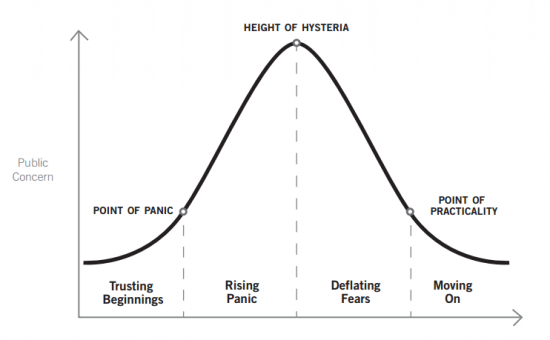
It was my pleasure this week to be invited to deliver some comments at an event hosted by the Information Technology and Innovation Foundation (ITIF) to coincide with the release of their latest study, “The Privacy Panic Cycle: A Guide to Public Fears About New Technologies.” The goal of the new ITIF report, which was co-authored by Daniel Castro and Alan McQuinn, is to highlight the dangers associated with “the cycle of panic that occurs when privacy advocates make outsized claims about the privacy risks associated with new technologies. Those claims then filter through the news media to policymakers and the public, causing frenzies of consternation before cooler heads prevail, people come to understand and appreciate innovative new products and services, and everyone moves on.” (p. 1)
As Castro and McQuinn describe it, the privacy panic cycle “charts how perceived privacy fears about a technology grow rapidly at the beginning, but eventually decline over time.” They divide this cycle into four phases: Trusting Beginnings, Rising Panic, Deflating Fears, and Moving On. Here’s how they depict it in an image:
Continue reading →
 Last Wednesday, it was my great pleasure to testify at a Senate Commerce Committee hearing entitled, “The Connected World: Examining the Internet of Things.” The hearing focused “on how devices… will be made smarter and more dynamic through Internet technologies. Government agencies like the Federal Trade Commission, however, are already considering possible changes to the law that could have the unintended consequence of slowing innovation.”
But the session went well beyond the Internet of Things and became a much more wide-ranging discussion about how America can maintain its global leadership for the next-generation of Internet-enabled, data-driven innovation. On both sides of the aisle at last week’s hearing, one Senator after another made impassioned remarks about the enormous innovation opportunities that were out there. While doing so, they highlighted not just the opportunities emanating out of the IoT and wearable device space, but also many other areas, such as connected cars, commercial drones, and next-generation spectrum.
I was impressed by the energy and nonpartisan vision that the Senators brought to these issues, but I wanted to single out the passionate statement that Sen. Cory Booker (D-NJ) delivered when it came his turn to speak because he very eloquently articulated what’s at stake in the battle for global innovation supremacy in the modern economy. (Sen. Booker’s remarks were not published, but you can watch them starting at the 1:34:00 mark of the hearing video.) Continue reading →
Claire Cain Miller of The New York Times posted an interesting story yesterday noting how, “Technology Has Made Life Different, but Not Necessarily More Stressful.” Her essay builds on a new study by researchers at the Pew Research Center and Rutgers University on “Social Media and the Cost of Caring.” Miller’s essay and this new Pew/Rutgers study indirectly make a point that I am always discussing in my own work, but that is often ignored or downplayed by many technological critics, namely: We humans have repeatedly proven quite good at adapting to technological change, even when it entails some heartburn along the way.
The major takeaway of the Pew/Rutgers study was that, “social media users are not any more likely to feel stress than others, but there is a subgroup of social media users who are more aware of stressful events in their friends’ lives and this subgroup of social media users does feel more stress.” Commenting on the study, Miller of the
Times notes:
Fear of technology is nothing new. Telephones, watches and televisions were similarly believed to interrupt people’s lives and pressure them to be more productive. In some ways they did, but the benefits offset the stressors. New technology is making our lives different, but not necessarily more stressful than they would have been otherwise. “It’s yet another example of how we overestimate the effect these technologies are having in our lives,” said Keith Hampton, a sociologist at Rutgers and an author of the study. . . . Just as the telephone made it easier to maintain in-person relationships but neither replaced nor ruined them, this recent research suggests that digital technology can become a tool to augment the relationships humans already have.
I found this of great interest because I have written about how humans assimilate new technologies into their lives and become more resilient in the process as they learn various coping techniques. Continue reading →
Writing last week in The Wall Street Journal, Matt Moffett noted how many European countries continue to struggle with chronic unemployment and general economic malaise. (“New Entrepreneurs Find Pain in Spain“) It’s a dismal but highly instructive tale about how much policy incentives matter when it comes to innovation and job creation–especially the sort of entrepreneurial activity from small start-ups that is so essential for economic growth. Here’s the key takeaway:
Scarce capital, dense bureaucracy, a culture deeply averse to risk and a cratered consumer market all suppress startups in Europe. The Global Entrepreneurship Monitor, a survey of startup activity, found the percentage of the adult population involved in early stage entrepreneurial activity last year was just 5% in Germany, 4.6% in France and 3.4% in Italy. That compares with 12.7% in the U.S. Even once they are established, European businesses are, on average, smaller and slower growing than those in the U.S. The problems of entrepreneurs are one reason Europe’s economy continues to struggle after six years of crisis. The European Union this month cut its growth forecasts for the region for this year and next, citing weaker than expected performance in the eurozone’s biggest economies, Germany, France and Italy. This week, the Organization for Economic Cooperation and Development delivered its own pessimistic appraisal, with chief economist Catherine Mann saying, “The eurozone is the locus of the weakness in the global economy.”
[…]
Europe’s unemployment crisis may be eroding a deeply ingrained fear of failure that is a bigger impediment to entrepreneurship on the Continent than in other regions, according to academic surveys. “Fear of failure is less of an issue because the whole country is a failure, and most of us are out of business or have a hard time paying our bills,” said Nick Drandakis of Athens, who in 2011 founded Taxibeat, an app that provides passenger ratings on taxi drivers.
Continue reading →
How is it that we humans have again and again figured out how to assimilate new technologies into our lives despite how much those technologies “unsettled” so many well-established personal, social, cultural, and legal norms?
In recent years, I’ve spent a fair amount of time thinking through that question in a variety of blog posts (“Are You An Internet Optimist or Pessimist? The Great Debate over Technology’s Impact on Society”), law review articles (“Technopanics, Threat Inflation, and the Danger of an Information Technology Precautionary Principle”), opeds (“Why Do We Always Sell the Next Generation Short?”), and books (See chapter 4 of my new book, “Permissionless Innovation: The Continuing Case for Comprehensive Technological Freedom”).
It’s fair to say that this issue — how individuals, institutions, and cultures adjust to technological change — has become a personal obsession of mine and it is increasingly the unifying theme of much of my ongoing research agenda. The
economic ramifications of technological change are part of this inquiry, of course, but those economic concerns have already been the subject of countless books and essays both today and throughout history. I find that the social issues associated with technological change — including safety, security, and privacy considerations — typically get somewhat less attention, but are equally interesting. That’s why my recent work and my new book narrow the focus to those issues. Continue reading →
I’ve spent a lot of time here through the years trying to identify the factors that fuel moral panics and “technopanics.” (Here’s a compendium of the dozens of essays I’ve written here on this topic.) I brought all this thinking together in a big law review article (“Technopanics, Threat Inflation, and the Danger of an Information Technology Precautionary Principle”) and then also in my new booklet, “Permissionless Innovation: The Continuing Case for Comprehensive Technological Freedom.”
One factor I identify as contributing to panics is the fact that “bad news sells.” As I noted in the book, “Many media outlets and sensationalist authors sometimes use fear-based tactics to gain influence or sell books. Fear mongering and prophecies of doom are always effective media tactics; alarmism helps break through all the noise and get heard.”
In line with that, I want to highly recommend you check out this excellent new oped by John Stossel of Fox Business Network on “Good News vs. ‘Pessimism Porn‘.” Stossel correctly notes that “the media win by selling pessimism porn.” He says:
Are you worried about the future? It’s hard not to be. If you watch the news, you mostly see violence, disasters, danger. Some in my business call it “fear porn” or “pessimism porn.” People like the stuff; it makes them feel alive and informed.
Of course, it’s our job to tell you about problems. If a plane crashes — or disappears — that’s news. The fact that millions of planes arrive safely is a miracle, but it’s not news. So we soak in disasters — and warnings about the next one: bird flu, global warming, potential terrorism. I won Emmys hyping risks but stopped winning them when I wised up and started reporting on the overhyping of risks. My colleagues didn’t like that as much.
He continues on to note how, even though all the data clearly proves that humanity’s lot is improving, the press relentlessly push the “pessimism porn.” Continue reading →
Tomorrow, the Federal Trade Commission (FTC) will host an all-day workshop entitled, “Internet of Things: Privacy and Security in a Connected World.” [Detailed agenda here.] According to the FTC: “The workshop will focus on privacy and security issues related to increased connectivity for consumers, both in the home (including home automation, smart home appliances and connected devices), and when consumers are on the move (including health and fitness devices, personal devices, and cars).”
Where is the FTC heading on this front? This Politico story by Erin Mershon from last week offers some possible ideas. Yet, it still remains unclear whether this is just another inquiry into an exciting set of new technologies or if it is, as I worried in my recent comments to the FTC on this matter, “the beginning of a regulatory regime for a new set of information technologies that are still in their infancy.”
First, for those not familiar with the “Internet of Things,” this short new report from Daniel Castro & Jordan Misra of the Center for Data Innovation offers a good definition:
The “Internet of Things” refers to the concept that the Internet is no longer just a global network for people to communicate with one another using computers, but it is also a platform or devices to communicate electronically with the world around them. The result is a world that is alive with information as data flows from one device to another and is shared and reused for a multitude of purposes. Harnessing the potential of all of this data for economic and social good will be one of the primary challenges and opportunities of the coming decades.
The report continues on to offer a wide range of examples of new products and services that could fulfill this promise.
What I find somewhat worrying about the FTC’s sudden interest in the Internet of Things is that it opens to the door for some regulatory-minded critics to encourage preemptive controls on this exciting new wave of digital age innovation, based almost entirely on hypothetical worst-case scenarios they have conjured up. Continue reading →
Christopher Wolf, director of the law firm Hogan Lovells’ Privacy and Information Management group, addresses his new book with co-author Abraham Foxman, Viral Hate: Containing Its Spread on the Internet. To what extent do hateful or mean-spirited Internet users hide behind anonymity? How do we balance the protection of the First Amendment online while addressing the spread of hate speech? Wolf discusses how to define hate speech on the Internet; whether online hate speech leads to real-world violence; how news sites like the Huffington Post and New York Times have dealt with anonymity; lessons we should impart on the next generation of Internet users to discourage hate speech; and cases where anonymity has proved particularly beneficial or valuable.
Download
Related Links
 In a recent essay here “On the Line between Technology Ethics vs. Technology Policy,” I made the argument that “We cannot possibly plan for all the ‘bad butterfly-effects’ that might occur, and attempts to do so will result in significant sacrifices in terms of social and economic liberty.” It was a response to a problem I see at work in many tech policy debates today: With increasing regularity, scholars, activists, and policymakers are conjuring up a seemingly endless parade of horribles that will befall humanity unless “steps are taken” to preemptive head-off all the hypothetical harms they can imagine. (This week’s latest examples involve the two hottest technopanic topics du jour: the Internet of Things and commercial delivery drones. Fear and loathing, and plenty of “threat inflation,” are on vivid display.)
I’ve written about this phenomenon at even greater length in my recent law review article, “Technopanics, Threat Inflation, and the Danger of an Information Technology Precautionary Principle,” as well as in two lengthy blog posts asking the questions, “Who Really Believes in ‘Permissionless Innovation’?” and “What Does It Mean to ‘Have a Conversation’ about a New Technology?” The key point I try to get across in those essays is that letting such “precautionary principle” thinking guide policy poses a serious threat to technological progress, economic entrepreneurialism, social adaptation, and long-run prosperity. If public policy is guided at every turn by the precautionary mindset then innovation becomes impossible because of fear of the unknown; hypothetical worst-case scenarios trump all other considerations. Social learning and economic opportunities become far less likely under such a regime. In practical terms, it means fewer services, lower quality goods, higher prices, diminished economic growth, and a decline in the overall standard of living.
Indeed, if we live in constant fear of the future and become paralyzed by every boogeyman scenario that our creative little heads can conjure up, then we’re bound to end up looking as silly as this classic 2005 parody from
The Onion, “Everything That Can Go Wrong Listed.” Continue reading →




 The Technology Liberation Front is the tech policy blog dedicated to keeping politicians' hands off the 'net and everything else related to technology.