Posts tagged as:

In an opinion published in the Wall Street Journal last week, Federal Communications Commission Chairman Julius Genachowski admonished us to keep “discussions focused on solving problems, and on facts and data” when evaluating his spectrum policy proposals. That sounds reasonable, and it could be persuasive, if the FCC based its spectrum policy on consistently applied facts and data.

The FCC has instead chosen to selectively manipulate the facts and data to support its desired policy outcomes. Within a single quarter, the FCC has simultaneously concluded that:

  • 194 MHz of spectrum in the 2.5 GHz band is available for mobile broadband services (note: when the FCC wants to show licensed spectrum in the US compares favorably with licensed spectrum on a global basis and that the ratio of licensed to unlicensed spectrum in the US is relatively balanced), and
  • Only 55 MHz of the same 194 MHz in the 2.5 GHz band is available for mobile broadband services (note: when the FCC wants to deny a merger or limit the amount of spectrum available to disfavored competitors).

Neither the laws of physics and economics nor the regulations governing the 2.5 GHz band changed the actual facts and data in the intervening period between these inconsistent conclusions. The only things that changed were the results the FCC wanted to reach and the “facts and data” the FCC decided to present to the public. Continue reading →

In remarks delivered at the Hudson Institute today, Federal Communications Commissioner Ajit Pai outlined two paths for the Internet Protocol (or IP) transition: One that clings to a legacy of heavily-regulated, monopoly communications networks and another that embraces the future being wrought by the competitive nature of IP communications. He noted that, while the FCC has thus far refused to choose one path or the other, consumers have overwhelming chosen the lightly regulated, competitive IP technologies of the future over the preference for monopoly the government chose in the past. Commissioner Pai has chosen to side with consumers by choosing the future – the path that protects consumers while making it clear that 20th Century economic regulation will not be imported into the IP-world. Continue reading →

Congress recently mandated that the Federal Communications Commission (FCC) make additional spectrum available through a novel incentive auction designed to transition television broadcast spectrum to mobile use. The FCC’s task is to adequately compensate television broadcasters for relinquishing their spectrum while ensuring such spectrum is rapidly transitioned to mobile uses that benefit consumers nationwide.

This will be the most challenging and complex auction design the FCC has ever attempted. The FCC cannot avoid the complexity inherent in this unique auction design, but it  can emphasize simplicity and exercise restraint when considering the other service rules that will govern this new spectrum. To maximize its opportunity for success in this daunting circumstance, the FCC should leverage proven policies wherever possible.

Successful spectrum policies are critical to sustaining innovation, economic growth, and global competitiveness in the mobile era. Today, consumer demand for tablets and smartphones is straining the limits of mobile Internet capacity, which is threatening our nation’s lead in mobile innovation. The quickest and least costly way to increase mobile network capacity is to add spectrum, and the incentive auction is how the FCC intends to bolster our spectrum resources. The continued success of the mobile Internet thus depends on the success of the incentive auction, and the auction’s success depends on policy decisions that must be made by the FCC. Continue reading →

Today marks the seventeenth birthday of the Telecommunications Act of 1996. Since it became law nearly two decades ago, the 1996 Act has largely succeeded in meeting its principal goals. Ironically, its success is becoming its potential failure.

By the time most teenagers turn seventeen, they have already begun planning their future after high school. Their primary school achievements are only a beginning in a lifetime of future possibilities. For most legislation, however, there is no future after the initial goals of Congress are achieved. Fortunately, the seventeen year-old 1996 Act isn’t like most legislation.

Congress recognized that when the goals of the 1996 Act were achieved, many of its regulations would no longer be necessary. In its wisdom, Congress provided the FCC with statutory authority to adapt our communications laws to future changes in the communications market. This authority includes the ability for the FCC to forbear from applying an unnecessary or outdated law.

Unfortunately, the FCC has been very reluctant to exercise this authority. It has instead preferred to remain within the familiar walls of stagnant regulations while the opportunity of Internet transformation knocks on the door. If the FCC refuses to use its forbearance authority, the only future for the 1996 Act is to live in the proverbial parents’ basement and eat 20 th Century leftovers. If the FCC instead chooses to act, it could accelerate investment in new broadband infrastructure and the transition to an all-Internet future. Continue reading →

posted an analysis of Netflix’s new Internet blocking strategy last week. I concluded that Netflix is attempting to leverage net neutrality regulations to gain an anticompetitive price advantage in the marketplace. In my view, this harm is an unintended consequence of the FCC’s decision to abandon its free market approach to the Internet and adopt net neutrality rules that enhance the market power of so-called “edge” companies. As Neil Stevens said in his Tech at Night column: “Told you so.”

Harold Feld apparently agrees that Netflix is threatening competition, and he has is own case of Cassandrafreude (“told you so,” but with a smile). In his view, however, the problem is that the FCC didn’t go far enough. He believes this situation could have been avoided if the FCC had applied common carrier regulation to the Internet (also known as Title II), which would regulate the Internet using statutes written for the old monopoly telephone network.

Though Harold Feld and I disagree on the appropriate level of Internet regulation (I would prefer less rather than more), it appears we do agree on several issues raised by Netflix’s decision to block access to its Super HD service. The unintended consequence of Netflix’s decision is that the ensuing debate has clarified some important Internet policy issues. Continue reading →

When the smoke cleared and I found myself half caught-up on sleep, the information and sensory overload that was CES 2013 had ended.

There was a kind of split-personality to how I approached the event this year. Monday through Wednesday was spent in conference tracks, most of all the excellent Innovation Policy Summit put together by the Consumer Electronics Association. (Kudos again to Gary Shapiro, Michael Petricone and their team of logistics judo masters.)

The Summit has become an important annual event bringing together legislators, regulators, industry and advocates to help solidify the technology policy agenda for the coming year and, in this case, a new Congress.

I spent Thursday and Friday on the show floor, looking in particular for technologies that satisfy what I coined the The Law of Disruption: social, political, and economic systems change incrementally, but technology changes exponentially.

What I found, as I wrote in a long post-mortem for Forbes, is that such technologies are well-represented at CES, but are mostly found at the edges of the show–literally. Continue reading →

Unfortunately, most consumers won’t realize that Netflix is trying to impose its costs on all Internet consumers to gain an anticompetitive price advantage against its over-the-top competitors.

At the Consumer Electronic Show two weeks ago, Netflix announced that it would block consumer access to high definition and 3D movies (HD) for customers of Internet service providers (ISPs) that Netflix disfavors. Netflix’s goal is to coerce ISPs into paying for a free Internet fast lane for Netflix content. If Netflix succeeds, it would harm Internet consumers and competition among video streaming providers. It would also fundamentally alter the economics and openness of the Internet, “where consumers make their own choices about what applications and services to use and are free to decide what content they want to access, create, or share with others.”

Ironically, Netflix’s strategy is a variant of the doomsday narrative spun by net neutrality activists over the last decade. Their narrative assumes ISPs will use their gatekeeper control to block their customers from accessing Internet content distributed by competitors. Of course, ISPs have never blocked consumer access to competitive Internet content. Now that the FCC has distorted the Internet marketplace through the adoption of asymmetric net neutrality rules, Netflix, the dominant streaming video provider, has decided to block consumer access to its content.

This may not seem like a big deal given the relatively limited HD content currently available on Netflix. But that’s about to change in a very big way. Netflix recently announced a new multi-year licensing agreement that makes it the “ exclusive American subscription TV service for first run live-action and animated features from the Walt Disney Studios.” In addition to Disney-branded content (e.g., The Lion King), the deal includes content produced by Pixar (e.g., Brave), Lucasfilm (e.g., Star Wars), and Marvel (e.g., The Avengers). Netflix also announced a multi-year deal with Turner Broadcasting and Warner Bros. that includes the Cartoon Network and exclusive distribution rights to TNT’s television series Dallas. As an analyst recently told Ars Technica, “These movies, if you’ve got young kids—you’ve got to have Netflix.”

Netflix has decided to use this new market power to force ISPs to pay for its own Internet fast lane. In classic double-speak, Netflix calls its fast lane the “Netflix Open Connect” content delivery network (CDN). Though Netflix uses the word “open” to describe its CDN, it is not part of the open Internet. It is only “open” to Netflix for the delivery of its content, and it is only “open” to ISPs who connect to it on terms dictated by Netflix. Continue reading →

By Geoffrey Manne & Berin Szoka

As Democrats insist that income taxes on the 1% must go up in the name of fairness, one Democratic Senator wants to make sure that the 1% of heaviest Internet users pay the same price as the rest of us. It’s ironic how confused social justice gets when the Internet’s involved.

Senator Ron Wyden is beloved by defenders of Internet freedom, most notably for blocking the Protect IP bill—sister to the more infamous SOPA—in the Senate. He’s widely celebrated as one of the most tech-savvy members of Congress. But his latest bill, the “Data Cap Integrity Act,” is a bizarre, reverse-Robin Hood form of price control for broadband. It should offend those who defend Internet freedom just as much as SOPA did.

Wyden worries that “data caps” will discourage Internet use and allow “Internet providers to extract monopoly rents,” quoting a New York Times editorial from July that stirred up a tempest in a teapot. But his fears are straw men, based on four false premises.

First, US ISPs aren’t “capping” anyone’s broadband; they’re experimenting with usage-based pricing—service tiers. If you want more than the basic tier, your usage isn’t capped: you can always pay more for more bandwidth. But few users will actually exceed that basic tier. For example, Comcast’s basic tier, 300 GB/month, is so generous that 98.5% of users will not exceed it. That’s enough for 130 hours of HD video each month (two full-length movies a day) or between 300 and 1000 hours of standard (compressed) video streaming.

Second, Wyden sets up a false dichotomy: Caps (or tiers, more accurately) are, according to Wyden, “appropriate if they are carefully constructed to manage network congestion,” but apparently for Wyden the only alternative explanation for usage-based pricing is extraction of monopoly rents. This simply isn’t the case, and propagating that fallacy risks chilling investment in network infrastructure. In fact, usage-based pricing allows networks to charge heavy users more, thereby recovering more costs and actually reducing prices for the majority of us who don’t need more bandwidth than the basic tier permits—and whose usage is effectively subsidized by those few who do. Unfortunately, Wyden’s bill wouldn’t allow pricing structures based on cost recovery—only network congestion. So, for example, an ISP might be allowed to price usage during times of peak congestion, but couldn’t simply offer a lower price for the basic tier to light users.

That’s nuts—from the perspective of social justice as well as basic economic rationality. Even as the FCC was issuing its famous Net Neutrality regulations, the agency rejected proposals to ban usage-based pricing, explaining:

prohibiting tiered or usage-based pricing and requiring all subscribers to pay the same amount for broadband service, regardless of the performance or usage of the service, would force lighter end users of the network to subsidize heavier end users. It would also foreclose practices that may appropriately align incentives to encourage efficient use of networks.

It is unclear why Senator Wyden thinks the FCC—no friend of broadband “monopolists”—has this wrong. Continue reading →


Given the rate at which telephone companies are losing customers when they cannot raise prices as a regulatory matter, it is preposterous to continue presuming that they could raise prices as an economic matter.

Today, the United States Telecom Association (USTA) asked the Federal Communications Commission (FCC) to declare that incumbent telephone companies are no longer monopolies. Ten years ago, when most households had “plain old telephone service,” this request would have seemed preposterous. Today, when only one in three homes have a phone line, it is merely stating the obvious: Switched telephone service has no market power at all. Continue reading →

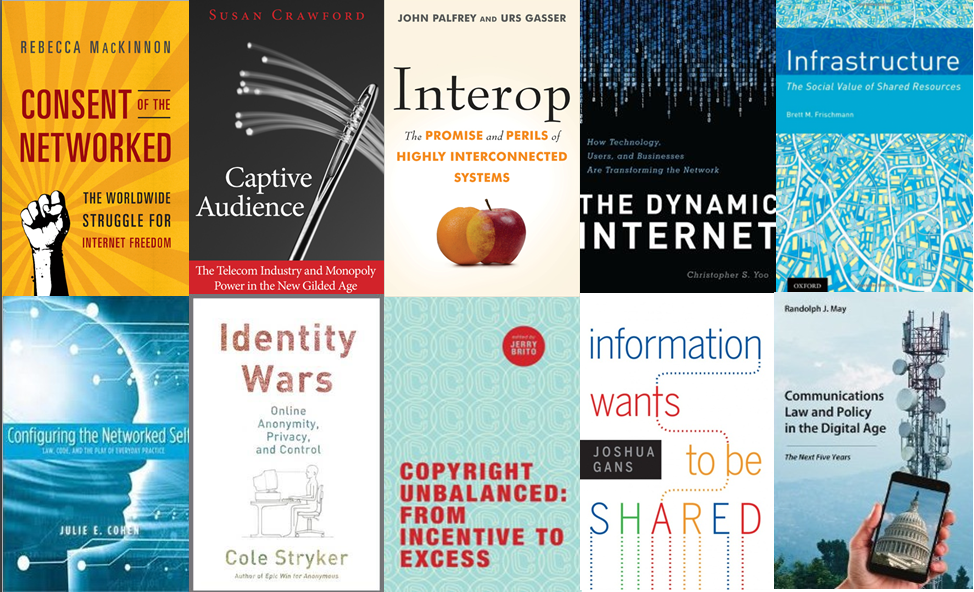
The number of major cyberlaw and information tech policy books being published annually continues to grow at an astonishing pace, so much so that I have lost the ability to read and review all of them. In past years, I put together end-of-year lists of important info-tech policy books (here are the lists for 2008, 2009, 2010, and 2011) and I was fairly confident I had read just about everything of importance that was out there (at least that was available in the U.S.). But last year that became a real struggle for me and this year it became an impossibility. A decade ago, there was merely a trickle of Internet policy books coming out each year. Then the trickle turned into a steady stream. Now it has turned into a flood. Thus, I’ve had to become far more selective about what is on my reading list. (This is also because the volume of journal articles about info-tech policy matters has increased exponentially at the same time.)

So, here’s what I’m going to do. I’m going to discuss what I regard to be the five most important titles of 2012, briefly summarize a half dozen others that I’ve read, and then I’m just going to list the rest of the books out there. I’ve read most of them but I have placed an asterisk next to the ones I haven’t.  Please let me know what titles I have missed so that I can add them to the list. (Incidentally, here’s my compendium of all the major tech policy books from the 2000s and here’s the running list of all my book reviews.)

Continue reading →