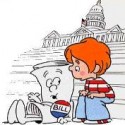
 My article for CNET News.com this morning analyzes the “leaked” net neutrality bill from Rep. Henry Waxman, chair of the House Energy and Commerce Committee. I put leaked in quotes because so many sources came up with this document yesterday that its escape from the secrecy of the legislative process hardly seems dramatic. Reporters with sources inside Waxman’s office, including The Hill and The Washington Post, expect Waxman to introduce the bill sometime this week.
The CNET article goes through the bill in some detail, and I won’t duplicate the analysis here. It is a relatively short piece of legislation that makes limited changes to Title I of the Communications Act, giving the FCC only the authority it needs to implement “core” regulations that would allow the agency to enforce violations of the open Internet principles. Continue reading →
Stung by criticism of its site as the “worst in government”—that mighta been Jerry Brito talking—the FCC has rolled out a new set of sites under a “Reboot” brand.
When I first saw the presentation on it at today’s Gov 2.0 Summit, I thought that the FCC has merely redone its web site, but it appears to be releasing data that can be re-purposed in any number of ways for true public oversight of the agency.
Developers, check out FCC.gov/developer and let us know what you think of it.
[Fellow members of the Society for the Prevention of Vice, I urge you to take immediate action to continue our crusade to clean up America’s media marketplace by ridding it of the scourge of media hyper-violence. A clip has come to our attention that merits particular concern and I hope you will agree something must be done by our government before such filth gets widespread dissemination. So, please join me in signing this petition to the FCC to take action now—for the children—before such unspeakable acts of violence are mimicked by millions of youth across America.]
TO: Julius Genachowski, Chairman, Federal Communications Commission
FROM: Adam Thierer, President, Society for the Prevention of Vice (formerly known as the Society for Soft Pillow Fights)
RE: Another example of unspeakable media violence that must be stopped
Dear Chairman Genachowski:
A video has come to our attention that displays, once again, the media industry’s utter disregard for human decency and the dignity of life, and we hope you will agree something must be done to stop its dissemination before it is too late. In this video:
- A man’s nose is seemingly twisted off his face (as he screams in agony) and then his face is forced onto a grinding machine while sparks fly off his burning flesh (he again screams in agony);
- A shoe with an extended spike is inserted into a man’s head and then his eyeball and then his ear lobe (he screams in agony each time);
- The man who was impaled with said shoe spike then bites the offender’s foot (he, too, screams in agony);
- A blow-torch is used to light a man’s buttocks afire (he screams in agony);
- A man climbs a pole, plays with live electrical wires, is then is electrocuted after chewing on said wires, and then falls to the ground still shaking from the voltage running through his body (he screams in agony);
- A wrench is dropped on a man’s head (he screams in agony) and he then uses said wrench to hit another man over the head and violently twist his nose with it (he screams in agony); and
- Finally, the electrocuted man has a light bulb inserted into one ear and a screwdriver into the other (he screams in agony and then, bizarrely, he laughs to end the clip — as if he is mocking the depravity of what we have just witnessed!)
I have attached a clip of this unspeakably evil carnival of pain, but I warn you that it could forever darken your soul. Can you imagine, sir, if earlier generations of American youth had seen this? Could America have produced “The Greatest Generation” if the youth of the World War II era had grown up watching such filth? We now know from several psychological studies that children will mimic whatever they see on the screen. If they see such depictions of violence in media, they will reenact it themselves in the real world. In other words, “monkey see-monkey do.” Please, on behalf of all those signing this petition, and for the sake of our children, I beg you to help us put a stop to this moral outrage before our great civilization decays and withers away in a sea of media hyper-violence such as this: Continue reading →
The Progress and Freedom Foundation has just published a white paper I wrote for them titled “The Seven Deadly Sins of Title II Reclassification (NOI Remix).” This is an expanded and revised version of an earlier blog post that looks deeply into the FCC’s pending Notice of Inquiry regarding broadband Internet access. You can download a PDF here.
I point out that beyond the danger of subjecting broadband Internet to extensive new regulations under the so-called “Third Way” approach outlined by FCC Chairman Julius Genachowski, a number of other troubling features in the Notice indicate an even broader agenda for the agency with regard to the Internet. Continue reading →
Earlier this week, The Daily Show’s Jon Stewart summed up the debate over net neutrality by stating, “On one side [are] those who want the marketplace to remain a wide open market of ideas, and on the other side [is] a larger group who have no idea what net neutrality means.”
Stewart may have been joking, but he was right about one thing – many folks are confused about what net neutrality actually is and what it would mean for Internet users.
That’s why I decided to enter the America’s Got Net video contest, sponsored by the Open Internet Coalition, a pro-net neutrality trade association. In a short video entitled, “The Open Internet and Lessons from the Ma Bell Era,” I explain how mandating net neutrality would endanger the networks of tomorrow and insulate entrenched firms from competition. Enjoy!
http://www.youtube.com/v/ZS_udd5K91o?fs=1&hl=en_US
I continue to be mystified by the contention of some Net neutrality advocates that it is not a form of economic regulation. The reality, of course, is that Net neutrality would ban business models and necessitate price controls. If that ain’t regulation, I don’t know what is. As Robert Litan and Hal Singer note in their new Harvard Business Review essay, “Why Business Should Oppose Net Neutrality,” “Non-discrimination under the FCC’s net neutrality proposal means that ISPs cannot offer enhanced services beyond the plain-vanilla access service to content providers at any price.” Thus, any type of service prioritization or price discrimination would be prohibited under the FCC’s Net neutrality regulatory regime.
As I explained in this earlier essay and in the video below, this would be a disaster for investment, innovation, and consumer welfare. Differentiated and prioritized services and pricing are part of almost every industrial sector in a capitalistic economy, and there’s no reason things should it be any different for broadband. As Litan and Singer note, “The concept of premium services and upgrades should be second-nature to businesses. From next-day delivery of packages to airport lounges, businesses value the option of upgrading when necessary. That one customer chooses to purchase the upgrade while the next opts out would never be considered ‘discriminatory.'”
And let’s not forget, something has to pay for Internet access and investment in new facilities. Differentiated services can help by allowing carriers to price more intensive or specialized users and uses to ensure that carriers don’t have to hit everyone – including average household users – with the same bill for service. Why would we want to make that illegal through Net neutrality regulation and the misguided price control schemes of a bygone regulatory era?
http://www.youtube.com/v/AgxzFwqqFGw?fs=1&hl=en_US
Wall Street Journal columnist Holman Jenkins has a terrific, wide-ranging interview with Google CEO Eric Schmidt in today’s paper that is well worth reading. One thing worth highlighting is Schmidt’s comments on the “economic disaster that is the American newspaper.” He argues that, “The only way the problem [of insufficient revenue for news gathering] is going to be solved is by increasing monetization, and the only way I know of to increase monetization is through targeted ads.”
Absolutely correct. It’s a point that Berin Szoka, Ken Ferree and I tried to make in PFF’s mega-filing in the FCC’s “Future of Media” proceeding in early May, and Berin and I stressed it in even more detail in our piece on”Chairman Leibowitz’s Disconnect on Privacy Regulation & the Future of News.” The key takeaway: If Washington goes to war against advertising — and targeted advertising in particular — then there will be no future for private news. As we stated there:
The reason for the indispensability of advertising is simple: Information (including news and other forms of “content”) has “public good” characteristics that make it is very difficult (and occasionally impossible) for information-publishers to recoup their investments. Simply put, they quite literally lack pricing power: Whatever they charge, someone else will charge less for a close substitute, inevitably leading to “free” distribution of the content, even though the content is anything but free to produce. Advertising is the one business model that has traditionally saved the day by rewarding publishers for attracting the attention of an audience.
Thus an attack on advertising is an attack on media / news itself. And yet Washington is currently engaged in an all-out assault on advertising, marketing, and data collection efforts / business models.
Incidentally, Google recently submitted comments with the Federal Trade Commission in reaction to its Staff Discussion Draft about the future of journalism and laid out their views on many of these issues. More importantly, as summarized on pg. 30 (of the pdf) of this Newspaper Association of America filing to the FTC, Google has proposed an interesting monetization model that utilizes Google Search, Google Checkout and DoubleClick ad server, “to build a premium content system for newspapers.” Worth checking out. Kudos to Google for taking these steps and to Schmidt for again stressing the importance of targeted advertising for the future of media.
The release of a joint policy framework from Google and Verizon this week touched off even more activity in the never-ending saga of Net Neutrality than the rumors about the possibility such an agreement was in the works did the week before.
Op-ed pages, business and technology news programs, and public radio’s precious moments were overrun with anxious talking heads denouncing or praising the latest developments, or even a few of us trying just to explain what was and was not actually being said and done.
That’s not how August is supposed to be in policyland, when Washington reverts to the swamp from which it came. (John Adams left early one summer during his Presidency and refused to return long after the heat had broken.) I had hoped at long last to get around to finalizing last year’s tax return or maybe fixing my perennially-broken irrigation system, but oh well. Continue reading →
In a 3-2 vote, the Federal Communications Commission recently decided to jack up its official definition of “broadband” from 200 kbps download to the 4 mbps dpwnload/1 mbps upload used as a benchmark in Our Big Fat National Broadband Plan. The three commissioners in the majority also declared that the definition of broadband will continue to evolve as consumers purchase faster connections to utilize new applications.
Several months earlier, the FCC launched a proceeding to figure out how to convert universal service subsidies for rural telephone service into universal service subsidies for rural broadband service. Put these two decisions together, and it looks like the majority on the FCC is hell-bent on establishing rural broadband subsidies as a perpetual entitlement program that will never “solve” the rural availability problem because the goalposts will keep moving.
The current USF program taxes price-sensitive services (long distance and wireless) to subsidize a service that is not very price sensitive (local phone connections). If the FCC takes a further step on the funding side and starts collecting universal service assessments from broadband, it will diminish broadband subscribership by taxing a service that is even more price sensitive: broadband connections. (I explained this a few months ago here.)
It’s time to get off this merry-go-round. The solution was suggested by MIT economist Jerry Hausman back when the FCC first started creating the current universal service programs in response to the Telecom Act of 1996: use revenues from spectrum auctions.
Instead of having the FCC perpetually collect assessments from broadband or telephone services to subsidize broadband buildout in rural areas, Congress should earmark revenues from the next spectrum auction for one-time buildout grants in high-cost areas. The grants should be awarded via a competitive procurement auction that would force subsidy-seekers in different locations to compete with each other for the federal dollars. And Congress should explicitly wind down the universal service telephone subsidies in high cost areas and prohibit the FCC from using universal service assessments to fund broadband deployment in these places.
Using revenues from spectrum auctions would avoid the distortions and perverse consequences caused by ongoing universal service assessments on broadband or telephone services. One-shot deployment grants would ensure that the availability problem gets solved, so the federal government can declare victory and get out of the perpetual subsidy business.
Of course, some locations in the US are so expensive to serve that the potential revenues might not even cover the
operating costs of broadband. But it does not follow that operators in these places need an ongoing stream of subsidies. When preparing their subsidy bids, they will have to calculate how large the one-shot payment needs to be to induce them to take on the capital costs and the ongoing operating costs. In other words, they can bank some of the one-shot subsidy and use it to cover the difference between revenues and operating costs.
This modest proposal does not address all aspects of the universal service fund. But it would achieve a clear objective — bringing broadband to rural areas — while allowing the FCC to extricate itself from the business of distributing $4.6 billion a year in subsidies. Let’s see a timetable for withdrawal!


 The Technology Liberation Front is the tech policy blog dedicated to keeping politicians' hands off the 'net and everything else related to technology.