Today, AT&T announced they had abandoned their planned acquisition of T-Mobile after the DOJ sued to block the deal and the FCC published a report sharply critical of the deal. The following statement can be attributed to TechFreedom Fellows Larry Downes, Geoffrey Manne and Berin Szoka:
Nearly two years ago, the Obama FCC declared a spectrum crisis. But Congress has refused to authorize the agency to reallocate underused spectrum from television broadcasters and government agencies—which would take years anyway.
The AT&T/T-Mobile merger would have eased this crisis and accelerated the deployment of next-generation 4G networks. The government killed the deal based on formalistic and outdated measures of market concentration—even though the FCC’s own data show dynamic competition, falling prices, and new entry. The disconnect is jarring.
Those celebrating the deal’s collapse will wake up to a sober reality: There is no Plan B for more spectrum. All the hand-wringing about “preserving” competition has only denied consumers a strong 4G LTE competitor to compete with Verizon—and slammed the brakes on continued growth of the mobile marketplace.
Unfortunately, this is just part of a broader pattern of regulators attempting to engineer technology markets they don’t understand. The letter sent today by the Senate Antitrust Subcommittee urging the Department of Justice to investigate Google’s business practices relies on similar contortions of market definition to conclude that the search market is not competitive. In both cases, regulators are applying 1960s economics to 21st century markets.
Ultimately, it’s consumers who will lose from such central planning.
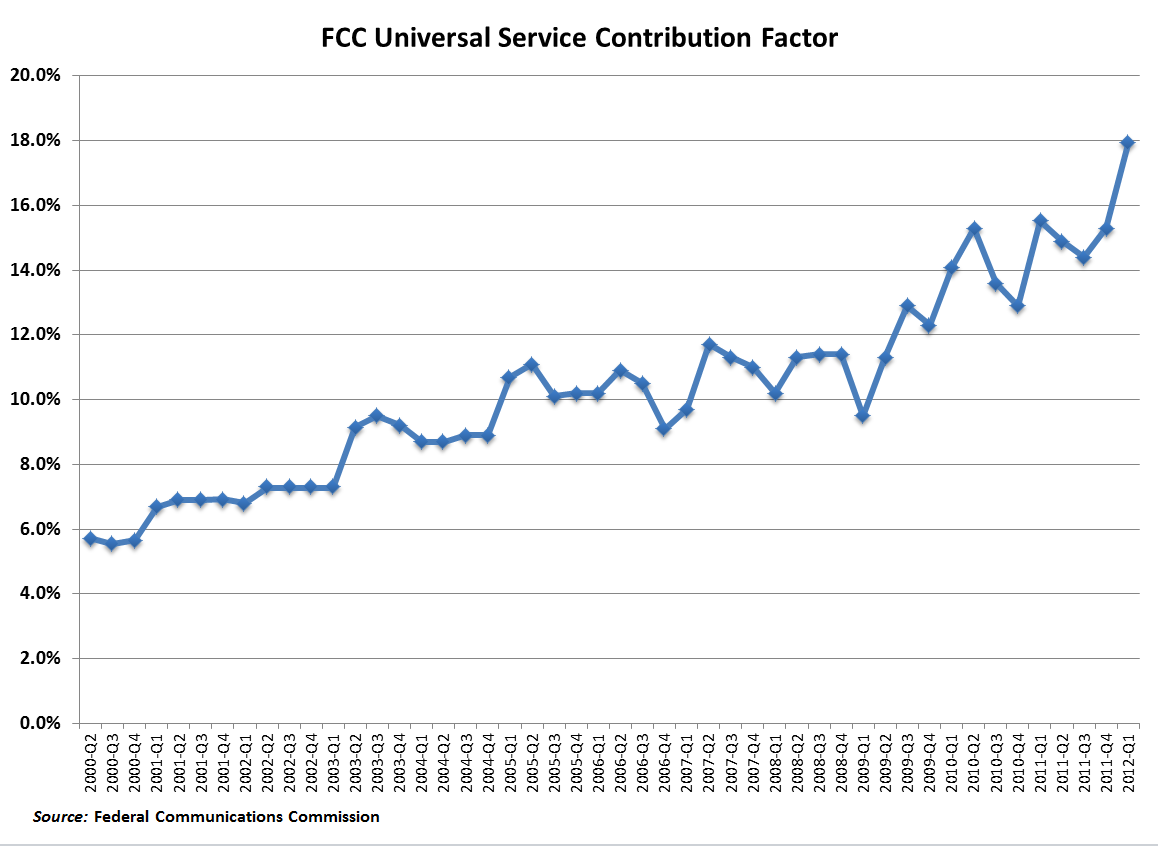
The FCC’s universal service tax is officially out of control. The agency announced yesterday that the “universal service contribution factor” for the 1st quarter of 2012 will go up to 17.9%. This “contribution factor” is a tax imposed on telecom companies that is adjusted on a quarterly basis to accommodate universal service programs. The FCC doesn’t like people calling it a tax, but that’s exactly what it is. And it just keeps growing and growing. In fact, as the chart below reveals, it has been exploding in recent years. It was in single digits just a few years ago but is now heading toward 20%. And not only is this tax growing more burdensome, but it is completely unsustainable. As the taxable base (traditional interstate telephony) is eroded by new means of communicating, the tax rate will have to grow exponentially or the base will have to be broadened to cover new technologies and services. We should have junked the current carrier-delivered universal service subsidy system years ago and gone with a straight-forward voucher system. A means-tested voucher could have targeted assistance to those who needed it without creating an inefficient, unsustainable hidden tax like we have now. For all the ugly details, I recommend reading all of Jerry Ellig’s research on the issue.
 I’ve written several articles in the last few weeks critical of the dangerously unprincipled turn at the Federal Communications Commission toward a quixotic, political agenda. But as I reflect more broadly on the agency’s behavior over the last few years, I find something deeper and even more disturbing is at work. The agency’s unreconstructed view of communications, embedded deep in the Communications Act and codified in every one of hundreds of color changes on the spectrum map, has become dangerously anachronistic.
The FCC is required by law to see separate communications technologies delivering specific kinds of content over incompatible channels requiring distinct bands of protected spectrum. But that world ceased to exist, and it’s not coming back. It is as if regulators from the Victorian Age were deciding the future of communications in the 21
st century. The FCC is moving from rogue to steampunk.
With the unprecedented release of the staff’s draft report on the AT&T/T-Mobile merger, a turning point seems to have been reached. I wrote on
CNET (see “FCC: Ready for Reform Yet?”) that the clumsy decision to release the draft report without the Commissioners having reviewed or voted on it, for a deal that had been withdrawn, was at the very least ill-timed, coming in the midst of Congressional debate on reforming the agency. Pending bills in the House and Senate, for example, are especially critical of how the agency has recently handled its reports, records, and merger reviews. And each new draft of a spectrum auction bill expresses increased concern about giving the agency “flexibility” to define conditions and terms for the auctions.
The release of the draft report, which edges the independent agency that much closer to doing the unconstitutional bidding not of Congress but the White House, won’t help the agency convince anyone that it can be trusted with any new powers. Let alone the novel authority to hold voluntary incentive auctions to free up underutilized broadcast spectrum.
 Continue reading →
[Cross posted at Truth on the Market]
As everyone knows by now, AT&T’s proposed merger with T-Mobile has hit a bureaucratic snag at the FCC. The remarkable decision to refer the merger to the Commission’s Administrative Law Judge (in an effort to derail the deal) and the public release of the FCC staff’s internal, draft report are problematic and poorly considered. But far worse is the content of the report on which the decision to attempt to kill the deal was based.
With this report the FCC staff joins the exalted company of AT&T’s complaining competitors (surely the least reliable judges of the desirability of the proposed merger if ever there were any) and the antitrust policy scolds and consumer “advocates” who, quite literally, have never met a merger of which they approved.
In this post I’m going to hit a few of the most glaring problems in the staff’s report, and I hope to return again soon with further analysis.
As it happens, AT&T’s own response to the report is actually very good and it effectively highlights many of the key problems with the staff’s report. While it might make sense to take AT&T’s own reply with a grain of salt, in this case the reply is, if anything, too tame. No doubt the company wants to keep in the Commission’s good graces (it is the very definition of a repeat player at the agency, after all). But I am not so constrained. Using the company’s reply as a jumping off point, let me discuss a few of the problems with the staff report. Continue reading →
It was my pleasure this week to host a terrific panel discussion about the future of broadband policy and FCC reform featuring Raymond Gifford, a Partner at the law firm of Wilkinson Barker Knauer, LLP, Jeffrey Eisenach, a Managing Director and Principal at Navigant Economics and an Adjunct Professor at George Mason University Law School, and Howard Shelanski, Professor of Law at Georgetown Law School who previously served as Chief Economist for the Federal Communications Commission and as a Senior Economist for the President’s Council of Economic Advisers at the White House. We discussed two new papers by Gifford and Eisenach on these issues.
Continue reading →
The Senate might vote this week on Sen. Hutchison’s resolution of disapproval for the FCC’s net neutrality rules. If ever there was a regulation that showed why independent regulatory agencies ought to be required to conduct solid regulatory analysis before writing a regulation, net neutrality is it.
For more than three decades, executive orders have required executive branch agencies to prepare a Regulatory Impact Analysis accompanying major regulations. One of the first things the agency is supposed to do is identify the market failure, government failure, or other systemic problem the regulation is supposed to solve. The agency ought to demonstrate a problem actually exists to show that a regulation is actually necessary.
But the net neutrality rules have virtually no analysis of a systemic problem that actually exists, and no data demonstrating that the problem is real. Instead, the FCC’s order outlines the incentives Internet providers might face to treat some traffic differently from other traffic, in a discussion heavily freighted with “could’s” and “may’s”. Then it offers up just four familiar anecdotes that have been used repeatedly to support the claim that non-neutrality is a significant threat (all four fit in paragraph 35 of the order). The FCC asserts without support that Internet providers have incentives to do these things even if they lack market power, and indeed in a footnote it dispenses with the need to consider market power: “Because broadband providers have the ability to act as gatekeepers even in the absence of market power with respect to end users, we need not conduct a market power analysis.” (footnote 87)
Thus far, no administration of either party has sought to apply Regulatory Impact Analysis requirements to independent agencies. If administrations won’t, Congress should.
On Wednesday, November 9th, the Mercatus Center will be hosting an event on “A New Framework for Broadband and the FCC.” It will take place at the Reserve Officers Association from 10:00am – 11:30am. At the event, telecom experts Raymond Gifford, Jeffrey Eisenach, and Howard Shelanski that will examine if a new framework might be needed for broadband policy and the possibility of reforming the Federal Communications Commission. Both Eisenach and Gifford will be presenting new papers at the event and Shelanski will be offering commentary. RSVP here to hold a seat. Complete event summary follows. Continue reading →
Federal Communications Chairman Genachowski previewed the universal service reform plan the commissioners are discussing in a speech today.
The speech offers a masterful summary of the myriad inefficiencies created by the current universal service subsidies and intercarrier compensation payments. Most of the examples highlight plain old-fashioned waste. The universal service program collects billions of dollars from telephone subscribers, then simply wastes a goodly portion of it by subsidizing telephone competition in places where unsubsidized service from cable or satellite already exists, subsidizing multiple mobile wireless competitors, and subsidizing local phone companies that have little incentive for cost containment because they are still subject to rate-of-return regulation. The intercarrier compensation system uses per-minute charges to collect billions of dollars from telephone subscribers and hands it to phone companies that sometimes charge as little as $8 a month for phone service. There’s also a race to game this system as the companies that benefit seek new ways to inflate the regulated charges they collect, and the companies that pay seek clever ways to avoid paying.
It’s a powerful brief for reform. Never thought I’d live to see the day whan an FCC chairman would say so many things that are substantiated by economic research.
Nevertheless, a few parts of the speech give me cause for concern about the solutions the FCC commissioners may be discussing.
First, the chairman claims that 18 million Americans live in areas without access to broadband — up from the 14 million estimated in the National Broadband Plan. The size of this figure suggests to me that the FCC is still over-estimating the number of people without access by defining “broadband” as a speed fast enough to exclude 3G wireless, many small rural Wireless Internet Service Providers, and satellite. Absent an adjustment in the definition of broadband, the subsidy program will be larger than it needs to be, and so telephone consumers will pay excessive universal service charges. Continue reading →
 On NPR’s Marketplace this morning, I talk about net neutrality litigation with host John Moe.
Nearly a year after the FCC passed controversial new “Open Internet” rules by a 3-2 vote, the White House finally gave approval for the rules to be published last week, unleashing lawsuits from both supporters and detractors.
The supporters don’t have any hope or expectation of getting a court to make the rules more comprehensive. So why sue? When lawsuits challenging federal regulations are filed in multiple appellate courts, a lottery determines which court hears a consolidated appeal.
So lawsuits by net neutrality supporters are a procedural gimmick, an effort to take cases challenging the FCC’s authority out of the D.C. Circuit Court of Appeals, which has already made clear the FCC has no legal basis here.
Continue reading →
 For Forbes this morning, I reflect on the publication late last week of the FCC’s “Open Internet” or net neutrality rules and their impact on spectrum auctions past and future. Hint: not good.
An important study last year by Prof. Faulhaber and Prof. Farber, former chief economist and chief technologist, respectively, for the FCC, found that the last-minute imposition of net neutrality limits on the 700 MHz “C” block in the FCC’s 2008 auction reduced the winning bid by 60%–a few billion dollars for the Treasury.
Yet the FCC maintained in the December Report and Order approving similar rules for all broadband providers that the cost impact of these “prophylactic” rules would be minimal, because, after all, they simply endorse practices most providers already follow. (And the need for the new rules, then, came from where?)
Continue reading →


 The Technology Liberation Front is the tech policy blog dedicated to keeping politicians' hands off the 'net and everything else related to technology.