Posts tagged as:

This morning I spoke at a U.S. Chamber of Commerce event on “Responsible Data Uses: Benefits to Consumers, Businesses and the Economy.” In preparing for the event, I dusted off some old working notes for speeches I had delivered at other events about privacy policy and “big data” and expanded them a bit to account for recent policy developments. For what it’s worth, I figured I would post those notes here.  (I apologize about the informality but I never write out my speeches, I just work from bullet points.)

—————–

Benefits of “Big Data”

  • “big data” has numerous micro- and macroeconomic benefits
  • Micro benefits:
    • data aggregation of all varieties has powerful social and economic benefits that are sometimes invisible to consumers and citizens but are nonetheless enjoyed by them
    • big data can positively impact the 3 key micro variables – quality, quantity & price – and benefit consumers / citizens in the process
  • Macro benefits:
    • Data is the lifeblood of the information economy and it has an increasing bearing on the global competitiveness of companies and countries
    • In the old days, when we talked about comparative and competitive advantage, the focus was on natural resources, labor, and capital.
    • Today, we increasingly talk about another variable: information
    • Data is increasing one of the most important resources that can benefit economic growth, innovation, and the competitive advantage of firms and nations.

Privacy Concerns

  • of course, “big data” also raises big privacy concerns for many groups and individuals
  • this has led to calls for regulatory action and virtually all levels of government – federal, state, local, and international – are considering expanded controls on data collection and aggregation


Continue reading →

The European Commission has a new report out today on “Implementation of the Safer Social Networking Principles for the EU.” It’s a status report on the implementation of “Safer Social Networking Principles for the EU“, a “self-regulatory” agreement the EC brokered with 17 social networking sites and other online operators back in 2009. (Co-regulatory would be more accurate here, since the EC is steering, and industry is simply rowing.) The goal was to make the profiles of minors more private and provide other safeguards.

Generally speaking, the EC’s evaluation suggests that great progress has been made, although there’s always room for improvement. For example, the report found that “13 out of the 14 sites tested provide safety information, guidance and/or educational materials specifically targeted at minors;” “Safety information for minors is quite clear and age-appropriate on all sites that provide it, good progress since the first assessment last year; “Reporting mechanisms are more effective now than in 2010;” and most sites have improved Terms of Use that are easy for minors to understand and/or a child-friendly version of the Terms of Use or Code of Conduct; and many “provide safety information for children and parents which is both easy to find and to understand.” Again, there’s always room for improvement, but the general direction is encouraging, especially considering how new many of these sites are.

Unfortunately, Neelie Kroes, Vice President of the European Commission for the Digital Agenda, spun the report in the opposite direction. She issued a statement saying: Continue reading →

Reading through the respective December 2010 privacy reports from the Federal Trade Commission (FTC) and Department of Commerce (DoC), one cannot help but be struck by the Obama Administration’s seeming desire to make America’s tech sector — and the regulatory regime that governs it — more closely resemble Europe’s.  The push for an ambitious new “privacy framework” and set of “fair information practices” is just a riff borrowed from the EU data directive.  And although the Obama team stops short of calling privacy a “dignity right” as many European policymakers are prone to do, it’s clear from both the FTC and DoC reports that that’s were they want to take us.

It’s interesting to me, though, that the Obama Administration relies on two fundamentally flawed rationales for the “European-ification” of American privacy law.  In this regard, I’ll reference some passages from the DoC’s report that appear in the section on “The Economic Imperative” for a new regime, which appears on pages 13-16 of the report.

Myth #1: Privacy Regs Are Needed to Get More People Online or Using Digital Technology

First, the DoC pulls out the old saw about the need for expanded privacy regs to ensure greater online trust and, as a result, promote increased online interactions.  The report claims that “maintaining consumer trust is vital to the success of the digital economy” and that “an erosion of trust will inhibit the adoption of new technologies” (p. 15)  The problem with the theory that online commerce or consumer interactions online are somehow being thwarted by a lack of more privacy regulation is that it is plainly contradicted by the facts.  Continue reading →

By Ryan Radia and Wayne Crews

Today, the European Commission opened a formal antitrust investigation into Google to probe allegations that the firm rigged its search engine to discriminate against rivals. This intervention in the online search market, however, will distort the market’s evolution, discourage competitors from innovating, and ultimately hurt consumers.

Google isn’t a monopoly now, but the more it tries to become one, the better it will be for us all. When capitalist enterprises strive to earn a bigger market share, rival firms are forced to respond by trying to improve their offerings. Even if Google is delivering biased search results, it is only paving the way for competitors to break into the search market.

The European Commission is wrong to assume that Google possesses monopoly power. Google accounts for just 6 percent of all dollars spent on advertising in Europe. And even loyal Google users regularly find websites through competing search engines like Bing or through social websites like Facebook and Twitter.

Before resorting to tired old competition laws, European policy makers should remember that the Internet economy is hardly understood by anybody—including by regulators. We are in terra incognita; no one knows how information markets will evolve. But one thing is for sure: Online search technology cannot evolve properly if it is improperly regulated. Why make risky investments in hopes of revolutionizing Internet markets if marvelous success means regulation and confiscation?

The real threat to consumers is not from successful high-tech firms like Google, but from overreaching government interventions into competitive market processes. As economists have documented in scholarly journals, antitrust intervention is especially problematic in the information age, because it severely underestimates the critical role of innovation in dynamic high-tech markets. Continue reading →

A report in the U.K. Telegraph notes that the European Union is seeking to create a so-called “right to be forgotten” online, and has “drafted potential legislation that would include new, unprecedented privacy rights for citizens sharing personal data.” Details are sparse at this point, but according to this new 20-page European Commission document, “A Comprehensive Approach on Personal Data Protection in the European Union,” the EU will be:

clarifying the so-called ‘right to be forgotten’, i.e. the right of individuals to have their data no longer processed and deleted when they are no longer needed for legitimate purposes. This is the case, for example, when processing is based on the person’s consent and when he or she withdraws consent or when the storage period has expired. (p.8)

Two brief comments on this.  First, it should be apparent that any “right to be forgotten” conflicts mightily with free speech rights and press freedom. As I discussed at greater length in this review of Solove’s Understanding Privacy as well as my essay on “Two Paradoxes of Privacy Regulation,” the problem with enshrining expansive privacy “rights” into law is that it means there will need to be stricter limits placed on speech and press freedoms.  As Eugene Volokh noted in his 2000 law review article entitled, “Freedom of Speech, Information Privacy, and the Troubling Implications of a Right to Stop People from Speaking About You“: Continue reading →

Today’s The Wall Street Journal Europe published an editorial that Alberto Mingardi of Istituto Bruno Leoni and I penned about the competition complaints brought against Google in Europe.

The EU Searches for a Monopolist, Finds Google

If policy makers set the terms in a primitive year like 2010, nobody will have to respond to Google.

By WAYNE CREWS AND ALBERTO MINGARDI

Google isn’t a monopoly now, but the more it tries to become one, the better it will be for us all. Competition works in this way: Capitalist enterprises strive to gain in profits and market share. In turn, competitors are forced to respond by trying to improve their offerings. Innovation is the healthy output of this competitive game. The European Commission, while pondering complaints against the Internet search giant, might consider this point.

Google has been challenged by a German, a British, and a French Web site, for its dominant position in the market for Web search and online advertisement. The U.S. search engine is said to be imposing difficult terms and conditions on competitors and partners, who are now calling regulators into action. Google’s search algorithm is accused of being “biased” by business partners and competing publishers alike.

Before resorting to the old commandments of antitrust, we should consider that the Internet world is still largely impervious and unknown to anybody—including regulators. We are in terra incognita, and nobody knows the likely evolution of the market. But one thing is for sure: Online search can’t evolve properly if it’s improperly regulated—no matter the stage of evolution.

Continue reading →

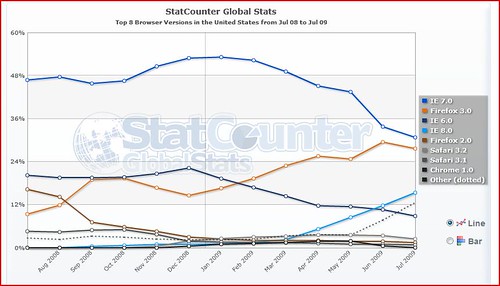
Really, what would we do without European antitrust regulators protecting us from the evils of browser innovation? If Microsoft was allowed to actually bundle its Internet Explorer browser alongside its operating system we might actually do something really crazy… like perhaps try it! After all, the latest browser stats make it pretty clear most of us have a choice and that fewer and fewer of us rely on IE. As Erick Schonfeld noted on Tech Crunch today:

The new browser wars on on. More than a decade after Microsoft killed off Netscape with Internet Explorer, competition in the browser market has never been stronger. Just last week, Mozilla released Firefox 3.5, which has now been downloaded nearly 14 million times. Earlier in June, Apple released Safari 4. In March, Microsoft introduced Internet Explorer 8, and Google came out with a speedier beta of its Chrome browser. Some early data is coming in showing relative market share and how fast people are upgrading. If you look at the chart above from Statcounter, it indicates that since March Internet Explorer has lost 11.4 percent market share to other browsers. [..] Where did that go? It went to Firefox, Safari, and Chrome. Nearly 5 percent of that, or about half, went to Firefox 3.0, which currently has 27.6 percent market share. That doesn’t count last week’s upgrade.

08-09 browser stats

Alas, as I pointed out in my essay a few weeks ago (“European Regulators Think Consumers Too Stupid to Know How to Download a Different Browser“), some Euro-crats still seem to believe that changing browsers requires great detective skills to unearth alternatives.  It’s just pure poppycock and yet another sad example of how antitrust law is usually hopelessly behind the times and has absolutely nothing to do with protecting consumers or fostering innovation.

Now, please excuse me while I get back to surfing the Net via Firefox and Chrome (and Opera on my mobile phone). My God, how did I ever find these browser alternatives!

According to Ina Fried of CNet News, Microsoft plans to remove its Internet Explorer web browser from the new versions of Windows 7 when it ships it in Europe later this year. [Additional coverage at ZDNet.]  MS is apparently doing so to assuage the concerns of EU antitrust officials, who have been obsessed with the company for the past decade. [Update: Here is MS official announcement.]

Apparently, European officials think their citizens are too stupid to find an alternative browser.  I mean, seriously, how hard is it?  Does the competition lack name recognition such that consumers can’t find them?  Hmmm… Google and Apple seem to be pretty well known brands, and their browsers (Chrome & Safari) are pretty easy to find.  And then there’s Mozilla’s Firefox browser (my PC favorite) and Opera (my mobile phone favorite), which are outstanding browsers. [Incidentally, Firefox already has 31% share of the European market.]

OK, OK, the regulators might say, but these competitors are just too expensive!  Uh, no, wait… every one of them is free. So, strike that theory.

Well, the regulators need another theory then. How about illegal tying of products and services! You know, there’s only certain sites or services you can use with IE, right?   Nope, that theory doesn’t work either.  And does anyone believe that MS could really tie OS functionality to the use of IE? How long would the world tolerate Outlook e-mails or Word documents that only allowed linking to URLs via IE??  Come on.

OK, any other theories left? Not that I can think of. Which brings us back to the only theory the Euro-crats have left: people are sheep. They’ll take whatever MS bundles into the OS free, you see, and they will use it more than they use competing products.  Thus, we regulators have to save them from their own stupidity! The masses just don’t know what’s good for them!  These free, integrated services are harming them! And, therefore, the only remaining solution is to kill innovation by crippling functionality and removing the free offering. That’s pro-consumer! … or so say the European antitrust bureaucrats.

Meanwhile, back in the real world, a whole lotta innovation continues to take place. But shhhh.. don’t tell the Euro-crats. They need a company to pick on. Welcome to the Theater of the Techno-Absurd.

By Berin Szoka & Adam Thierer

As we noted in our intro to this ongoing series, Google’s tenth anniversary has passed with Googlephobia reaching new heights of hysteria.

But is Google really too big and dangerous, or are people just too lazy to find other alternatives to each of the wonderful services that Google offers?  If one is truly paranoid about the firm’s supposed dominance, it doesn’t take much effort to live a Google-free life. To prove it, we set out to find alternatives to each of the services that Google provides.  After awhile, we got a little tired of compiling alternatives in each category and just provided links for the additional choices at your disposal.  It’s tough to see what the fuss is about with the cornucopia of choices at our disposal.  If you don’t like Google, then just don’t use it or any of its services.  The choice is yours.

In each case, we’ve listed Google first, even though Google may not be the market leader ( e.g., Google’s relatively unknown social network Orkut).

Search Engines

Continue reading →

Googlephobia: The Series

by on September 11, 2008 · 9 comments

By Berin Szoka & Adam Thierer as part of an ongoing series

With Google celebrating its 10th anniversary this week, many panicky pundits are using the occasion to claim that Google has become the Great “Satan” of the Internet.  Nick Carr wonders what the future holds for “The OmniGoogle.” The normally level-headed Mike Malone worries that Google is “turning into Big Brother.”  And Washington Post’s Rob Dubbin says that he can’t escape Google’s “tentacles,” even for just 24 hours.  Meanwhile, speculation abounds that the Justice Department is preparing a major antitrust lawsuit against Google concerning its advertising partnership with Yahoo! or perhaps even a broader suit concerning Google’s “dominance” of online advertising generally.

Carr quotes Google co-founder Sergey Brin’s now-famous 2003 interview:

I think people tend to exaggerate Google’s significance in both directions.  Some say Google is God.  Others say Google is Satan.  But if they think Google is too powerful, remember that with search engines, unlike other companies, all it takes is a single click to go to another search engine. People come to Google because they choose to.  We don’t trick them.

In the last five years, Google has become far more than just a search engine.  As Google’s suite of suite of complementary products continues to grow, so too does the specter of Google as an all-knowing and therefore all-powerful economic colossus.  Yet Google isn’t even close to being the sort of nefarious monopolist out to destroy user privacy at every turn, as some seem to imply—if not exclaim.  Indeed, in our view, the Net is overall a far better place because of the existence of Google and the many free services it provides consumers.

Our point is not that Google should be immune from criticism.  Indeed, healthy criticism of corporate actions plays a vital role in the free market by disciplining corporate policies and behavior—often thus providing an effective alternative to government regulation.  This is particularly important in the area of consumer privacy protection, as demonstrated by Google’s quick response to public concern about its Chrome EULA. Continue reading →