Alex Tabarrok, author of the ebook Launching The Innovation Renaissance: A New Path to Bring Smart Ideas to Market Fast discusses America’s declining growth rate in total factor productivity, what this means for the future of innovation, and what can be done to improve the situation.
Accroding to Tabarrok, patents, which were designed to promote the progress of science and the useful arts, have instead become weapons in a war for competitive advantage with innovation as collateral damage. College, once a foundation for innovation, has been oversold. And regulations, passed with the best of intentions, have spread like kudzu and now impede progress to everyone’s detriment. Tabarrok outs forth simple reforms in each of these areas and also explains the role immigration plays in innovation and national productivity.
Download
Related Links
Today I’ll be testifying at a Senate Commerce Committee hearing on online privacy and commercial data collection issues. In my remarks, I make three primary points:
- First, no matter how well-intentioned, restrictions on data collection could negatively impact the competitiveness of America’s digital economy, as well as consumer choice.
- Second, it is unwise to place too much faith in any single, silver-bullet solution to privacy, including “Do Not Track,” because such schemes are easily evaded or defeated and often fail to live up to their billing.
- Finally, with those two points in mind, we should look to alternative and less costly approaches to protecting privacy that rely on education, empowerment, and targeted enforcement of existing laws. Serious and lasting long-term privacy protection requires a layered, multifaceted approach incorporating many solutions.
The testimony also contains 4 appendices elaborating on some of these themes.
Down below, I’ve embedded my testimony, a list of 10 recent essays I’ve penned on these topics, and a video in which I explain “How I Think about Privacy” (which was taped last summer at an event up at the University of Maine’s Center for Law and Innovation). Finally, the best summary of my work on these issues can be found in this recent Harvard Journal of Law & Public Policy article, “The Pursuit of Privacy in a World Where Information Control is Failing.” (This is the first of two complimentary law review articles I will be releasing this year dealing with privacy policy. The second, which will be published early this summer by the George Mason University Law Review, is entitled, “A Framework for Benefit-Cost Analysis in Digital Privacy Debates.”) Continue reading →
Last week on his personal blog, Peter Fleischer, Global Privacy Counsel for Google, posted an interesting essay entitled “We Need a Better, Simpler Narrative of US Privacy Laws.” Fleischer says that Europe has done a better job marketing its privacy regime to the world than the United States and argues that “The US has to figure out how to explain its privacy laws on the global stage” since “Europe is convincing many countries around the world to implement privacy laws that follow the European model.” He notes that “in the last year alone, a dozen countries in Latin America and Asia have adopted euro-style privacy laws [while] not a single country, anywhere, has followed the US model.” Fleischer argues that this has ramifications for long-term trade policy and global Internet regulation more generally.
I found this essay very interesting because I deal with some of these issues in my latest law review article, “The Pursuit of Privacy in a World Where Information Control is Failing” (Harvard Journal of Law & Public Policy, vol. 36, no. 2, Spring 2013). In the article, I suggest that the U.S. does have a unique privacy regime and it is one that is very similar in character to the regime that governs online child safety issues. Whether we are talking about online safety or digital privacy, the defining characteristics of the U.S. regime are that it is bottom-up, evolutionary, education-based, empowerment-focused, and resiliency-centered. It focuses on responding to safety and privacy harms after exhausting other alternatives, including market responses and the evolution of societal norms.
The EU regime, by contrast, is more top-down in character and takes a more static, inflexible view of privacy rights. It tries to impose a one-size-fits-all model on a diverse citizenry and it attempts to do so through heavy-handed data directives and ongoing “agency threats.” It is a regime that makes more sweeping pronouncements about rights and harms and generally recommends a “precautionary principle” approach to technological change in which digital innovation is more “permissioned.”
Put simply, the U.S. regime is
reactive in character while the E.U. regime is more preemptive. The U.S. system focuses on responding to safety and privacy problems using a more diverse toolbox of solutions, some of which are governmental in character while others are based on evolving social and market norms and responses. To be clear, law does enter the picture here in the U.S., but it does so in a very different way than it does in the E.U. Continue reading →
 I’m excited to announce the release of my latest law review article, “The Pursuit of Privacy in a World Where Information Control is Failing,” which appears in the next edition (vol. 36) of the Harvard Journal of Law & Public Policy. This is the first of two complimentary law review articles that I will be releasing this year dealing with privacy policy. The second, which will be published later this summer by the George Mason University Law Review, is entitled, “A Framework for Benefit-Cost Analysis in Digital Privacy Debates.” (FYI: Both articles focus on privacy claims made against private actors — namely, efforts to limit private data collection — and not on privacy rights against governments.)
The new
Harvard Journal article is divided into three major sections. Part I focuses on some of normative challenges we face when discussing privacy and argues that there may never be a widely accepted, coherent legal standard for privacy rights or harms here in the United States. It also explores the tensions between expanded privacy regulation and online free speech. Part II turns to the many enforcement challenges that are often ignored when privacy policies are being proposed or formulated and argues that legislative and regulatory efforts aimed at protecting privacy must now be seen as an increasingly intractable information control problem. Most of the problems policymakers and average individuals face when it comes to controlling the flow of private information online are similar to the challenges they face when trying to control the free flow of digitalized bits in other information policy contexts, such as online safety, cybersecurity, and digital copyright.
If the effectiveness of law and regulation is limited by the normative considerations discussed in Part I and the practical enforcement complications discussed in Part II, what alternatives remain to assist privacy-sensitive individuals? I address that question in Part III of the paper and argue that the approach America has adopted to deal with concerns about objectionable online speech and child safety offers a path forward on the privacy front as well. Continue reading →
I have always found it strange that the ACLU speaks with two voices when it comes to user empowerment as a response to government regulation of the Internet. That is, when responding to government efforts to regulate the Internet for online safety or speech purposes, the ACLU stresses personal responsibility and user empowerment as the first-order response. But as soon as the conversation switches to online advertising and data collection, the ACLU suggests that people are basically sheep who can’t possibly look out for themselves and, therefore, increased Internet regulation is essential. They’re not the only ones adopting this paradoxical position. In previous essays I’ve highlighted how both EFF and CDT do the same thing. But let me focus here on ACLU.
Writing today on the ACLU “Free Future” blog, ACLU senior policy analyst Jay Stanley cites a new paper that he says proves “the absurdity of the position that individuals who desire privacy must attempt to win a technological arms race with the multi-billion dollar internet-advertising industry.” The new study Stanley cites says that “advertisers are making it impossible to avoid online tracking” and that it isn’t paternalistic for government to intervene and regulate if the goal is to enhance user privacy choices. Stanley wholeheartedly agrees. In this and other posts, he and other ACLU analysts have endorsed greater government action to address this perceived threat on the grounds that, in essence, user empowerment cannot work when it comes to online privacy.
Again, this represents a very different position from the one that ACLU has staked out and brilliantly defended over the past 15 years when it comes to user empowerment as the proper and practical response to government regulation of objectionable online speech and pornography. For those not familiar, beginning in the mid-1990s, lawmakers started pursuing a number of new forms of Internet regulation — direct censorship and mandatory age verification were the primary methods of control — aimed at curbing objectionable online speech. In case after case, the ACLU rose up to rightly defend our online liberties against such government encroachment. (I was proud to have worked closely with many former ACLU officials in these battles.) Most notably, the ACLU pushed back against the Communications Decency Act of 1996 (CDA) and the Child Online Protection Act of 1998 (COPA) and they won landmark decisions for us in the process. Continue reading →
Andrew Orlowski of The Register (U.K.) recently posted a very interesting essay making the case for treating online copyright and privacy as essentially the same problem in need of the same solution: increased property rights. In his essay (“‘Don’t break the internet’: How an idiot’s slogan stole your privacy“), he argues that, “The absence of permissions on our personal data and the absence of permissions on digital copyright objects are two sides of the same coin. Economically and legally they’re an absence of property rights – and an insistence on preserving the internet as a childlike, utopian world, where nobody owns anything, or ever turns a request down. But as we’ve seen, you can build things like libraries with permissions too – and create new markets.” He argues that “no matter what law you pass, it won’t work unless there’s ownership attached to data, and you, as the individual, are the ultimate owner. From the basis of ownership, we can then agree what kind of rights are associated with the data – eg, the right to exclude people from it, the right to sell it or exchange it – and then build a permission-based world on top of that.”
And so, he concludes, we should set aside concerns about Internet regulation and information control and get down to the business of engineering solutions that would help us property-tize both intangible creations and intangible facts about ourselves to better shield our intellectual creations and our privacy in the information age. He builds on the thoughts of Mark Bide, a tech consultant:
For Bide, privacy and content markets are just a technical challenges that need to be addressed intelligently.”You can take two views,” he told me. “One is that every piece of information flowing around a network is a good thing, and we should know everything about everybody, and have no constraints on access to it all.” People who believe this, he added, tend to be inflexible – there is no half-way house. “The alternative view is that we can take the technology to make privacy and intellectual property work on the network. The function of copyright is to allow creators and people who invest in creation to define how it can be used. That’s the purpose of it. “So which way do we want to do it?” he asks. “Do we want to throw up our hands and do nothing? The workings of a civilised society need both privacy and creator’s rights.” But this a new way of thinking about things: it will be met with cognitive dissonance. Copyright activists who fight property rights on the internet and have never seen a copyright law they like, generally do like their privacy. They want to preserve it, and will support laws that do. But to succeed, they’ll need to argue for stronger property rights. They have yet to realise that their opponents in the copyright wars have been arguing for those too, for years. Both sides of the copyright “fight” actually need the same thing. This is odd, I said to Bide. How can he account for this irony? “Ah,” says Bide. “Privacy and copyright are two things nobody cares about unless it’s their own privacy, and their own copyright.”
These are important insights that get at a fundamental truth that all too many people ignore today: At root,
most information control efforts are related and solutions for one problem can often be used to address others. But there’s another insight that Orlowski ignores: Whether we are discussing copyright, privacy, online speech and child safety, or cybersecurity, all these efforts to control the free flow of digitized bits over decentralized global networks will be increasingly complex, costly, and riddled with myriad unintended consequences. Importantly, that is true whether you seek to control information flows through top-down administrative regulation or by assigning and enforcing property rights in intellectual creations or private information.
Let me elaborate a bit (and I apologize for the rambling mess of rant that follows).
[UPDATE Feb. 2012: This little essay eventually led to an 80-page working paper, “Technopanics, Threat Inflation, and the Danger of an Information Technology Precautionary Principle.”]
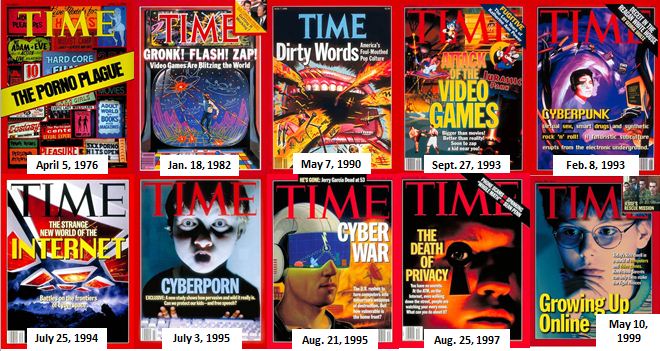
In this essay, I will suggest that (1) while “moral panics” and “techno-panics” are nothing new, their cycles seem to be accelerating as new communications and information networks and platforms proliferate; (2) new panics often “crowd-out” or displace old ones; and (3) the current scare over online privacy and “tracking” is just the latest episode in this ongoing cycle.
What Counts as a “Techno-Panic”?
First, let’s step back and define our terms. Christopher Ferguson, a professor at Texas A&M’s Department of Behavioral, Applied Sciences and Criminal Justice, offers the following definition: “A moral panic occurs when a segment of society believes that the behavior or moral choices of others within that society poses a significant risk to the society as a whole.” By extension, a “techno-panic” is simply a moral panic that centers around societal fears about a specific contemporary technology (or technological activity) instead of merely the content flowing over that technology or medium. In her brilliant 2008 essay on “The MySpace Moral Panic,” Alice Marwick noted: Continue reading →
Distracted driving is a serious problem. When you’re flying down the road at speed maneuvering a 2-ton piece of machinery, you need to be paying attention to the road to keep yourself, and others around you, safe. Distractions of any sort can be dangerous and undercut the driver’s ability to stay focused. And it’s certainly true that digital devices can be among the biggest distractions. But I think we have to ask some practical questions about just how far law can and should go to minimize that distraction.
I raise this issue because, according to this Bloomberg article yesterday, “U.S. Transportation Secretary Ray LaHood says he believes motorists are distracted by any use of mobile phones while driving, including hands-free calls, as his department begins research that may lead him to push for a ban.” Sec. LaHood believes that even hands-free phone conversations are a “cognitive distraction” and should be prohibited. Also, “his concerns extend to vehicle information and entertainment systems such as Ford Motor Co.’s Sync and General Motors Co.’s OnStar,” which means that almost every conceivable in-vehicle technology could be regulated under LaHood’s scheme.
To be clear, I’m not necessarily opposed to laws addressing talking on phones or texting while driving since those actions can have dangerous consequences. But I’ve always preferred a more generic enforcement strategy when it comes to distracted driving laws. As I noted in my old 2007 essay, “Banning In-Car Technologies Won’t Work,” to the extent law enforcement needs to be brought into the picture it should be done in a technology-agnostic or activity-agnostic fashion. I went on to argue: Continue reading →
Sen. Amy Klobuchar just released a letter to Facebook demanding the site require “a prominent safety button or link on the profile pages of users under the age of 18″—akin to the so-called “panic button” app launched earlier this week by the UK’s Child Exploitation & Online Protection Centre (CEOP). She doesn’t seem to realize that this app is available to all Facebook users, not just those in the UK. But her focus on empowerment tools and education is admirable, and it’s certainly a fair question to ask what sites like Facebook and MySpace are doing in these areas.
Unfortunately, Klobuchar’s letter also engages in blatant fear-mongering:
Recent research has shown that one in four American teenagers have been victims of a cyber predator. And when teens experience abusive behavior online, only ten percent discuss it with their parents and even fewer report the misconduct to law enforcement. It’s clear that teenagers need to know how to respond to a cyber attack and I believe we need stronger reporting mechanisms to keep our kids safe.
Klobuchar doesn’t actually
cite anything, so it’s not clear what research she’s relying on. The 25% statistic is particularly incendiary, suggesting a nationwide cyber-predation crisis—perhaps leading the public to believe 8 or 9 million teens have been lured into sexual encounters offline. Perhaps the Senator considers every cyber-bully a cyber predator—which might get to the 25% number. But there are two serious problem with that moral equivalence.
First, to equate child predation with peer bullying is to engage in a dangerous game of defining deviancy down. Predation and bullying are
radically different things. The first (sexual abuse) is a clear and heinous crime that can lead to long-term psychological damage. The second might be a crime in certain circumstances, but generally not. And it is even less likely to be a crime when it occurs among young peers, which research shows constitutes the vast majority of cases. As Adam Thierer and I noted in our Congressional testimony last year, there are legitimate concerns about cyberbullying, but it’s something best dealt with by parents and schools rather than prosecutors (like Klobuchar in her pre-Senate career).
Second, a series of official taskforces have concluded that the cyberpredator technopanic is vastly overblown. Continue reading →
The Online Safety and Technology Working Group (OSTWG) has just released its final report to Congress entitled, “Youth Safety on a Living Internet.” As I mentioned here last year, this government task force was established by the “Protecting Children in the 21st Century Act,” (part of the ‘‘Broadband Data Improvement Act’,’ Pub. L. No. 110-385) and its mission was to review and evaluate:
- The status of industry efforts to promote online safety through educational efforts, parental control technology, blocking and filtering software, age-appropriate labels for content or other technologies or initiatives designed to promote a safe online environment for children;
- The status of industry efforts to promote online safety among providers of electronic communications services and remote computing services by reporting apparent child pornography, including any obstacles to such reporting;
- The practices of electronic communications service providers and remote computing service providers related to record retention in connection with crimes against children; and,
- The development of technologies to help parents shield their children from inappropriate material on the Internet.
The task force included over 30 experts from academia, industry, advocacy groups, and think tanks. It was my great honor to be a member of OSTWG and to serve as the chair of 1 of the 4 subcommittees. The four subcommittees addressed: data retention, child pornography reporting, educational efforts, and parental controls technologies. I chaired that last subcommittee on parental controls.
Our conclusions will not be surprising to those who have read previous online safety task force reports, which I have summarized in 2009 white paper, “Five Online Safety Task Forces Agree: Education, Empowerment & Self-Regulation Are the Answer.” Generally speaking, we concluded that there is no silver-bullet technical solution to online child safety concerns. Instead – and again in agreement with previous research and task force reports – we have concluded that a diverse toolbox and a “layered approach” must be brought to bear on these problems and concerns. Here’s how we put it in the report:
Continue reading →

 The Technology Liberation Front is the tech policy blog dedicated to keeping politicians' hands off the 'net and everything else related to technology.