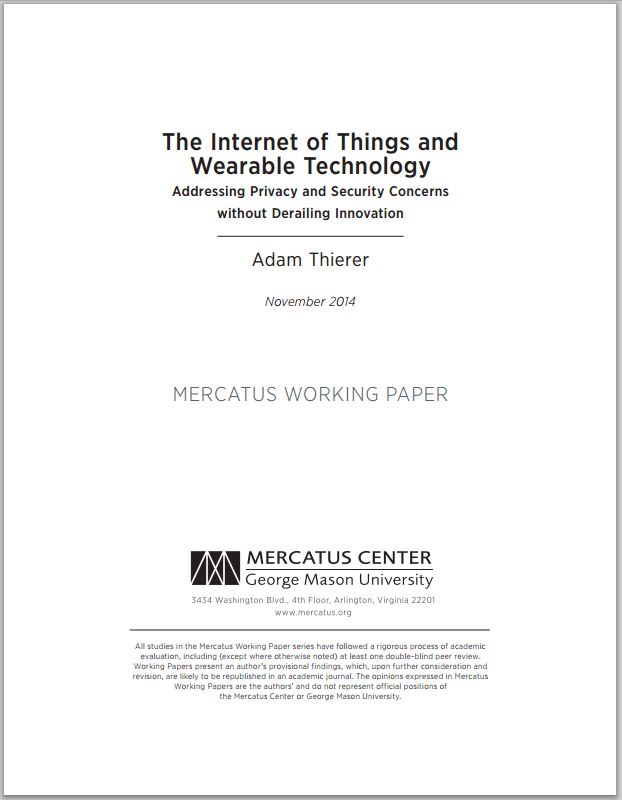
 The Mercatus Center at George Mason University has just released my latest working paper, “The Internet of Things and Wearable Technology: Addressing Privacy and Security Concerns without Derailing Innovation.” The “Internet of Things” (IoT) generally refers to “smart” devices that are connected to both the Internet and other devices. Wearable technologies are IoT devices that are worn somewhere on the body and which gather data about us for various purposes. These technologies promise to usher in the next wave of Internet-enabled services and data-driven innovation. Basically, the Internet will be “baked in” to almost everything that consumers own and come into contact with.
Some critics are worried about the privacy and security implications of the Internet of Things and wearable technology, however, and are proposing regulation to address these concerns. In my new 93-page article, I explain why preemptive, top-down regulation would derail the many life-enriching innovations that could come from these new IoT technologies. Building on a recent book of mine, I argue that “permissionless innovation,” which allows new technology to flourish and develop in a relatively unabated fashion, is the superior approach to the Internet of Things.
As I note in the paper and my earlier book, if we spend all our time living in fear of the worst-case scenarios — and basing public policies on them — then best-case scenarios can never come about. As the old saying goes: nothing ventured, nothing gained. Precautionary principle-based regulation paralyzes progress and must be avoided. We instead need to find constructive, “bottom-up” solutions to the privacy and security risks accompanying these new IoT technologies instead of top-down controls that would limit the development of life-enriching IoT innovations. Continue reading →
On Thursday, it was my great pleasure to present a draft of my forthcoming paper, “The Internet of Things & Wearable Technology: Addressing Privacy & Security Concerns without Derailing Innovation,” at a conference that took place at the Federal Communications Commission on “Regulating the Evolving Broadband Ecosystem.” The 3-day event was co-sponsored by the American Enterprise Institute and the University of Nebraska College of Law.
The 65-page working paper I presented is still going through final peer review and copyediting, but I posted a very rough first draft on SSRN for conference participants. I expect the paper to be released as a Mercatus Center working paper in October and then I hope to find a home for it in a law review. I will post the final version once it is released. [UPDATE:The final version of this working paper was released on November 19, 2014.]
In the meantime, however, I thought I would post the 46 slides I presented at the conference, which offer an overview of the nature of the Internet of Things and wearable technology, the potential economic opportunities that exist in this space, and the various privacy and security challenges that could hold this technological revolution back. I also outlined some constructive solutions to those concerns. I plan to be very active on these issues in coming months.
Continue reading →
My latest law review article is entitled, “Privacy Law’s Precautionary Principle Problem,” and it appears in Vol. 66, No. 2 of the Maine Law Review. You can download the article on my Mercatus Center page, on the Maine Law Review website, or via SSRN. Here’s the abstract for the article:
Privacy law today faces two interrelated problems. The first is an
information control problem. Like so many other fields of modern cyberlaw—intellectual property, online safety, cybersecurity, etc.—privacy law is being challenged by intractable Information Age realities. Specifically, it is easier than ever before for information to circulate freely and harder than ever to bottle it up once it is released.
This has not slowed efforts to fashion new rules aimed at bottling up those information flows. If anything, the pace of privacy-related regulatory proposals has been steadily increasing in recent years even as these information control challenges multiply.
This has led to privacy law’s second major problem:
the precautionary principle problem. The precautionary principle generally holds that new innovations should be curbed or even forbidden until they are proven safe. Fashioning privacy rules based on precautionary principle reasoning necessitates prophylactic regulation that makes new forms of digital innovation guilty until proven innocent.
This puts privacy law on a collision course with the general freedom to innovate that has thus far powered the Internet revolution, and privacy law threatens to limit innovations consumers have come to expect or even raise prices for services consumers currently receive free of charge. As a result, even if new regulations are pursued or imposed, there will likely be formidable push-back not just from affected industries but also from their consumers.
In light of both these information control and precautionary principle problems, new approaches to privacy protection are necessary. Continue reading →
Patrick Byrne, CEO of Overstock.com, discusses how Overstock.com became one of the first online retail stores to accept Bitcoin. Byrne provides insight into how Bitcoin lowers transaction costs, making it beneficial to both retailers and consumers, and how governments are attempting to limit access to Bitcoin. Byrne also discusses his project DeepCapture.com, which raises awareness for market manipulation and naked short selling, as well as his philanthropic work and support for education reform.
Download
Related Links
Last week, it was my great pleasure to be invited on NPR’s “On Point with Tom Ashbrook,” to debate Jeffrey Rosen, a leading privacy scholar and the president and chief executive of the National Constitution Center. In an editorial in the previous Sunday’s New York Times (“Madison’s Privacy Blind Spot”), Rosen proposed “constitutional amendment to prohibit unreasonable searches and seizures of our persons and electronic effects, whether by the government or by private corporations like Google and AT&T.” He said his proposed amendment would limit “outrageous and unreasonable” collection practices and would even disallow consumers from sharing their personal information with private actors even if they saw an advantage in doing so.
I responded to Rosen’s proposal in an essay posted on the IAPP
Privacy Perspectives blog, “Do We Need A Constitutional Amendment Restricting Private-Sector Data Collection?” In my essay, I argued that there are several legal, economic, and practical problems with Rosen’s proposal. You can head over to the IAPP blog to read my entire response but the gist of it is that “a constitutional amendment [governing private data collection] would be too sweeping in effect and that better alternatives exist to deal with the privacy concerns he identifies.” There are very good reasons we treat public and private actors differently under the law and there “are all far more practical and less-restrictive steps that can be taken without resorting to the sort of constitutional sledgehammer that Jeff Rosen favors. We can protect privacy without rewriting the Constitution or upending the information economy,” I concluded.
But I wanted to elaborate on one particular thing I found particularly interesting about Rosen’s comments when we were on NPR together. During the show, Rosen kept stressing how we needed to adopt a more European construction of privacy as “dignity rights” and he even said his proposed privacy amendment would even disallow individuals from surrendering their private data or their privacy because he viewed these rights as “unalienable.” In other words, from Rosen’s perspective, privacy pretty much trumps
everything, even if you want to trade it off against other values. Continue reading →
With each booth I pass and presentation I listen to at the 2014 International Consumer Electronics Show (CES), it becomes increasingly evident that the “Internet of Things” era has arrived. In just a few short years, the Internet of Things (IoT) has gone from industry buzzword to marketplace reality. Countless new IoT devices are on display throughout the halls of the Las Vegas Convention Center this week, including various wearable technologies, smart appliances, remote monitoring services, autonomous vehicles, and much more.
This isn’t vaporware; these are devices or services that are already on the market or will launch shortly. Some will fail, of course, just as many other earlier technologies on display at past CES shows didn’t pan out. But many of these IoT technologies will succeed, driven by growing consumer demand for highly personalized, ubiquitous, and instantaneous services.
But will policymakers let the Internet of Things revolution continue or will they stop it dead in its tracks? Interestingly, not too many people out here in Vegas at the CES seem all that worried about the latter outcome. Indeed, what I find most striking about the conversation out here at CES this week versus the one about IoT that has been taking place in Washington over the past year is that there is a large and growing disconnect between consumers and policymakers about what the Internet of Things means for the future.
When every device has a sensor, a chip, and some sort of networking capability, amazing opportunities become available to consumers. And that’s what has them so excited and ready to embrace these new technologies. But those same capabilities are exactly what raise the blood pressure of many policymakers and policy activists who fear the safety, security, or privacy-related problems that might creep up in a world filled with such technologies.
But at least so far, most consumers don’t seem to share the same worries. Continue reading →
 I’m pleased to announce the release of my latest law review article, “A Framework for Benefit-Cost Analysis in Digital Privacy Debates.” It appears in the new edition of the George Mason University Law Review. (Vol. 20, No. 4, Summer 2013)
This is the second of two complimentary law review articles I am releasing this year dealing with privacy policy. The first, “The Pursuit of Privacy in a World Where Information Control is Failing,” was published in Vol. 36 of the Harvard Journal of Law & Public Policy
this Spring. (FYI: Both articles focus on privacy claims made against private actors — namely, efforts to limit private data collection — and not on privacy rights against governments.)
My new article on benefit-cost analysis in privacy debates makes a seemingly contradictory argument: benefit-cost analysis (“BCA”) is extremely challenging in online child safety and digital privacy debates, yet it remains essential that analysts and policymakers attempt to conduct such reviews. While we will never be able to perfectly determine either the benefits or costs of online safety or privacy controls, the very act of conducting a regulatory impact analysis (“RIA”) will help us to better understand the trade-offs associated with various regulatory proposals. Continue reading →
Last month, it was my great pleasure to serve as a “provocateur” at the IAPP’s (Int’l Assoc. of Privacy Professionals) annual “Navigate” conference. The event brought together a diverse audience and set of speakers from across the globe to discuss how to deal with the various privacy concerns associated with current and emerging technologies.
My remarks focused on a theme I have developed here for years: There are no simple, silver-bullet solutions to complex problems such as online safety, security, and privacy. Instead, only a “layered” approach incorporating many different solutions–education, media literacy, digital citizenship, evolving society norms, self-regulation, and targeted enforcement of existing legal standards–can really help us solve these problems. Even then, new challenges will present themselves as technology continues to evolve and evade traditional controls, solutions, or norms. It’s a never-ending game, and that’s why education
must be our first-order solution. It better prepares us for an uncertain future. (I explained this approach in far more detail in this law review article.)
Anyway, if you’re interested in an 11-minute video of me saying all that, here ya go. Also, down below I have listed several of the recent essays, papers, and law review articles I have done on this issue.
Continue reading →
This afternoon, Berin Szoka asked me to participate in a TechFreedom conference on “COPPA: Past, Present & Future of Children’s Privacy & Media.” [CSPAN video is here.] It was a in-depth, 3-hour, 2-panel discussion of the Federal Trade Commission’s recent revisions to the rules issued under the 1998 Children’s Online Privacy Protection Act (COPPA).
While most of the other panelists were focused on the devilish details about how COPPA works in practice (or at least
should work in practice), I decided to ask a more provocative question to really shake up the discussion: What are we going to do when COPPA fails?
My notes for the event follow down below. I didn’t have time to put them into a smooth narrative, so please pardon the bullet points. Continue reading →
Today over at the International Association of Privacy Professionals (IAPP) Daily Dashboard blog, I have a guest post entitled, “Let’s Not Place All Our Eggs in the Do Not Track Basket.” The essay builds on my Senate Commerce Committee testimony last week by arguing that:
If there’s one lesson I’ve learned in twenty-one years of covering information technology policy, it’s that there are no simple silver-bullet solutions to complex issues like online safety, hate speech, spam, cybersecurity, data breaches or digital privacy. Problems such as these demand a layered, multifaceted approach that incorporates many solutions, the first among these being education and awareness-based efforts.
I continue on to explain why that means we should be cautious about placing too much faith in privacy techno-fixes like Do Not Track, which won’t likely be any more successful than past silver bullet efforts. (Note: Justin Brookman of CDT will be offering a counterpoint to my essay next week on the IAPP blog. I look forward to seeing what he has to say. He also testified alongside me in the Senate last week.)
By the way, for those of you not familiar with the IAPP, it is “the largest and most comprehensive global information privacy community and resource, helping practitioners develop and advance their careers and organizations manage and protect their data. More than just a professional association, the IAPP provides a home for privacy professionals around the world to gather, share experiences and enrich their knowledge.” In my opinion, the IAPP is doing amazing work and deserves the attention of anyone who cares about the future of privacy and privacy policy. I strongly recommend you check out their excellent site and explore all the important resources they provide and other things they do.
Anyway, if you are interested in the issues discussed in my IAPP guest post, you might also want to check out some of the related essays down below the fold: Continue reading →


 The Technology Liberation Front is the tech policy blog dedicated to keeping politicians' hands off the 'net and everything else related to technology.