Today I appeared on CNBC [video here and embedded down below] to discuss concerns about emerging “smart-sign” technology, which could give rise to a new generation of interactive retail advertising and marketing efforts. This is in the news because, as Don Clark and Nick Wingfield report today in The Wall Street Journal (“Intel, Microsoft Offer Smart-Sign Technology: Retailers, Product Marketers Could Discern Viewer, Make Choices on What to Display and Transfer Coupons Via Phone“), Intel and Microsoft have announced that:
they will collaborate to help companies create and use new forms of digital signs. By exploiting Intel chips and Microsoft software, the companies hope to bring more interactivity to such devices and help retailers customized marketing offers to consumers.
Signs equipped with cameras and specialized software could recognize the age, gender and height of people in front of them, and tell what products and images received the most attention, the companies said. By gathering information about which messages are more effective, they add, traditional retailers could develop marketing approaches that better counter Web-based competitors. “Every year retailers lose more ground to online [sellers], and they have to do something about that,” said Joe Jensen, general manager of Intel’s embedded computing division.
Down below, I have jotted down a couple of thoughts about the rise of “digital signage” and more targeted forms of retail marketing, only a few of which I was able to get across in this short TV spot. I think it’s an exciting new development for both retailers and consumers for the reasons I explain down below:
http://plus.cnbc.com/rssvideosearch/action/player/id/1383744249/code/cnbcplayershare
Continue reading →
 So, did the decade just end or do we have another year to go? Honestly, I’ve never understood when the cut-off is from one decade to the next. (My friend Larry Magid struggles with the same question in his recent column on “The Decade in Technology.”) Nonetheless, I’ve seen a lot of best-of-decade lists published recently, so I thought I would throw my own out there even though it is still a work in progress.
I have been attempting to compile the definitive bibliography for our digital decade—the definitive list of Internet policy books, that is. I started throwing this together two years ago when I was penning my list of “The Most Important Internet Policy Books of 2008” and continued to work on it as I was finishing up my 2009 installment as well. I grabbed every book off my shelf that dealt with the future of the Internet and the impact the Digital Revolution is having on our lives, culture, and economy and threw the title and a link onto this list. (I’m also using the list to help structure my thoughts for a forthcoming book of my own on Internet Optimists vs. Pessimists, something I’ve been writing a lot about here in recent years.)
Below you will find what I’ve got so far. There are around 80 90 books on the list. I’ve divided the list by year, but you may be wondering what determined the order the books appear in. In essence, I’ve listed what I feel are the 1 or 2 most important titles first and then just added others randomly. Eventually, I plan to post a “Most Important Internet Policy Books of the Decade” list outlining which titles I believe have been the most influential. I suspect I’ll name Benkler’s Wealth of Networks to the top slot followed closely by Zittrain’s The Future of the Internet, Lessig’s Free Culture, and Chris Anderson’s The Long Tail. Anyway, that’s for another day.
For now, I would just like to ask for reader suggestions regarding what other titles that should appear on this list. I will add titles as they come in. I want to stress, however, that I am trying to keep this list limited to books that have something to say about
Internet policy (cyber-law, digital economics, information technology politics, etc).
I hope others find this useful. And yes, I have read all most of the books on this list! As I’ve noted here before, I’m a bit of book nerd. (Now that I’ve received so many helpful additions to the list, there are some titles on the list I have not had a chance to read through yet). Continue reading →
My friend Larry Magid, a technology columnist for CBS News.com and others, has a wonderful new column out about “The Decade in Technology.” You have to read it to appreciate just how far we have come in such a short time. Larry notes:
[T]he past 10 years were a momentous period for technology. Not only was there no iPhone a decade ago, there was hardly anything that could be considered a smartphone. The BlackBerry was introduced in 1999, when the well-heeled techno-savvy were carrying around flip phones. That year, 1999, was the height of the dot-com boom. But when you look back at it, the online world was nothing like it is today. There was no Facebook (founded in 2004) or Twitter (2007). Even MySpace wasn’t founded until 2003. The term Web 2.0 hadn’t been coined and most people who were online used the Web mostly to consume information. Those with the skills and resources to post to the Web were called “Webmasters.” Today, everyone with a Facebook account is a master of his or her own Web.
I tried to document the incredible technological changes in my own life over the past decade in this essay I penned on Super Bowl Sunday last February: “10 Years Ago Today… (Thinking About Technological Progress).”
Larry also notes that giants came and went as technology continued to evolve in unexpected ways:
Ten years ago AOL was the most popular Internet service provider and was so successful that it was able to purchase media giant Time Warner in January 2000 for $182 billion in stock. But the marriage didn’t make it through the decade. The two companies formally split up this month, with AOL, once again, being traded on the New York Stock Exchange as a separate company. AOL thrived in the ’90s because people were using the service to go online via phone. Today most American homes have broadband.
That’s something I wrote about at length in my recent paper on “A Brief History of Media Merger Hysteria.” Anyway, read Larry’s entire piece. It really drives home how lucky we are to be living in the midst of such at technological renaissance and information cornucopia.
2009 was not as big of a year for Internet and information technology (“info-tech”) policy books as 2008 was, but there were still some notable titles released that offered interesting perspectives about the future of the Net and the impact the Digital Revolution is having on our lives, culture, and economy. So, like last year, I figured I would throw together my list of the 10 most important info-tech policy books of the year.
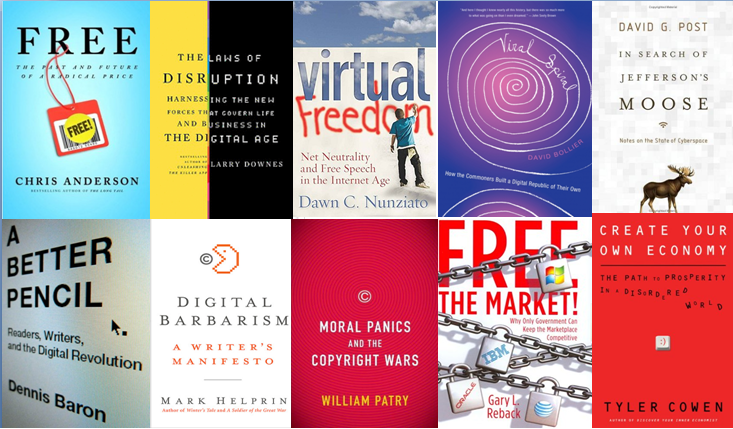 First, let me repeat a few of the same caveats and disclaimers that I set forth last year. What qualifies as an “important” info-tech policy book? Simply put, it’s a title that many people are currently discussing and that we will likely be referencing for many years to come. However, I want to be clear that merely because a book appears on my list it does not necessarily mean I agree with everything said in it. In fact, as was the case in previous years, I found much with which to disagree in my picks for the most important books of 2009 and I find that the cyber-libertarianism I subscribe to has very few fans out there.
Another caveat: Narrowly-focused titles lose a few points on my list. For example, if a book deals mostly with privacy issues, copyright law, or antitrust policy, it does not exactly qualify as the same sort of “tech policy book” as other titles found on this list since it is a narrow exploration of just one set of issues with a bearing on technology policy.
With those caveats in mind, here are my choices for the Most Important Info-Tech Policy Books of 2009. Continue reading →
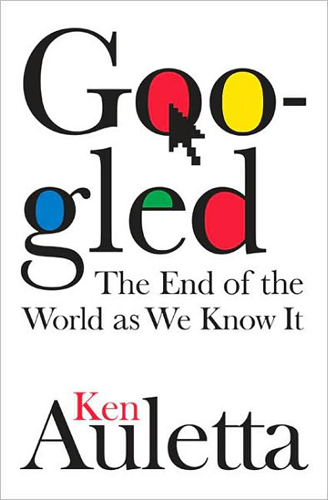 I just finished Ken Auletta’s latest book,
Googled: The End of the World As We Know It, and I highly recommend it. Auletta is an amazingly gifted journalist and knows how put together a hell of good story. It helps in this case that he was granted unprecedented access to the Google team and their day-to-day workings at the Googleplex. I’m really shocked by the level of access he was granted to important meetings and officials–over 150 interviews with Googlers, including 11 with CEO Eric Schmidt and several with founders Sergey Brin and Larry Page. That’s impressive.
I just finished Ken Auletta’s latest book,
Googled: The End of the World As We Know It, and I highly recommend it. Auletta is an amazingly gifted journalist and knows how put together a hell of good story. It helps in this case that he was granted unprecedented access to the Google team and their day-to-day workings at the Googleplex. I’m really shocked by the level of access he was granted to important meetings and officials–over 150 interviews with Googlers, including 11 with CEO Eric Schmidt and several with founders Sergey Brin and Larry Page. That’s impressive.
The book shares much in common with Randall Stross’s excellent Planet Google: One Company’s Audacious Plan to Organize Everything We Know, which I reviewed here earlier this year. Both books recount the history of Google from its early origins to present. And both survey a great deal of ground in terms of the challenges that Google faces as it matures and the policy issues that are relevant to the company (privacy, free speech, copyright law, etc).
What makes Auletta’s book unique is the way we taps his extensive “old media” world contacts and integrates such a diverse cast of characters into the narrative — Mel Karmazin (former Viacom, now Sirius XM), Bob Iger (Disney), Howard Stringer (Sony), Martin Sorrrell (WPP), Irwin Gotlieb (Group M), and even the Internet’s “inventor”–Al Gore! Auletta interviews them or recounts stories about their interactions with Google to show the growing tensions being created by this disruptive company and its highly disruptive technologies. There are some terrifically entertaining anecdotes in the book, but the bottom line is clear: Google has made a lot of enemies in a very short time.
Indeed, the book is as much about the decline of old media as it is about Google’s ascendancy. What Auletta has done so brilliantly here is to tell their stories together and ask how much old media’s recent woes can be blamed on Google and digital disintermediation in general. “If Google is destroying or weakening old business models,” Auletta argues, “it is because the Internet inevitably destroys old ways of doing things, spurs ‘creative destruction.’ This does not mean that Google is not ambitious to grow, and will not grow at the expense of others. But the rewards, and the pain, are unavoidable,” he concludes. Continue reading →
I’ve just released a new PFF white paper looking at the hysteria that has often accompanied major media mergers and then taking a look at the marketplace reality years after the fact. Here‘s the PDF, but I have also pasted the entire thing down below.
_____________________________
A Brief History of Media Merger Hysteria:
From AOL-Time Warner to Comcast-NBC
by Adam Thierer
Although the pending union of Comcast and NBC Universal has not yet made it to the altar, Chicken Little-esque wails about the marriage have already begun in earnest. For example, the pro-regulatory media organization Free Press has already set up a website to complain about the deal.[1] And Jeff Chester, executive director of the Center for Digital Democracy, has called it “an unholy marriage.”[2] The fever only promises to spread once the deal is formally announced, and a lengthy fight over the deal is expected at the Federal Communications Commission (FCC) and whichever antitrust agency reviews the deal.[3]
But reality tends to play out somewhat less dramatically than the script penned by the media worrywarts. It’s worth looking back at some of the more prominent examples of media merger hysteria in recent years to understand why such panic is unwarranted, and why a deal between Comcast and NBC Universal is unlikely to lead to the sort of problems that the pessimists suggest.[4] Continue reading →
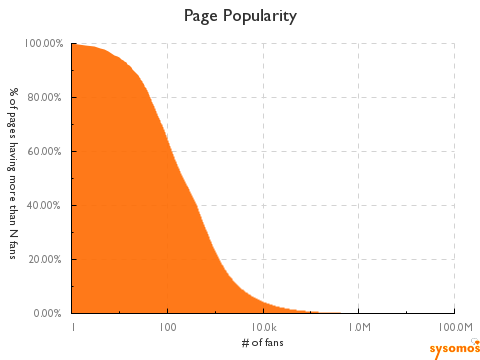 Perfect media equality is impossible. There has never been anything close to “equal outcomes” when it comes to the distribution or relative success of old media: books, magazines, music, movies, book, theater tickets, etc. A small handful of titles have always dominated, usually according to a classic “power law” or “80-20? distribution, with roughly 20% of the titles getting 80% of the traffic / revenue.
But here’s the really interesting thing:
This trend is increasing, not decreasing, for newer and more “democratic” online media. As I pointed out in two previous essays [“YouTube, Power Laws & the Persistence of Media Inequality” & “Cuban on Fragmentation & Attention in the Blogosphere (or Why Power Laws Really Do Govern All Media)”], there is solid evidence that blogs, YouTube, Twitter, and other digital media outlets and platforms not only follow a classic power law distribution but that the distribution is even more heavily skewed toward the “fat head” of the distribution curve, not “the long tail” of it.
The latest evidence of the persistence of power laws across media comes from Facebook. Erick Schonfeld has a new essay up at TechCrunch (“It’s Not Easy Being Popular. 77 Percent Of Facebook Fan Pages Have Under 1,000 Fans“) highlighting some new findings from an upcoming report by Sysomos, a social media monitoring and analytics firm. Here’s the summary from Schonfeld: Continue reading →
Yo people, help me build this list of the best Internet and digital technology (“Info-Tech”) policy reporters on Twitter:
http://twitter.com/AdamThierer/infotech-policy-reporters/members
I’m trying to make sure I’m following the best reporters out there who cover public policy developments related to the Internet, cyberlaw, digital media, and so on. I’ve got just under 50 reporters on there currently, but I’m sure I’m missing some. I would love to get some other suggestions about who is missing from my list, and I encourage others to follow my list if they find it a useful way to keep track of some of the best reporters on this beat.
Incidentally, I do understand it is hard to define exactly who counts as a “reporter” these days, but my general rule of thumb here is that (I think) almost everybody on my list actually gets paid to write about these issues. In other words, I kept tech policy bloggers off this list. There’s just too many of them to count.
 I very much enjoyed Dennis Baron’s new book, A Better Pencil: Readers, Writers, and the Digital Revolution, and highly recommend you pick it up. Baron does a wonderful job exploring the history of techno-pessimism and the endless battles about the impact of new technologies on life and learning, something I have written about here before in my essays on “Internet optimists vs. pessimists” (See: 1, 2, 3).
I have a complete review of Baron’s
A Better Pencil now up on the City Journal‘s website here. I’ve also pasted it down below.
Plato Wrote it Down
by Adam Thierer
a review of A Better Pencil: Readers, Writers, and the Digital Revolution, by Dennis Baron (Oxford University Press, 280 pp., $24.95)
In the beginning, Dennis Baron reminds us in his new book,
A Better Pencil, there was the word—the spoken word, that is. Oral tradition, the passing of knowledge through stories and lectures, was the primary method of instruction and learning throughout early human civilization. But then a few innovative souls decided to start writing everything down on stones and clay. Almost as soon as they did, a great debate began on the impact of new communications technology on culture and education. And it rages on today, with a new generation of optimists and skeptics battling over the impact that computing, the Internet, and digital technologies have on our lives and on how we learn about the world.
Continue reading →
Today I was invited to the Federal Communications Commission (FCC) to testify at one of the agency’s Broadband Working Group workshops. This particular workshop was on “Broadband Consumer Context,” which focused on “a range of challenges and opportunities as the internet becomes a focal point for commercial transactions, social networking, and a host of activities pertaining to information gathering and exchange.”
I was asked to address the issue of whether there is a relationship between online safety concerns and broadband uptake. In my testimony, I noted that, in my 15 years of research in this area, I have never unearthed any substantive empirical evidence suggesting a correlation between parental concerns about online activity and overall household broadband uptake. I have seen occasional anecdotal news stories discussing the concerns some parents have had about their kids online that led them to reject online connectivity, but these stories have been exceedingly rare (and I haven’t seen any in recent memory).
I also argued that I did not think it at all surprising that such anecdotes are harder to find, or that empirical evidence on this front seems non-existent. I argued that there were four logical explanations for why parental concerns about online safety haven’t “moved the broadband needle” much in the negative direction:
- Not every home has children present
- Parents use a variety of household media rules to control media & Internet usage
- A vibrant marketplace of parental control technologies exists
- Likely that most parents believe that the benefits of broadband outweigh the potential downsides
For all the details on each of those, read my entire testimony or check out the presentation embedded below that I made to the FCC today. Continue reading →

 The Technology Liberation Front is the tech policy blog dedicated to keeping politicians' hands off the 'net and everything else related to technology.