Posts tagged as:

Vivek Wadhwa, who is affiliated with Harvard Law School and is director of research at Duke University’s Center for Entrepreneurship, has a terrific column in today’s Washington Post warning of the dangers of government trying to micromanage high-tech innovation and the Digital Economy from above.

For reasons I have never been able to understand, the Washington Post uses different headlines for its online opeds versus its print edition. That’s a shame, because while I like the online title of Wadhwa’s essay, “Uncle Sam’s Choke-Hold on Innovation,” the title in the print edition is better: “Google, Twitter and the Best Regulator.” By “best regulator” Wadhwa means the marketplace, and this is a point we have hammered on here at the TLF relentlessly: Contrary to what some critics suggest, the best regulator of “market power” is the market itself because of the way it punishes firms that get lethargic, anti-innovative, or just plain cocky. Wadhwa notes:

The technology sector moves so quickly that when a company becomes obsessed with defending and abusing its dominant market position, countervailing forces cause it to get left behind. Consider: The FTC spent years investigating IBM and Microsoft’s anti-competitive practices, yet it wasn’t government that saved the day; their monopolies became irrelevant because both companies could not keep pace with rapid changes in technology — changes the rest of the industry embraced. The personal-computer revolution did IBM in; Microsoft’s Waterloo was the Internet. This — not punishment from Uncle Sam — is the real threat to Google and Twitter if they behave as IBM and Microsoft did in their heydays.

Continue reading →

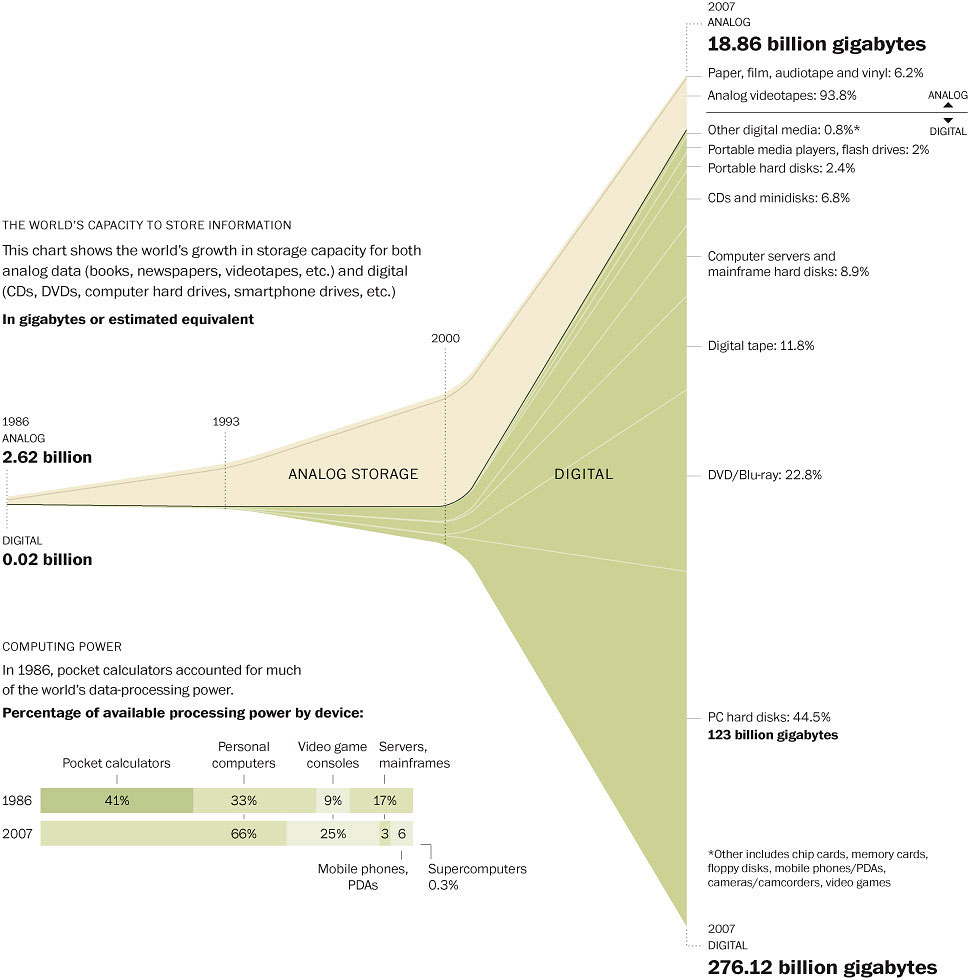
Here’s an amazing graphic that appeared in today’s Washington Post depicting how digital information has grown exploded over the past two decades. It’s better viewed on a large monitor from this link on the Post website. And here’s the accompanying Post article. The underlying data come from a new study by Martin Hilbert and Priscila Lopez of the University of Southern California, which is entitled, “The World’s Technological Capacity to Store, Communicate, and Compute Information.” It appears in the latest issue of Science but is not available without a subscription.

This is the second of two essays making “The Case for Internet Optimism.” This essay was included in the book, The Next Digital Decade: Essays on the Future of the Internet (2011), which was edited by Berin Szoka and Adam Marcus of TechFreedom. In my previous essay, which I discussed here yesterday, I examined the first variant of Internet pessimism: “Net Skeptics,” who are pessimistic about the Internet improving the lot of mankind. In this second essay, I take on a very different breed of Net pessimists:  “Net Lovers” who, though they embrace the Net and digital technologies, argue that they are “dying” due to a lack of sufficient care or collective oversight.  In particular, they fear that the “open” Internet and “generative” digital systems are giving way to closed, proprietary systems, typically run by villainous corporations out to erect walled gardens and quash our digital liberties.  Thus, they are pessimistic about the long-term survival of the Internet that we currently know and love.

Leading exponents of this theory include noted cyberlaw scholars Lawrence Lessig, Jonathan Zittrain, and Tim Wu.  I argue that these scholars tend to significantly overstate the severity of this problem (the supposed decline of openness or generativity, that is) and seem to have very little faith in the ability of such systems to win out in a free market. Moreover, there’s nothing wrong with a hybrid world in which some “closed” devices and platforms remain (or even thrive) alongside “open” ones. Importantly, “openness” is a highly subjective term, and a constantly evolving one.  And many “open” systems or devices are as perfectly open as these advocates suggest.

Finally, I argue that it’s likely that the “openness” advocated by these advocates will devolve into expanded government control of cyberspace and digital systems than that unregulated systems will become subject to “perfect control” by the private sector, as they fear.  Indeed, the implicit message in the work of all these hyper-pessimistic critics is that markets must be steered in a more sensible direction by those technocratic philosopher kings (although the details of their blueprint for digital salvation are often scarce).   Thus, I conclude that the dour, depressing “the-Net-is-about-to-die” fear that seems to fuel this worldview is almost completely unfounded and should be rejected before serious damage is done to the evolutionary Internet through misguided government action.

I’ve embedded the entire essay down below in Scribd reader, but it can also be found on TechFreedom’s Next Digital Decade book website and SSRN.

Continue reading →

Here’s the first of two essays I’ve recently penned making “The Case for Internet Optimism.” This essay was included in the book, The Next Digital Decade: Essays on the Future of the Internet (2011), which was edited by Berin Szoka and Adam Marcus of TechFreedom.  In these essays, I identify two schools of Internet pessimism: (1) “Net Skeptics,” who are pessimistic about the Internet improving the lot of mankind; and (2) “Net Lovers,” who appreciate the benefits the Net brings society but who fear those benefits are disappearing, or that the Net or openness are dying.  (Regular readers of this blog will be familiar with these themes since I sketched them out in previous essays here such as, “Are You an Internet Optimist or Pessimist?” and “Two Schools of Internet Pessimism.”) The second essay is here.

This essay focuses on the first variant of Internet pessimism, which is rooted in general skepticism about the supposed benefits of cyberspace, digital technologies, and information abundance. The proponents of this pessimistic view often wax nostalgic about some supposed “good ‘ol days” when life was much better (although they can’t seem to agree when those were). At a minimum, they want us to slow down and think twice about life in the Information Age and how it’s personally affecting each of us.  Occasionally, however, this pessimism borders on neo-Ludditism, with some proponents recommending steps to curtail what they feel is the destructive impact of the Net or digital technologies on culture or the economy.  I identify the leading exponents of this view of Internet pessimism and their major works. I trace their technological pessimism back to Plato but argue that their pessimism is largely unwarranted. Humans are more resilient than pessimists care to admit and we learn how to adapt to technological change and assimilate new tools into our lives over time. Moreover, were we really better off in the scarcity era when we were collectively suffering from information poverty?  Generally speaking, despite the challenges it presents society, information abundance is a better dilemma to be facing than information poverty.  Nonetheless, I argue, we should not underestimate or belittle the disruptive impacts associated with the Information Revolution.  But we need to find ways to better cope with turbulent change in a dynamist fashion instead of attempting to roll back the clock on progress or recapture “the good ‘ol days,” which actually weren’t all that good.

Down below, I have embedded the entire chapter in a Scribd reader, but the essay can also be found on the TechFreedom website for the book as well as on SSRN.  I have also includes two updated tables that appeared in my old “optimists vs. pessimists” essay.  The first lists some of the leading Internet optimists and pessimists and their books. The second table outlines some of the major lines of disagreement between these two camps and I divided those disagreements into (1) Cultural / Social beliefs vs. (2) Economic / Business beliefs.

Continue reading →

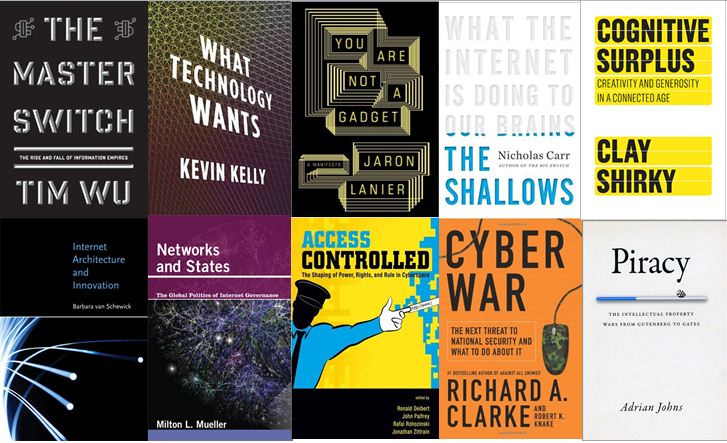
Wow, what a year for cyberlaw and information technology policy books!  Both in terms of number of titles and the gravity of the books released, 2010 was one of the biggest years of the past decade (perhaps matched only by 2006 or 2008 in terms of significance).  So, here’s my annual list of the Most Important Info-Tech Policy Books of 2010.

First, however, as is the case each year [see my 2008 & 2009 lists], I need to repeat a few disclaimers.  First, what qualifies as an “important” info-tech policy book is highly subjective, but I would define it as a title that many people — especially scholars in the field — are currently discussing and that we will likely be referencing for many years to come.  But I “weight” books in the sense that narrowly-focused titles lose a few points. For example, books that deal mostly with privacy issues, copyright law, or antitrust policy do not exactly qualify as the same sort of “info-tech policy book” as other titles that offer a broader exploration of policy issues / concerns. For that reason, “big picture” info-tech policy books tend to rank higher on my lists.

The second caveat: Merely because a book appears on my list it does not necessarily mean I agree with everything in it. In fact, as was the case in previous years, I found much with which to disagree in my picks for the most important books of 2010 and I find that the cyber-libertarianism I subscribe to has very few fans out there.

With those caveats in mind, here are my choices for the Most Important Info-Tech Policy Books of 2010. Continue reading →

By Adam Thierer & Berin Szoka

In a series of upcoming essays, we will be examining proposals being put forward today that would have the government play a greater role in sustaining struggling media enterprises, “saving journalism,” or promoting more “public interest” content. The reason we’re working up this multi-part series is because, with many traditional media operators struggling, and questions being raised about how journalism in particular will be supported in the future, Washington policymakers are currently considering what role government can and should play in helping media providers reinvent themselves in the face of tumultuous technological change wrought by the Digital Revolution.

For example, the Federal Communications Commission (FCC) recently kicked off a new “Future of Media” effort with a workshop on “Serving the Public Interest in the Digital Era.” (The  filing deadline for the FCC’s “Future of Media” proceeding is May 7th).  Likewise, the Federal Trade Commission (FTC) has hosted two workshops asking “How Will Journalism Survive the Internet Age?”  Meanwhile, the Senate has already held hearings about “the future of journalism,” and Senator Benjamin L. Cardin (D-MD) recently introduced the “Newspaper Revitalization Act,” which would allow newspapers to become tax-exempt non-profits in an effort to help them stay afloat.

Thus, in light of Washington’s sudden interest in the future of media and journalism, we will be taking a hard look at several issues and proposals that are being floated today, including:

  • Taxes on media devices, mobile phones, or broadband bills to channel money to media enterprises / content;
  • Taxes / fees on broadcasters to funnel support to their public sector competitors or to public interest programs;
  • “News vouchers” or “public interest vouchers” that would encourage citizens to channel support to media providers;
  • Taxes on private advertising to subsidize non-commercial / public media content;
  • Expanded postal subsidies for media mail; and
  • Targeted welfare programs for out-of-work journalists or corporate welfare in the form of bailouts for failing media enterprises.

You won’t be surprised to hear that we are generally quite skeptical of most of these ideas, but we promise to give each one serious consideration.  We’ll kick things off tomorrow with our essay on why taxing media devices or distribution systems to fund media content is not a particularly good idea.

Very cool little video here by Jess3 documenting Internet growth and activity. Ironically, Berin sent it to me as Adam Marcus and I were updating the lengthy list of Net & online media stats you’ll find down below. Many of the stats we were compiling are shown in the video. Enjoy!

http://vimeo.com/moogaloop.swf?clip_id=9641036&server=vimeo.com&show_title=1&show_byline=1&show_portrait=1&color=ffffff&fullscreen=1
  • 1.73 billion Internet users worldwide as of Sept 2009; an 18% increase from the previous year. [1]
  • 81.8 million .COM domain names at the end of 2009; 12.3 million .NET names & 7.8 million .ORG names. [2]
  • 234 million websites as of Dec 2009; 47 million were added in 2009. [3] In 2006, Internet users in the United States viewed an average of 120.5 Web pages each day. [4]
  • There are roughly 26 million blogs on the Internet [5] and even back in 2007, there were over 1.5 million new blog posts every day (17 posts per second). [6] Continue reading →

Harvard Berkman Center professor Jonathan Zittrain has published another pessimistic, Steve-Jobs-is-Taking-Us-Straight-To-Cyber-Hell editorial building on the gloomy thesis he set forth in his 2008 book, The Future of the Internet and How to Stop It. His latest piece appears in the Financial Times and it’s entitled, “A Fight over Freedom at Apple’s Core. Concerning the recent Apple iPad announcement, Zittrain warns: “Mr Jobs ushered in the personal computer era and now he is trying to usher it out.”

I’m not going to go into yet another lengthy dissertation about what it so misguided about his thesis that cyberspace is becoming more “regulable” and that digital “generativity” is dying because of the rise of devices like the iPhone & iPad, or sites like Facebook.  Instead, I will just point you to the many things I’ve written before explaining just how far off the mark Prof. Zittrain is on this point. [See the complete list down below + video of our debate.]

But let me just say this… Ignoring that fact that he is an iPhone user himself — which makes no sense considering that he thinks of Apple as the font of all cyber-evil — he can’t muster any substantive empirical evidence proving that the Net and digital devices are being more “closed, sterile, and tethered,” as he repeatedly claims in his book and editorials.  And that’s not surprising because the reality is that the digital world is more open and generative than ever, and even if there are some “closed” devices and systems out there, they are actually quite innovative and not perfectly closed as Zittrain suggests. The spectrum of “open vs. closed” systems and devices is incredible diverse and nothing is perfectly “open” or “closed.”  We can have the best of both worlds: many open systems with some partial “walled gardens” here and there (or hybrid systems combining both). Regardless, we are witnessing greater digital “generativity” and innovation with each passing year. Until Zittrain can prove the opposite, his thesis must be considered a failure.

Finally, I want to associate myself with this excellent critique of the Zittrain thesis by Prof. Ed Felten, who points out that Zittrain’s argument doesn’t even work for the iPad, which I would agree is a fairly “closed appliance” in the Zittrainian scheme of the things:

Continue reading →

[I’ve been working on an outline for a book I hope to write surveying technological skepticism throughout history. I first started thinking about this topic two years when I noticed that a great number of recent books about Internet policy could generally be grouped into one of two camps: Internet optimists vs. Internet pessimists. I subsequently penned an essay on the subject that generated a fair bit of attention. So, I figured I must be on to something, and the more Net policy books I read, the more I realized that the divisions between these two camps were growing wider and increasingly heated. Thus, I thought I would share this very rough draft (much of it still in outline form) of the opening chapter of that book I want to write about this great intellectual war over the impact of technology on society. I invite reader input. Update Jan. 2011: I finally published a full-length essay on this topic. You can find it here. ]

__________

The impact of technological change on culture, learning, and morality has long been the subject of intense debate, and every technological revolution brings out a fresh crop of both pessimists and pollyannas. Indeed, a familiar cycle has repeat itself throughout history whenever new modes of production (from mechanized agriculture to assembly-line production), means of transportation (water, rail, road, or air), energy production processes (steam, electric, nuclear), medical breakthroughs (vaccination, surgery, cloning), or communications techniques (telegraph, telephone, radio, television) have appeared on the scene.

The cycle goes something like this. A new technology appears. Those who fear the sweeping changes brought about by this technology see a sky that is about to fall. These “techno-pessimists” predict the death of the old order (which, ironically, is often a previous generation’s hotly-debated technology that others wanted slowed or stopped).  Embracing this new technology, they fear, will result in the overthrow of traditions, beliefs, values, institutions, business models, and much else they hold sacred.

The pollyannas, by contrast, look out at the unfolding landscape and see mostly rainbows in the air. Theirs is a rose-colored world in which the technological revolution du jour is seen as improving the general lot of mankind and bringing about a better order.  If something has to give, then the old ways be damned! For such “techno-optimists,” progress means some norms and institutions must adapt—perhaps even disappear—for society to continue its march forward.

Our current Information Revolution is no different. It too has its share of techno-pessimists and techno-optimists. Indeed, before most of us had even heard of the Internet, people were already fighting about it—or at least debating what the rise of the Information Age meant for our culture, society, and economy. Continue reading →

by Adam Thierer & Berin Szoka, Progress Snaphot 6.1

Stephanie Clifford of the  New York Times posted a very interesting article this week summarizing a recent “on-the-record chat” the Times staff had with Federal Trade Commission (FTC) chairman Jon Leibowitz and FTC Bureau of Consumer Protection chief David Vladeck.  The interview [discussed by Braden here] is profoundly important in that it reveals an alarming disconnect regarding the relationship between “privacy” regulation and the future of media, which were the subjects of their discussion with Times staff.  Namely, Leibowitz and Vladeck apparently fail to appreciate how the delicate balance between commercial advertising and journalism is at risk precisely because of the sort of regulations they apparently are ready to adopt.  Because the value of online advertising depends on data about its effectiveness and consumers’ likely interests, and because advertising is indispensable to funding media, what’s ultimately at stake here is nothing short of the future of press freedom.

The “Day of Reckoning” Is Upon Us

Leibowitz and Vladeck spend the first half of The Times interview wringing their hands about “privacy policies,” the declarations made by websites and advertising networks about their data collection and use practices (for which the FTC can and must hold them accountable).  But the two feel that privacy policies don’t adequately inform consumers.  Chairman Leibowitz claims that online companies “haven’t given consumers effective notice, so they can make effective choices.”  And Mr. Vladeck states that advise-and-consent models “depended on the fiction that people were meaningfully giving consent.” But he and the FTC seem ready to abandon the notice and choice model because the “literature is clear” that few people read privacy policies, Vladeck told the Times.  He and Leibowitz continue:

“Philosophically, we wonder if we’re moving to a post-disclosure era and what that would look like,” Mr. Vladeck said. “What’s the substitute for it?” He said the commission was still looking into the issue, but it hoped to have an answer by June or July, when it plans to publish a report on the subject. Mr. Leibowitz gave a hint as to what might be included: “I have a sense, and it’s still amorphous, that we might head toward opt-in,” Mr. Leibowitz said.

This clearly foreshadows the regulatory endgame we have long suspected was coming.  When the FTC released its “Self-Regulatory Principles for Online Behavioral Advertising” eleven months ago, we asked: “What’s the Harm & Where Are We Heading?”  Their answers to both questions have become clearer with each new calculated comment—all apparently intended to slowly “turn up the heat” on the advertising industry so that the proverbial frog will stay in the pot until the water finally boils.  Leibowitz’s FTC has simply dodged the “harm” question with a four-part strategy: Continue reading →