Adam Thierer, Senior Research Fellow at the Mercatus Center discusses his recent working paper with coauthor Brent Skorup, A History of Cronyism and Capture in the Information Technology Sector. Thierer takes a look at how cronyism has manifested itself in technology and media markets — whether it be in the form of regulatory favoritism or tax privileges. Which tech companies are the worst offenders? What are the consequences for consumers? And, how does cronyism affect entrepreneurship over the long term?
Ian Brown and Christopher T. Marsden’s new book, Regulating Code: Good Governance and Better Regulation in the Information Age, will go down as one of the most important Internet policy books of 2013 for two reasons. First, their book offers an excellent overview of how Internet regulation has unfolded on five different fronts: privacy and data protection; copyright; content censorship; social networks and user-generated content issues; and net neutrality regulation. They craft detailed case studies that incorporate important insights about how countries across the globe are dealing with these issues. Second, the authors endorse a specific normative approach to Net governance that they argue is taking hold across these policy arenas. They call their preferred policy paradigm “prosumer law” and it envisions an active role for governments, which they think should pursue “smarter regulation” of code.
In terms of organization, Brown and Marsden’s book follows the same format found in Milton Mueller’s important 2010 book Networks and States: The Global Politics of Internet Governance; both books feature meaty case studies in the middle bookended by chapters that endorse a specific approach to Internet policymaking. (Incidentally, both books were published by MIT Press.) And, also like Mueller’s book, Brown and Marsden’s Regulating Code does a somewhat better job using case studies to explore the forces shaping Internet policy across the globe than it does making the normative case for their preferred approach to these issues. Continue reading →
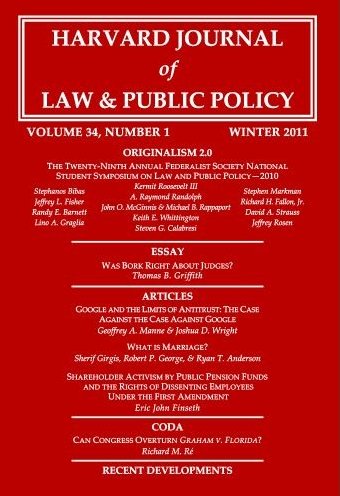
I’m excited to announce the release of my latest law review article, “The Pursuit of Privacy in a World Where Information Control is Failing,” which appears in the next edition (vol. 36) of the Harvard Journal of Law & Public Policy. This is the first of two complimentary law review articles that I will be releasing this year dealing with privacy policy. The second, which will be published later this summer by the George Mason University Law Review, is entitled, “A Framework for Benefit-Cost Analysis in Digital Privacy Debates.” (FYI: Both articles focus on privacy claims made against private actors — namely, efforts to limit private data collection — and not on privacy rights against governments.)
The new
Harvard Journal article is divided into three major sections. Part I focuses on some of normative challenges we face when discussing privacy and argues that there may never be a widely accepted, coherent legal standard for privacy rights or harms here in the United States. It also explores the tensions between expanded privacy regulation and online free speech. Part II turns to the many enforcement challenges that are often ignored when privacy policies are being proposed or formulated and argues that legislative and regulatory efforts aimed at protecting privacy must now be seen as an increasingly intractable information control problem. Most of the problems policymakers and average individuals face when it comes to controlling the flow of private information online are similar to the challenges they face when trying to control the free flow of digitalized bits in other information policy contexts, such as online safety, cybersecurity, and digital copyright.
If the effectiveness of law and regulation is limited by the normative considerations discussed in Part I and the practical enforcement complications discussed in Part II, what alternatives remain to assist privacy-sensitive individuals? I address that question in Part III of the paper and argue that the approach America has adopted to deal with concerns about objectionable online speech and child safety offers a path forward on the privacy front as well. Continue reading →
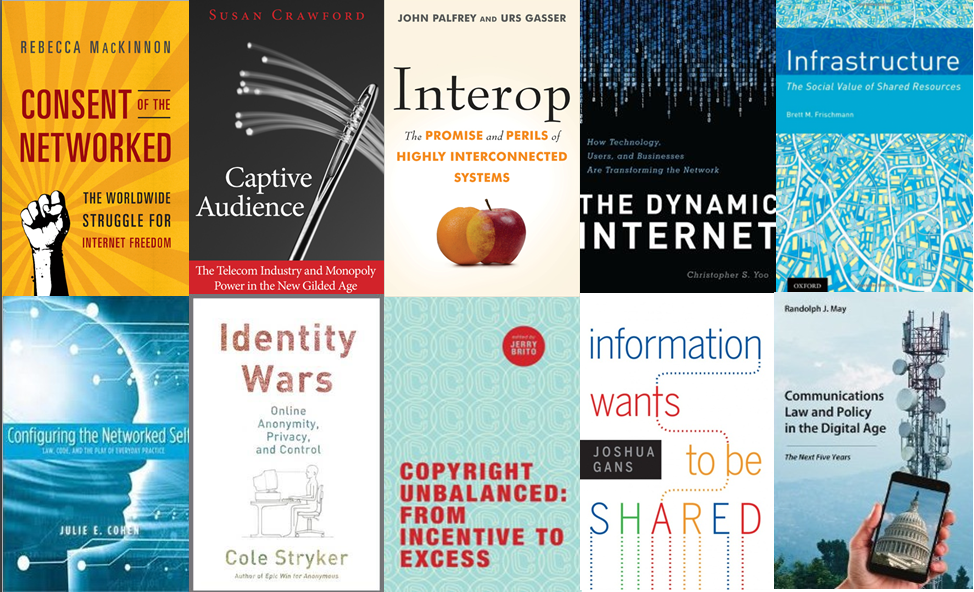
The number of major cyberlaw and information tech policy books being published annually continues to grow at an astonishing pace, so much so that I have lost the ability to read and review all of them. In past years, I put together end-of-year lists of important info-tech policy books (here are the lists for 2008, 2009, 2010, and 2011) and I was fairly confident I had read just about everything of importance that was out there (at least that was available in the U.S.). But last year that became a real struggle for me and this year it became an impossibility. A decade ago, there was merely a trickle of Internet policy books coming out each year. Then the trickle turned into a steady stream. Now it has turned into a flood. Thus, I’ve had to become far more selective about what is on my reading list. (This is also because the volume of journal articles about info-tech policy matters has increased exponentially at the same time.)
So, here’s what I’m going to do. I’m going to discuss what I regard to be the five most important titles of 2012, briefly summarize a half dozen others that I’ve read, and then I’m just going to list the rest of the books out there. I’ve read most of them but I have placed an asterisk next to the ones I haven’t. Please let me know what titles I have missed so that I can add them to the list. (Incidentally, here’s my compendium of all the major tech policy books from the 2000s and here’s the running list of all my book reviews.)
Here’s a presentation I delivered on “The War on Vertical Integration in the Digital Economy” at the latest meeting of the Southern Economic Association this weekend. It outlines concerns about vertical integration in the tech economy and specifically addresses regulatory proposals set forth by Tim Wu (arguing for a “separations principle” for the tech economy) & Jonathan Zittrain (arguing for “API neutrality” for social media and digital platforms). This presentation is based on two papers published by the Mercatus Center at George Mason University: “Uncreative Destruction: The Misguided War on Vertical Integration in the Information Economy” (with Brent Skorup) & “The Perils of Classifying Social Media Platforms as Public Utilities.”
Is competition really a problem in the tech industry? That was the question the folks over at WebProNews asked me to come on their show and discuss this week. I offer my thoughts in the following 15-minute clip. Also, down below I have embedded a few of my recent relevant essays on this topic, a few of which I mentioned during the show.
I’m pretty rough on all the Internet and info-tech policy books that I review. There are two reasons for that. First, the vast majority of tech policy books being written today should never have been books in the first place. Most of them would have worked just fine as long-form (magazine-length) essays. Too many authors stretch a promising thesis into a long-winded, highly repetitive narrative just to say they’ve written an entire book about a subject. Second, many info-tech policy books are poorly written or poorly argued. I’m not going to name names, but I am frequently unimpressed by the quality of many books being published today about digital technology and online policy issues.
The books of Harvard University cyberlaw scholars John Palfrey and Urs Gasser offer a welcome break from this mold. Their recent books, Born Digital: Understanding the First Generation of Digital Natives, and Interop: The Promise and Perils of Highly Interconnected Systems, are engaging and extremely well-written books that deserve to be books. There’s no wasted space or mindless filler. It’s all substantive and it’s all interesting. I encourage aspiring tech policy authors to examine their works for a model of how a book should be done.
In a 2008 review, I heaped praise on Born Digital and declared that this “fine early history of this generation serves as a starting point for any conversation about how to mentor the children of the Web.” I still recommend highly to others today. I’m going to be a bit more critical of their new book, Interop, but I assure you that it is a text you absolutely must have on your shelf if you follow digital policy debates. It’s a supremely balanced treatment of a complicated and sometimes quite contentious set of information policy issues.
In the end, however, I am concerned about the open-ended nature of the standard that Palfrey and Gasser develop to determine when government should intervene to manage or mandate interoperability between or among information systems. I’ll push back against their amorphous theory of “optimal interoperability” and offer an alternative framework that suggests patience, humility, and openness to ongoing marketplace experimentation as the primary public policy virtues that lawmakers should instead embrace. Continue reading →
Yesterday on TechCrunch, Josh Constine posted an interesting essay about how some in the press were “Selling Digital Fear” on the privacy front. His specific target was The Wall Street Journal, which has been running an ongoing investigation of online privacy issues with a particular focus on online apps. Much of the reporting in their “What They Know” series has been valuable in that it has helped shine light on some data collection practices and privacy concerns that deserve more scrutiny. But as Constine notes, sometimes the articles in the WSJ series lack sufficient context, fail to discuss trade-offs, or do not identify any concrete harm or risk to users. In other words, some of it is just simple fear-mongering. Constine argues:
Reality has yet to stop media outlets from yelling about privacy, and because the WSJ writers were on assignment, they wrote the “Selling You On Facebook” hit piece despite thin findings. These kind of articles can make mainstream users so worried about the worst-case scenario of what could happen to their data, they don’t see the value they get in exchange for it. “Selling You On Facebook” does bring up the important topic of how apps can utilize personal data granted to them by their users, but it overstates the risks. Yes, the business models of Facebook and the apps on its platform depend on your personal information, but so do the services they provide. That means each user needs to decide what information to grant to who, and Facebook has spent years making the terms of this value exchange as clear as possible.
“While sensationalizing the dangers of online privacy sure drives page views and ad revenue,” Constine also noted, “it also impedes innovation and harms the business of honest software developers.” These trade-offs are important because, to the extent policymakers get more interested in pursing privacy regulations based on these fears, they could force higher prices or less innovation upon us with very little benefit in exchange.
Of course, the press generating hypothetical fears or greatly inflating dangers is nothing new. We have seen it happen many times in the past and it can be seen at work in many other fields today (online child safety is a good example). In my recent 80-page paper on “Technopanics, Threat Inflation, and the Danger of an Information Technology Precautionary Principle,” I discussed how and why the press and other players inflate threats and sell fear. Here’s a passage from my paper: Continue reading →
In this paper, I note that to the extent public utility-style regulation has been debated within the Internet policy arena over the past decade, the focus has been almost entirely on the physical layer of the Internet. The question has been whether Internet service providers should be considered “essential facilities” or “natural monopolies” and regulated as public utilities. The debate over “net neutrality” regulation has been animated by such concerns.
While that debate still rages, the rhetoric of public utilities and essential facilities is increasingly creeping into policy discussions about other layers of the Internet, such as the search layer. More recently, there have been rumblings within academic and public policy circles regarding whether social media platforms, especially social networking sites, might also possess public utility characteristics. Presumably, such a classification would entail greater regulation of those sites’ structures and business practices.
Proponents of treating social media platforms as public utilities offer a variety of justifications for regulation. Amorphous “fairness” concerns animate many of these calls, but privacy and reputational concerns are also frequently mentioned as rationales for regulation. Proponents of regulation also sometimes invoke “social utility” or “social commons” arguments in defense of increased government oversight, even though these notions lack clear definition.
Social media platforms do not resemble traditional public utilities, however, and there are good reasons why policymakers should avoid a rush to regulate them as such. Continue reading →
[UPDATE: 2/14/2013: As noted here, this paper was published by the Minnesota Journal of Law, Science & Technology in their Winter 2013 edition. Please refer to that post for more details and cite this final version of the paper going forward.]
Fear is an extremely powerful motivating force, especially in public policy debates where it is used in an attempt to sway opinion or bolster the case for action. Often, this action involves preemptive regulation based on false assumptions and evidence. Such fears are frequently on display in the Internet policy arena and take the form of full-blown “technopanic,” or real-world manifestations of this illogical fear. While it’s true that cyberspace has its fair share of troublemakers, there is no evidence that the Internet is leading to greater problems for society.
This paper considers the structure of fear appeal arguments in technology policy debates and then outlines how those arguments can be deconstructed and refuted in both cultural and economic contexts. Several examples of fear appeal arguments are offered with a particular focus on online child safety, digital privacy, and cybersecurity. The various factors contributing to “fear cycles” in these policy areas are documented.
To the extent that these concerns are valid, they are best addressed by ongoing societal learning, experimentation, resiliency, and coping strategies rather than by regulation. If steps must be taken to address these concerns, education and empowerment-based solutions represent superior approaches to dealing with them compared to a precautionary principle approach, which would limit beneficial learning opportunities and retard technological progress.
The complete paper can be found on the Mercatus site here, on SSRN, or on Scribd. I’ve also embedded it below in a Scribd reader. Continue reading →
The Technology Liberation Front is the tech policy blog dedicated to keeping politicians' hands off the 'net and everything else related to technology. Learn more about TLF →



 The Technology Liberation Front is the tech policy blog dedicated to keeping politicians' hands off the 'net and everything else related to technology.