The Obama Administration has just released a draft “Consumer Privacy Bill of Rights Act of 2015.” Generally speaking, the bill aims to translate fair information practice principles (FIPPs) — which have traditionally been flexible and voluntary guidelines — into a formal set of industry best practices that would be federally enforced on private sector digital innovators. This includes federally-mandated Privacy Review Boards, approved by the Federal Trade Commission, the agency that will be primarily responsible for enforcing the new regulatory regime.
Many of the principles found in the Administration’s draft proposal are quite sensible as best practices, but the danger here is that they could soon be converted into a heavy-handed, bureaucratized regulatory regime for America’s highly innovative, data-driven economy.
No matter how well-intentioned this proposal may be, it is vital to recognize that restrictions on data collection could negatively impact innovation, consumer choice, and the competitiveness of America’s digital economy.
Online privacy and security is vitally important, but we should look to use alternative and less costly approaches to protecting privacy and security that rely on education, empowerment, and targeted enforcement of existing laws. Serious and lasting long-term privacy protection requires a layered, multifaceted approach incorporating many solutions.
That is why flexible data collection and use policies and evolving best practices will ultimately serve consumers better than one-size-fits all, top-down regulatory edicts. Continue reading →
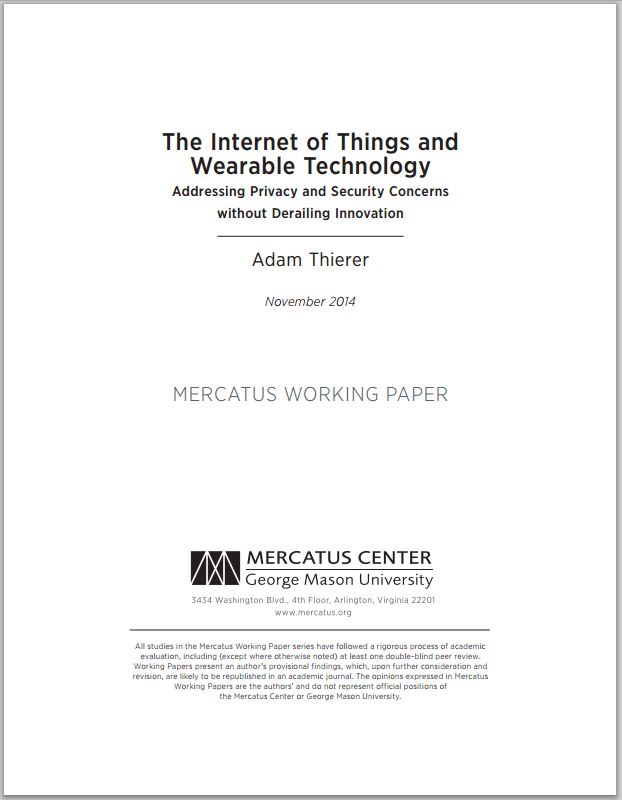 The Mercatus Center at George Mason University has just released my latest working paper, “The Internet of Things and Wearable Technology: Addressing Privacy and Security Concerns without Derailing Innovation.” The “Internet of Things” (IoT) generally refers to “smart” devices that are connected to both the Internet and other devices. Wearable technologies are IoT devices that are worn somewhere on the body and which gather data about us for various purposes. These technologies promise to usher in the next wave of Internet-enabled services and data-driven innovation. Basically, the Internet will be “baked in” to almost everything that consumers own and come into contact with.
Some critics are worried about the privacy and security implications of the Internet of Things and wearable technology, however, and are proposing regulation to address these concerns. In my new 93-page article, I explain why preemptive, top-down regulation would derail the many life-enriching innovations that could come from these new IoT technologies. Building on a recent book of mine, I argue that “permissionless innovation,” which allows new technology to flourish and develop in a relatively unabated fashion, is the superior approach to the Internet of Things.
As I note in the paper and my earlier book, if we spend all our time living in fear of the worst-case scenarios — and basing public policies on them — then best-case scenarios can never come about. As the old saying goes: nothing ventured, nothing gained. Precautionary principle-based regulation paralyzes progress and must be avoided. We instead need to find constructive, “bottom-up” solutions to the privacy and security risks accompanying these new IoT technologies instead of top-down controls that would limit the development of life-enriching IoT innovations. Continue reading →
On Thursday, it was my great pleasure to present a draft of my forthcoming paper, “The Internet of Things & Wearable Technology: Addressing Privacy & Security Concerns without Derailing Innovation,” at a conference that took place at the Federal Communications Commission on “Regulating the Evolving Broadband Ecosystem.” The 3-day event was co-sponsored by the American Enterprise Institute and the University of Nebraska College of Law.
The 65-page working paper I presented is still going through final peer review and copyediting, but I posted a very rough first draft on SSRN for conference participants. I expect the paper to be released as a Mercatus Center working paper in October and then I hope to find a home for it in a law review. I will post the final version once it is released. [UPDATE:The final version of this working paper was released on November 19, 2014.]
In the meantime, however, I thought I would post the 46 slides I presented at the conference, which offer an overview of the nature of the Internet of Things and wearable technology, the potential economic opportunities that exist in this space, and the various privacy and security challenges that could hold this technological revolution back. I also outlined some constructive solutions to those concerns. I plan to be very active on these issues in coming months.
Continue reading →
My latest law review article is entitled, “Privacy Law’s Precautionary Principle Problem,” and it appears in Vol. 66, No. 2 of the Maine Law Review. You can download the article on my Mercatus Center page, on the Maine Law Review website, or via SSRN. Here’s the abstract for the article:
Privacy law today faces two interrelated problems. The first is an
information control problem. Like so many other fields of modern cyberlaw—intellectual property, online safety, cybersecurity, etc.—privacy law is being challenged by intractable Information Age realities. Specifically, it is easier than ever before for information to circulate freely and harder than ever to bottle it up once it is released.
This has not slowed efforts to fashion new rules aimed at bottling up those information flows. If anything, the pace of privacy-related regulatory proposals has been steadily increasing in recent years even as these information control challenges multiply.
This has led to privacy law’s second major problem:
the precautionary principle problem. The precautionary principle generally holds that new innovations should be curbed or even forbidden until they are proven safe. Fashioning privacy rules based on precautionary principle reasoning necessitates prophylactic regulation that makes new forms of digital innovation guilty until proven innocent.
This puts privacy law on a collision course with the general freedom to innovate that has thus far powered the Internet revolution, and privacy law threatens to limit innovations consumers have come to expect or even raise prices for services consumers currently receive free of charge. As a result, even if new regulations are pursued or imposed, there will likely be formidable push-back not just from affected industries but also from their consumers.
In light of both these information control and precautionary principle problems, new approaches to privacy protection are necessary. Continue reading →
Last December, it was my pleasure to take part in a great event, “The Disruptive Competition Policy Forum,” sponsored by Project DisCo (or The Disruptive Competition Project). It featured several excellent panels and keynotes and they’ve just posted the video of the panel I was on here and I have embedded it below. In my remarks, I discussed:
- benefit-cost analysis in digital privacy debates (building on this law review article);
- the contrast between Europe and America’s approach to data & privacy issues (referencing this testimony of mine);
- the problem of “technopanics” in information policy debates (building on this law review article);
- the difficulty of information control efforts in various tech policy debates (which I wrote about in this law review article and these two blog posts: 1, 2);
- the possibility of less-restrictive approaches to privacy & security concerns (which I have written about here as well in those other law review articles);
- the rise of the Internet of Things and the unique challenges it creates (see this and this as well as my new book); and,
- the possibility of a splintering of the Internet or the rise of “federated Internets.”
The panel was expertly moderated by Ross Schulman, Public Policy & Regulatory Counsel for CCIA, and also included remarks from John Boswell, SVP & Chief Legal Officer at SAS, and Josh Galper, Chief Policy Officer and General Counsel of Personal, Inc. (By the way, you should check out some of the cool things Personal is doing in this space to help consumers. Very innovative stuff.) The video lasts one hour. Here it is:
Last week, it was my great pleasure to be invited on NPR’s “On Point with Tom Ashbrook,” to debate Jeffrey Rosen, a leading privacy scholar and the president and chief executive of the National Constitution Center. In an editorial in the previous Sunday’s New York Times (“Madison’s Privacy Blind Spot”), Rosen proposed “constitutional amendment to prohibit unreasonable searches and seizures of our persons and electronic effects, whether by the government or by private corporations like Google and AT&T.” He said his proposed amendment would limit “outrageous and unreasonable” collection practices and would even disallow consumers from sharing their personal information with private actors even if they saw an advantage in doing so.
I responded to Rosen’s proposal in an essay posted on the IAPP
Privacy Perspectives blog, “Do We Need A Constitutional Amendment Restricting Private-Sector Data Collection?” In my essay, I argued that there are several legal, economic, and practical problems with Rosen’s proposal. You can head over to the IAPP blog to read my entire response but the gist of it is that “a constitutional amendment [governing private data collection] would be too sweeping in effect and that better alternatives exist to deal with the privacy concerns he identifies.” There are very good reasons we treat public and private actors differently under the law and there “are all far more practical and less-restrictive steps that can be taken without resorting to the sort of constitutional sledgehammer that Jeff Rosen favors. We can protect privacy without rewriting the Constitution or upending the information economy,” I concluded.
But I wanted to elaborate on one particular thing I found particularly interesting about Rosen’s comments when we were on NPR together. During the show, Rosen kept stressing how we needed to adopt a more European construction of privacy as “dignity rights” and he even said his proposed privacy amendment would even disallow individuals from surrendering their private data or their privacy because he viewed these rights as “unalienable.” In other words, from Rosen’s perspective, privacy pretty much trumps
everything, even if you want to trade it off against other values. Continue reading →
 I’m pleased to announce the release of my latest law review article, “A Framework for Benefit-Cost Analysis in Digital Privacy Debates.” It appears in the new edition of the George Mason University Law Review. (Vol. 20, No. 4, Summer 2013)
This is the second of two complimentary law review articles I am releasing this year dealing with privacy policy. The first, “The Pursuit of Privacy in a World Where Information Control is Failing,” was published in Vol. 36 of the Harvard Journal of Law & Public Policy
this Spring. (FYI: Both articles focus on privacy claims made against private actors — namely, efforts to limit private data collection — and not on privacy rights against governments.)
My new article on benefit-cost analysis in privacy debates makes a seemingly contradictory argument: benefit-cost analysis (“BCA”) is extremely challenging in online child safety and digital privacy debates, yet it remains essential that analysts and policymakers attempt to conduct such reviews. While we will never be able to perfectly determine either the benefits or costs of online safety or privacy controls, the very act of conducting a regulatory impact analysis (“RIA”) will help us to better understand the trade-offs associated with various regulatory proposals. Continue reading →
It was my pleasure last night to take part in an hour-long conversation on “Privacy, Security, and the Digital Age,” which was co-sponsored by Mediaite and the Koch Institute. The discussion focused on a wide range of issues related to government surveillance powers, Big Data, and the future of privacy. It opened with dueling remarks from former U.S. Ambassador to the U.N. John Bolton and Ben Wizner of the ACLU. You can view their respective remarks here.
I then sat on a panel that included Atlantic Media CTO Tom Cochrane and Michael R. Nelson, who is affiliated with with Bloomberg Government and Georgetown University. The entire session was expertly moderated by Andrew Kirell of Mediaite. He did an amazing job facilitating the discussion. Anyway, the videos for my panel are below, split into two parts. My comments focused heavily on the importance of separating the government uses of data from private sector uses and explaining the need to create a high and tight firewall between State and Industry when it comes to information sharing. I also argued that we will never get a handle on government-related privacy concerns until we get control of the scope of government power. I used the example of the drug war and our government’s constantly-expanding militaristic activities both abroad and here at home. So long as government is expanding without any rational, constitutional constraint, we are going to have serious surveillance and privacy problems. (See this essay, “It’s About Power, not Privacy,” by my colleague Eli Dourado for more on that theme.)
Last month, it was my great pleasure to serve as a “provocateur” at the IAPP’s (Int’l Assoc. of Privacy Professionals) annual “Navigate” conference. The event brought together a diverse audience and set of speakers from across the globe to discuss how to deal with the various privacy concerns associated with current and emerging technologies.
My remarks focused on a theme I have developed here for years: There are no simple, silver-bullet solutions to complex problems such as online safety, security, and privacy. Instead, only a “layered” approach incorporating many different solutions–education, media literacy, digital citizenship, evolving society norms, self-regulation, and targeted enforcement of existing legal standards–can really help us solve these problems. Even then, new challenges will present themselves as technology continues to evolve and evade traditional controls, solutions, or norms. It’s a never-ending game, and that’s why education
must be our first-order solution. It better prepares us for an uncertain future. (I explained this approach in far more detail in this law review article.)
Anyway, if you’re interested in an 11-minute video of me saying all that, here ya go. Also, down below I have listed several of the recent essays, papers, and law review articles I have done on this issue.
Continue reading →
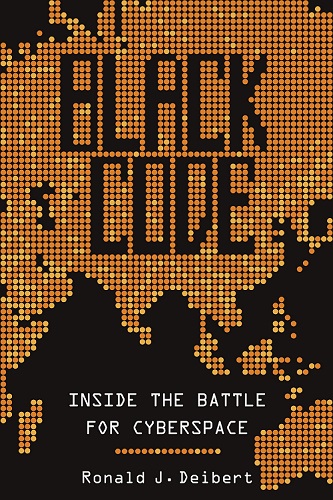
 Ronald J. Deibert is the director of The Citizen Lab at the University of Toronto’s Munk School of Global Affairs and the author of an important new book, Black Code: Inside the Battle for Cyberspace, an in-depth look at the growing insecurity of the Internet. Specifically, Deibert’s book is a meticulous examination of the “malicious threats that are growing from the inside out” and which “threaten to destroy the fragile ecosystem we have come to take for granted.” (p. 14) It is also a remarkably timely book in light of the recent revelations about NSA surveillance and how it is being facilitated with the assistance of various tech and telecom giants.
The clear and colloquial tone that Deibert employs in the text helps make arcane Internet security issues interesting and accessible. Indeed, some chapters of the book almost feel like they were pulled from the pages of techno-thriller, complete with villainous characters, unexpected plot twists, and shocking conclusions. “Cyber crime has become one of the world’s largest growth businesses,” Deibert notes (p. 144) and his chapters focus on many prominent recent examples, including cyber-crime syndicates like Koobface, government cyber-spying schemes like GhostNet, state-sanctioned sabotage like Stuxnet, and the vexing issue of zero-day exploit sales.
Deibert is uniquely qualified to narrate this tale not just because he is a gifted story-teller but also because he has had a front row seat in the unfolding play that we might refer to as “How Cyberspace Grew Less Secure.” Continue reading →

 The Technology Liberation Front is the tech policy blog dedicated to keeping politicians' hands off the 'net and everything else related to technology.