
Posts tagged as:

DroidSeems like everywhere I turn someone is gushing about their new Droid phone, including my TLF colleagues Berin Szoka, Braden Cox, and Ryan Radia, who all had great fun rubbing their new toys in my nose over the past couple of days. And why not, it’s a very cool little device.  It makes my HTC Touch seems positively archaic in some ways, and it’s only a year old.  Apparently, 100,000 people already picked up a Droid in just its first weekend on the market.

But here’s the first thing that pops in my mind every time I see someone showing off their new Droid: How can a device like this even exist when America’s leading cyberlaw experts have been telling us that the whole digital world is increasingly going to hell because of “closed” devices, proprietary code, and managed networks?  I’m speaking, of course, about the lamentations of Harvard professors Lawrence Lessig, Jonathan Zittrain, and their many disciples.  As faithful readers will recall, I have relentlessly hammered this crew for their unwarranted cyber-Chicken Little-ism and hyper techno-pessimism. (See my many battles with Zittrain [1, 2, 3, 4, 5, 6 + video] and my 2-part debate with Lessig earlier this year).

“Left to itself,” Lessig warned in Code, “cyberspace will become a perfect tool of control.”  He went on to forecast a dystopian future in which nefarious corporate schemers would quash our digital liberties unless benevolent public philosopher kings stepped in to save our poor souls. Code was the Old Testament of cyber-collectivism. The New Testament arrived last year with Zittrain’s The Future of the Internet and How to Stop It. In it, we hear the grim prediction that “sterile and tethered” digital technologies and networks will triumph over the more “open and generative” devices and systems of the past.  The iPhone and TiVo are cast as villains in Zittrain’s drama since they apparently represent the latest manifestations of Lessig’s “perfect control” paranoia.

Apple’s “Angel of Death”

How completely out-of-control has this thinking gotten?  Well, here’s David Weinberger — another Harvard Berkman Center worrywart — talking about that supposed satanic font of all evil, the Apple AppStore: Continue reading →

What Unites Advocates of Speech Controls & Privacy Regulation? [pdf]

by Adam Thierer & Berin Szoka The Progress & Freedom Foundation, Progress on Point No. 16.19

Anyone who has spent time following debates about speech and privacy regulation comes to recognize the striking parallels between these two policy arenas. In this paper we will highlight the common rhetoric, proposals, and tactics that unite these regulatory movements. Moreover, we will argue that, at root, what often animates calls for regulation of both speech and privacy are two remarkably elitist beliefs:

  1. People are too ignorant (or simply too busy) to be trusted to make wise decisions for themselves (or their children); and/or,
  2. All or most people share essentially the same values or concerns and, therefore, “community standards” should trump household (or individual) standards.

While our use of the term “elitism” may unduly offend some understandably sensitive to populist demagoguery, our aim here is not to launch a broadside against elitism as Time magazine culture critic William H. Henry once defined it: “The willingness to assert unyieldingly that one idea, contribution or attainment is better than another.”[1] Rather, our aim here is to critique that elitism which rises to the level of political condescension and legal sanction. We attack not so much the beliefs of some leaders, activists, or intellectuals that they have a better idea of what it in the public’s best interest than the public itself does, but rather the imposition of those beliefs through coercive, top-down mandates.

That sort of elitism—elitism enforced by law—is often the objective of speech and privacy regulatory advocates. Our goal is to identify the common themes that unite these regulatory movements, explain why such political elitism is unwarranted, and make it clear how it threatens individual liberty as well as the future of free and open Internet. As an alternative to this elitist vision, we advocate an empowerment agenda: fostering an environment in which users have the tools and information they need to make decisions for themselves and their families. Continue reading →

I’ve posted another response in the Cato Unbound online debate over the impact of Lawrence Lessig’s Code and Other Laws of Cyberspace upon the book’s 10th anniversary.  You will recall that I went fairly hard on Prof. Lessig in my essay, “Code, Pessimism, and the Illusion of ‘Perfect Control,’” and Lessig responded with a counter-punch that went after me for it.  I respond in a new essay about “Our Conflict of Cyber-Visions.” In the piece, I address Lessig’s assertion that I just didn’t understand the central teachings of Code, as well as his reluctance to accept the “cyber-collectivism” label that I affixed to his book and life’s work.  Again, please hop over to Cato Unbound for my complete response.

But one thing from the essay that I thought worth reproducing here is my effort to better define the key principles that separate the cyber-libertarian and cyber-collectivist schools of thinking.  I argue that it comes down to this:

The cyber-libertarian believes that “code failures” are ultimately better addressed by voluntary, spontaneous, bottom-up, marketplace responses than by coerced, top-down, governmental solutions. Moreover, the decisive advantage of the market-driven approach to correcting code failure comes down to the rapidity and nimbleness of those response(s).

Of course, another key difference relates to how quickly one jumps to the conclusion that “code failures” are actually occurring at all. I argue:

Continue reading →

The week-long Cato Unbound online debate about the 10th anniversary of Lawrence Lessig’s Code and Other Laws of Cyberspace continues today with Prof. Lessig’s response to Declan McCullagh’s opening essay, “What Larry Didn’t Get,” Jonathan Zittrain’s follow-up essay, and my essay on, “Code, Pessimism, and the Illusion of ‘Perfect Control.’”  Needless to say, Prof. Lessig isn’t too happy with my response. You should jump over to the Cato site to read the entire thing, but here are a couple of excerpts and my response.

To my suggestion that there is a qualitative difference between law and code, Prof. Lessig says:

I’ve argued that things aren’t quite a simple as some libertarians would suggest. That there’s not just bad law. There’s bad code. That we don’t need to worry just about Mussolini. We also need to worry about DRM or the code AT&T deploys to help the government spy upon users. That public threats to liberty can be complemented by private threats to liberty. And that the libertarian must be focused on both.  […] Of course, law is law. Who could be oblivious to that? And who would need a book to explain it?  But the fact that “law is law” does not imply that it has a “much greater impact in shaping markets and human behavior.” Sometimes it does — especially when that “law” is delivered by a B1 bomber. But ask the RIAA whether it is law or code that is having a “greater impact in shaping markets” for music. Or ask the makers of Second Life whether the citizens of that space find themselves more constrained by the commercial code of their geo-jurisdiction or by the fact that the software code of Second Life doesn’t permit you simply to walk away (so to speak) with another person’s scepter. Whether and when law is more effective than code is an empirical matter — something to be studied, and considered, not dismissed by banalities spruced up with italics.

Well, I beg the professor’s pardon for excessive use of italics.  [I won’t ask for an apology for misspelling my last name in his piece!] Regardless, it’s obvious that we’ll just never see eye-to-eye on the crucial distinction between law and code. Again, as I stated in my essay: “With code, escape is possible. Law, by contrast, tends to lock in and limit; spontaneous evolution is supplanted by the stagnation of top-down, one-size-fits-all regulatory schemes.”

Lessig largely dismisses much of this with that last line above, suggesting that we just need to keep studying the matter to determine the right mix of what works best.  To be clear, while I’m all for studying the impact of law vs. code as “an empirical matter,” that in turn begs the question of how we define effectiveness or success. I suspect that the professor and I would have a “values clash” over some rather important first principles in that regard.  This is, of course, a conflict of visions that we see throughout the history of philosophy; a conflict between those who put the individual and the individual’s rights at the core of any ethical political system versus those who would place the rights of “the community,” “the public” or some other amorphous grouping(s) at the center of everything.  It’s a classic libertarian vs. communitarian / collectivist debate.

Continue reading →

The Cato Unbound online debate about the 10th anniversary of Lawrence Lessig’s Code and Other Laws of Cyberspace continues today with my response to Declan McCullagh’s opening essay, “What Larry Didn’t Get,” as well as Jonathan Zittrain’s follow-up.

In my response, “Code, Pessimism, and the Illusion of ‘Perfect Control,'” I begin by arguing that:

The problem with peddling tales of a pending techno-apocalypse is that, at some point, you may have to account for your prophecies — or false prophecies as the case may be. Hence, the problem for Lawrence Lessig ten years after the publication of his seminal book, Code and Other Laws of Cyberspace.

I go on to argue that:

Lessig’s lugubrious predictions proved largely unwarranted. Code has not become the great regulator of markets or enslaver of man; it has been a liberator of both. Indeed, the story of the past digital decade has been the exact opposite of the one Lessig envisioned in Code.

After providing several examples of just how wrong Lessig’s predictions were, I then ask:

[W]hy have Lessig’s predictions proven so off the mark? Lessig failed to appreciate that markets are evolutionary and dynamic, and when those markets are built upon code, the pace and nature of change becomes unrelenting and utterly unpredictable. With the exception of some of the problems identified above, a largely unfettered cyberspace has left digital denizens better off in terms of the information they can access as well as the goods and services from which they can choose. Oh, and did I mention it’s all pretty much free-of-charge? Say what you want about our cyber-existence, but you can’t argue with the price!

Continue reading →

As I mentioned on Monday,  the folks over at Cato Unbound have put together an online debate about the impact of Lawrence Lessig’s Code and Other Laws of Cyberspace as it turns 10 this year.

The opening essay from Declan McCullagh, “What Larry Didn’t Get,” took Lessig to task for favoring rule by “technocratic philosopher kings” over the spontaneous invisible hand of code.   In Round 2 of the debate, Harvard’s Jonathan Zittrain comes to Lessig’s defense and suggests that the gap between Lessig and libertarians is not as wide as Declan suggests:

The debate between Larry and the libertarians is more subtle. Larry says: I’m with you on the aim — I want to maintain a free Internet, defined roughly as one in which bits can move between people without much scrutiny by the authorities or gatekeeping by private entities. Code’s argument was and is that this state of freedom isn’t self-perpetuating. Sooner or later government will wake up to the possibilities of regulation through code, and where it makes sense to regulate that way, we might give way — especially if it forestalls broader interventions.

Run over to Cato Unbound to read the rest.  My response will be going up next (on Friday) and then Prof. Lessig’s will be up next Monday.

Post Jeffersons MooseI used to have a (semi-crazy) uncle who typically began conversations with lame jokes or bad riddles. This sounds like one he might have used had he lived long enough: What do Thomas Jefferson, a moose, and cyberspace have in common?

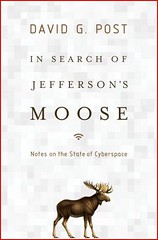
The answer to that question can be found in a new book, In Search of Jefferson’s Moose: Notes on the State of Cyberspace, by David G. Post, a Professor of Law at Temple University. Post, who teaches IP and cyberspace law at Temple, is widely regarded as one of the intellectual fathers of the “Internet exceptionalist” school of thinking about cyberlaw.  Basically, Post sees this place we call “cyberspace” as something truly new, unique, and potentially worthy of some special consideration, or even somewhat different ground rules than we apply in meatspace. More on that in a bit.

[ Full disclosure: Post’s work was quite influential on my own thinking during the late 1990s, so much so that when I joined the Cato Institute in 2000, one of the first things I did was invite David to become an adjunct scholar with Cato. He graciously accepted and remains a Cato adjunct scholar today. Incidentally, Cato is hosting a book forum for him on February 4th that I encourage you to attend or watch online. Anyway, it’s always difficult to be perfectly objective when you know and admire someone, but I will try to do so here.]

Post’s book is essentially an extended love letter — to both cyberspace and Jefferson. Problem is, as Post even admits at the end, it’s tough to know which subject this book is suppose to teach us more about. The book loses focus at times — especially in the first 100 pages — as Post meanders between historical tidbits of Jefferson’s life and thinking and what it all means for cyberspace. But the early focus is on TJ.  Thus, those who pick up the book expecting to be immediately immersed in cyber-policy discussions may be a bit disappointed at first.  As a fellow Jefferson fanatic, however, I found all this history terrifically entertaining, whether it was the story of Jefferson’s Plow and his other agricultural inventions and insights, TJ’s unique interest in science (including cryptography), or that big moose of his.

OK, so what’s the deal with the moose? When TJ was serving as a minister to France in in the late 1780s, at considerable expense to himself, he had the complete skeleton, skin and horns of a massive American moose shipped to the lobby of his Paris hotel. Basically, Jefferson wanted to make a bold statement to his French hosts about this New World he came from and wake them up to the fact that some very exciting things were happening over there that they should be paying attention to. That’s one hell of way to make a statement!

Continue reading →