Posts tagged as:

book stackSo, did the decade just end or do we have another year to go? Honestly, I’ve never understood when the cut-off is from one decade to the next. (My friend Larry Magid struggles with the same question in his recent column on “The Decade in Technology.”) Nonetheless, I’ve seen a lot of best-of-decade lists published recently, so I thought I would throw my own out there even though it is still a work in progress.

I have been attempting to compile the definitive bibliography for our digital decade—the definitive list of Internet policy books, that is. I started throwing this together two years ago when I was penning my list of “The Most Important Internet Policy Books of 2008” and continued to work on it as I was finishing up my 2009 installment as well. I grabbed every book off my shelf that dealt with the future of the Internet and the impact the Digital Revolution is having on our lives, culture, and economy and threw the title and a link onto this list. (I’m also using the list to help structure my thoughts for a forthcoming book of my own on Internet Optimists vs. Pessimists, something I’ve been writing a lot about here in recent years.)

Below you will find what I’ve got so far. There are around 80 90 books on the list. I’ve divided the list by year, but you may be wondering what determined the order the books appear in. In essence, I’ve listed what I feel are the 1 or 2 most important titles first and then just added others randomly. Eventually, I plan to post a “Most Important Internet Policy Books of the Decade” list outlining which titles I believe have been the most influential. I suspect I’ll name Benkler’s Wealth of Networks to the top slot followed closely by Zittrain’s The Future of the Internet, Lessig’s Free Culture, and Chris Anderson’s The Long Tail. Anyway, that’s for another day.

For now, I would just like to ask for reader suggestions regarding what other titles that should appear on this list. I will add titles as they come in. I want to stress, however, that I am trying to keep this list limited to books that have something to say about Internet policy (cyber-law, digital economics, information technology politics, etc).

I hope others find this useful.  And yes, I have read all most of the books on this list!  As I’ve noted here before, I’m a bit of book nerd.  (Now that I’ve received so many helpful additions to the list, there are some titles on the list I have not had a chance to read through yet). Continue reading →


Cyberbullying constitutes one of the largest growth categories of recent cyberlaw legislative proposals, and many state legislatures have already enacted measures aimed at combating this problem using a variety of approaches.  Those attempting to monitor ongoing developments in this field might find it useful to examine this National Conference of State Legislatures (NCSL) compendium of recent state cyberbullying bills.

In June, Berin Szoka and I published a PFF white paper, “Cyberbullying Legislation: Why Education is Preferable to Regulation.”  That paper mostly address federal legislation and, in particular, we contrasted the approaches set forth in Rep. Linda Sánchez’s (D-CA) “Megan Meier Cyberbullying Prevention Act,” versus the “School and Family Education about the Internet (SAFE Internet) Act,” which was introduced in the Senate by Sen. Robert Menendez (D-NJ) and in the House by Rep. Debbie Wasserman Schultz (D-FL).  Whereas the Sánchez bill would create a new federal felony to address these problems, the SAFE Internet Act proposes an education-based approach to the issue.

Generally speaking, Berin and I favor the latter approach, to the extent federal legislators feel the need to act. But we argued that state experimentation on this front may be the better way to go at this time.  As the NCSL survey suggests, states are pursing a variety of strategies and will continue to do so.  In light of that, I’m not sure why any federal legislation is needed at this time.  If the feds are really eager to push something at the national level, perhaps a generic public awareness / PSA campaign would make the most sense while more tailored state-based experimentation continues.  This is rare example of where state-based experimentation with a cyberlaw issue actually makes a lot of sense.

Eric Goldman is the man.  His “Technology & Marketing Law Blog” is must-reading for cyberlaw geeks; packed with indispensable updates and insights about breaking development in the world of Internet law.

Anyway, he’s just published his “2008 Cyberlaw Year-in-Review,” which provides a comprehensive overview of the major developments and cases from the past year. This is the sort of compendium that I used to have to spend big bucks to get from DC law firms.  And Eric just gives it away as a public resource.  God bless him.

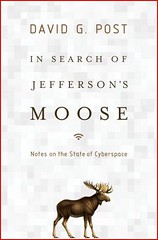
Post Jeffersons MooseI used to have a (semi-crazy) uncle who typically began conversations with lame jokes or bad riddles. This sounds like one he might have used had he lived long enough: What do Thomas Jefferson, a moose, and cyberspace have in common?

The answer to that question can be found in a new book, In Search of Jefferson’s Moose: Notes on the State of Cyberspace, by David G. Post, a Professor of Law at Temple University. Post, who teaches IP and cyberspace law at Temple, is widely regarded as one of the intellectual fathers of the “Internet exceptionalist” school of thinking about cyberlaw.  Basically, Post sees this place we call “cyberspace” as something truly new, unique, and potentially worthy of some special consideration, or even somewhat different ground rules than we apply in meatspace. More on that in a bit.

[ Full disclosure: Post’s work was quite influential on my own thinking during the late 1990s, so much so that when I joined the Cato Institute in 2000, one of the first things I did was invite David to become an adjunct scholar with Cato. He graciously accepted and remains a Cato adjunct scholar today. Incidentally, Cato is hosting a book forum for him on February 4th that I encourage you to attend or watch online. Anyway, it’s always difficult to be perfectly objective when you know and admire someone, but I will try to do so here.]

Post’s book is essentially an extended love letter — to both cyberspace and Jefferson. Problem is, as Post even admits at the end, it’s tough to know which subject this book is suppose to teach us more about. The book loses focus at times — especially in the first 100 pages — as Post meanders between historical tidbits of Jefferson’s life and thinking and what it all means for cyberspace. But the early focus is on TJ.  Thus, those who pick up the book expecting to be immediately immersed in cyber-policy discussions may be a bit disappointed at first.  As a fellow Jefferson fanatic, however, I found all this history terrifically entertaining, whether it was the story of Jefferson’s Plow and his other agricultural inventions and insights, TJ’s unique interest in science (including cryptography), or that big moose of his.

OK, so what’s the deal with the moose? When TJ was serving as a minister to France in in the late 1780s, at considerable expense to himself, he had the complete skeleton, skin and horns of a massive American moose shipped to the lobby of his Paris hotel. Basically, Jefferson wanted to make a bold statement to his French hosts about this New World he came from and wake them up to the fact that some very exciting things were happening over there that they should be paying attention to. That’s one hell of way to make a statement!

Continue reading →

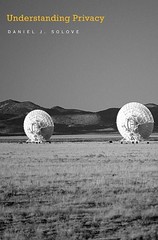
Solove Understanding Privacy book coverWith the publication of Understanding Privacy (Harvard University Press 2008), George Washington University Law School professor Daniel J. Solove has firmly established himself as one of America’s leading intellectuals in the field of information policy and cyberlaw.  Solove had already made himself a force to be reckoned with in this field with the publication of important books like The Future of Reputation: Gossip, Rumor, and Privacy on the Internet (Yale University Press 2007), The Digital Person: Technology and Privacy in the Information Age (NYU Press 2004) and his treatise on Information Privacy Law with Paul M. Schwartz of the Berkeley School of Law (Aspen Publishing, 2d ed. 2006).  But with Understanding Privacy, Solove has now elevated himself to that rarefied air of “people worth watching” in the cyberlaw field; an intellectual — like Lawrence Lessig or Jonathan Zittrain — whose every publication becomes something of an event in the field to which all eyes turn upon release.

Like those other intellectuals, however, my respect for their stature should not be confused with agreement with their positions.  In fact, my disagreements with Lessig and Zittrain are frequently on display here and, we have been critical of Solove here in the past as well. [Here’s Jim Harper’s review of Solove’s last book, with which I am in wholehearted agreement.]  In a similar vein, although I greatly appreciate what Prof. Solove attempts to accomplish in Understanding Privacy — and I am sure it will change the way we conceptualize and debate privacy policy in the future — I found his approach and conclusions highly problematic.

Continue reading →

Jonathan Zittrain, who is affiliated with Oxford University and Harvard’s Berkman Center, recently released a provocatively titled book: The Future of the Internet–And How to Stop It. It’s an interesting read and I recommend you pick it up despite what I’ll say about it in a moment. (Incidentally, if you ever have a chance to hear Jonathan speak, I highly recommend you do so. He is, bar none, the most entertaining tech policy geek in the world. Imagine Dennis Miller with a cyberlaw degree.) Zittrain Future of the Net cover

Jonathan’s book contrasts two different paradigms that he argues could define the Net’s future: The “generative” Net versus what he refers to as a world of “tethered, sterile appliances.” By “generative” he means technologies or networks that invite or allow tinkering and all sorts of creative uses. Think general-purpose personal computers and the traditional “best efforts” Internet. “Tethered, sterile appliances” by contrast, are technologies or networks that discourage or disallow tinkering. Basically, “take it or leave it” proprietary devices like Apple’s iPhone or the TiVo, or online walled gardens like the old AOL and current cell phone networks.

Jonathan’s thesis is that, for a variety of reasons [viruses, Spam, identify theft, etc], we run the risk of seeing the glorious days of the generative, open Net give way to more tethered devices and closed networks. He states:

Continue reading →