Posts tagged as:

[I’ve been working on an outline for a book I hope to write surveying technological skepticism throughout history. I first started thinking about this topic two years when I noticed that a great number of recent books about Internet policy could generally be grouped into one of two camps: Internet optimists vs. Internet pessimists. I subsequently penned an essay on the subject that generated a fair bit of attention. So, I figured I must be on to something, and the more Net policy books I read, the more I realized that the divisions between these two camps were growing wider and increasingly heated. Thus, I thought I would share this very rough draft (much of it still in outline form) of the opening chapter of that book I want to write about this great intellectual war over the impact of technology on society. I invite reader input. Update Jan. 2011: I finally published a full-length essay on this topic. You can find it here. ]

__________

The impact of technological change on culture, learning, and morality has long been the subject of intense debate, and every technological revolution brings out a fresh crop of both pessimists and pollyannas. Indeed, a familiar cycle has repeat itself throughout history whenever new modes of production (from mechanized agriculture to assembly-line production), means of transportation (water, rail, road, or air), energy production processes (steam, electric, nuclear), medical breakthroughs (vaccination, surgery, cloning), or communications techniques (telegraph, telephone, radio, television) have appeared on the scene.

The cycle goes something like this. A new technology appears. Those who fear the sweeping changes brought about by this technology see a sky that is about to fall. These “techno-pessimists” predict the death of the old order (which, ironically, is often a previous generation’s hotly-debated technology that others wanted slowed or stopped).  Embracing this new technology, they fear, will result in the overthrow of traditions, beliefs, values, institutions, business models, and much else they hold sacred.

The pollyannas, by contrast, look out at the unfolding landscape and see mostly rainbows in the air. Theirs is a rose-colored world in which the technological revolution du jour is seen as improving the general lot of mankind and bringing about a better order.  If something has to give, then the old ways be damned! For such “techno-optimists,” progress means some norms and institutions must adapt—perhaps even disappear—for society to continue its march forward.

Our current Information Revolution is no different. It too has its share of techno-pessimists and techno-optimists. Indeed, before most of us had even heard of the Internet, people were already fighting about it—or at least debating what the rise of the Information Age meant for our culture, society, and economy. Continue reading →

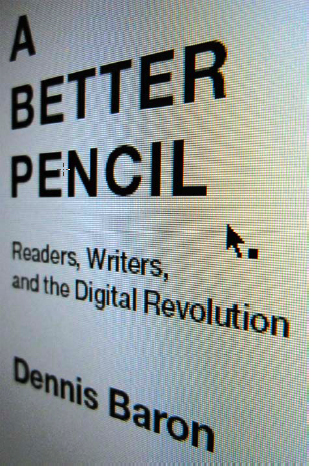
A Better Pencil book coverI very much enjoyed Dennis Baron’s new book, A Better Pencil: Readers, Writers, and the Digital Revolution, and highly recommend you pick it up. Baron does a wonderful job exploring the history of techno-pessimism and the endless battles about the impact of new technologies on life and learning, something I have written about here before in my essays on “Internet optimists vs. pessimists” (See: 1, 2, 3).

I have a complete review of Baron’s A Better Pencil now up on the City Journal‘s website here.  I’ve also pasted it down below.


Plato Wrote it Down by Adam Thierer

a review of A Better Pencil: Readers, Writers, and the Digital Revolution, by Dennis Baron (Oxford University Press, 280 pp., $24.95)

In the beginning, Dennis Baron reminds us in his new book, A Better Pencil, there was the word—the spoken word, that is. Oral tradition, the passing of knowledge through stories and lectures, was the primary method of instruction and learning throughout early human civilization. But then a few innovative souls decided to start writing everything down on stones and clay. Almost as soon as they did, a great debate began on the impact of new communications technology on culture and education. And it rages on today, with a new generation of optimists and skeptics battling over the impact that computing, the Internet, and digital technologies have on our lives and on how we learn about the world.

Continue reading →

What Unites Advocates of Speech Controls & Privacy Regulation? [pdf]

by Adam Thierer & Berin Szoka The Progress & Freedom Foundation, Progress on Point No. 16.19

Anyone who has spent time following debates about speech and privacy regulation comes to recognize the striking parallels between these two policy arenas. In this paper we will highlight the common rhetoric, proposals, and tactics that unite these regulatory movements. Moreover, we will argue that, at root, what often animates calls for regulation of both speech and privacy are two remarkably elitist beliefs:

  1. People are too ignorant (or simply too busy) to be trusted to make wise decisions for themselves (or their children); and/or,
  2. All or most people share essentially the same values or concerns and, therefore, “community standards” should trump household (or individual) standards.

While our use of the term “elitism” may unduly offend some understandably sensitive to populist demagoguery, our aim here is not to launch a broadside against elitism as Time magazine culture critic William H. Henry once defined it: “The willingness to assert unyieldingly that one idea, contribution or attainment is better than another.”[1] Rather, our aim here is to critique that elitism which rises to the level of political condescension and legal sanction. We attack not so much the beliefs of some leaders, activists, or intellectuals that they have a better idea of what it in the public’s best interest than the public itself does, but rather the imposition of those beliefs through coercive, top-down mandates.

That sort of elitism—elitism enforced by law—is often the objective of speech and privacy regulatory advocates. Our goal is to identify the common themes that unite these regulatory movements, explain why such political elitism is unwarranted, and make it clear how it threatens individual liberty as well as the future of free and open Internet. As an alternative to this elitist vision, we advocate an empowerment agenda: fostering an environment in which users have the tools and information they need to make decisions for themselves and their families. Continue reading →

Hello, Jonah

by on December 3, 2008 · 9 comments