[Last updated July 2021.]
I spend a lot of time reading books and essays about technology; more specifically, books and essays about technology history and criticism. Yet, I am often struck by how few of the authors of these works even bother defining what they mean by “technology.” I find that frustrating because, if you are going to make an attempt to either study or critique a particular technology or technological practice or development, then you probably should take the time to tell us how broadly or narrowly you are defining the term “technology” or “technological process.”
 Of course, it’s not easy. “In fact, technology is a word we use all of the time, and ordinarily it seems to work well enough as a shorthand, catch-all sort of word,” notes the always-insightful Michael Sacasas in his essay “Traditions of Technological Criticism.” “That same sometimes useful quality, however, makes it inadequate and counter-productive in situations that call for more precise terminology,” he says.
Quite right, and for a more detailed and critical discussion of how earlier scholars, historians, and intellectuals have defined or thought about the term “technology,” you’ll want to check out Michael’s other recent essay, “What Are We Talking About When We Talk About Technology?” which preceded the one cited above. We don’t always agree on things — in fact, I am quite certain that most of my comparatively amateurish work must make his blood boil at times! — but you won’t find a more thoughtful technology scholar alive today than Michael Sacasas. If you’re serious about studying technology history and criticism, you should follow his blog and check out his book, The Tourist and The Pilgrim: Essays on Life and Technology in the Digital Age, which is a collection of some of his finest essays.
Anyway, for what it’s worth, I figured I would create this post to list some of the more interesting definitions of “technology” that I have uncovered in my own research. I suspect I will add to it in coming months and years, so please feel free to suggest other additions since I would like this to be a useful resource to others. Continue reading →
Marc Hochstein, Executive Editor of American Banker, a leading media outlet covering the banking and financial services community, discusses bitcoin.
According to Hochstein, bitcoin has made its name as a digital currency, but the truly revolutionary aspect of the technology is its dual function as a payment system competing against companies like PayPal and Western Union. While bitcoin has been in the news for its soaring exchange rate lately, Hochstein says the actual price of bitcoin is really only relevant for speculators in the short-term; in the long-term, however, the anonymous, decentralized nature of bitcoin has far-reaching implications.
Hochstein goes on to talk about the new market in bitcoin futures and some of bitcoin’s weaknesses—including the volatility of the bitcoin market.
Download
Related Links
Andy Greenberg, technology writer for Forbes and author of the new book “This Machine Kills Secrets: How WikiLeakers, Cypherpunks, and Hacktivists Aim to Free the World’s Information,” discusses the rise of the cypherpunk movement, how it led to WikiLeaks, and what the future looks like for cryptography.
Greenberg describes cypherpunks as radical techie libertarians who dreamt about using encryption to shift the balance of power from the government to individuals. He shares the rich history of the movement, contrasting one of t the movement’s founders—hardcore libertarian Tim May—with the movement’s hero—Phil Zimmerman, an applied cryptographer and developer of PGP (the first tool that allowed regular people to encrypt), a non-libertarian who was weary of cypherpunks, despite advocating crypto as a tool for combating the power of government.
According to Greenberg, the cypherpunk movement did not fade away, but rather grew into a larger hacker movement, citing the Tor network, bitcoin, and WikiLeaks as example’s of its continuing influence. Julian Assange, founder of WikiLeaks, belonged to a listserv followed by early cypherpunks, though he was not very active at the time, he says.
Greenberg is excited for the future of information leaks, suggesting that the more decentralized process becomes, the faster cryptography will evolve.
Download
Related Links
Joshua Gans, professor of Strategic Management at the University of Toronto’s Rotman School of Management and author of the new book Information Wants to be Shared, discusses modern media economics, including how books, movies, music, and news will be supported in the future.
Gans argues that sharing enhances most information’s value. He also explains that the business models of traditional media companies, gatekeepers who have relied on scarcity and control, have collapsed in the face of new technologies. Equally important, he argues that sharing can revive moribund, threatened industries even as he examines platforms that have, almost accidentally, thrived in this new environment.
Download
Related Links
Is geek culture sexist? Joseph Reagle, Assistant Professor of Communications Studies at Northeastern University and author of a new paper entitled, “Free as in Sexist? Free culture and the gender gap,” returns to Surprisingly Free to address geek feminism and the technology gender gap.
According to Reagle, only 1% of the free software community and 9% of Wikipedia editors are female, which he sees as emblematic of structural problems in the geek community. While he does not believe that being a geek or a nerd is in any way synonymous with being a sexist, he concludes that three things that he otherwise loves—geekiness, openness, and the rhetoric and ideology of freedom–are part of the problem inasmuch as they allow informal cliques to arise, dominate the discussion, and squeeze out minority views. Reagle also comments on a unintentional androcentricity he has observed even amongst free software community heroes, highlighting the ways in which this behavior can be alienating to women and prevents geek culture from growing beyond its traditional base.
Reagle prescribes a 3-step solution to sexism in geek culture: talking about gender; challenging and expanding what it means to be a geek; and not allowing the rhetoric of freedom to be used as an excuse for bad behavior.
Reagle further supports efforts to form female-only subcultures within the geek community, which opponents argue goes against the free software value of openness. Instead of the balkanization of their movement that opponents fear, these closed-group discussions actually strengthen geek culture at large, according to Reagle.
Download
Related Links
Ronald A. Cass, Dean Emeritus of Boston University School of Law, discusses his new book, Laws of Creation: Property Rights in the World of Ideas, which he co-authored with Boston University colleague Keith Hylton. Written as a primer for understanding intellectual property law and a defense of intellectual property, Laws of Creation explains the basis of IP and its justification.
According to Cass, not all would-be reformers share a similar guiding philosophy, distinguishing between those who support property rights but nevertheless have specific critiques of the intellectual property system as it currently stands, and reformers who do not see a place for property.
Cass explains that the current intellectual property system is neither wholly good nor wholly bad, but is a matter of weighing tradeoffs. On the whole, he argues, intellectual property benefits society. Cass also argues that intellectual property law in the U.S. is still more functional than that in other countries, such as Italy, and that, while it would benefit from some reform, it is fundamentally a workable system.
Download
Related Links
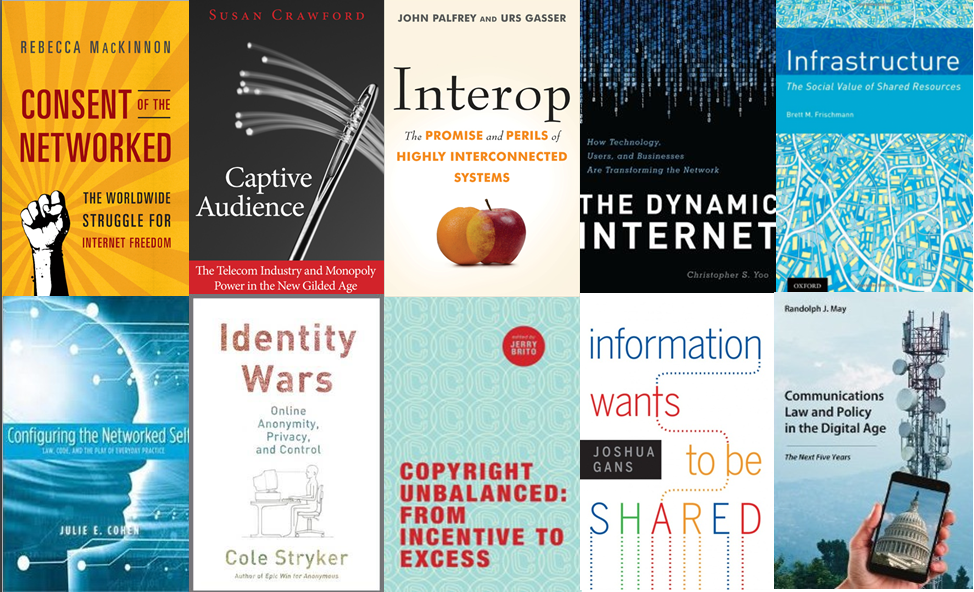
The number of major cyberlaw and information tech policy books being published annually continues to grow at an astonishing pace, so much so that I have lost the ability to read and review all of them. In past years, I put together end-of-year lists of important info-tech policy books (here are the lists for 2008, 2009, 2010, and 2011) and I was fairly confident I had read just about everything of importance that was out there (at least that was available in the U.S.). But last year that became a real struggle for me and this year it became an impossibility. A decade ago, there was merely a trickle of Internet policy books coming out each year. Then the trickle turned into a steady stream. Now it has turned into a flood. Thus, I’ve had to become far more selective about what is on my reading list. (This is also because the volume of journal articles about info-tech policy matters has increased exponentially at the same time.)
So, here’s what I’m going to do. I’m going to discuss what I regard to be the five most important titles of 2012, briefly summarize a half dozen others that I’ve read, and then I’m just going to list the rest of the books out there. I’ve read most of them but I have placed an asterisk next to the ones I haven’t. Please let me know what titles I have missed so that I can add them to the list. (Incidentally, here’s my compendium of all the major tech policy books from the 2000s and here’s the running list of all my book reviews.)
Continue reading →
Here’s the first of two essays I’ve recently penned making “The Case for Internet Optimism.” This essay was included in the book, The Next Digital Decade: Essays on the Future of the Internet (2011), which was edited by Berin Szoka and Adam Marcus of TechFreedom. In these essays, I identify two schools of Internet pessimism: (1) “Net Skeptics,” who are pessimistic about the Internet improving the lot of mankind; and (2) “Net Lovers,” who appreciate the benefits the Net brings society but who fear those benefits are disappearing, or that the Net or openness are dying. (Regular readers of this blog will be familiar with these themes since I sketched them out in previous essays here such as, “Are You an Internet Optimist or Pessimist?” and “Two Schools of Internet Pessimism.”) The second essay is here.
This essay focuses on the first variant of Internet pessimism, which is rooted in general skepticism about the supposed benefits of cyberspace, digital technologies, and information abundance. The proponents of this pessimistic view often wax nostalgic about some supposed “good ‘ol days” when life was much better (although they can’t seem to agree when those were). At a minimum, they want us to slow down and think twice about life in the Information Age and how it’s personally affecting each of us. Occasionally, however, this pessimism borders on neo-Ludditism, with some proponents recommending steps to curtail what they feel is the destructive impact of the Net or digital technologies on culture or the economy. I identify the leading exponents of this view of Internet pessimism and their major works. I trace their technological pessimism back to Plato but argue that their pessimism is largely unwarranted. Humans are more resilient than pessimists care to admit and we learn how to adapt to technological change and assimilate new tools into our lives over time. Moreover, were we really better off in the scarcity era when we were collectively suffering from information poverty? Generally speaking, despite the challenges it presents society, information abundance is a better dilemma to be facing than information poverty. Nonetheless, I argue, we should not underestimate or belittle the disruptive impacts associated with the Information Revolution. But we need to find ways to better cope with turbulent change in a dynamist fashion instead of attempting to roll back the clock on progress or recapture “the good ‘ol days,” which actually weren’t all that good.
Down below, I have embedded the entire chapter in a Scribd reader, but the essay can also be found on the TechFreedom website for the book as well as on SSRN. I have also includes two updated tables that appeared in my old “optimists vs. pessimists” essay. The first lists some of the leading Internet optimists and pessimists and their books. The second table outlines some of the major lines of disagreement between these two camps and I divided those disagreements into (1) Cultural / Social beliefs vs. (2) Economic / Business beliefs.
Continue reading →
 I really enjoyed this editorial in today’s Wall Street Journal by sci-fi novelist Orson Scott Card, author of Ender’s Game, among many other books. Card engages in some interesting soul searching about the impact of the Net and digital technology on our lives, economy, and culture. He concludes his essay by noting that:
We’re still the same human beings we always were. Consumers still act like consumers; people still search for love and friendship. But the Internet has freed us from the boundaries of distance and many of the risks of embarrassment in social interactions. This re-sorted geography has brought its own pitfalls and forced us to create new rules of etiquette.
But just as I have no desire to give up cars, trains and planes to return to the hay-eating, vet-needing, poop-generating, one-horsepower horse, I don’t want to go back to pre-Google research, pre-Amazon shopping, pre-blog newsmedia, or the loneliness of villages limited by geography.
Quite right. Card is expressing the sort of “pragmatic optimism” I’ve written about here before in my essays about the ongoing battle between Internet optimists and pessimists. I’ve tried to articulate a sort of middle ground position in this debate that embraces the amazing technological changes at work in today’s Information Age but does so with a healthy dose of humility and appreciation for the disruptive impact and pace of that change. As I’ve noted before, we need to think about how to mitigate the negative impacts associated with technological change without adopting the paranoid tone or Luddite-ish recommendations of the pessimists. Read Card’s entire essay to get a better feel for how we can begin to think in that way.
In his essay today, “Go On, Opt Out. Just Don’t Come Cryin’ To Me …,” John Battelle has some very sensible thinking on the “Do Not Track” idea and privacy regulation more generally:
Look, if you want to, you can put yourself on a “do not track” list in the Real World. As you walk around in our Real World, where small shopkeepers and Starbucks alike attempt to lure you into their stores, you can simply decide to ignore their come ons. You can refuse to get a grocery card, and forego the discounts they offer. You can forego the countless coupons, come ons, and catalogs that come through your newspaper, browser, or your community mailer, and if you work at it, you can even opt out through some specialized services (with more coming soon, if the FTC gets its way). And you can turn off your television (cause lord knows even the shows are trying to influence you now), and you can ignore your friends when they talk about the latest, coolest promotion that Verizon or ATT has pushed them through their cell phones. If folks insist on talking about stuff that might smack of someone selling you something, heck, you can start to dress like the Unabomber and withdraw entirely from our obviously commercial culture. You might look weird, but at least folks will leave you alone. And if you do, your world will either be better, or it will suck more. Your call.
But don’t come crying to me when you realize that in opting out of our marketing-driven world, you’ve also opted out of, well, a pretty important part of our ongoing cultural conversation, one that, to my mind, is getting more authentic and transparent thanks to digital platforms. And, to my mind, you’ve also opted out of being a thinking person capable of filtering this stuff on your own, using that big ol’ bean which God, or whoever you believe in, gave you in the first place. Life is a conversation, and part of it is commercial. We need to buy stuff, folks. And we need to sell stuff too.
Amen, brother. This is a point Berin Szoka and I have made repeatedly here in the past:
The debate over privacy regulation is fundamentally tied up with the future of online content and culture. The idea of a cost-free opt-out model for the all online data collection / advertising may sound seductive to some, but we must take into account the opportunity costs of regulation. The real world is full of trade-offs and, despite what the Federal Trade Commission seems to think, there is no such thing as a free lunch.


 The Technology Liberation Front is the tech policy blog dedicated to keeping politicians' hands off the 'net and everything else related to technology.