Posts tagged as:

Free Willie?

by on August 10, 2009 · 31 comments

Thanks to comments on my earlier post, Copyright Duration and the Mickey Mouse Curve, I’ve been encouraged to reflect on what would happen if, in fact, Steamboat Willie had fallen into the public domain. Could we then reuse Mickey Mouse, the star of that show, without facing any liability to the Walt Disney Company? I drafted this answer for my book, Intellectual Privilege (here edited for blogging):

Scholars have made surprisingly strong arguments that Steamboat Willie, a cartoon that the Walt Disney Company cites as establishing its copyright rights in Mickey Mouse, has fallen into the public domain. As a thought experiment, let us assume the truth of that claim. What would happen if Walt Disney Company—if, indeed, nobody—held a copyright in Steamboat Willie? Certainly, each of use would by default enjoy complete freedom to copy, distribute, display, or perform the cartoon, because the expiration of the work’s copyright would also end the exclusive rights of the Walt Disney Company and its assigns the exercise those statutory privileges. So, too, would we escape copyright’s limitations on making derivative versions of Steamboat Willie—versions that might show Mickey standing at a lectern rather than at a pilot’s wheel, for instance, or have him expounding on copyright law.

The Walt Disney Company would retain its copyrights in later, plumper versions of the Mickey Mouse, of course. Contemporary artists wanting to reinterpret the character free from the company’s veto would thus have to draw inspiration primarily from the earlier, skinnier, version. Given that the characters would share a common ancestor, however, even mice derived solely from Steamboat Willie would often strongly resemble the modern-day Mickey Mouse.

Continue reading →

Herewith another recent addition to my draft book, Intellectual Privilege: A Libertarian View of Copyright, (inspired, in part, by Berin Szoka’s recent claim, “I just don’t know what the right balance [for copyright] is! I’m glad there are others patient enough to try to figure it out. This is why we have economists and… yes, even lawyers!”):

As an illustration of the public choice pressures that drive copyright policy, consider the fate of the copyright in Steamboat Willie, a 1928 cartoon that the Walt Disney Company cites as establishing its copyright claim in Mickey Mouse. Scholars have made a surprisingly strong case that, because the requisite formalities of the 1909 Copyright Act were not satisfied, Steamboat Willie has fallen into the public domain. The Walt Disney Company has responded to such claims by threatening to bring suit for “slander of title,” demonstrating how seriously it takes its copyright in Steamboat Willie. Let us take that copyright seriously, too, then, so that we might better understand the public choice effects of the Walt Disney Company’s interests.

Copyright Duration and the Mickey Mouse Curve

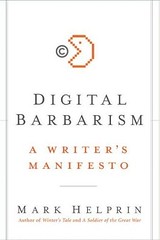
Last month, Digital Barbarism book cover National Review magazine published a review that I penned of Mark Helprin’s new book, Digital Barbarism: A Writer’s Manifesto.  Helprin’s book is both a passionate defense of copyright law as well as a mini-autobiography.  Helprin is one of the great novelists and essayists of the past half-century, and his book A Soldier of a Great War is one of my all-time favorite novels.  I cannot in strong enough words encourage you to read that book; it is profoundly moving. (I almost named my son after the lead character in the book!)

Thus, I was quite excited when I learned that Helprin had penned a defense of copyright and I jumped at the chance to review it when the folks at National Review asked me to do so.  Alas, as you will see in my review, I was terribly disappointed.  I wish Helprin would have stuck with the very reasonable tone he adopted in this excellent podcast interview he did recently with John J. Miller of National Review Online. Unfortunately, he went a different direction in the book, as I make clear in my review:


National Review July 20, 2009

“Man, Machine, and Copyright” a review of Digital Barbarism: A Writer’s Manifesto, by Mark Helprin by Adam Thierer

It would be difficult to think of anyone more ideally suited to pen a passionate defense of copyright law than novelist Mark Helprin.  Helprin has written several of the finest works of modern literature, including his masterpiece, A Soldier of the Great War, a narrative of transcendent beauty. In Digital Barbarism, Helprin sets out to use his formidable gift for the written word to repel the “cyber mob” that has attacked copyright law and called for its curtailment, or even abolition.

Unfortunately, while Helprin occasionally rises to great heights in his defense of copyright, he too often sinks to lamentable lows — by resorting to the same unbecoming rhetorical tactics used by the mob he seeks to condemn. Indeed, his book is filled with gratuitous vitriol and neo-Luddite ramblings about the Internet and Information Age that severely detract from his defense of copyright. This is a shame, because, in places, Digital Barbarism makes a fine case against those critics who wrongly view copyright as an impediment to the creation and diffusion of content. “The availability of information is not and will not be restrained by the copyright system any more than it is or will be restrained by the delivery systems that make it possible,” Helprin argues. Why, he asks, “must ‘content’ be free” when everything else — access to the Internet, digital devices, etc. — costs good money? He notes that the movement that advocates “free,” universal access to all copyrighted material in the name of “openness” and “the public good” would, ironically, “destroy the dream it advocates”: Continue reading →

Probably largely the same reason that people hate lawyers:  Anytime you’re dealing with legal rights and contracts, it’s a pain to get anything done. (Having just celebrated my fifth law school reunion, I should know!)

Case in point: I was thrilled to discover the Canadian radio show The Age of Persuasion, dedicated to a subject I’ve come to know and love (to the point of considerable repetition): advertising! Yup, that’s right, those annoying little ads that fund all the free online content and services we all take for granted.

Anyway, the good news is that the show is available online.  The bad news is that it’s only available in streaming audio form—which means I can’t take it with me on my iPod, which means I’ll basically never listen to it.  From Podcasting: what’s ‘holding up the delay’?:

Okay, we’ve got to stop meeting like this.

Time, she passes, yet the legals surrounding podcasting are yet to be settled. Meanwhile, our finely honed spider-sense (and a steady stream of daily emails) tells us many of you are wondering when an AOP podcast will happen.

Alas, for the moment, we are bound not to release Age of Persuasion episodes for podcast. (No, we don’t like it either.)

Continue reading →

As part of a revise-and-resubmit process, I’ve been spending much of my summer upgrading my draft book, Intellectual Privilege: A Libertarian View of Copyright. That effort has led me to revisit copyright’s constitutional foundations. I find them very shaky, indeed. This passage (with footnotes excerpted) explains why modern copyright law often fails “to promote the Progress of Science and the useful Arts”:

What would copyright look like if we took the Constitution at its word, requiring that copyright promote the progress of both science and the useful arts? We would then have to look askance at the current practice of affording copyright protection to such purely artistic creations as songs, plays, novels, paintings, and sculptures. Even supposing that “science” reaches broadly enough to cover all of the humane sciences—a reading that Malla Pollack documents as an original meaning of the term—copyright law today focuses far more on the expressive arts than on the “useful” ones.

Taking “Science and useful Arts” seriously would thus radically narrow the proper scope of copyright. The first Copyright Act, enacted in 1790 by some of the same people who wrote and ratified the Constitution, covered only maps, charts, and books. Permitting copyrights in first two types of works plainly promoted both science and the useful arts. Lawmakers in 1790 probably regarded books, too, primarily as tools rather than diversions. Novels had yet to rise to prominence, after all; the first American one, William Hill Brown’s THE POWER OF SYMPATHY, had appeared only the year before, and even it aimed at practical ends, promising “to Expose the fatal consequences of SEDUCTION.” Judging from the titles in libraries and on sale, fiction made up only a small portion of the books available in late eighteenth century America. The 1790 Copyright Acts moreover excluded such purely artistic expressions as songs, plays, paintings, and sculptures—even though its drafters undoubtedly knew of and appreciated those sorts of works.

It appears, then, that “[t]o promote the Progress of Science and useful Arts” originally meant that that copyrights had to serve practical ends, rather than merely expressive ones. But originalists should not alone embrace that constitutional limitation on copyright’s scope. Given that “Science” now connotes a more technical and specialized endeavor than it did in the eighteenth century, the plain, present, public meaning of the Constitution likewise counsels against extending copyright protection to purely artistic works. Whether we give the Constitution’s text its original meaning or its current one, therefore, copyright should cover little more than maps, charts, non-fiction books, illustrations, documentaries, computer programs, and architecture. Most songs, plays, fictional books, paintings, sculptures, dances, movies, and other artistic works, because they fail to promote the progress of science and the useful arts, would on that reasoning not qualify for copyright protection.

However rigorously logical, that argument against the constitutionality of almost all modern copyright law will, I grant, probably generate more grins than agreement. Courts and commentators have hitherto hardly bothered to distinguish between “Science and useful Arts”; still less have they taken those words to impose real limitations on federal power. Here as elsewhere, acquiescence to long-accepted practices has dulled us to the Constitution’s bracingly straightforward words. We should read them anew and reflect that the Founding generation did not evidently think that granting statutory privileges to such purely artistic creations as romantic operas or pretty pictures would promote the progress of both science and the useful arts. Furthermore, most citizens today would, if presented with the Constitution’s plain language rather than the convoluted arguments of professional jurisprudes, probably say the same thing about pop songs, blockbuster movies, and the like. That is certainly not to say that purely expressive works lack value. They may very well promote such important goals as beauty, truth, and simple amusement. The Constitution requires that copyright promote something else, however—”the Progress of Science and useful Arts”—and a great many works now covered by copyright cannot plausibly claim to do both.

This argument against the constitutionality of most modern copyright relies, by the way, on a prior argument about the structure of the copyright clause; to wit, that “Science and useful Arts” modifies both “authors” and “inventors.” Also, I intend to follow up the above with an analysis of how the Supreme Court in Eldred took a view almost exactly opposite to the text-based one I’ve embraced. (I’d call that an admission, were I not proud to disagree with the Court.)

[[Crossposted at Agoraphilia, TechLiberation Front.]

John Palfrey, co-author of Born DigitalOn this episode of “Tech Policy Weekly,” we’re launching a new format called “Tech Book Corner” that will feature occasional conversations with the authors of important new books about technology policy and the other issues that we debate frequently at the Tech Liberation Front blog.
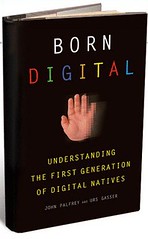
On this debut episode of Book Corner, we are joined by John Palfrey, a professor of law at Harvard University and the co-director of the Berkman Center for Internet & Society at Harvard. Along with his Berkman Center colleague Urs Gasser, Prof. Palfrey has recently co-authored Born Digital: Understanding the First Generation of Digital Natives, which was published last summer by Basic Books and which you can find out more information about at www.borndigitalbook.com. [Incidentally, I reviewed Born Digital here last October and I also named it one of the most important technology policy books of 2008.]

Born Digital cover

In our discussion, Prof. Palfrey explains who exactly counts as a “digital native” and tells us why he decided to write a book about them. He discusses why he believes that there has been some overreaction by older generations to fears about this Digital Generation and he argues that we need “to separate what we need to worry about from what’s not so scary” and “what we ought to resist from what we ought to embrace.” He then outlines how we should think about these issues and concerns going forward, and he stresses the importance of “balancing caution with encouragement” as we do so. Finally, he then applies that framework to three specific issues: privacy, child safety, and copyright.

It’s an interesting conversation and you can begin listening to it immediately by downloading the MP3 file here or by just clicking the play button below!

[display_podcast]

Isle of Man Coat of ArmsThe Isle of Man may soon implement a “blanket license” whereby Manx broadband users could download as much music as they like in exchange for paying a “fee” (also known as a “tax,” since this would be non-optional) to their ISP that would supposedly be as low as $1.38/month.  The Manx proposal sounds a lot like how SoundExchange administers a blanket license in the U.S. for web-casting of copyrighted music:

the money collected by the Internet providers would be sent to a special agency that would distribute the proceeds to the copyright owners, including the record labels and music publishers. They would receive payments based on how often their music was downloaded or streamed over the Internet, as they now do in many countries when it is performed live or on the radio.

As Adam Thierer has noted,  Larry Lessig has endorsed at least a voluntary version of this idea, but Adam has raised a number of tough questions: Continue reading →

My piece about the U.S. Chamber of Commerce event last Friday on U.S. intellectual property attachés giving a report, and taking a hard line, on the enforcement of U.S. intellectual property, overseas, is now live on ip-watch.org.

Here’s the first couple of paragraphs:

WASHINGTON, DC – Nations ranging from Brazil to Brunei to Russia are failing to properly protect the intellectual property assets of US companies and others, and international organisations are not doing enough to stop it, seven IP attachés to the US Foreign and Commercial Service lamented recently.

Meanwhile, an industry group issued detailed recommendations for the incoming Obama administration’s changes to the US Patent and Trademark Office.

The problems in other nations extend from Brazil’s failure to issue patents for commercially significant inventions by US inventors, to an almost-complete piracy-based economy in Brunei, to an only-modest drop in the rate of Russian piracy from 65 percent to 58 percent.

The attachés, speaking at an event organised by the US Chamber of Commerce and its recently beefed-up Global Intellectual Property Center (GIPC), blasted the record of familiar intellectual property trouble zones like Brunei, Thailand and Russia.

But the problems extend to the attitudes and omissions of major trading partners like Brazil, India and even well-developed European nations, said the attachés.

[more at http://www.ip-watch.org/weblog/index.php?p=1387….]

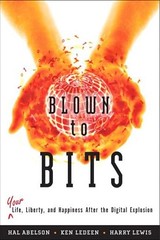
Blown to Bits coverI’ve just finished reading Blown to Bits: Your Life, Liberty, and Happiness After the Digital Explosion, by Hal Abelson, Ken Ledeen, and Harry Lewis, and it’s another title worth adding to your tech policy reading list. The authors survey a broad swath of tech policy territory — privacy, search, encryption, free speech, copyright, spectrum policy — and provide the reader with a wonderful history and technology primer on each topic.

I like the approach and tone they use throughout the book. It is certainly something more than “Internet Policy for Dummies.” It’s more like “Internet Policy for the Educated Layman”: a nice mix of background, policy, and advice. I think Ray Lodato’s Slashdot review gets it generally right in noting that, “Each chapter will alternatively interest you and leave you appalled (and perhaps a little frightened). You will be given the insight to protect yourself a little better, and it provides background for intelligent discussions about the legalities that impact our use of technology.”

Abelson, Ledeen, and Lewis aren’t really seeking to be polemical in this book by advancing a single thesis or worldview. To the extent the book’s chapters are guided by any central theme, it comes in the form of the “two basic morals about technology” they outline in Chapter 1:

The first is that information technology is inherently neither good nor bad — it can be used for good or ill, to free us or to shackle us. Second, new technology brings social change, and change comes with both risks and opportunities. All of us, and all of our public agencies and private institutions, have a say in whether technology will be used for good or ill and whether we will fall prey to its risks or prosper from the opportunities it creates. (p. 14)

Mostly, what they aim to show is that digital technology is reshaping society and, whether we like or it not, we better get used to it — and quick!  “The digital explosion is changing the world as much as printing once did — and some of the changes are catching us unaware, blowing to bits our assumptions about the way the world works… The explosion, and the social disruption that it will create, have barely begun.” (p 3)

In that sense, most chapters discuss how technology and technological change can be both a blessing and a curse, but the authors are generally more optimistic than pessimistic about the impact of the Net and digital technology on our society. What follows is a quick summary of some of the major issues covered in Blown to Bits.

Continue reading →