As a cyber-libertarian, I’ve been lucky enough to work with people of all ideological stripes in pursuit of various public policy objectives. I’ve made selective alliances with people on the Right on economic policy issues (like opposing Net Neutrality regulation, Internet taxes, etc) and also worked closely with folks on the Left on speech and culture issues (content controls, anonymity, online safety concerns, etc).
While engaging with with people on both sides of the political fence, I’m often struck by some of their internal inconsistencies. Conservatives, for example, talk about a big game about personal responsibility on some issues, but quickly abandon that notion when they claim media content or online speech should be regulated by the State (typically “for the children.”) In this essay, I’d like to discuss interesting inconsistencies on the political Left, especially among advocates of strong privacy regulation (most of whom tend to be Left-leaning in their worldview). In particular, here are the two things I find most interesting about modern privacy advocates:
(1)
Most privacy advocates are vociferous First Amendment supporters, yet they abandon their free speech values and corresponding constitutional tests when it comes to privacy regulation. When it comes to proposals to regulate media content or online speech, most folks on the Left have a very principled, clear-cut position: people (or parents) should take responsibility for unwanted information flows in their lives (or the lives of their children). In particular, they rightly argue that the many user empowerment tools on the market (filters, monitoring software, other parental control technologies) constitute a so-called “less-restrictive means” of controlling content when compared to government regulation.
Advocacy groups that I have a great deal of respect for and work with quite closely on these issues–such as EFF, CDT and ACLU—all take this position. Generally speaking, they argue that, when it comes to speech regulation, “household standards” (user-level controls) should trump “community standards” (government regulation). And in Court—where I frequently file joint amicus briefs with them—they repeatedly employ the “less-restrictive means” test to counter government efforts to regulate information flows.
But when it comes to privacy, they throw all this out the window! Continue reading →
Toy Story 3 offers many pleasures and not a little wisdom. I absorbed them with a shocking output of tears, both the laughing kind and otherwise. At one point, too, I raised my fist in solidarity, moved by the political philosophy voiced by Barbie (brilliantly played by Barbie). I liked Barbie’s quote so much that I put it on a t-shirt:
Nice, huh? Click on the picture to customize the shirt for your build and style.
Continue reading →
The grandly-named Public Domain Archive, evidently a production of Osaka-based Digirock, Inc., offers a few MP3s of classical music and historical speeches. Thanks to a suggestion from Tyler Cowen, I’m enjoying a 1942 recording of Beethoven’s 9th even as I type. Am I breaking the law in so doing? The copyright notice posted on the Public Domain Archive, while quite charming, hardly reassures:
To the People
In japan, All files open to the public on this site are certainly lawful.
But, if you do not live in Japan, You might do not have to use files.
You should check the law of your country.
As proves too often true for works, like this 1942 recording, that fall under the aegis of the 1909 Copyright Act, it is not easy to figure out if the underylying work enjoys any claim to protection under U.S. law. Perhaps, after all, it was not published with the proper formalities, here, and thus fell into the public domain.
In this case, though, it looks like we can dodge those complications. U.S. copyright law affords exclusive rights only to copying, creation of derivative works, public distribution, public performance, and public display.
See 17 USC § 106. So long as I listen to a MP3 solely via streaming, without saving a copy, it is hard to see how I’ve violated any of those rights. Perhaps Digirock, Inc. has violated U.S. law by offering me the MP3, but that is no concern of mine (and probably not much of a concern to Digirock, Inc.).
That legal scenario suggests an interesting conclusion: an offshore copyright-free zone—one set up by intellectual pirates or in a stubbornly independent country—might give U.S. residents ample, free, and legal access to all sorts of copyrighted works—even ones protected under U.S. law.
[Crossposted at Agoraphilia and The Technology Liberation Front.]
In their 2006 Cato Policy Analysis, Amateur-to-Amateur: The Rise of a New Creative Culture, Gregory Lastowka and Dan Hunter wrote about how the functions that make up the creative cycle—creation, selection, production, dissemination, promotion, sale, and use of expressive content—are undergoing revolutionary decentralization and disintermediation.
The only thing professional in the clip below was the writing of the song. It deserves its credit, but the performance itself, production of the video, its selection, dissemination, and promotion (Twitter users, YouTube) are all amateur or amateur supported by a professionally managed, ad-supported platform.
http://www.youtube.com/v/bxDlC7YV5is&hl=en_US&fs=1&rel=0
Watch it a second time to take in the reactions of the girl sitting in front of the map. If you like, compare it with the tacky, overproduced, and flat “professional” video.
This is amateur entertainment that rivals any professional production, in part because it’s amateur. Assuming this performer dedicates himself further to his craft, he can rival or surpass anything put out by yesterday’s professionals.
(And, yes, I’m waiting to learn that I’ve been duped by some clever marketing scheme, but I hope this is real.)
From our bulletin board at home:

 Last week there was another leak of the secretly negotiated Anti-Counterfeiting Trade Agreement (ACTA). This time it was a copy of the of the entire latest draft. It seems to dispel some of the initial worries bloggers had written about, including customs searches of your iPod at the border, but also stokes other concerns. For one thing, the U.S. seems to be pushing for protocols to cut off copyright violators from their internet access.
In the most recent episode of the Surprisingly Free Podcast, I talk with Prof. Michael Geist of the University of Ottawa, who has been following ACTA more closely than anyone else. He explains that not only is the content of ACTA troubling, but the fact that it’s being negotiated in such secrecy.
Listen to other episodes and remember to subscribe to the podcast using RSS or iTunes.
As I mentioned, I’m out in Vegas attending the Tech Policy Summit at CES today and tomorrow and trying to blog about some of what’s going on. Here’s my summary of panel#1 on broadband policy and panel #2 on spectrum policy. The third panel was on the future of copyright and content creation. The session was moderated by Declan McCullagh, Sr. Correspondent, CBSNews.com and Contributor, CNET News. The panelists included:
- Jim Griffin, President, Choruss LLC and Advisor to Warner Music Group
- Fred von Lohmann, Senior Staff Attorney, Electronic Frontier Foundation
- Gigi Sohn, Co-founder and President, Public Knowledge
- Hank Shocklee, Creative Director and CEO Music Producer, Founder of Public Enemy and President, Shocklee Entertainment
- Michael Robertson, Founder, MP3.com
- Dave Allen, Co-founder and President, Pampelmoose and Co-founder, Fight
I have briefly summarized some of what each speaker said down below:
Continue reading →
2009 was not as big of a year for Internet and information technology (“info-tech”) policy books as 2008 was, but there were still some notable titles released that offered interesting perspectives about the future of the Net and the impact the Digital Revolution is having on our lives, culture, and economy. So, like last year, I figured I would throw together my list of the 10 most important info-tech policy books of the year.
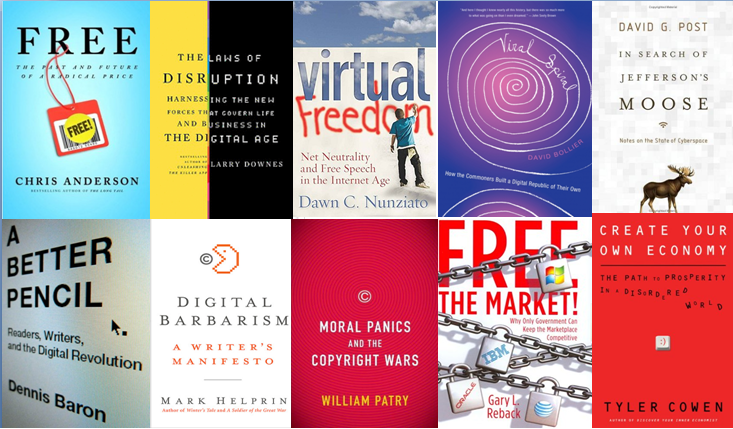 First, let me repeat a few of the same caveats and disclaimers that I set forth last year. What qualifies as an “important” info-tech policy book? Simply put, it’s a title that many people are currently discussing and that we will likely be referencing for many years to come. However, I want to be clear that merely because a book appears on my list it does not necessarily mean I agree with everything said in it. In fact, as was the case in previous years, I found much with which to disagree in my picks for the most important books of 2009 and I find that the cyber-libertarianism I subscribe to has very few fans out there.
Another caveat: Narrowly-focused titles lose a few points on my list. For example, if a book deals mostly with privacy issues, copyright law, or antitrust policy, it does not exactly qualify as the same sort of “tech policy book” as other titles found on this list since it is a narrow exploration of just one set of issues with a bearing on technology policy.
With those caveats in mind, here are my choices for the Most Important Info-Tech Policy Books of 2009. Continue reading →


 The Technology Liberation Front is the tech policy blog dedicated to keeping politicians' hands off the 'net and everything else related to technology.