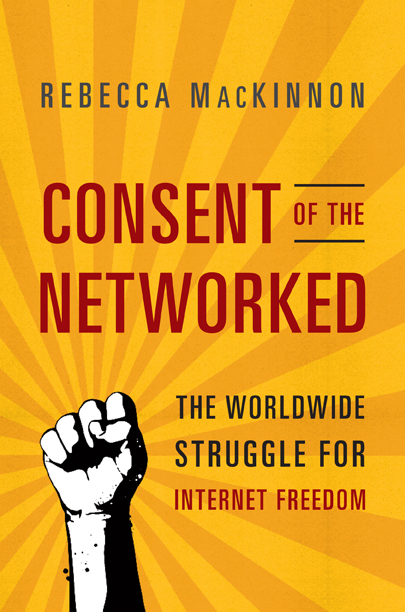
 Rebecca MacKinnon’s new book, Consent of the Networked: The Worldwide Struggle for Internet Freedom, is well-researched exploration of the forces driving Internet developments and policy across the globe today. She serves up an outstanding history of recent global protest movements and social revolutions and explores the role that Internet technologies and digital networks played in those efforts. She also surveys some of the recent policy fights here and abroad over issues such as online privacy, Net neutrality regulation, free speech matters, and the copyright wars. The Consent of the Networked is certainly worth reading and will go down as one of the most important Internet policy books of 2012.
A Call to Action
Of course, it’s not just a history lesson. MacKinnon has also issued a call-to-arms here. As a well-known web activist, MacKinnon has emerged as a leading force in the broad-based, if loosely-defined, “Net freedom” movement. The term “Net freedom,” she notes, means very different things to different people. It’s “like a Rorschach inkblot test: different people look at the same ink splotch and see very different things.” (p. 188) Nonetheless, on the global stage, the Internet freedom movement is fundamentally tied up with efforts to hold both governments and corporate actors more accountable for their actions toward the Netizens, digital networks, and online speech and expression. Continue reading →
 My latest weekly Forbes column (“The Twilight of Copyright?”) considers the future of copyright law and the controversy generated by “Stop Online Piracy Act” (SOPA). [See Ryan Radia’s mega-post for all the details on the SOPA fight.] After co-editing a big book on copyright law with Wayne Crews nine years ago (Copy Fights: The Future of Intellectural Property in the Information Age, Cato Institute, 2002), I decided to stop covering copyright policy altogether. Any attempt to try to find balance in this debate is pretty much futile, and I also got tired of losing friends over the issue. (Nothing starts a good catfight among libertarians like copyright policy.)
I don’t plan to jump back in the fight in a big way, but I felt compelled to say something about SOPA since it represents one of the most sweeping attempts at Internet regulation ever conceived. As much as I detest the culture of free-riding that exists online today, I think extreme solutions like SOPA are never justified. And I’m not even sure it would work in practice. In my
Forbes essay, I wonder aloud about what’s left to try. I lay out three options: (1) Do nothing: Leave the shell of copyright law in place and hope for best; (2) Massive vertical integration: Let conduit guys buy out content owners and let them figure out how to pay content creators; (3) Blanket online compulsory license: Force everyone to pay an embedded fee on broadband or devices to cross-subsidize content.
In the end, I argue that all three solutions have serious drawbacks but, sadly, I don’t really have any fresh ideas to offer. Anyway, read the whole thing if you’re interested in the topic. I think I’m done with it for another decade.
 I’ve written two articles on the Protect IP Act of 2011, introduced last week by Sen. Leahy (D-Vt.).
For CNET, I look at some of the key differences, better and worse, between Protect IP and its predecessor last year, known as COICA.
On Forbes this morning, I have a long meditation on what Protect IP says about the current state of the Internet content wars. Copyright, patent, and trademark are under siege from digital technology, and for now at least are clearly losing the arms race.
The new bill isn’t exactly the nuclear option in the fight between the media industries and everyone else, but it does signal increased desperation. Continue reading →
POLITICO reports that a bill aimed at combating so-called “rogue websites” will soon be introduced in the U.S. Senate by Sen. Patrick Leahy. The legislation, entitled the PROTECT IP Act, will substantially resemble COICA (PDF), a bill that was reported unanimously out of the Senate Judiciary Committee late last year but did not reach a floor vote. As more details about the new bill emerge, we’ll likely have much more to say about it here on TLF.
I discussed my concerns about and suggested changes to the COICA legislation here last November; the PROTECT IP Act reportedly contains several new provisions aimed at mitigating concerns about the statute’s breadth and procedural protections. However, as Mike Masnick points out on Techdirt, the new bill — unlike COICA — contains a private right of action, although that right may not permit rights holders to disable infringing domain names. Also unlike COICA, the PROTECT IP Act would apparently require search engines to cease linking to domain names that a court has deemed to be “dedicated to infringing activities.”
For a more in-depth look at this contentious and complex issue, check out the panel discussion that the
Competitive Enterprise Institute and TechFreedom hosted last month. Our April 7 event explored the need for, and concerns about, legislative proposals to combat websites that facilitate and engage in unlawful counterfeiting and copyright infringement. The event was moderated by Juliana Gruenwald of National Journal. The panelists included me, Danny McPherson of VeriSign, Tom Sydnor of the Association for Competitive Technology, Dan Castro of the Information Technology & Innovation Foundation, David Sohn of the Center for Democracy & Technology, and Larry Downes of TechFreedom.
http://vimeo.com/moogaloop.swf?clip_id=22293715&server=vimeo.com&show_title=1&show_byline=1&show_portrait=1&color=00ADEF&fullscreen=1&autoplay=0&loop=0
CEI-TechFreedom Event: What Should Lawmakers Do About Rogue Websites? from CEI Video on Vimeo.
When it comes to information control, everybody has a pet issue and everyone will be disappointed when law can’t resolve it. I was reminded of this truism while reading a provocative blog post yesterday by computer scientist Ben Adida entitled “(Your) Information Wants to be Free.” Adida’s essay touches upon an issue I have been writing about here a lot lately: the complexity of information control — especially in the context of individual privacy. [See my essays on “Privacy as an Information Control Regime: The Challenges Ahead,” “And so the IP & Porn Wars Give Way to the Privacy & Cybersecurity Wars,” and this recent FTC filing.]
In his essay, Adida observes that:
In 1984, Stewart Brand famously said that information wants to be free. John Perry Barlow reiterated it in the early 90s, and added “Information Replicates into the Cracks of Possibility.” When this idea was applied to online music sharing, it was cool in a “fight the man!” kind of way. Unfortunately, information replication doesn’t discriminate: your personal data, credit cards and medical problems alike, also want to be free. Keeping it secret is really, really hard.
Quite right. We’ve been debating the complexities of information control in the Internet policy arena for the last 20 years and I think we can all now safely conclude that information control is hugely challenging regardless of the sort of information in question. As I’ll note below, that doesn’t mean control is impossible, but the
relative difficulty of slowing or stopping information flows of all varieties has increased exponentially in recent years.
But Adida’s more interesting point is the one about the selective morality at play in debates over information control. That is, people generally expect or favor information freedom in some arenas, but then get pretty upset when they can’t crack down on information flows elsewhere. Indeed, some people can get downright religious about the whole “information-wants-to-be-free” thing in some cases and then, without missing a beat, turn around and talk like information totalitarians in the next breath. Continue reading →
Reputation oils the gears of many markets. People’s expressions of opinion about goods and services help establish the reputations of sellers and service providers. Knowing that they are the subject of reputation systems that they do not control, service providers do a better job on average than they otherwise would. Slacking off even once can sully a reputation and produce well-placed economic sanctions: people won’t do business. Withdrawing reputation information from the public sphere will generally slow the process of winnowing bad actors out of any market and rewarding most highly the good ones. Commercial opinion is a little engine of positive externalities.
Federal privacy regulations under the Health Insurance Portability and Accountability Act shaped the information terms in health care services in ways people are right to disagree with. So it might be tempting to trade away one’s right to criticize a doctor for greater privacy protection. But a new site called DoctoredReviews.com argues against that bargain—indeed, it argues the bargain is illusory—and it criticizes the use of copyright law to enforce the deal.
Apparently, a group called Medical Justice is offering doctors a form contract to give to patients that holds out greater privacy protection for the patient if the patient will refrain from criticizing the doctor. That’s a deal people should be free to make, though—again—it’s probably a bad one. One way that the deal is enforced is by giving the doctor a copyright in the expressions of opinion that patients may issue. This gives the doctor a right to issue “take-down” notices to web sites where content critical of them is found.
This peculiar use of copyright takes the virtuous cycle where a patient talking about an experience with a doctor benefits others, and doesn’t just nip it—bringing it back to zero. It places enforcement costs on third parties. The enforcement of copyrights in commentary pushes negative externalities onto web site operators as it deprives markets of useful information.
The DoctoredOpinions site has a good, concise explanation of the law as it relates to website owners. I think copyright has some explaining to do—its distinction from rights in physical property is in high relief—if its enforcement can draw disinterested and uninvolved third parties into an administrative/litigation vortex.
The English language is public domain (the language itself, not everything said with it). So it’s worthless, right? No dollars change hands when people use it. Perhaps it could be made worth something if someone were to own it. The owner could charge a license fee to people who use English, making substantial revenue on this suddenly valuable language.
Congress can take works in the public domain and make intellectual property of them according to the Tenth Circuit Court of Appeals in a case that approved Congress “restoring” public domain works to copyrighted status. (The case is Golan v. Holder, and the Supreme Court has granted certiorari.)
But would we really be better off if the English language were given a dollar value through the mechanism of ownership and licensing? No. What is now a costless positive-externality machine would turn into a profit-center for one lucky owner. The society would not be better off, just that owner. If we had to pay for a language, we would regard that as a cost.
In a similar vein, Mike Masnick at TechDirt indulges the somewhat tongue-in-cheek observation that Microsoft costs the world economy $500 billion by accumulating to itself that would have gone to other things. It’s a sort of Broken Window fallacy for intellectual property: the idea that creating ownership of intellectual goods creates value. What is not seen when intellectual property is withheld from the public domain is the unpaid uses that might have been made of it.
Now, Microsoft has reaped wonderful benefits from its intellectual creations because it has bestowed wonderful benefits on societies across the globe. But might it have provided all these benefits for slightly less reward, leaving more money with consumers for their preferred uses?
This is all a way of challenging the mental habit of assuming that dollars are equal to value. In the area of intellectual property (whether or not protected by federal statutes), things that have no effect on the economy (because they’re in the public domain) may have huge value. Things privately owned because of intellectual property law may have less value than they should, even though their owners collect lots of money.
It seems peculiar to me that some of the same individuals and groups who so vociferously opposed a “broadcast flag” technological mandate in past years are now in a mad rush to have federal policymakers mandate a “Do Not Track” regulatory regime for privacy purposes. The broadcast flag debate, you will recall, centered around the wisdom of mandating a technological fix to the copyright arms race before digitized high-definition broadcast signals were effectively “Napster-ized.” At least that was the fear six or seven years ago. TV broadcasters and some content companies wanted the Federal Communications Commission (FCC) to recognize and enforce a string of code that would have been embedded in digital broadcast program signals such that mass redistribution of video programming could have been prevented.
Flash forward to the present debate about mandating a “Do Not Track” scheme to help protect privacy online. As I noted in my filing last week to the Federal Trade Commission, at root, Do Not Track is just another “information control regime.” Much like the broadcast flag proposal, it’s an attempt to use a technological quick-fix to solve a complex problem. When it comes to such information control efforts, however, there aren’t many good examples of simple fixes or silver-bullet solutions that have worked, at least not for very long. The debates over Wikileaks, online porn, Internet hate speech, and Spam all demonstrate how challenging it can be to put information back into the bottle once it is released into the digital wild.
To be clear, I am not opposed to technological solutions like broadcast flag or Do Not Track,
but I am opposed to forcing them upon the Internet and digital markets in a top-down, centrally-planned fashion. While I am skeptical that either scheme would work well in practice (whether voluntary or mandated), my concern in these debates is that forcing such solutions by law will have many unintended consequences, not the least of which will be the gradual growth of invasive cyberspace controls in these or other contexts. After all, if we can have “broadcast flags” and “Do Not Track” schemes, why not “flag” mandates for objectionable speech or “Do Not Porn” browser mandates? Continue reading →
 Every once and awhile it’s worth taking a step back and looking at the long view of how Internet policy developments have unfolded and consider where they might be heading next. We’ve reached such a moment as it pertains to efforts to police the Internet for copyright piracy, objectionable online content, privacy violations, and cybersecurity. We’re at an interesting crossroads in this regard since the prospects for successful cracking down on copyright piracy and pornography appear grim. Seemingly every effort that has been tried has failed. The Net is awash in online porn and pirated content. I am not expressing a normative position on this, rather, I’m just stating what now seems to be commonly accepted fact.
In the meantime, the United States is in the process of creating new information control regimes and this time its access to personal information and cybersecurity that are the focus of regulatory efforts. The goal of the privacy-related regulatory efforts is to help Netizens better protect their privacy in online environments and stop the “arms race” of escalating technological capabilities. The goal of cybersecurity efforts is to make digital networks and systems more secure or, more profoundly as we see in the Wikileaks case, it is to bottle up state secrets.
These efforts are also likely to fail. Simply stated, it’s a nightmare to bottle-up information once it’s out there. Continue reading →
On November 18, the Senate Judiciary Committee unanimously approved the “Combating Online Infringements and Counterfeits Act” (COICA). The bill would enable the U.S. Attorney General to obtain a court order disabling access to web domains that are “dedicated to infringing activities.”
These “rogue websites” are a real problem, as the website Fight Online Theft explains, so it’s a good thing that Congress is working to address them. However, some of COICA’s provisions raise profound constitutional concerns, and the bill lacks adequate safeguards to protect against the unwarranted suspension of Internet domain names, as the website Don’t Censor the Net argues. The bill also doesn’t provide a mechanism for website operators targeted by the Attorney General to defend their site in an adversary judicial proceeding. This week, a group of over 40 law professors submitted a letter to the U.S. Senate arguing that COICA, in its current form, suffers from “egregious Constitutional infirmities.”
To address these concerns, CEI is urging Congress to amend COICA to provide for more robust safeguards, including: Continue reading →


 The Technology Liberation Front is the tech policy blog dedicated to keeping politicians' hands off the 'net and everything else related to technology.