Posts tagged as:

I find myself delighted, but also mildly disappointed, by a short speech making the rounds on the Internets, given by Amelia Anderstotter, Swedish Member of the European Parliament representing the Pirate Party. For its forcefulness, the speech misses a key distinction about which advocates of freedom, which I think members of the Pirate Party mean to be, should be very clear.

It’s a delightful speech because it’s a crisp rejection of the authoritarian forces that seek to control communications. In doing so, they hinder the development of culture. The woman delivering the speech is equal parts young, serious, and articulate. I reject authoritarianism, too, and I work to eliminate or hold at bay many of the same forces as Anderstotter, so that civil society can organize itself as it will.

I’m nonplussed, though, by the line that has gotten the speech so much attention.

“I would like to paraphrase George Michael from I think 1992,” she says. “‘Fuck you, this is my culture.’ And if copyright or telecommunications operators are standing in the way, I think they should go.'”

In one sense, the bracing language works. It is what generated a lot of interest in her words. But the context of the quote does not work as well. You see, when confronted with paparazzi photos showing him engaged in late-night cruising at a London park, Michael said, “Are you gay? No? Well then Fuck Off! Because this is my culture and you don’t understand it.” That is vituperation when confronted about arguably unhealthy behavior. It is not the conformity-rejecting line you might have expected in “Freedom! ’90,” presaging Michaels’ dispute with Sony over the release of Listen Without Prejudice Vol. 2.

One should certainly be free to act as Michael did among a community of consenting adults, and to reject criticism as he did. But when a speaker’s job is to persuade skeptics, one might choose an example of contempt for authority that the audience can easily embrace. With this quote, Anderstotter didn’t seat her rejection of authority firmly in logic and justice.

That’s a narrow point about influence, but the real weakness of the speech is in its internal logic. In the name of freedom, she calls for authoritarian regulatory interventions on private-sector network operators.

“[V]ery few top political figures in the world have acknowledged,” she says, that free speech and human rights protection “will require regulatory intervention on some private sectors.”

And later: “The control over communities and the ability to shape them must be with the communities themselves. Infrastructure must be regulated to enable that ability and such autonomy.”

Note how her use of passive voice hides the actor. Infrastructure “must be regulated” to achieve her agreeable goals. By whom? Perhaps one imagines beneficent gods fixing things up, but the regulations she seeks will almost certainly come from “the Governments and … public officials and lobbyists” that she says she wishes would fuck off.

A coherent system of rights does not have internal conflicts. If your freedoms come at the expense of someone else’s, you haven’t sorted out yet what “freedom” is.

Anderstotter is on the right track in many respects. Timid though the debate may be from her perspective, the scope and duration of copyright protection is again controversial among U.S. libertarians and conservatives. But her rejection of authoritarianism is an implicit embrace of authoritarianism at the same time.

With a little sorting out, she and the Pirate Party could get it right. Until then, the cultural reference she brings to mind for me is “meet the new boss, same as the old boss.”


Stan Liebowitz on copyright and incentivesStan Liebowitz, Ashbel Smith Professor of Economics at the University of Texas at Dallas, discusses his paper, “Is Efficient Copyright a Reasonable Goal?” According to Leibowitz, economists could hypothetically calculate the exact copyright terms necessary to incentivize creators to make new works without allowing them to capture “rents,” or profits above the bare minimum necessary. However, he argues, efficiency might not be the best goal for copyright.

Liebowitz argues from a fairness or justice perspective that society should not favor an economically efficient copyright law, but one that treats creators of copyrighted works the same as workers in other types of industries. In other industries, he argues, workers are allowed to capture and keep rents.

Download

Related Links

A few weeks I wrote an intentionally provocative post comparing copyright to Solyndra. My argument was that just as Congress has a knowledge problem and a public choice problem picking the right technologies to subsidize, so does it have these problems when it comes to picking winners and losers when it comes to setting out the contours of copyright.

I’m grateful for all the wonderful feedback I got on that post, and I agree with those who pointed out that a problem with my analogy was that unlike subsidies to Solyndra, copyright doesn’t pick particular politically connected individuals or companies to privilege. I think it’s much more accurate to say that Congress can use copyright to privilege certain classes of well-organized industries or companies.

A case in point that shows how Congress picks winners and losers is being debated right now: the framework that governs digital music broadcasting royalties for satellite radio and internet radio stations like Pandora. Today you pay a different royalty rate for playing a sound recording (like the lasted LMFAO opus) depending on what kind of radio station you are. Satellite radio stations pay 6 to 8 percent of their gross revenues each year in royalties. Pandora, however, pays around 50 percent, and it will likely be more next year. Meanwhile, traditional AM and FM radio stations pay nothing, zip, zero, zilch.

I won’t get into the public choice problems that may have led to this situation, but the fact is that one legacy industry is not just being subsidized with free access to an essential input (sound recordings), but it is also protected. That protection comes at the expense of a new and innovative industry–internet radio–that is being charged punishing rates for the same essential input.

My colleague Matt Mitchell recently published an excellent paper entitled The Pathology of Privilege: The Economic Consequences of Government Favoritism that catalogs the different ways government has favored particular industries. He also shows how this behavior “misdirects resources, impedes genuine economic progress, breeds corruption, and undermines the legitimacy of both the government and the private sector.” The uneven playing field in the digital music space fits right in with the type of privilege he discussed.

Conservatives and libertarians who are wary of such government extensions of privilege should keep their eye on copyright as the source of many such imbalances.

Aereo LogoRyan Radia recently posted an impassioned and eminently reasonable defense of copyright with which I generally agree, especially since he acknowledges that “our Copyright Act abounds with excesses and deficiencies[.]” However, Ryan does this in the context of defending broadcaster rights against internet retransmitters, such as ivi and Aereo, and I have a bone to pick with that. He writes,
[Copyright] is why broadcasters may give their content away for free to anybody near a metropolitan area who has an antenna and converter box, while simultaneously preventing third parties like ivi from distributing the same exact content (whether free of charge or for a fee). At first, this may seem absurd, but consider how many websites freely distribute their content on the terms they see fit. That’s why I can read all the Techdirt articles I desire, but only on Techdirt’s website. If copyright protection excluded content distributed freely to the general public, creators of popular ad-supported content would soon find others reproducing their content with fewer ads.

I think what Ryan is missing is that copyright is not why broadcasters give away their content for free over the air. The real reason is that they are required to do so as a condition of their broadcast license. In exchange for free access to one of the main inputs of their business–spectrum–broadcasters agree to make their signal available freely to the public. Also, the fact that TV stations broadcast to metro areas (and not regionally or nationally) is not the product of technical limitations or business calculus, but because the FCC decided to only offer metro-sized licenses in the name of “localism.” That’s not a system I like, but it’s the system we have.

So, if what the public gets for giving broadcasters free spectrum is the right to put up an antenna and grab the signals without charge, why does it matter how they do it? To me a service like Aereo is just an antenna with a very long cable to one’s home, just like the Supreme Court found about CATV systems in Fortnightly. What broadcasters are looking to do is double-dip. They want free spectrum, but then they also want to use copyright to limit how the public can access their over-the-air signals. To address Ryan’s analogy from above, Techdirt is not like a broadcaster because it isn’t getting anything from the government in exchange for a “public interest” obligation.

Ideally, of course, spectrum would be privatized. In that world I think we’d see little if any ad-supported broadcast TV because there are much better uses for the spectrum. If there was any broadcast TV, it would be national or regional as there is hardly any market for local content. And the signal would likely be encrypted and pay-per-view, not free over-the-air. In such a world the copyright system Ryan favors makes sense, but that’s not the world we live in. As long as the broadcasters are getting free goodies like spectrum and must-carry, their copyright claims ring hollow.

Imagine a service that livestreams major broadcast television channels over the Internet for $4.99 a month — no cable or satellite subscription required. For an extra 99 cents a month, the service offers DVR functionality, making it possible to record, rewind, and pause live broadcast television on any broadband-equipped PC.

If this service sounds too good to be true, that’s because it is. But for a time, it was the business model of ivi. Cheaper than a cable/satellite/fiber subscription and more reliable than an over-the-air antenna, ivi earned positive reviews when it launched in September 2010.

Soon thereafter, however, a group of broadcast networks, affiliates, and content owners sued ivi in federal court for copyright infringement. The court agreed with the broadcasters and ordered ivi to cease operations pending the resolution of the lawsuit.

ivi appealed this ruling to the 2nd Circuit, which affirmed the trial court’s preliminary injunction earlier this month in an opinion (PDF) by Judge Denny Chin. The appeals court held as follows:

  • The rights holders would likely prevail on their claim that ivi infringed on their performance rights, as ivi publicly performed their copyrighted programs without permission;
  • ivi is not a “cable system” eligible for the Copyright Act’s compulsory license for broadcast retransmissions, as ivi distributes video over the Internet, rather than its own facilities;
  • Allowing ivi to continue operating would likely cause irreparable harm to the rights holders, as ivi’s unauthorized distribution of copyrighted programs diminishes the works’ market value, and ivi would likely be unable to pay damages if it loses the lawsuit;
  • ivi cannot be “legally harmed by the fact that it cannot continue streaming plaintiffs’ programming,” thus tipping the balance of hardships in plaintiffs’ favor;
  • While the broad distribution of creative works advances the public interest, the works streamed by ivi are already widely accessible to the public.

As much as I enjoy a good statutory construction dispute, to me, the most interesting question here is whether ivi caused “irreparable harm” to rights holders.

Writing on Techdirt, Mike Masnick is skeptical of the 2nd Circuit’s holding, criticizing its “purely faith-based claims … that a service like ivi creates irreparable harm to the TV networks.” He argues that even though ivi “disrupt[s] the ‘traditional’ way that [the broadcast television] industry’s business model works … that doesn’t necessarily mean that it’s automatically diminishing the value of the original.” Citing the VCR and DVR, two technologies that disrupted traditional methods of monetizing content, Mike concludes that “[t]here’s no reason to think” ivi wouldn’t “help [content owners’] business by increasing the value of shows by making them more easily watchable by people.”

Continue reading →

I’m working on a project looking at libertarian views on copyright (more on that soon), and I’d like to solicit your feedback on an analogy I’m developing. I’ve set up a comment thread at Google+ and I’d sincerely appreciate your thoughts on this post. Email feedback is also appreciated. Here goes…

Libertarians, conservatives and other supporters of a free market tend to be critical of government programs that subsidize particular industries. For example, the loan guarantees that allowed Solyndra to set up shop. We don’t like them because they distort the market and tend to lead to rent-seeking, if not corruption.

Why do we have loan guarantees for renewable energy projects like Solyndra’s solar power technology? Quite simply it’s because we’d like to see more renewable energy technology developed; more than is profitable to develop right now. So, the government offers a subsidy to incentivize the creation of such technology, which will eventually benefit the public at large. So far so good, but there are problems with this kind of government privilege.

First, there is a knowledge problem. How do we know that we’re not already getting the right amount of investment in renewable technologies? Without a government subsidy, there would still be investment in renewable energy technologies. We just think it’s not enough. But even putting aside how we can know that, the other question is, how much investment is optimal? Without a market process to guide investment, we don’t know how much is enough. So when the government offers subsidies, it’s guessing. It’s likely offering too little or too much, with each error introducing its own inefficiencies. Continue reading →

So, the Department of Justice has formally filed suit against Apple and several major book publishers claiming collusion over eBook pricing. Let’s say Apple and the publishers are guilty as charged and in violation of our nation’s antitrust laws. Here’s my opinion on that: So what? What Apple and the publishers are doing here is trying to find a way to sustain creative works in an era when copyright law is slowly dying. As I noted here in a post yesterday, I take no joy in reporting the fact that property rights for intellectual creations no longer function effectively. I wish they did still work, but they are failing rather miserably in an age of highly decentralized digital dissemination. Moreover, I am not prepared to see government go to absurd enforcement extremes in an attempt to make intellectual property rights work. But, that being said, something needs to sustain and cross-subsidize cultural creations in an age of mass piracy. I have increasingly come to believe that consolidation of content and conduit (or devices) is a big part of the answer. Alternatively, some sort of informal collusion among cultural creators and information distributors may be the answer.

Apple and the publishers have figured that out and come up with a plan that keeps intellectual works flowing while making sure that the creators behind them get paid. At a time when copyright critics always say “just find a better business model” Apple and the publishers did just that. But now Department of Justice officials say that business model should be forbidden. That’s crazy.  If we’re going to let copyright die, we should at least grant more pricing and deal-making flexibility to the creative community to structure business arrangements that might give them a lifeline.

But won’t such deals give publishers and other creative artists and industries more pricing power that will help them keep prices up artificially? Yes, of course! That is the whole point! God forbid we actually have to pay something to cultural creators. Ain’t that a scandal. But here’s a news flash: That’s what copyright law was all about, too. It was about helping creators put some fences around their “property” to help them maintain some degree of pricing power for goods with zero marginal cost. The scheme worked brilliantly for many years. It spawned a vibrant marketplace of ideas and helped America become the leading exporter of expressive works on the planet. But now the effectiveness of traditional copyright is fading rapidly. Industry consolidation, cross-promotions, pricing deals, and so on, will increasingly be the “better business model” some will turn to.  So, are we going to allow it? Or will critics just keep mouthing “go find a better business model” and have the government step in every time they don’t like the one industry chooses?  I say let experimentation continue.

Andrew Orlowski of The Register (U.K.) recently posted a very interesting essay making the case for treating online copyright and privacy as essentially the same problem in need of the same solution: increased property rights. In his essay (“‘Don’t break the internet’: How an idiot’s slogan stole your privacy“), he argues that, “The absence of permissions on our personal data and the absence of permissions on digital copyright objects are two sides of the same coin. Economically and legally they’re an absence of property rights – and an insistence on preserving the internet as a childlike, utopian world, where nobody owns anything, or ever turns a request down. But as we’ve seen, you can build things like libraries with permissions too – and create new markets.” He argues that “no matter what law you pass, it won’t work unless there’s ownership attached to data, and you, as the individual, are the ultimate owner. From the basis of ownership, we can then agree what kind of rights are associated with the data – eg, the right to exclude people from it, the right to sell it or exchange it – and then build a permission-based world on top of that.”

And so, he concludes, we should set aside concerns about Internet regulation and information control and get down to the business of engineering solutions that would help us property-tize both intangible creations and intangible facts about ourselves to better shield our intellectual creations and our privacy in the information age. He builds on the thoughts of Mark Bide, a tech consultant:

For Bide, privacy and content markets are just a technical challenges that need to be addressed intelligently.”You can take two views,” he told me. “One is that every piece of information flowing around a network is a good thing, and we should know everything about everybody, and have no constraints on access to it all.” People who believe this, he added, tend to be inflexible – there is no half-way house. “The alternative view is that we can take the technology to make privacy and intellectual property work on the network. The function of copyright is to allow creators and people who invest in creation to define how it can be used. That’s the purpose of it. “So which way do we want to do it?” he asks. “Do we want to throw up our hands and do nothing? The workings of a civilised society need both privacy and creator’s rights.”  But this a new way of thinking about things: it will be met with cognitive dissonance. Copyright activists who fight property rights on the internet and have never seen a copyright law they like, generally do like their privacy. They want to preserve it, and will support laws that do. But to succeed, they’ll need to argue for stronger property rights. They have yet to realise that their opponents in the copyright wars have been arguing for those too, for years. Both sides of the copyright “fight” actually need the same thing. This is odd, I said to Bide. How can he account for this irony? “Ah,” says Bide. “Privacy and copyright are two things nobody cares about unless it’s their own privacy, and their own copyright.”

These are important insights that get at a fundamental truth that all too many people ignore today: At root, most information control efforts are related and solutions for one problem can often be used to address others. But there’s another insight that Orlowski ignores: Whether we are discussing copyright, privacy, online speech and child safety, or cybersecurity, all these efforts to control the free flow of digitized bits over decentralized global networks will be increasingly complex, costly, and riddled with myriad unintended consequences. Importantly, that is true whether you seek to control information flows through top-down administrative regulation or by assigning and enforcing property rights in intellectual creations or private information.

Let me elaborate a bit (and I apologize for the rambling mess of rant that follows).

Continue reading →

On numerous occasions here at the TLF over the past eight years, I’ve noted the profound influence that the late Ithiel de Sola Pool had on my thinking about the interaction of technology, information, and public policy. In fact, when I needed to pick a thematic title for my weekly Forbes column, it only took me a second to think of the perfect one: “Technologies of Freedom.” I borrowed that from the title of Pool’s 1983 masterpiece, Technologies of Freedom: On Free Speech in an Electronic Age. As I noted in my short Amazon.com review, Pool’s technological tour de force is simply breathtaking in its polemical power and predictive capabilities. Reading this book three decades after it was published, one comes to believe that Pool must have possessed a crystal ball or had a Nostradamus-like ability to foresee the future.

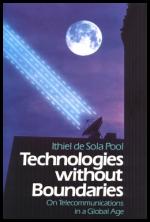
I felt that same was this week when I was re-reading some chapters from his posthumous book, Technologies without Boundaries: On Telecommunications in a Global Age–a collection of his remaining essays nicely edited and tied together by Eli Noam after Pool’s death in 1984. Re-reading it again reminded me of Pool’s remarkable predictive powers. In particular, the closing chapter on “Technology and Culture” includes some of Pool’s thoughts on the future of copyright. As you read through that passage below, please try to remember he wrote these words back in the early 1980s, long before most people had even heard of the Internet and when home personal computing was only just beginning to take off. Yet, from what he already knew about networked computers and digital methods of transmitting information, Pool was able to paint a prescient portrait of the future copyright wars that we now find ourselves in the midst of. Here’s what he had to say almost 30 years ago about how things would play out: Continue reading →

A new report says the opposite, though perhaps “legacy” entertainment companies are failing to keep up.

By any measure, it appears that we are living in a true Renaissance era for content. More money is being spent overall. Households are spending more on entertainment. And a lot more works are being created.

Good news! Check out: “The Sky is Rising.”