Alex Tabarrok, author of the ebook Launching The Innovation Renaissance: A New Path to Bring Smart Ideas to Market Fast discusses America’s declining growth rate in total factor productivity, what this means for the future of innovation, and what can be done to improve the situation.
Accroding to Tabarrok, patents, which were designed to promote the progress of science and the useful arts, have instead become weapons in a war for competitive advantage with innovation as collateral damage. College, once a foundation for innovation, has been oversold. And regulations, passed with the best of intentions, have spread like kudzu and now impede progress to everyone’s detriment. Tabarrok outs forth simple reforms in each of these areas and also explains the role immigration plays in innovation and national productivity.
Download
Related Links
Paul J. Heald, professor of law at the University of Illinois Urbana-Champaign, discusses his new paper “Do Bad Things Happen When Works Enter the Public Domain? Empirical Tests of Copyright Term Extension.”
The international debate over copyright term extension for existing works turns on the validity of three empirical assertions about what happens to works when they fall into the public domain. Heald discusses a study he carried out with Christopher Buccafusco that found that all three assertions are suspect. In the study, they show that audio books made from public domain bestsellers are significantly more available than those made from copyrighted bestsellers. They also demonstrate that recordings of public domain and copyrighted books are of equal quality.
Since copyrighted works will once again begin to fall into the public domain starting in 2018, Heald says, it’s likely that content owners will ask Congress for yet another term extension. He argues that his empirical findings suggest it should not be granted.
Download
Related Links
Joshua Gans, professor of Strategic Management at the University of Toronto’s Rotman School of Management and author of the new book Information Wants to be Shared, discusses modern media economics, including how books, movies, music, and news will be supported in the future.
Gans argues that sharing enhances most information’s value. He also explains that the business models of traditional media companies, gatekeepers who have relied on scarcity and control, have collapsed in the face of new technologies. Equally important, he argues that sharing can revive moribund, threatened industries even as he examines platforms that have, almost accidentally, thrived in this new environment.
Download
Related Links
In anticipation of a hearing in the House Judiciary Committee Wednesday afternoon, Sandra Aistars, executive director of the Copyright Alliance, writes in The Hill about the principles that should guide copyright reform, calling for debate “based in reality rather than rhetoric.”
Chief among these principles is that protecting authors is in the public interest. Ensuring that all creators retain the freedom of choice in determining how their creative work is used, disseminated and monetized is vital to protecting freedom of expression.
Arguing for authors in terms of freedom of choice and expression is good rhetoric, but it’s quite unlike what I expect you’ll hear during Cato’s noon Wednesday forum on copyright and the book Laws of Creation: Property Rights in the World of Ideas.
Authors Ron Cass and Keith Hylton methodically go through each intellectual property doctrine and explore its economic function, giving few words to authors’ “choice” or their “freedom of expression.” They certainly don’t denigrate authors or their role, but Cass and Hylton don’t vaunt them the way Aistars does either.
Recent events in the copyright area are providing much grist for the discussion. You can still register for the book forum, treating it as a warm-up for Wednesday afternoon’s hearing, if your freedom of choice and expression so dictate.
Register here now for next Wednesday’s Cato book forum on Laws of Creation: Property Rights in the World of Ideas.
In the book, Ronald A. Cass and Keith Hylton reject the idea that changing technology undermines the case for intellectual property rights. They argue that making the work of inventors and creators free would be a costly mistake.
That cuts against the bulk of academic opinion today, which is critical of the broad scope and length of intellectual property protections today. The book has qualities that many libertarians will enjoy because it starts with first principles: the theoretical underpinnings and practical benefits of property rights.
By no means does the book answer all the questions, and we’ll have TLF’s own Jerry Brito, the editor of Copyright Unbalanced, on hand to provide commentary.
That’s Wednesday (3/20) at noon in the Cato Institute’s F.A. Hayek auditorium. There’s no such thing as a free lunch, but the sandwiches provided afterwards come at the low cost of learning more dimensions of the intellectual property debate. Register now!
Ronald A. Cass, Dean Emeritus of Boston University School of Law, discusses his new book, Laws of Creation: Property Rights in the World of Ideas, which he co-authored with Boston University colleague Keith Hylton. Written as a primer for understanding intellectual property law and a defense of intellectual property, Laws of Creation explains the basis of IP and its justification.
According to Cass, not all would-be reformers share a similar guiding philosophy, distinguishing between those who support property rights but nevertheless have specific critiques of the intellectual property system as it currently stands, and reformers who do not see a place for property.
Cass explains that the current intellectual property system is neither wholly good nor wholly bad, but is a matter of weighing tradeoffs. On the whole, he argues, intellectual property benefits society. Cass also argues that intellectual property law in the U.S. is still more functional than that in other countries, such as Italy, and that, while it would benefit from some reform, it is fundamentally a workable system.
Download
Related Links
Gabriella Coleman, the Wolfe Chair in Scientific and Technological Literacy in the Art History and Communication Studies Department at McGill University, discusses her new book, “Coding Freedom: The Ethics and Aesthetics of Hacking,” which has been released under a Creative Commons license.
Coleman, whose background is in anthropology, shares the results of her cultural survey of free and open source software (F/OSS) developers, the majority of whom, she found, shared similar backgrounds and world views. Among these similarities were an early introduction to technology and a passion for civil liberties, specifically free speech.
Coleman explains the ethics behind hackers’ devotion to F/OSS, the social codes that guide its production, and the political struggles through which hackers question the scope and direction of copyright and patent law. She also discusses the tension between the overtly political free software movement and the “politically agnostic” open source movement, as well as what the future of the hacker movement may look like.
Download
Related Links
The number of major cyberlaw and information tech policy books being published annually continues to grow at an astonishing pace, so much so that I have lost the ability to read and review all of them. In past years, I put together end-of-year lists of important info-tech policy books (here are the lists for 2008, 2009, 2010, and 2011) and I was fairly confident I had read just about everything of importance that was out there (at least that was available in the U.S.). But last year that became a real struggle for me and this year it became an impossibility. A decade ago, there was merely a trickle of Internet policy books coming out each year. Then the trickle turned into a steady stream. Now it has turned into a flood. Thus, I’ve had to become far more selective about what is on my reading list. (This is also because the volume of journal articles about info-tech policy matters has increased exponentially at the same time.)
So, here’s what I’m going to do. I’m going to discuss what I regard to be the five most important titles of 2012, briefly summarize a half dozen others that I’ve read, and then I’m just going to list the rest of the books out there. I’ve read most of them but I have placed an asterisk next to the ones I haven’t. Please let me know what titles I have missed so that I can add them to the list. (Incidentally, here’s my compendium of all the major tech policy books from the 2000s and here’s the running list of all my book reviews.)
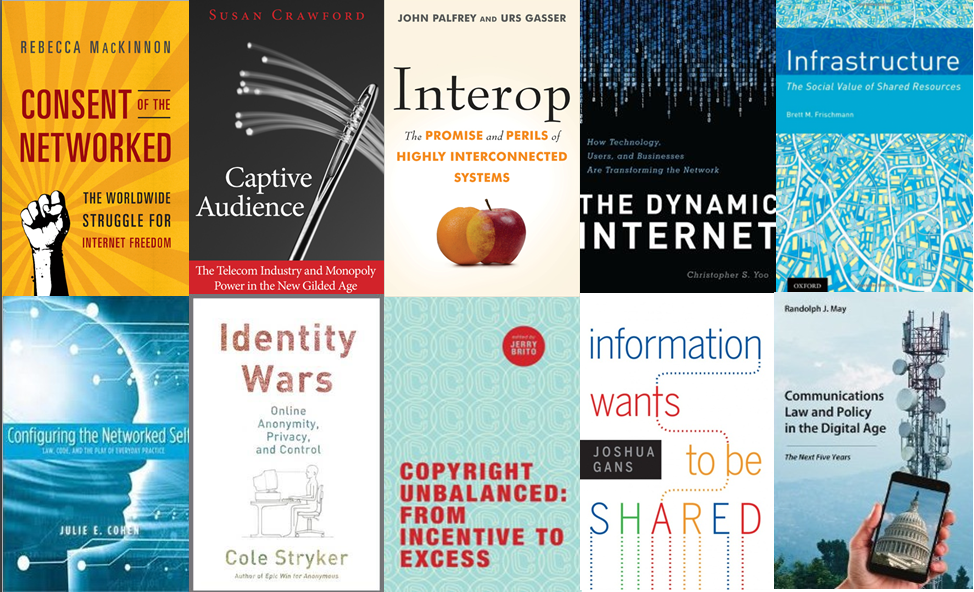
Continue reading →
In last week’s episode of Surprisingly Free, Tom Bell introduced his chapter in Copyright Unbalanced, a new book on the conservative and libertarian case for copyright reform, edited by Jerry Brito. This week, Geoff Manne, lecturer in law at Lewis & Clark Law School and Executive Director of the International Center for Law & Economics, explains how, while also working from libertarian principles, he arrived at a very different view of copyright than either Brito or Bell.
Taking an economic approach to property rights, Manne argues that there is a necessary tradeoff between incentive to create and widespread access. While Manne does recognize the value of widespread use, he says that its benefits must be weighed against the potential breakdown in specialization of labor and the value added by commercialization.
According to Manne, just because someone has exclusive rights to something, doesn’t mean that it won’t be optimally distributed, and, in fact, the highest value ownership right tends to transfer from the creator to the users over time.
Manne concludes that if the government can have any important role, it’s the creation and enforcement of property rights, including copyright, and that that may necessitate new copyright laws.
Download
Related Links
Tom W. Bell, professor of law at Chapman University and author of the concluding essay in Copyright Unbalanced, a new book edited by Surprisingly Free’s own Jerry Brito, discusses the ways in which copyright has evolved over time and why reform is vital.
Bell differentiates copyright from other types of property, arguing that conflating the two terms causes great confusion amongst laypeople and, over time, corrodes the value placed in tangible property rights. According to Bell, copyright is a privilege created by statute that doesn’t exist in a state of nature and is not recognized by common law.
As a special type of economic good, copyright must be treated differently than tangible property rights, according to Bell, who outlines five proposals for copyright reform.
While Bell is not opposed to copyright, he argues that copyright enforcement has gone too far, and lawmakers should structure policies to lead us towards a world in which we conceivably do without it.
Download
Related Links

 The Technology Liberation Front is the tech policy blog dedicated to keeping politicians' hands off the 'net and everything else related to technology.