Posts tagged as:

Firefox logoAs noted in the first installment of our “Privacy Solution Series,” we are outlining various user-empowerment or user “self-help” tools that allow Internet users to better protect their privacy online-and especially to defeat tracking for online behavioral advertising purposes. These tools and methods form an important part of a layered approach that we believe offers an effective alternative to government-mandated regulation of online privacy.

In the last installment, we covered the privacy features embedded in Microsoft’s Internet Explorer (IE) 8. This installment explores the privacy features in the Mozilla Foundation’s Firefox 3, both the current 3.0.7 version and the second beta for the next release, 3.5 (NOTE – The name for the next version of Firefox was just changed from 3.1 to 3.5 to reflect the large number of changes, but the beta is still named 3.1 Beta 2). We’ll make it clear which features are new to 3.1/3.5 and those which are shared with 3.0.7. Future installments will cover Google’s Chrome 1.0, Apple’s Safari 4, and some of the more useful privacy plug-ins for browsers . The availability and popularity of privacy plug-ins for Firefox such as AdBlock (which we discussed here), NoScript and Tor significantly augments the privacy management capabilities of Firefox beyond the capability currently baked into the browser.  In evaluating the Web browsers, we examine:

(1) cookie management; (2) private browsing; and (3) other privacy features

Continue reading →

Google’s new “Interest Based Advertising” (IBA) program represents the company’s first foray into what is generally called “Online Behavioral Advertising” (OBA):  In order to deliver more relevant advertising, Google will begin tailoring ads delivered through AdSense on the Google Content Network (GCN) and YouTube.com (but not Google.com).  This tailoring will be based on a profile of each user’s interests created by tracking their browsing activity across sites that use AdSense-but not search queries or other user information.  Until now, (i) AdSense has delivered essentially “contextual” advertising by choosing which ad to display on a page based on an algorithmic analysis of keywords on that page; and (ii) Google has tracked users’ browsing only for analytics purposes-to limit the number of times a user sees a particular ad (to prevent overexposure) and to allow sequencing of ads in campaigns where one ad must follow another. 

Google is sure to be attacked for crossing a “line in the sand” drawn by some privacy advocates between contextual and behavioral advertising-even though Google’s closest competitor, Yahoo!, already offers a similar program, and the concept in general is hardly new.  Google’s position as the leading search engine and third party ad-delivery network will no doubt cause paroxysms of privacy hysteria among those who consider targeted advertising inherently invasive, unfair or manipulative.

But those whose first priority is advancing consumer privacy, not advancing a political or regulatory agenda, should applaud Google for excluding sensitive categories and for putting the new Ad Preference Manager at the core of the company’s new IBA program.  The Ad Preference Manager sets a new “gold standard” for implementing the principles of Notice and Choice, which have formed the core of both OBA industry self-regulation and the various regulatory proposals made in recent years.  Indeed, Google has done precisely what Adam Thierer and I have called for:  giving consumers more granular control over their own privacy preferences by developing better tools.

Continue reading →

By Adam Thierer, Berin Szoka, & Adam Marcus

IE logoAs noted in the first installment of our “Privacy Solution Series,” we are outlining various user-empowerment or user “self-help” tools that allow Internet users to better protect their privacy online-and especially to defeat tracking for online behavioral advertising purposes.  These tools and methods form an important part of a layered approach that we believe offers an effective alternative to government-mandated regulation of online privacy.

In some of the upcoming installments we will be exploring the privacy controls embedded in the major web browsers consumers use today: Microsoft’s Internet Explorer (IE) 8, the Mozilla Foundation’s Firefox 3, Google’s Chrome 1.0, and Apple’s Safari 4. In evaluating these browsers, we will examine three types of privacy features:

(1) cookie management controls; (2) private browsing; and (3) other privacy features

We will first be focusing on the default features and functions embedded in the browsers. We plan to do subsequent installments on the various downloadable “add-ons” available for browsers, as we already did for AdBlock Plus in the second installment of this series. Continue reading →

As a means of introducing myself to TLF readers, this is an article that I wrote for the PFF blog in September that has not been previously mentioned on the TLF. Most of my other PFF blog posts have been cross-posted by Adam Thierer or Berin Szoka, but I’ve taken ownership of those posts so they appear on my TLF author page.

This is the first in a series of articles that will focus directly on technology instead of technology policy. With an average age of 57, most members of Congress were at least 30 when the IBM PC was introduced in 1981. So it is not surprising that lawmakers have difficulty with cutting-edge technology. The goal of this series is to provide a solid technical foundation for the policy debates that new technologies often trigger. No prior knowledge of the technologies involved is assumed, but no insult to the reader’s intelligence is intended.

This article focuses on cookies–not the cookies you eat, but the cookies associated with browsing the World Wide Web. There has been public concern over the privacy implications of cookies since they were first developed. But to understand them , you must know a bit of history.

According to Tim Berners Lee, the creator of the World Wide Web, “[g]etting people to put data on the Web often was a question of getting them to change perspective, from thinking of the user’s access to it not as interaction with, say, an online library system, but as navigation th[r]ough a set of virtual pages in some abstract space. In this concept, users could bookmark any place and return to it, and could make links into any place from another document. This would give a feeling of persistence, of an ongoing existence, to each page.”[1. Tim Berners-Lee, Weaving The Web: The Original Design and Ultimate Destiny of the World Wide Web. p. 37. Harper Business (2000).] The Web has changed quite a bit since the early 1990s.

Today, websites are much more dynamic and interactive, with every page being customized for each user. Such customization could include automatically selecting the appropriate language for the user based on where they’re located, displaying only content that has been added since the last time the user visited the site, remembering a user who wants to stay logged into a site from a particular computer, or keeping track of items in a virtual shopping cart. These features are simply not possible without the ability for a website to distinguish one user from another and to remember a user as they navigate from one page to another. Today, in the Web 2.0 era, instead of Web pages having persistence (as Berners-Lee described), we have dynamic pages and “user-persistence.”

This paper describes the various methods websites can use to enable user-persistence and how this affects user privacy. But the first thing the reader must realize is that the Web was not initially designed to be interactive; indeed, as the quote above shows, the goal was the exact opposite. Yet interactivity is critical to many of the things we all take for granted about web content and services today.

Continue reading →

Chris Soghoian called out a problem and now takes credit for a fix to the way the Whitehouse.gov Web site delivered third-party cookies – specifically YouTube cookies.

The use of YouTube videos on the President’s site is a Web 2.0-ish improvement, which is welcome, but embedding videos meant that YouTube was placing cookies on the computers of visitors to Whitehouse.gov and – as a natural result – collecting records of people’s visits to that site.

Things got weird when the Whitehouse.gov privacy policy exempted YouTube cookies from the general ban on persistent cookies on federal Web sites.

For videos that are visible on WhiteHouse.gov, a ‘persistent cookie’ is set by third party providers when you click to play a video. . . . This persistent cookie is used by YouTube to help maintain the integrity of video statistics. A waiver has been issued by the White House Counsel’s office to allow for the use of this persistent cookie.

A government entity should not show preference for a particular service provider in a policy like this and the White House should either exempted third-party cookies generally, or not at all.

The federal government’s June, 1999 policy on cookies (formerly found here, but apparently moved) reflects June, 1999 thinking about cookies – as sinister and dastardly. It was a little silly back then, and is more so today.

Continue reading →

The Progress & Freedom Foundation has just launched the new Center for Internet Freedom.  CIF offers an alternative to the proliferation of advocacy groups calling for government intervention online by offering timely analyses and critiques of proposals that diminish the vital role of free markets, free speech and property rights.  We aim to drive the Internet policy debate in new directions by emphasizing a layered approach of technological innovation, user education, user self-help, industry self-regulation, and the enforcement of existing laws consistent with the First Amendment.  Such an approach is a less restrictive—and generally more effective—alternative to increased regulation.  

Here are some of the issues I’ll be working on as CIF’s Director in conjunction with my esteemed colleagues Adam Thierer, Adam Marcus, and adjunct fellows: 

  • Defending online advertising as the lifeblood of online content & services, especially in the “Long Tail”;
  • Emphasizing market solutions to problems of privacy protection, especially regarding the use of cookies and packet inspection data;
  • Protecting online speech and expression both in the U.S. and abroad;
  • Defending Section 230 immunity for Internet intermediaries;
  • Opposing online taxation and legal barriers to e-commerce and digital payments, especially at the state and local levels; and
  • Ensuring that Internet governance remains transparent and accountable without hampering the evolution of the Internet.

By Berin Szoka & Adam Thierer Progress Snapshot 4.19 (PDF)

Since the fall of 2008, a debate has raged in Washington over “targeted online advertising,” an ominous-sounding shorthand for the customization of Internet ads to match the interests of users.  Not only are these ads more relevant and therefore less annoying to Internet users than untargeted ads, they are more cost-effective to advertisers and more profitable to websites that sell ad space.  While such “smarter” online advertising scares some—prompting comparisons to a corporate “Big Brother” spying on Internet users—it is also expected to fuel the rapid growth of Internet advertising revenues from $21.7 billion in 2007 to $50.3 billion in 2011-an annual growth rate of more than 24%. Since this growing revenue stream ultimately funds the free content and services that Internet users increasingly take for granted, policymakers should think very carefully about what’s really best for consumers before rushing to regulate an industry that has thrived for over a decade under a layered approach that combines technological “self-help” by privacy-wary consumers, consumer education, industry self-regulation, existing state privacy tort laws, and Federal Trade Commission (FTC) enforcement of corporate privacy policies.

In an upcoming PFF Special Report, we will address the many technical, economic, and legal aspects of this complicated policy issue-especially the possibility that regulation may unintentionally thwart market responses to the growing phenomenon of users blocking online ads.

We will also issue a three-part challenge to those who call for regulation of online advertising practices:

  1. Identify the harm or market failure that requires government intervention.
  2. Prove that there is no less restrictive alternative to regulation.
  3. Explain how the benefits of regulation outweigh its costs.

Continue reading →

By Adam Thierer & Berin Szoka

The goal of our “Privacy Solution Series,” as we noted in the first installment, is to detail the many “technologies of evasion” (i.e., user-empowerment or user “self-help” tools) that allow web surfers to better protect their privacy online—and especially to defeat tracking for online behavioral advertising purposes.  These tools and methods form an important part of a layered approach that, in our view, provides an effective alternative to government-mandated regulation of online privacy.

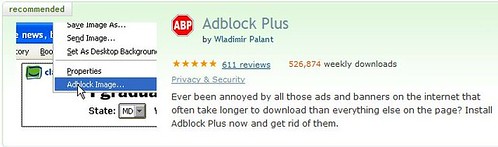
In this second installment in this series, we will highlight Adblock Plus (ABP), a free downloadable extension for the Firefox web browser (as well as for the Flock browser, though we focus on the Firefox version here).

Adblock Plus

Purpose: The primary purpose of Adblock Plus is to block online ads from being downloaded and displayed on a user’s screen as they browse the Web.  In a broad sense, this functionality might be considered a “privacy” tool by those who consider it an intrusion upon, or violation of, their “privacy” to be “subjected” to seeing advertisements as they browse the web.  But if one thinks of privacy in terms of what others know about you, Adblocking is not so much about “privacy” as about user annoyance (measured in terms of distracting images cluttering webpages or simply in terms of long download times for webpages).  In this sense, ABP may not qualify as a “technology of evasion,” strictly speaking.  But, as explained below the fold, ABP does allow its users to “evade” some forms of online tracking by blocking the receipt of some, but not all, tracking cookies.

Cost: Like almost all other Firefox add-ons, both the ABP extensions and the filter subscriptions on which it relies (as described below) are free.

Popularity / Adoption: While there are a wide variety of ad-blocking tools available, Adblock Plus is far and away the leader.  ABP has proven enormously popular since its release in November 2005 as the successor to Adblock, which was first developed in 2002 and reached over 10,000,000 downloads before being abandoned by its developer and even today garners nearly 40,000 downloads a week.  This history of Adblock provides further details.

ABP was named one the 100 best products of 2007 by PC World magazine and is now the #1 most downloaded add-on for Firefox with over 500,000 weekly downloads, up significantly for just a few months.  In a blog post last month, ABP creator Wladimir Palant estimated that “no more than 5% of Firefox users have Adblock Plus installed,” but that percentage is bound to grow larger as more people discover Adblock.  As one indicator of ABP’s popularity, the number of Google searches for “Adblock” has nearly eclipsed the number of searches for “identity theft,” which seems like a far more serious concern than having to look at web ads. Continue reading →

By Adam Thierer & Berin Szoka

Whatever ordinary Americans actually think about online privacy, it remains a hot topic inside the Beltway. While much of that amorphous concern focuses on government surveillance and government access to information about web users, many in Washington have focused on targeted online advertising by private companies as a dire threat to Americans’ privacy — and called for prophylactic government regulation of an industry that is expected to more than double in size to $50.3 billion in 2011 from $21.7 billion last year.

In 1998, when targeted advertising was in its infancy, the FTC proposed four principles as the basis for self-regulation of online data collection: notice, choice, access & security. In 2000, the Commission declared that too few online advertisers adhered to these principles and therefore recommended that Congress mandate their application in legislation that would allow the FTC to issue binding regulations. Subsequent legislative proposals (indexed by CDT by Congress here along with other privacy bills) have languished in Congress ever since. During this time self-regulation of data collection (e.g., the National Advertising Initiative) has matured, the industry has flourished without any clear harm to users and the FTC has returned to its original support for self-regulation over legislation or regulatory mandates.

But over the last year, the advocates of regulation have succeeded in painting a nightmarish picture of all-invasive snooping by online advertisers using more sophisticated techniques of collecting data for targeted advertising. The Federal Trade Commission (FTC) has responded cautiously by proposing voluntary self-regulatory guidelines intended to address these concerns, because the agency recognizes that this growing revenue stream is funding the explosion of “free” (to the user) online content and services that so many Americans now take for granted, and that more sophisticated targeting produces ads that are more relevant to consumers (and therefore also more profitable to advertisers).

Continue reading →