Sherwin Siy, Vice President of Legal Affairs at Public Knowledge, discusses emerging issues in digital copyright policy. He addresses the Department of Commerce’s recent green paper on digital copyright, including the need to reform copyright laws in light of new technologies. This podcast also covers the DMCA, online streaming, piracy, cell phone unlocking, fair use recognition, digital ownership, and what we’ve learned about copyright policy from the SOPA debate.
Download
Related Links
 CBS and Time Warner Cable have been embroiled in a heated contractual battle over the past week that has resulted in viewers in some major markets losing access to CBS programming. When disputes like these go nuclear and signal blackouts occur, it is inevitable that some folks will call for policy interventions since nobody likes it when the content they love goes dark.
While some policy responses are warranted in this matter, policymakers should proceed with caution. Heated contractual negotiations are a normal part of any capitalist marketplace. We shouldn’t expect lawmakers to intervene to speed up negotiations or set content prices because that would disrupt the normal allocation of programming by placing a regulatory thumb too heavily on one side of the scale. This is why I am somewhat sympathetic to CBS in this fight. In an age when content creators struggle to protect their copyrighted content and get compensation for it, the last thing we need is government intervention that undermines the few distribution schemes that actually work well.
On the other hand, Time Warner Cable deserves sympathy here, too, since CBS currently enjoys some preexisting regulatory benefits. As I noted in this 2012
Forbes oped, “Toward a True Free Market in Television Programming,” many layers of red tape still encumber America’s video marketplace and prevent a truly free market in video programming from developing. The battle here revolves around the “retransmission consent” rules that were put in place as part of the Cable Act of 1992 and govern how video distributors carry signals from TV broadcasters, which includes CBS.
But those “retrans” rules are not the only part of the regulatory mess here. Continue reading →
Earlier today on Twitter, I listed what I thought were the Top 5 “Biggest Internet Policy Issues of 2012.” In case you don’t follow me on Twitter — and shame on you if you don’t! — here were my choices:
- Copyright wars reinvigorated post-SOPA; tide starting to turn in favor of copyright reform. [TLF posts on copyright.]
- Privacy still red-hot w ECPA reform, online advertising regs & kids’ privacy issues all pending. [TLF posts on privacy.]
- WCIT makes Internet governance / NetFreedom a major issue worldwide. [TLF posts on Net governance.]
- Antitrust threat looms larger w pending Google case + Apple books investigation. [TLF posts on antitrust.]
- Cybersecurity regulatory push continues in both legislative (CISPA) & executive branch. [TLF posts on cybersecurity.]
Lists like these are entirely subjective, of course, but I am basing my list on the general amount of chatter I tended to see and hear about each topic over the course of the year.
What do you think the top tech policy issues of the year were?
With each passing year, Washington’s appetite for Internet regulation grows. While “Hands Off the Net!” was a popular rallying cry just a decade ago—and was even a shared sentiment among many policymakers—today’s zeitgeist seems to instead be “Hands All Over the Net.” Countless interests and regulatory advocates have pet Internet policy issues they want Washington to address, including copyright, privacy, cybersecurity, online taxation, broadband regulation, among many others.
Rep. Darrell Issa (R-CA) wants to do something to slow down this legislative locomotive. He has proposed the “Internet American Moratorium Act (IAMA), which would impose a two-year moratorium on “any new laws, rules or regulations governing the Internet.” The prohibition would apply to both Congress and the Executive Branch but makes an exception to any rules dealing with national security.
Will Rep. Issa’s proposal make any difference if implemented? Any congressionally imposed legislative moratorium is a symbolic gesture and not a binding constraint since Congress is always free to pass another law later to get around an earlier prohibition. So, in that sense, a moratorium might not change much. Nonetheless, such symbolic gestures are often important and Issa is to be commended for at least trying to raise awareness about the dangers of creeping regulation of online life and the digital economy.
If policymakers really want to take a more substantive step to slow the flow of red tape, they should consider a different approach. Instead of (or, perhaps, in addition to) a two-year legislative moratorium, they should impose a variant of “Moore’s Law” for information technology laws and regulations. “Moore’s Law,” as most of you know, is the principle named after Intel co-founder Gordon E. Moore who first observed that, generally speaking, the processing power of computers doubles roughly every 18 months while prices remain fairly constant.
As I argued in a Forbes column earlier this year, we should apply this same principle to high-tech policy. Continue reading →
 I’ve written several articles in the last few weeks critical of the dangerously unprincipled turn at the Federal Communications Commission toward a quixotic, political agenda. But as I reflect more broadly on the agency’s behavior over the last few years, I find something deeper and even more disturbing is at work. The agency’s unreconstructed view of communications, embedded deep in the Communications Act and codified in every one of hundreds of color changes on the spectrum map, has become dangerously anachronistic.
The FCC is required by law to see separate communications technologies delivering specific kinds of content over incompatible channels requiring distinct bands of protected spectrum. But that world ceased to exist, and it’s not coming back. It is as if regulators from the Victorian Age were deciding the future of communications in the 21
st century. The FCC is moving from rogue to steampunk.
With the unprecedented release of the staff’s draft report on the AT&T/T-Mobile merger, a turning point seems to have been reached. I wrote on
CNET (see “FCC: Ready for Reform Yet?”) that the clumsy decision to release the draft report without the Commissioners having reviewed or voted on it, for a deal that had been withdrawn, was at the very least ill-timed, coming in the midst of Congressional debate on reforming the agency. Pending bills in the House and Senate, for example, are especially critical of how the agency has recently handled its reports, records, and merger reviews. And each new draft of a spectrum auction bill expresses increased concern about giving the agency “flexibility” to define conditions and terms for the auctions.
The release of the draft report, which edges the independent agency that much closer to doing the unconstitutional bidding not of Congress but the White House, won’t help the agency convince anyone that it can be trusted with any new powers. Let alone the novel authority to hold voluntary incentive auctions to free up underutilized broadcast spectrum.
 Continue reading →
This week I will again be attending the Family Online Safety Institute’s excellent annual summit. The 2-day affair brings together some of the world’s leading experts on online safety and privacy issues. It’s a great chance to learn about major developments in the field. As I was preparing for the session I am moderating on Thursday, I thought back to the first FOSI annual conference, which took place back in 2007. What is remarkable about that period compared to now is that there was a flurry of legislative and regulatory activity related to online child safety then that we simply do not see today.
In fact, just 3 1/2 years ago, John Morris of the Center for Democracy and Technology and I compile a legislative index [summary here] that cataloged the more than 30 legislative proposals that had been introduced in the the 110th session of Congress. There was also a great deal of interest in these issues within the regulatory community. Finally, countless state and local measures related to online safety and speech issues had been floated. Today, by contrast, it is hard for me to find any legislative measures focused on online safety regulation at the federal level, and I don’t see much activity at the agency level either. I haven’t surveyed state and local activity, but it seems like it has also died down.
Generally speaking, I think this is a good development since I am opposed to most proposals to regulate online speech, expression, or conduct. But let’s ignore the particular wisdom of such measures and ask a simple question:
What explains the decline in Internet safety legislation and online content regulation? I believe there are three possible explanations: Continue reading →
My latest Mercatus Center white paper is entitled “Kids, Privacy, Free Speech & the Internet: Finding The Right Balance.” From the intro:
Concerns about children’s privacy are an important part of [the ongoing privacy debate]. The Children’s Online Privacy Protection Act of 1998 (COPPA) already mandates certain online-privacy protections for children under the age of 13. The goal of COPPA was to enhance parents’ involvement in their children’s online activities and better safeguard kids’ personal information online. The FTC is currently considering an expansion of COPPA, and lawmakers in the House of Representatives introduced legislation that would expand COPPA and apply additional FIPPS regulations to teenagers. Some state-based measures also propose expanding COPPA
While well-intentioned, efforts to expand privacy regulation along these lines would cause a number of unintended consequences of both a legal and economic nature. In particular, expanding COPPA raises thorny issues about online free speech and anonymity. Ironically, it might also require that
more information about individuals be collected to enforce the law’s parental-consent provisions. There are better ways to protect the privacy of children online than imposing burdensome new regulatory mandates on the Internet and online consumers. Education, empowerment, and targeted enforcement of unfair and deceptive practice policies represent the better way forward.
The paper can be downloaded on SSRN, Scribd, or directly from the Mercatus website at the link above.
The debate over the imposition of sales tax collection obligations on interstate vendors is heating up again at the federal level with the introduction of S. 1452, “The Main Street Fairness Act.” [pdf] The measure would give congressional blessing to a multistate compact that would let states impose sales taxes on interstate commerce, something usually blocked by the Commerce Clause of the U.S. Constitution. Senator Dick Durbin (D-IL) introduced the bill in the Senate along with Tim Johnson (D-SD) and Jack Reed (D-RI). The measure is being sponsored in the House of Representatives by John Conyers (D-MI) and Peter Welch (D-VT). At this time, there are no Republican co-sponsors even though Sen. Mike Enzi was rumored to be a considered co-sponsoring the measure before introduction.
Without any Republicans on board the effort, the measure may not advance very far in Congress. Nonetheless, to the extent the measure gets any traction, it is worth itemizing a few of the problems with this approach. My Mercatus Center colleague Veronique de Rugy and I have done some work on this issue together in the past and we are planning a short new paper on the topic. It will build on this lengthy Cato Institute paper we authored together in 2003, “The Internet Tax Solution: Tax Competition, Not Tax Collusion.” The key principle we set forth was this: “Congress must.. take an affirmative stand against efforts by state and local governments to create a collusive multistate tax compact to tax interstate sales.” “It would be wrong,” we argued, “for members of Congress to abdicate their responsibility to safeguard the national marketplace by giving the states carte blanche to tax interstate commercial activities through a tax compact. The guiding ethic of this debate must remain tax competition, not tax collusion.” Continue reading →
Two privacy bills are already up for consideration. And at yesterday’s Senate Commerce hearing on Consumer Online Privacy, we heard Senator Kerry announce that he will be working on new legislation to regulate online privacy. While we wait to see what Kerry will offer, NetChoice has concerns over the bills we do know about: Rep. Rush’s “Best Practices Act” and the Boucher/Stearns Discussion Draft. Our side-by-side comparison identifies four concerns: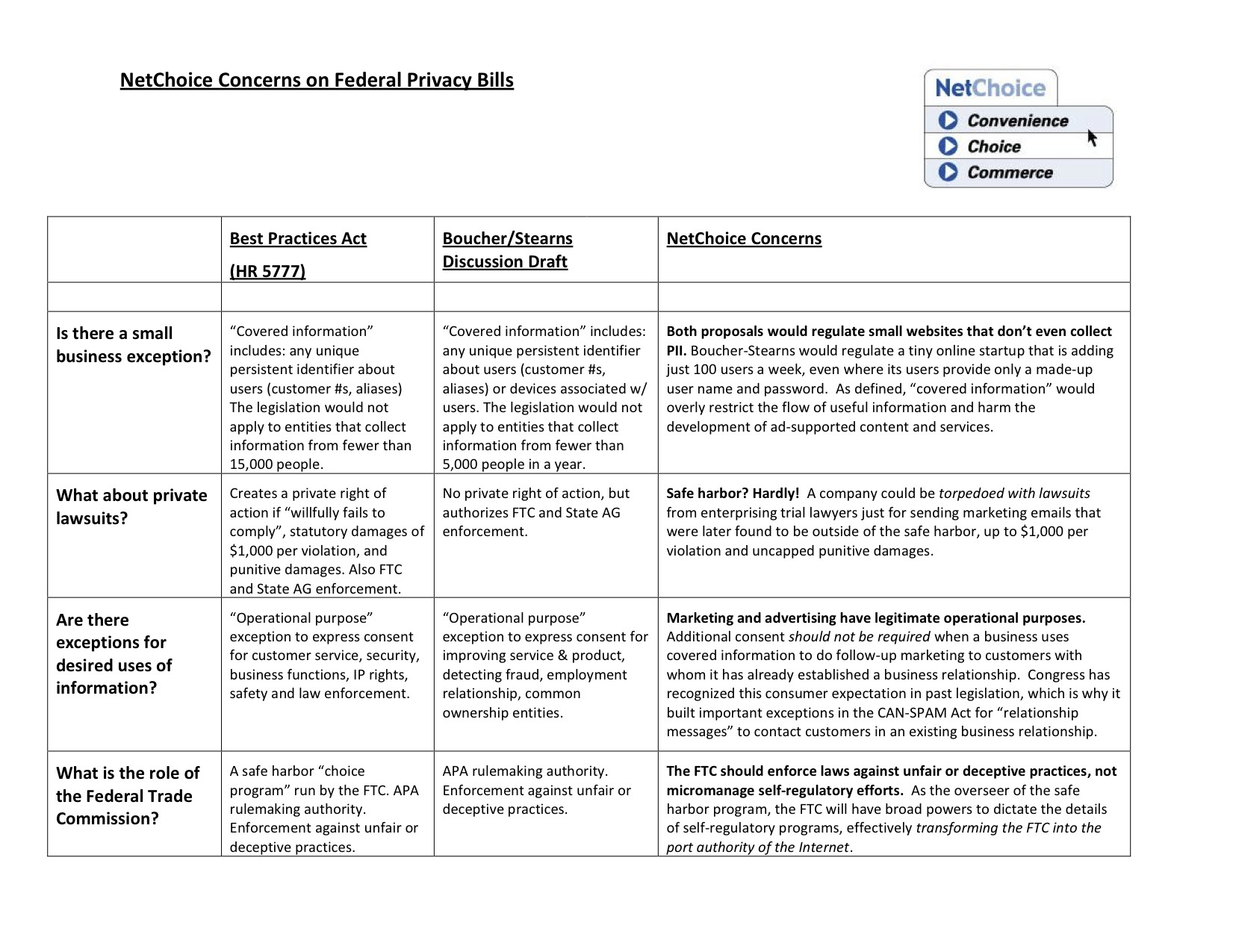
- Both proposals would regulate small websites that don’t even collect PII. Boucher-Stearns would regulate a tiny online startup that is adding just 100 users a week, even where its users provide only a made-up user name and password. As defined, “covered information” would overly restrict the flow of useful information and harm the development of ad-supported content and services. Continue reading →
I was very pleased to hear this announcement today from leading Senate and House Democrats regarding a much-needed update of our nation’s communications laws:
Today, Senator John D. (Jay) Rockefeller IV, Chairman of the U.S. Senate Commerce, Science, and Transportation Committee, Rep. Henry A. Waxman, the Chairman of the House Committee on Energy and Commerce, Senator John F. Kerry, the Chairman of the Senate Subcommittee on Communications, Technology, and the Internet, and Rep. Rick Boucher, the Chairman of the House Subcommittee on Communications, Technology, and the Internet announced they will start a process to develop proposals to update the Communications Act. As the first step, they will invite stakeholders to participate in a series of bipartisan, issue-focused meetings beginning in June. A list of topics for discussion and details about this process will be forthcoming.
This is great news, and an implicit acknowledgment by top Democratic leaders that the FCC most certainly does not have the authority to move forward unilaterally with regulatory proposals such as Net neutrality mandates or Title II reclassification efforts.
I very much look forward to engaging with House and Senate staff on these issues since this is something I’ve spent a great deal of time thinking about over the past 15 years. Most recently, Mike Wendy and I released a paper entitled, “The Constructive Alternative to Net Neutrality Regulation and Title II Reclassification Wars,” in which we outline some of the possible reform options out there. We built upon PFF’s “Digital Age Communications Act Project,” (DACA) which was introduced in February of 2005 with the ultimate aim of crafting policy that is adaptive to the frequently changing communications landscape. You can find all the white papers from the 5 major working groups here. I also encourage those interested in this issue to take a look at the video from this event we hosted earlier this month asking, “What Should the Next Communications Act Look Like?” Lots of good ideas came up there.
Anyway, down below I have included the video from that event as well as a better description of the DACA model for those interested in details about how that model of Communications Act reform would work. I think DACA holds great promise going forward since it represents a moderate, non-partisan approach to reforming communications policy for the better. I pulled this summary from the paper that Mike Wendy and I recently penned: Continue reading →


 The Technology Liberation Front is the tech policy blog dedicated to keeping politicians' hands off the 'net and everything else related to technology.