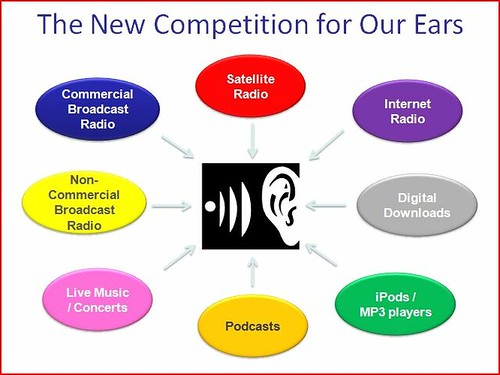
Much ink is spilled over the expanding array of video marketplace choices that are competing for the attention of our eyeballs, but much less is usually written about the competition for our ears. As this excellent new Business Week article by Olga Kharif makes clear, competition and innovation in the audio marketplace has never been more vibrant. It’s something I’ve pointed out here before and here’s a chart I created for my Media Metrics report to highlight all the new competition for our ears. We’ve come a long way since the days of my youth, when transistor radios and vinyl records were the extent of audio competition!
Over at Ars, Ryan Paul has an appropriately sharp-tongued response to the Mozilla Foundation’s troubling move to become a cheerleader for the European Commission’s ongoing antitrust efforts against Microsoft. Apparently Mozilla will assist the EC’s investigation “by offering expertise about the browser market.”
Paul focuses on what’s wrong with this in both a micro and macro sense. He rightly points out that the potential remedies here do not bode well for the future of this sector, since regulatory tinkering with high-tech product standards is bound to end badly and create a terrible precedent for future interventions. “It’s hard to find a rational argument in favor of mandatory standards enforcement,” Paul says. “It would be punitive and unhelpful to the advancement of the web.” Moreover, Paul notes that things have never looked better on the browser front:
Claims that Microsoft’s monopoly status has eliminated competition in the browser market sound hollow in the face of the profoundly vibrant browser market that exists today. The record-setting launch of Firefox 3 added up to over 8 million downloads in the first 24 hours alone. Firefox’s global market share continues to climb every month and the browser has grabbed almost 30 percent of the European market.
And let’s not forget about those two little companies called Google and Apple who have competing products in the field! They’re making serious inroads in the browser wars. Moreover, Microsoft is struggling to hold on to whatever “dominance” they have left in their core market: OS. As Paul concludes:
To the observant tech enthusiast, all signs seem to indicate that Microsoft’s monopoly is on its way out. The Redmond giant is in no danger of annihilation, but it’s definitely not positioned to dictate terms to the rest of the industry anymore.
But what is perhaps most shocking about Mozilla’s call for intervention is the way that Mozilla Foundation chairperson Mitchell Baker minimizes the importance of not just Firefox, but the entire open source movement, when justifying EC intervention in this marketplace.
Continue reading →
Those who criticize Google as a “monopoly” usually focus on the search and advertising markets. Google may indeed have a huge lead in those markets, but it is by no means a “monopoly” in the strict sense of the word as the only (“mono-“) seller in that market.
If the critics are concerned about about true “monopoly” or at least something close to it, perhaps they ought to focus on Feedburner, the free service Google acquired back in 2007. If one takes a very narrow definition of the service Feedburner offers, one could argue that there is no real alternative to Feedburner. But on the other hand:
I have a very simple solution. I use my own RSS feed I don’t need some other company providing a enhanced solution. I have never understood why people used feedburner at all.
Getting statistics from a feed is elementary. There are several services out their that provide podcast statistics.
Stupidity in giving someone else control over ones feed is something I will never get. I have no sympathy for those having feedburner issues.
Regardless, some leading bloggers have expressed outrage over Feedburner’s less-than-perfect reliability—see this recent rant by Michael Arrington. But we call in the federales to “fix” the “problem”—if one properly apply that term to a free service beloved by (nearly all) bloggers everywhere just because it’s not absolutely, positively 100% reliable or instantaneous or simply because some people don’t like the idea of using yet another Google product, no matter how good it is—let’s see what Feedsqueezer, a soon-to-be-launched service, will offer.
Note: The word “monopoly” is now commonly used to mean “control that makes possible the manipulation of prices.” It’s not obvious what that would mean in the case of those Google services, that are both free to the user and not directly related to any price paid by, say an advertiser—as distinct from, say, Adwords or Adsense, where there are at least prices that might, in theory, be controlled.
As Berin and I have noted here before (here and here), there seems to be no shortage of competition and innovation in the mobile operating system (OS) space. We’ve got:
- Apple’s iPhone platform,
- Microsoft’s Windows Mobile,
- Symbian,
- Google’s Android,
- BlackBerry,
- Palm OS (+ Palm’s new WebOS),
- the LiMo platform, and
- OpenMoko.
I am missing any? I don’t think so. Even if I have, this is really an astonishing degree of platform competition for a network-based industry. Network industries are typically characterized by platform consolidation over time as both application developers and consumers flock to just a couple of standards — and sometimes just one — while others gradually fade away. But that has not yet been the case for mobile operating systems. I just can’t see it lasting, however. As I argued in my essay on “Too Much Platform Competition?,” I would think that many application providers would be clamoring for consolidation to make it easier to develop and roll out new services. Some are, and yet we still have more than a half-dozen mobile OS platforms on the market.
Regardless, the currently level of platform competition also seems to run counter to the thesis set forth by Jonathan Zittrain and others who fear the impending decline or death of digital “generativity.” That is, technologies or networks that invite or allow tinkering and all sorts of creative uses are supposedly “dying” or on the decline because companies are trying to exert more control over proprietary or closed systems.
Continue reading →
Continuing the “Cutting the (Video) Cord” series started by my PFF colleague Adam Thierer: The WSJ had two great pieces yesterday about the increasing competitive relevance of television distributed by Internet—a trend that was at the heart of an amicus
brief PFF recently filed in support of C omcast’s challenge of the FCC’s 30% cap on cable ownership. The first WSJ piece declares that:
After more than a decade of disappointment, the goal of marrying television and the Internet seems finally to be picking up steam. A key factor in the push are new TV sets that have networking connections built directly into them, requiring no additional set-top boxes for getting online. Meanwhile, many consumers are finding more attractive entertainment and information choices on the Internet — and have already set up data networks for their PCs and laptops that can also help move that content to their TV sets.
The easier it is for consumers to receive traditional television programming (in addition to other kinds of video content) distributed over the Internet on their television, the less “gatekeeper” or “bottleneck” power cable distributors have over programming. So the Netflix-capable and Yahoo-widget-capable televisions described by the WSJ piece go a long way to increasing the substitutability of what we call Internet Video Programming Distributors (IVPDs) for Multichannel Video Programming Distributors (MVPDs), such as cable, satellite television and fiber services offered by telcos such as Verizon’s FiOS.
While such televisions are only expected to reach 14% of all TV sales by 2012, one must remember that a growing number of set-top boxes (
e.g., the Roku Digitial Video Player, game consoles like the Microsoft XBox 360 and Sony PlayStation 3, and TiVo DVRs) allow users to users to receive IVPD programming on their existing televisions.
As we argued in our amicus brief, the immense competitive importance of IVPDs lies not in the potential for some users to “cut the cord” to cable and other MVPDs (though that will surely happen), but in the immediate impact IVPDs have as an alternative distribution channel for programmers. In the pending D.C. Circuit case, we argue that both the FCC’s 30% cap, issued in December 2007, and the underlying portions of the 1992 Cable Act authorizing such a cap should be struck down as unconstitutional because the ready availability of IVPDs as an alternative distribution channel means that cable no longer has the “special characteristic” of gatekeeper/bottleneck power that would justify imposing such a unique burden on the audience size of cable operators. (Of course, Direct Broadcast Satellite and Telco Fiber are also eating away at cable’s share of the MVPD marketplace.)
The second WSJ piece, an op/ed, illustrates beautifully how cable operators are already losing “market power” (or at least negotiating leverage) in a very tangible way: they’re having to pay more for programming. Specifically, the Journal describes how Viacom plaid chicken with Time Warner—and won. Continue reading →
Microsoft’s share of the browser market across all versions of Internet Explorer has dropped, by one estimate, dropped from 78.58% in December 2007 to 68.15% in December 2008 (or by just under 8% in another estimate).
[IE’s] share dropped from 69.77% in November to 68.15% in December. [During the same period,] Firefox gained more than half a point and ended up at 21.34%, Safari approaches the [10%] hurdle with 7.93% and Chrome came in at 1.04%, the first time Google was able to cross the 1% mark.
This is particularly interesting:
Since IE6 is used primarily within corporations, its market share is much higher during the week than it is on weekends. As a result, all other browsers gain on weekends and especially during a holiday. Because of that circumstance, Net Applications noted that the December numbers should be taken with a grain of salt. However, it is worth the note that IE6 achieved … market share numbers of about 28% during the week and about 21% on weekends in early 2008. In December, these numbers were down to about 20% during the week and 15% on weekends.
So, Microsoft still has an established base among corporate users, where IT administrators generally prevent employees from installing new applications (including browsers) and the sysadmins often don’t roll out alternative browsers across a corporate network for any one of several possible reasons, including:
- They just don’t want to bother having to install, regularly upgrade and support another piece of software;
- They may overestimate the security vulnerability of such alternative browsers compared to Internet Explorer;
- The crustier sysadmins may not realize that today’s browsers are not only free for individual users, but also for corporate users–unlike the old Netscape Navigator; and
- Corporate intranets may be designed for IE, in which case rolling out an alternative browser might cause confusion among less tech-savvy employees.
Microsoft may still have an advantage that could be considered “unfair,” but so what? Continue reading →
As TLF readers may know, I took over in July as Chairman of the Board of the Space Frontier Foundation. As I explained in my recent interview on The Space Show, SFF has been the leading citizens’ advocacy group for space commercialization since 1988. Dedicated to promoting Princeton physicist Gerard O’Neill‘s vision of space settlement, as described in his 1976 masterpiece The High Frontier, the Foundation has always argued that “space is a place, not a program.”
We sent out the following press release on October 28, calling for a major transformation of the U.S. government’s space program by which the U.S. government would buy commercial transportation to the International Space Station. We’ll have more to say about this in the coming weeks.
Space Frontier Foundation Finds Funding Source for COTS-D
 The Space Frontier Foundation today called upon Presidential candidates Barack Obama and John McCain to invest the $2 billion in new funds they have promised to NASA for reducing the “Gap” in U.S. human spaceflight (after the Space Shuttle is retired in 2010) to spur innovation and competition in America.
Foundation Chairman Berin Szoka said “It’s time that our national leaders give American entrepreneurs a shot at closing this gap. Let’s take the two billion dollars in the candidates’ plans and fund up to five winners of COTS-D.”
The NASA Authorization Act of 2008, recently signed into law by the President, directs NASA to “issue a notice of intent [by mid-April 2009] … to enter into a funded, competitively awarded Space Act Agreement with two or more commercial entities’ for transporting humans to the ISS”-the “Capability D” of NASA’s Commercial Orbital Transportation Services program (or COTS-D for short). But that directive is not yet funded.
Szoka continued, “Let’s have an American competition in space – to create good jobs, fuel innovation, and close the gap more quickly. With private funds matching government’s investment, we can dramatically leverage the $2 billion to produce breakthroughs in a new American industry – commercial orbital human spaceflight.” Continue reading →
The Federal Circuit significantly limited the patentability of software and business methods today. Mike Masnick at TechDirt summarizes the holding of the case as follows:
the court has said that there’s a two-pronged test to determine whether a software of business method process patent is valid: (1) it is tied to a particular machine or apparatus, or (2) it transforms a particular article into a different state or thing. In other words, pure software or business method patents that are neither tied to a specific machine nor change something into a different state are not patentable.
I’m sure several of my TLF colleagues will have a great deal to say about this. Tim Lee has already written about this on Ars Technica:
The Bilski decision, then, is a clear signal that the pendulum has begun to swing back toward tighter limits on software and business patents. However, it remains to be seen how far the court will go in this direction. Bilski was a relatively easy case. The applicant made little effort to hide the fact that he was seeking to patent a mental process, something the Supreme Court has clearly said is not allowed. Therefore, the Federal Circuit’s rejection of this patent doesn’t tell us how it will rule when confronted with software or business method patents that are tied more directly to a physical machine or a transformation of matter. And indeed, the Federal Circuit reiterated that some software and business method patents are valid, so we are unlikely to return to the near-prohibition on such patents that prevailed until the early 1980s.
Thoughts?
Debates about online privacy often seem to assume relatively homogeneous privacy preferences among Internet users. But the reality is that users vary widely, with many people demonstrating that they just don’t care who sees what they do, post or say online. Attitudes vary from application to application, of course, but that’s precisely the point: While many reflexively talk about the “importance of privacy” as if a monolith of users held a single opinion, no clear consensus exists for all users, all applications and all situations.
If a picture is worth a thousand words, this picture makes the point brilliantly—showing:
locations where [Flickr] users are more likely to post their photos as “public,” which is the default setting, in green. Places where Flickr users are more likely to put privacy controls on their photos show up in red.

Of course, geography is just one dimension across which users may vary in their attitudes about privacy, but the map makes the basic point about variation very well. Seeing what users
actually do in real life says a lot more about their preferences than merely polling them about what they think they care about in the abstract—as my colleagues Solveig Singleton and Jim Harper argued brilliantly in their 2001 paper With A Grain of Salt: What Consumer Privacy Surveys Don’t Tell Us (SSRN).

 Google has just
  The Technology Liberation Front is the tech policy blog dedicated to keeping politicians' hands off the 'net and everything else related to technology.