Posts tagged as:

I like the idea of having a neutral Internet that allows me to go where I want to go and read what I want to read, all for the price of my monthly subscription.  Sure, it took me awhile to figure out why anyone would want to access skype on an iphone (after all, an iphone is already a phone!), but now I can see why some people might enjoy making free international calls without having to plop down in front of the ol’ PC wedged into the guest bedroom.

At the same time, I don’t see a pressing need for regulation to ensure that we get whatever degree of neutrality is practical. Even in his speech announcing that he would propose net neutrality rules, FCC Chairman Genachowski could cite only the same three old anecdotes that have been tirelessly trotted out by others as proof that new regulation is required.  Sure, by Washington standards, that’s two more anecdotes than are usually required to justify issuing a regulation. But it’s hardly proof of a broad, systemic problem that requires new rules (as Jerry Brito and I argued here.)

Nevertheless, as the saying goes, “You can’t beat something with nothing.”  So I suggest a positive agenda to promote sustainable net neutrality. 

Many of the arguments for a non-neutral net are based on the assumption that last-mile bandwidth is, at least sometimes, congested — or may soon become that way as people use more bandwidth-intensive applications. One solution is for the network operator to prioritize some packets over others, so if I have a heart attack, my wife’s VOIP call for an ambulance doesn’t get crowded out by the neighbor’s kid playing video games with his buddies in Australia.  Another solution, though, is to make sure the network operators have adequate ability and incentive to build plenty of bandwidth. As an economist, I understand that some network management or usage-based pricing might be less expensive for consumers than building massive bandwidth. But that’s no reason to persist with policies that artificially constrain bandwidth. 

For wired broadband, a positive agenda to promote sustainable net neutrality means avoiding regulations that impair incentives for investment that increases the capacity of the last-mile network. For wireless broadband, that means freeing up more spectrum to be auctioned for commercial wireless services.  

And while you’re at it, FCC, maybe you can do something about the NIMBY problem that prevents me from receiving a decent 3G broadband signal in my house.  Now that would expand last-mile bandwidth and promote competition to boot!

Last night here on the TLF, Bret Swanson raised a number of objections with this FCC-commissioned report about international broadband comparisons, which was conducted by some folks at Harvard University’s Berkman Center. Meanwhile, over at the Digital Society blog, George Ou also offers a hard-nosed look at the Berkman broadband report and concludes “The underlying data cited by Berkman study is simply too flawed to be of any use.”  I recommend everyone check out both essays.  It will be interesting to hear how the Berkman folks respond.  Some of these international broadband comparisons are really fishy.  [Here’s a podcast we did on that issue two years ago.]

One quick point… Like Bret, I also found it shocking that–even though the report reads like an ode to forced access regulation–the Berkman folks didn’t spend much time discussing the result of America’s previous open-access regime. “The gaping, jaw-dropping irony of the report,” Bret argues, “was its failure even to mention the chief outcome of America’s previous open-access regime: the telecom/tech crash of 2000-02. We tried this before. And it didn’t work!”  Indeed, America’s regulatory experiment with forced access regulation involved a lot of well intentioned laws and regulation, and too many acronyms to count–CLECs, TELRIC, UNE-P, etc– but it did not result in serious, facilities-based competition.  Instead it offered us the fiction of competition through network-sharing, or what Peter Huber once referred to as building “networks out of paper.” The results were disastrous for investment during that period since regulatory uncertainly led to a lot of stunted innovation.

In sum, sharing is not competing.  You can socialize and commoditize old pipes for awhile and get decent results in the short-term, but you’ll sacrifice long-run investment and innovation if you do.  [For more background, see my recent essay on “The Fiction of Forced Access ‘Competition’ Revisited” and this old Cato piece on “UNE-P and the Future of Telecom “Competition” as well as Jeff Eisenach’s PFF white paper, “Broadband Policy: Does the U.S. Have It Right After All?”]

WalMartWal-Mart is often cast as a villain by some labor unions, local politicians and small retailers, but for the average consumer Wal-Mart has been a savior: A relentless price-cutting machine that instantly changes the dynamics of every market it touches. Indeed, when Wal-Mart decides to jump into a sector by offering a new good or service in its stores, something akin to “the Southwest effect” on steroids kicks in: That market segment is often transformed overnight in that the good or service Wal-Mart starts delivering is essentially instantly commoditized. For the seller of that good or service, this is both a blessing and a curse: They gain the massive market reach that goes along with being in Wal-Mart’s 8,000 retail stores. On the other hand, they instantly surrender any semblance of pricing power they once had.  And this typically also puts downward pressure on prices not just for the particular good carried in the Wal-Mart stores, but for that entire market segment more generally. [This exact scenario is currently playing out in the book marketplace as Wal-Mart has gone to war with Amazon in cost-cutting bonanza.]

The reason I bring all this up is because, as most of you probably already heard, Wal-Mart jumped into the prepaid cell phone business this week with the launch of Straight Talk:

a new solution in no-contract cellular, exclusively at more than 3,200 Walmart stores nationwide starting October 18, 2009. Straight Talk will bring to the market a new low price for no-contract wireless service with two prepaid plans now available to customers nationwide at $30 and $45 a month. Straight Talk will only be available in Walmart stores and online at www.Walmart.com and www.StraightTalk.com. The average U.S. adult spends $78 on his or her cell phone bill to receive 1000 minutes a month. By switching to the $30 Straight Talk plan, for example, the average 1,000 minutes-per-month consumer could save more than $500 per year and still be on a reliable nationwide network.

I don’t want to overplay the significance of this development, but I really do believe that Wal-Mart’s presence in this field is significant, at least for entry-level mobile phones. While it would be easy for those of us who use more advanced smartphones to shrug off the Wal-Mart announcement, it would be a mistake for reasons made clear by David Worthington over at Technologizer: Continue reading →

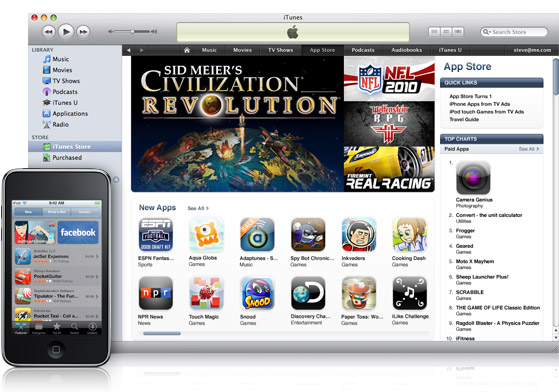
FCC Chairman Julius Genachowski suggested at an FCC field hearing this week that the federal government might create its own “version of iTunes.” Multichannel News reports: Itunes Store

The chairman asked panelists to think about the value of a clearinghouse where best practices could be shared. He suggested that might be a way to spur the spin-off of public-sector apps from private sector initiatives and to prevent reinventing the wheel, rather than tapping into what is already being done. There is not a lot of shared info out there, he said.

If all we’re talking about is a clearinghouse that provides easy access to apps for government-developed apps, Google Code or SourceForge may be a better model than iTunes—though perhaps without the instant name recognition by ordinary consumers. Like SourceForge, Google Code allows hosting and management of open source projects, including Google’s own products. iTunes, by contrast, essentially offers consumers finished apps. Also, iTunes is a stand-alone piece of software, of which the Apps Store is  just one part, while I can’t imagine why Genachowski’s “store” need be anything more than a website.

Whatever the analogy, such a “store” could well be a valuable tool for sharing the benefits of software development by government employees, both with the private sector and among federal agencies as well as state, local and even foreign governments. But what, exactly, Genachowski had in mind for the store remains awfully vague: Multichannel News mentions, as examples, “applications that do everything from monitoring heart rates and blood sugar to checking for greenhouse gas levels.” If the idea ever goes anywhere, it should be based on two principles:

  1. All apps should be open source and available to all users to use as they see fit.
  2. The store should be limited to apps developed by government employees to meet the needs of government agencies.

Continue reading →

Today is the filing deadline in a somewhat unusual Federal Communications Notice of Inquiry that asks how the commission should revise its framework for evaluating competition in mobile wireless communications. Among other things, the FCC asks how it should measure wireless companies’ profits. It’s clear from an earlier public notice issued by the FCC’s Wireless Bureau that regulators are looking for a way to identify “abnormal” profits that might justify new regulation.

For 13 years, Congress has required the FCC to issue annual reports on wireless competition.  These reports have usually found that wireless is pretty competitive by most conventional measures. There are now four national competitors, numerous regional ones that are growing larger, and a bunch of resellers.   The FCC’s most recent report provides numerous examples of innovation in technology, pricing, and services. 

About the only fly in the ointment is federal policies that severely limit the amount of spectrum allocated for “flexible use.”  Limits on the amount of flexible use spectrum are like taxi medallions: they hinder entry and  limit the amount of service the wireless firms can offer.

Nevertheless, the wireless industry’s performance has been impressive. Adjusted for inflation, average revenue per minute fell by 87 percent between 1997 and 2007, and average voice revenue per minute fell by 90 percent.  Just during the last five years, inflation-adjusted average revenue per minute fell by 53 percent, and average voice revenue per minute fell by 61 percent.

Could regulation improve on these outcomes? In our comments to the FCC, Jerry Brito and I offer a little thought experiment.  Suppose the wireless industry were subject to enlightened, highly efficient, and perfectly operating price regulation. Specifically, suppose the FCC had mandated a version of “incentive” regulation that allowed the wireless companies to increase their prices by no more than the rate of increase in the consumer price index minus an annual 7 percent offset to reflect increased productivity. (Seven percent is the highest productivity offset we’ve seen any telecommuncations regulator in the U.S. use in any context.) Would this be better or worse than what the market actually produced?

Wireless market vs incentive regs

This graph shows the answer.  If wireless had been subject to incentive regulation, even a 7 percent productivity offset would have reduced wireless revenue per minute by only 36 percent since 1997 and by 19 percent since 2002.  In other words, the lightly regulated wireless market produced price reductions nearly 2.5 times as large as those that could have been expected under severe, highly efficient, perfectly operating regulation. And these results measure only the price effects, not the explosion of innovation that accompanied the price reductions.

Would the results have been even better if more spectrum were available for wireless services?  Probably. But beyond that step, it’s doubtful that regulators could have done much else to improve on the 90 percent price reduction we’ve seen in the past decade.

In a week in which neutrality regulation is making a lot of news, I hope that Robert Hahn and Hal Singer’s terrific new study, “Why the iPhone Won’t Last Forever and What the Government Should Do to Promote its Successor” gets some attention. It provides a wonderful overview of how dynamically competitive the mobile marketplace has been over the past two decades and why critics are wrong to get worked up about the short-term “dominance” of Apple’s iPhone. Here’s the abstract of their paper:

Because of the overwhelming, positive response to the iPhone as compared to other smart phones, exclusive agreements between handset makers and wireless carriers have come under increasing scrutiny by regulators and lawmakers. In this paper, we document the myriad revolutions that have occurred in the mobile handset market over the past twenty years. Although casual observers have often claimed that a particular innovation was here to stay, they commonly are proven wrong by unforeseen developments in this fast-changing marketplace. We argue that exclusive agreements can play an important role in helping to ensure that another must-have device will soon come along that will supplant the iPhone, and generate large benefits for consumers. These agreements, which encourage risk taking, increase choice, and frequently lower prices, should be applauded by the government. In contrast, government regulation that would require forced sharing of a successful break-through technology is likely to stifle innovation and hurt consumer welfare.

“New technologies often seemingly emerge from nowhere, but also frequently lose their luster quickly,” Hahn and Singer go on to argue. As evidence they cite the recent examples of Second Life and MySpace, which were hyped as potentially become dominant providers in their respective areas just a few years ago, but now are subjected to intense competition. “[T]he the mobile handset market is subject to these same disruptive forces,” they argue: Continue reading →

Schumpeter ColumnI’m thrilled to hear that the Economist has just launched a new column about business, innovation and entrepreneurship in honor of Joseph Schumpeter (1883-1950), the brilliant Austrian economist who,

argued that innovation is at the heart of economic progress. It gives new businesses a chance to replace old ones, but it also dooms those new businesses to fail unless they can keep on innovating (or find a powerful government patron). In his most famous phrase he likened capitalism to a “perennial gale of creative destruction”. For Schumpeter the people who kept this gale blowing were entrepreneurs. He was responsible for popularising the word itself, and for identifying the entrepreneur’s central function: of moving resources, however painfully, to areas where they can be used more productively. But he also recognised that big businesses can be as innovative as small ones, and that entrepreneurs can arise from middle management as well as college dorm-rooms.

Schumpeter’s work on the dynamism of high-tech markets (later married with Clayton Christensen‘s concept of “disruptive innovation“) is one of the most persistent themes across cyber-libertarian thinking of all stripes on a wide variety of issues. You can listen to an interview with the new column’s author on the Economist podcast here (MP3). One important point the author makes is that Schumpeter realized that celebrating capitalism did not preclude criticizing individual capitalists when justified and vice versa—something all too often forgotten today.

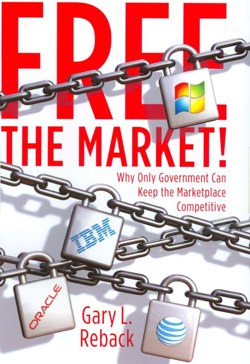
Reback book coverI recently finished reading Free the Market: Why Only Government Can Keep the Marketplace Competitive, a new book by noted antitrust agitator Gary L. Reback. Unsurprisingly, Reback, who led the antitrust jihad against Microsoft during the 1990s, has written a book that reads like an extended love letter to antitrust law. This man loves antitrust the way teenage girls love the Jonas Brothers — gushing, teary-eyed, ‘I-would-just-die-for-you’ sort of love.  In Reback’s world, antitrust seemingly has no costs, no downsides, no trade-offs.  It is our salvation and he serves as its high prophet. Everything good that happened in the world of high-tech over the past few decades?  Oh, you can thank Almighty Antitrust for that.  Anything bad that happened?  Well, then, clearly there just wasn’t enough antitrust enforcement!  That’s this book in a nutshell.

Think I’m kidding?  How about this gem of quote from pg. 247: “Antitrust enforcement spawned Silicon Valley’s software industry as well.”  Wow, who knew!  Of course, that’s utter poppycock and should be somewhat insulting to the many entrepreneurial men and women in the high-tech world who risked everything in an attempt to build a better mousetrap. In Reback’s view of things, however, none of those mousetraps would have ever gotten built without antitrust there to supposedly shelter them from wicked “monopolists” (read: any large company) already operating in the marketplace.   I’m sure many in Silicon Valley will also be surprised to hear Reback’s assertion that, “On closer examination, the Valley looks like one big public welfare project.” (p. 54)  Ah yes, the old myth that government gave us the Net we know and love today. Please. Like many others, Reback spins a revisionist history of how early ARPANET involvement and seed money somehow made the Internet great when, in reality, the Net was stuck in the digital dark ages until it was finally allowed to be commercialized in 1992.

What irks me most about this book, however, is Reback’s perpetuation of the myth that antitrust is somehow not a form of economic regulation.  I hear this tired old argument trotted out time and time again, even by many conservatives. Reback says, for example, that “Antitrust sets the rules of the road, so to speak, but doesn’t tell people where to drive.” By contrast, he argues, “Advocates of regulation want[] continuing government oversight and rule making to produce what would be the beneficial results of a free market… Neither approach works all the time, and decided between them remains difficult.” (p. 19)  Again, this “choice” is largely a fiction since, for many industries, we end up getting both! Continue reading →

Fred Vogelstein’s essay in Wired, “Great Wall of Facebook: The Social Network’s Plan to Dominate the Internet — and Keep Google Out” describes the intensifying clash between Google and Facebook—a clash that focuses on the ability to target advertising:

Like typical trash-talking youngsters, Facebook sources argue that their competition is old and out of touch. “Google is not representative of the future of technology in any way,” one Facebook veteran says. “Facebook is an advanced communications network enabling myriad communication forms. It almost doesn’t make sense to compare them.”

Apart from noting that Facebook directs users to Microsoft’s Bing as its default search engine for the Internet at large, the most interesting part of the article is Facebook’s “4-Step Plan for Online Domination”:

1. Build critical mass. In the eight months ending in April, Facebook has doubled in size to 200 million members, who contribute 4 billion pieces of info, 850 million photos, and 8 million videos every month. The result: a second Internet, one that includes users’ most personal data and resides entirely on Facebook’s servers. 2. Redefine search. Facebook thinks its members will turn to their friends—rather than Google’s algorithms—to navigate the Web. It already drives an eyebrow-raising amount of traffic to outside sites, and that will only increase once Facebook Search allows users to easily explore one another’s feeds. 3. Colonize the Web. Thanks to a pair of new initiatives—dubbed Facebook Connect and Open Stream—users don’t have to log in to Facebook to communicate with their friends. Now they can access their network from any of 10,000 partner sites or apps, contributing even more valuable data to Facebook’s servers every time they do it. 4. Sell targeted ads, everywhere. Facebook hopes to one day sell advertising across all of its partner sites and apps, not just on its own site. The company will be able to draw on the immense volume of personal data it owns to create extremely targeted messages. The challenge: not freaking out its users in the process.

Facebook can’t keep losing money forever.  Indeed, investors are willing to keep sinking money into Facebook during Phases 1-3 because they think it will pay off in Phase 4—when Facebook really threatens to be a fGoogle-killer.  But rather the fact that investors are willing to subsidize the creation of a wonderful platform now used by 200 million people (one fifth of all Internet users worldwide), or that Facebook might finally provide a counter-weight to the fearsome Google, the People for the Ethical Treatment of Data (PETD) are appalled.  One commenter on the Wired story put it best: Continue reading →

Last summer, my PFF colleague Barbara Esbin and I explained that, while many consumers dislike not being able to get popular smartphones like the iPhone on the wireless network of their choice, such exclusive deals actually benefit consumers. Barbara summarizes her testimony (PDF) as follows:

the dynamic created by the exclusive arrangement between Apple and AT&T that produced the iPhone allowed the two companies to bridge the gap between the technologies of today and the disruptive innovations of tomorrow. Moreover, it is undeniable that the breakthrough success of the iPhone has spurred a wave of competitors. If every wireless carrier had been able to sell the iPhone when it was initially released, I noted, it seems unlikely there would have been as much carrier support for developing competing products like the Google G1, RIM Blackberry Storm, Samsung Instinct or Palm Pre.