Posts tagged as:

The Mercatus Center at George Mason University has just released my new white paper, “The Perils of Classifying Social Media Platforms as Public Utilities.” [PDF] I first presented a draft of this paper last November at a Michigan State University conference on “The Governance of Social Media.” [Video of my panel here.]

In this paper, I note that to the extent public utility-style regulation has been debated within the Internet policy arena over the past decade, the focus has been almost entirely on the physical layer of the Internet. The question has been whether Internet service providers should be considered “essential facilities” or “natural monopolies” and regulated as public utilities. The debate over “net neutrality” regulation has been animated by such concerns.

While that debate still rages, the rhetoric of public utilities and essential facilities is increasingly creeping into policy discussions about other layers of the Internet, such as the search layer. More recently, there have been rumblings within academic and public policy circles regarding whether social media platforms, especially social networking sites, might also possess public utility characteristics. Presumably, such a classification would entail greater regulation of those sites’ structures and business practices.

Proponents of treating social media platforms as public utilities offer a variety of justifications for regulation. Amorphous “fairness” concerns animate many of these calls, but privacy and reputational concerns are also frequently mentioned as rationales for regulation. Proponents of regulation also sometimes invoke “social utility” or “social commons” arguments in defense of increased government oversight, even though these notions lack clear definition.

Social media platforms do not resemble traditional public utilities, however, and there are good reasons why policymakers should avoid a rush to regulate them as such. Continue reading →


The FCC Goes Steampunk

by on December 13, 2011 · 4 comments

I’ve written several articles in the last few weeks critical of the dangerously unprincipled turn at the Federal Communications Commission toward a quixotic, political agenda.  But as I reflect more broadly on the agency’s behavior over the last few years, I find something deeper and even more disturbing is at work.  The agency’s unreconstructed view of communications, embedded deep in the Communications Act and codified in every one of hundreds of color changes on the spectrum map, has become dangerously anachronistic.

The FCC is required by law to see separate communications technologies delivering specific kinds of content over incompatible channels requiring distinct bands of protected spectrum.  But that world ceased to exist, and it’s not coming back.  It is as if regulators from the Victorian Age were deciding the future of communications in the 21 st century.  The FCC is moving from rogue to steampunk.

With the unprecedented release of the staff’s draft report on the AT&T/T-Mobile merger, a turning point seems to have been reached.  I wrote on CNET  (see “FCC:  Ready for Reform Yet?”) that the clumsy decision to release the draft report without the Commissioners having reviewed or voted on it, for a deal that had been withdrawn, was at the very least ill-timed, coming in the midst of Congressional debate on reforming the agency.  Pending bills in the House and Senate, for example, are especially critical of how the agency has recently handled its reports, records, and merger reviews.  And each new draft of a spectrum auction bill expresses increased concern about giving the agency “flexibility” to define conditions and terms for the auctions.

The release of the draft report, which edges the independent agency that much closer to doing the unconstitutional bidding not of Congress but the White House, won’t help the agency convince anyone that it can be trusted with any new powers.   Let alone the novel authority to hold voluntary incentive auctions to free up underutilized broadcast spectrum.

Continue reading →

The Senate might vote this week on Sen. Hutchison’s resolution of disapproval for the FCC’s net neutrality rules.  If ever there was a regulation that showed why independent regulatory agencies ought to be required to conduct solid regulatory analysis before writing a regulation, net neutrality is it.

For more than three decades, executive orders have required executive branch agencies to prepare a Regulatory Impact Analysis accompanying major regulations.  One of the first things the agency is supposed to do is identify the market failure, government failure, or other systemic problem the regulation is supposed to solve. The agency ought to demonstrate a problem actually exists to show that a regulation is actually necessary.

But the net neutrality rules have virtually no analysis of a systemic problem that actually exists, and no data demonstrating that the problem is real.  Instead, the FCC’s order outlines the incentives Internet providers might face to treat some traffic differently from other traffic, in a discussion heavily freighted with “could’s” and “may’s”.  Then it offers up just four familiar anecdotes that have been used repeatedly to support the claim that non-neutrality is a significant threat  (all four fit in paragraph 35 of the order).  The FCC asserts without support that Internet providers have incentives to do these things even if they lack market power, and indeed in a footnote it dispenses with the need to consider market power: “Because broadband providers have the ability to act as gatekeepers even in the absence of market power with respect to end users, we need not conduct a market power analysis.” (footnote 87)

Thus far, no administration of either party has sought to apply Regulatory Impact Analysis requirements to independent agencies. If administrations won’t, Congress should.


Reps. Jackie Speier (D-Calif.) and Steve Womack (R-Ark.) have introducedThe Marketplace Equity Act,” which would open the floodgates to anything-goes State-based taxation of the Internet and interstate commerce. The bill essentially sacrifices constitutional fairness at the alter of “tax fairness.” Building on concerns raised by state and local officials as well as “bricks-and-mortar” retailers, Speier and Womack claim that, as “a matter of states’ rights” and “leveling the playing field,” Congress should bless state efforts to impose sales tax collection obligation on interstate (“remote”) companies.The measure would allow States to do so using one of three rate structures: (1) a single blended state/local rate; (2) a single maximum State rate; or (3) the actual local jurisdiction destination rate + the State rate (so long as the State “make(s) available adequate software to remote sellers that substantially eases the burden of collecting at multiple rates within the State.”)

This builds on a long-standing effort by some States to devise a multistate sales tax compact to collude and impose taxes on interstate transactions. In the Senate, Sen. Dick Durbin (D-IL) has floated legislation (“The Main Street Fairness Act”) that would bless such a state-based de facto national sales tax regime for the Internet.

There is a better way to achieve fairness without sacrificing tax competition or opening the doors to unjust, unconstitutional, and burdensome state-based taxation of interstate sales. In a new Mercatus Center essay,”The Internet, Sales Taxes, and Tax Competition,” Veronique de Rugy and I argue that: Continue reading →

I can’t help but think that there might be  a big advantage of having the AT&T-T-Mobile merger go to court.  For once, the high-profile action everyone pays attention to will occur in an antitrust forum where the decision criterion is the effects of the merger on consumer welfare, period.   Regardless of what one thinks about the merger, it’s nice to see that we’ll finally have a knock-down, drag-out fight based on whether a big telecommunications merger harms consumers and competition.  That’s the antitrust standard the Department of Justice has to satisfy in order to prevent the merger. 

This will be a refreshing change from the Federal Communications Commission’s “public interest” standard, which allows the commission to object on grounds other than consumer welfare and demand all manner of concessions that have nothing to do with remedying anticompetitive effects of a deal. Case in point: Comcast must now offer broadband service for $9.95 per month to low-income households as a condition for getting approval to buy 51 percent of NBCUniversal. Now, I’m all for seeing low-income households get access to broadband, but subsidizing one subset of customers has little to do with mitigating any possible anticompetitive effects of allowing a cable company to own NBCUniversal. As FCC Commissioners McDowell and Baker said in their statement on that transaction, “Any proposed remedies should be narrow and transaction specific, tailored to address particular anti-competitive harms. License transfer approvals should not serve as vehicles to extract from petitioners far-reaching and non-merger specific policy concessions that are best left to broader rulemaking or legislative processes.” 

In short, if AT&T wins in court, the FCC should approve the merger promptly without additional conditions.

According to a report today from SAI Business Insider, “The Federal Trade Commission is actively investigating Twitter and the way it deals with the companies building applications and services for its platform.”  Apparently the agency has reached out to some competing application / platform providers to ask questions about Twitter’s recent efforts to exert more control over the uses of its API by third parties. [The Wall Street Journal confirms the FTC’s interest in Twitter.]

It remains to be seen whether this leads to any serious regulatory action against Twitter by the FTC, but such a move wouldn’t necessarily be surprising considering the more activist tilt of the agency recently. It’s even less surprising considering that Columbia University law professor and prolific cyberlaw scholar Tim Wu was appointed as a senior advisor to the FTC earlier this year. When the announcement of Wu’s appointment was made, the Wall Street Journal kicked off an article with the warning, “Silicon Valley has a new fear factor.”  It seems the Journal may have been on to something!

It’s impossible to know how much of an influence Tim Wu is having on the agency, but as I have noted here before, Prof. Wu is man with a healthy appetite for regulatory activism. [See all my essays about Wu’s work here.] Moreover, he’s a man who has already determined that Twitter is a “monopolist” in his November 13, 2010 Wall Street Journal op-ed, “In the Grip of the New Monopolists.”

That essay prompted a fiery response from me [“Tim Wu Redefines Monopoly“] as well as a far more reasoned essay by antitrust gurus Geoff Manne and Josh Wright [“What’s An Internet Monopolist? A Reply to Professor Wu.”] Prof. Wu was kind enough to swing by the TLF and respond to my criticisms in an essay “On the Definition of Monopoly,” which he said served as a “corrective” to my earlier essay [even though I continue to believe that what I said fairly reflected the last four decades of economic wisdom on competition policy and that it is Wu who is well off the reservation with his expansionist views of antitrust enforcement].

Regardless of what one thinks about that exchange, if the FTC is moving forward with a case against Twitter, three practical questions need to be considered: (1) What’s the relevant market? (2) Where’s the harm? and (3) What’s the remedy?

I’ll briefly discuss each question below but should also mention that I already explored many of these issues in my essay,  “A Vision of (Regulatory) Things to Come for Twitter,” so I apologize in advance for the repetition.  I will then discuss all this in the context of Tim Wu’s latest law review article on “Agency Threats” and what he approvingly refers to as regulatory “threat regimes.” Continue reading →

For CNET this morning, I write about the latest tempest in the AT&T/T-Mobile USA merger teapot: cellular backhaul or “special access” as its known in the industry.

Like a child sitting on Santa’s lap at the mall, Sprint CEO Dan Hesse included backhaul in his wish list of conditions he’d like to see attached to the deal.  Yesterday, Public Knowledge duly confirmed that yes, backhaul is a “multiplier” problem for the deal.

(Sprint says they would like the deal blocked, but that is mere posturing.  What they really want is to use the FCC’s bloated and unprincipled merger review process to sneak in as many private concessions for themselves as they can get.   And who can blame them for trying?  More on that in a moment.)

For those who don’t know, backhaul is the process of moving cellular traffic (voice and data) to other high-speed networks (traditionally landline copper but now including cable, fiber, microwave and local Ethernet) to transport them to their ultimate destination.  As mobile use increases, of course, the necessity of reliable, high-speed backhaul to keep overall performance up becomes more critical than ever.

Continue reading →

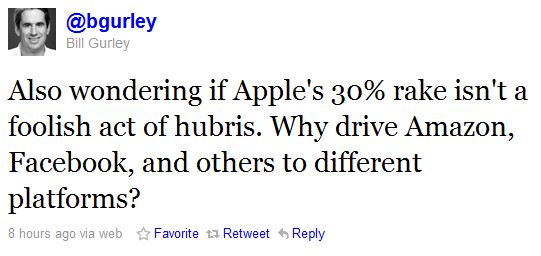
Venture capitalist Bill Gurley asked a good question in a Tweet late last night when he was “wondering if Apple’s 30% rake isn’t a foolish act of hubris. Why drive Amazon, Facebook, and others to different platforms?” As most of you know, Gurley is referring to Apple’s announcement in February that it would require a 30% cut of app developers’ revenues if they wanted a place in the Apple App Store.

Indeed, why would Apple be so foolish? Of course, some critics will cry “monopoly!” and claim that Apple’s “act of hubris” was simply a logical move by a platform monopolist to exploit its supposedly dominant position in the mobile OS / app store marketplace.  But what then are we to make of Amazon’s big announcement yesterday that it was jumping in the ring with its new app store for Android? And what are we to make of the fact that Google immediately responded to Apple’s 30% announcement by offering publishers a more reasonable 10%-of-the-cut deal?  And, as Gurley notes, you can’t forget about Facebook. Who knows what they have up their sleeve next.  They’ve denied any interest in marketing their own phone and, at least so far, have not announced any intention to offer a competing app store, but why would they need to? Their platform can integrate apps directly into it!  Oh, and don’t forget that there’s a little company called Microsoft out there still trying to stake its claim to a patch of land in the mobile OS landscape. Oh, and have you visited the HP-Palm development center lately?  Some very interesting things going on there that we shouldn’t ignore.

What these developments illustrate is a point that I have constantly reiterated here: Continue reading →

Former TLF blogger Tim Lee returns with this guest post. Find him most of the time at the Bottom-Up blog.

Thanks to Jim Harper for inviting me to return to TLF to offer some thoughts on the recent Adam ThiererTim Wu smackdown. I’ve recently finished finished reading The Master Switch, and I didn’t have have my friend Adam’s viscerally negative reactions.

To be clear, on the policy questions raised by The Master Switch, Adam and I are largely on the same page. Wu exaggerates the extent to which traditional media has become more “closed” since 1980, he is too pessimistic about the future of the Internet, and the policy agenda he sketches in his final chapter is likely to do more harm than good. I plan to say more about these issues in future writings; for now I’d like to comment on the shape of the discussion that’s taken place so far here at TLF, and to point out what I think Adam is missing about The Master Switch.

Here’s the thing: my copy of the book is 319 pages long. Adam’s critique focuses almost entirely on the final third of the book, (pages 205-319) in which Wu tells the history of the last 30 years and makes some tentative policy suggestions. If Wu had published pages 205-319 as a stand-alone monograph, I would have been cheering along with Adam’s response to it.

But what about the first 200-some pages of the book? A reader of Adam’s epic 6-part critique is mostly left in the dark about their contents. And that’s a shame, because in my view those pages not only contain the best part of the book, but they’re also the most libertarian-friendly parts.

Those pages tell the history of the American communications industries—telephone, cinema, radio, television, and cable—between 1876 and 1980. Adam only discusses this history in one of his six posts. There, he characterizes Wu as blaming market forces for the monopolization of the telephone industry. That’s not how I read the chapter in question. Continue reading →

The FCC proposed new rules today aimed at combating wireless “bill shock,” a term that describes mobile subscribers getting hit with overage charges they didn’t anticipate. The proposed rules would require wireless providers to create a system for alerting customers when they are about to incur extra usage charges for voice, text, data, or roaming.

I can certainly see why some consumers may be frustrated with wireless pricing practices. But this frustration hardly constitutes evidence that the mobile marketplace is actually failing. Yes, mobile carriers sometimes make mistakes, and they probably need to do more to ensure their customers understand how overage charges work.

Competitive forces, however, are far better equipped than federal regulators to punish providers that engage in
genuinely harmful practices. And if the federal government must “do something” about bill shock, educating mobile subscribers about where to locate and track their usage information is a far better approach than prescriptive, burdensome federal regulation.

Hypocritically, even as the FCC tries to reign in bill shock, its own policies are harming consumers far more than any wireless industry practices. The FCC has again and again put off spectrum auctions that would enable mobile providers to offer better services at lower prices. As a result, consumers are suffering to the tune of billions of dollars each year. Economists Thomas Hazlett and Roberto Munoz published a study last year in which they concluded that U.S. wireless prices would decline by 8% if the FCC were to allocate an additional 60mhz of spectrum to mobile telephony.

If the FCC truly cares about wireless subscribers, rather than simply grandstanding against competitive (if imperfect) mobile carriers, the Commission’s top priority should be to aggressively free up the airwaves.

But analysts at the Competitive Enterprise Institute urged the FCC not to interfere with market disputes and to instead turn its focus to the real obstacle to the wireless marketplace – the FCC’s own anti-consumer approach to spectrum allocation. “Educating mobile subscribers about where to locate their up-to-date usage information – which all major wireless providers make available – is a far better solution to ‘bill shock’ than prescriptive federal regulation,” argued Ryan Radia, CEI Associate Director of Technology Studies. Radia pointed out that some consumers’ frustration with current wireless pricing practices is hardly evidence that the mobile marketplace is failing. “To be sure, mobile carriers make occasional mistakes, and they need to work harder to ensure their customers stay well-informed,” Radia said. “But competitive forces are far better equipped than federal regulators to punish providers that engage in genuinely harmful practices or fail to satisfy consumers’ evolving preferences.” In its efforts to address wireless bill disputes, the FCC purports to represent consumers’ interests; yet, Radia argued, the agency is harming consumers by delaying action to free up radio spectrum — the lifeblood of wireless communications. “Consumers are suffering to the tune of billions of dollars each year on account of the FCC’s failure to free up radio spectrum for mobile communications,” Radia said. “Economists Thomas Hazlett and Roberto Munoz recently published a study finding that U.S. wireless prices would decline by 8% if the FCC were to allocate an additional 60mhz of spectrum to mobile telephony.” “If the FCC genuinely cares about wireless subscribers, it should focus on aggressively freeing up the airwaves instead of comparatively trivial issues like bill shock.”