This week at CTIA 2013, FCC Commissioner Jessica Rosenworcel presented ten ideas for spectrum policy. Though I don’t agree with all of them, she articulated a reasonable vision for spectrum policy that prioritizes consumer demand, incorporates market-oriented solutions, and establishes transparent goals and timelines. Commissioner Rosenworcel’s principled approach stands in stark contrast to the intellectually bankrupt incentive auction recommendation offered by the Department of Justice last month. Continue reading →
Gina Keating, author of Netflixed: The Epic Battle for America’s Eyeballs, discusses the startup of Netflix and their competition with Blockbuster.
Keating begins with the history of the company and their innovative improvements to the movie rental experience. She discusses their use of new technology and marketing strategies in DVD rental, which inspired Blockbuster to adapt to the changing market.
Keating goes on to describe Netflix’s transition to internet streaming and Blockbuster’s attempts to retain their market share.
Download
Related Links
Frontline relied on the DOJ foreclosure theory to predict that the lack of eligibility restrictions in the 700 MHz auction would “inevitably” increase prices, stifle innovation, and reduce the diversity of service offerings as Verizon and AT&T warehoused the spectrum. In reality, the exact opposite occurred.
The DOJ recently recommended that the FCC rig the upcoming incentive auction to ensure Sprint Nextel and T-Mobile are winners and Verizon and AT&T are losers. I previously noted that the DOJ spectrum plan (1) inconsistent with its own findings in recent merger proceedings and the intent of Congress, (2) inherently discriminatory, and (3) irrational as applied. Additional analysis indicates that it isn’t supported by economic theory or FCC factual findings either. Continue reading →
The Information Economy Project at the George Mason University School of Law is hosting a conference tomorrow, Friday, April 19. The conference title is From Monopoly to Competition or Competition to Monopoly? U.S. Broadband Markets in 2013. There will be two morning panels featuring discussion of competition in the broadband marketplace and the social value of “ultra-fast” broadband speeds.
We have a great lineup, including keynote addresses from Commissioner Joshua Wright, Federal Trade Commission and from Dr. Robert Crandall, Brookings Institution.
The panelists include:
Eli Noam, Columbia Business School
Marius Schwartz, Georgetown University, former FCC Chief Economist
Babette Boliek, Pepperdine University School of Law
Robert Kenny, Communications Chambers (U.K.)
Scott Wallsten, Technology Policy Institute
The panels will be moderated by Kenneth Heyer, Federal Trade Commission and Gus Hurwitz, University of Pennsylvania, respectively. A continental breakfast will be served at 8:00 am and a buffet lunch is provided. We expect to adjourn at 1:30 pm. You can find an agenda here and can RSVP here. Space is limited and we expect a full house, so those interested are encouraged to register as soon as possible.
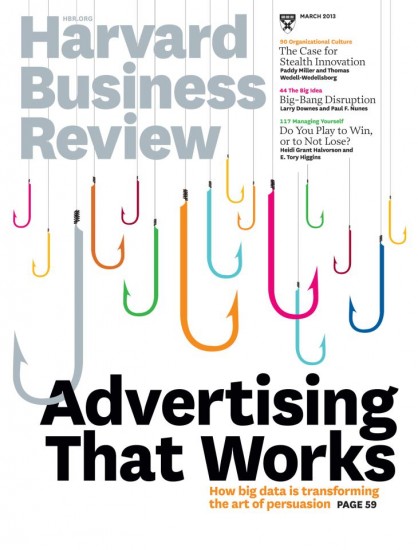 In the upcoming issue of Harvard Business Review, my colleague Paul Nunes at Accenture’s Institute for High Performance and I are publishing the first of many articles from an on-going research project on what we are calling “Big Bang Disruption.”
The project is looking at the emerging ecosystem for innovation based on disruptive technologies. It expands on work we have done separately and now together over the last fifteen years.
Our chief finding is that the nature of innovation has changed dramatically, calling into question much of the conventional wisdom on business strategy and competition, especially in information-intensive industries–which is to say, these days, every industry.
The drivers of this new ecosystem are ever-cheaper, faster, and smaller computing devices, cloud-based virtualization, crowdsourced financing, collaborative development and marketing, and the proliferation of mobile everything. There will soon be more smartphones sold than there are people in the world. And before long, each of over one trillion items in commerce will be added to the network.
The result is that new innovations now enter the market cheaper, better, and more customizable than products and services they challenge. (For example, smartphone-based navigation apps versus standalone GPS devices.) In the strategy literature, such innovation would be characterized as thoroughly “undiscplined.” It shouldn’t succeed. But it does. Continue reading →
Christopher S. Yoo, the John H. Chestnut Professor of Law, Communication, and Computer & Information Science at the University of Pennsylvania and author of the new book, The Dynamic Internet: How Technology, Users, and Businesses are Transforming the Network, explains that the Internet that we knew in its early days—one with a client-server approach, with a small number of expert users, and a limited set of applications and business cases—has radically changed, and so it may be that the architecture underlying the internet may as well.
According to Yoo, the internet we use today barely resembles the original Defense Department and academic network from which it emerged. The applications that dominated the early Internet—e-mail and web browsing—have been joined by new applications such as video and cloud computing, which place much greater demands on the network. Wireless broadband and fiber optics have emerged as important alternatives to transmission services provided via legacy telephone and cable television systems, and mobile devices are replacing personal computers as the dominant means for accessing the Internet. At the same time, the networks comprising the Internet are interconnecting through a wider variety of locations and economic terms than ever before.
These changes are placing pressure on the Internet’s architecture to evolve in response, Yoo says. The Internet is becoming less standardized, more subject to formal governance, and more reliant on intelligence located in the core of the network. At the same time, Internet pricing is becoming more complex, intermediaries are playing increasingly important roles, and the maturation of the industry is causing the nature of competition to change. Moreover, the total convergence of all forms of communications into a single network predicted by many observers may turn out to be something of a myth. Policymakers, Yoo says, should allow room for this natural evolution of the network to take place.
Download
Related Links
Today marks the seventeenth birthday of the Telecommunications Act of 1996. Since it became law nearly two decades ago, the 1996 Act has largely succeeded in meeting its principal goals. Ironically, its success is becoming its potential failure.
By the time most teenagers turn seventeen, they have already begun planning their future after high school. Their primary school achievements are only a beginning in a lifetime of future possibilities. For most legislation, however, there is no future after the initial goals of Congress are achieved. Fortunately, the seventeen year-old 1996 Act isn’t like most legislation.
Congress recognized that when the goals of the 1996 Act were achieved, many of its regulations would no longer be necessary. In its wisdom, Congress provided the FCC with statutory authority to adapt our communications laws to future changes in the communications market. This authority includes the ability for the FCC to forbear from applying an unnecessary or outdated law.
Unfortunately, the FCC has been very reluctant to exercise this authority. It has instead preferred to remain within the familiar walls of stagnant regulations while the opportunity of Internet transformation knocks on the door. If the FCC refuses to use its forbearance authority, the only future for the 1996 Act is to live in the proverbial parents’ basement and eat 20
th Century leftovers. If the FCC instead chooses to act, it could accelerate investment in new broadband infrastructure and the transition to an all-Internet future. Continue reading →
Matt Yglesias today responded with a post of his own to a NYT article about sports channels and cable pricing by Brian Stelter that Yglesias believed had “bad analysis.” I’m here to defend Stelter a little bit because I think Yglesias was too harsh and that Yglesias erred in his own post about the nature of cable bundling. Yglesias’ posts on cable bundling are good, and especially valuable because his Slate and ThinkProgress audiences are not the most receptive to economic justifications for perceived unfair corporate pricing schemes. In part due to him I suspect, you rarely hear econ and business bloggers calling for a la carte pricing of cable channels.
And Yglesias is certainly right that you can’t really complain about the price of your cable package, which includes the few channels you watch plus the sports channels you don’t watch, because you obviously value the channels more than the price you pay per month, even if the sports are a “waste.” He falters when he says
So since those channels are worth $60 to you, even if unbundling happens your cable provider is going to find a way to charge you approximately $60 for them. Because at the end of the day, you’re paying your cable provider for access to the channels you do watch—not for access to the channels you don’t watch. The channels you don’t watch are just there. If the channels you do watch are worth $60 to you, then $60 is what you’ll pay for them.
Continue reading →
Unfortunately, most consumers won’t realize that Netflix is trying to impose its costs on all Internet consumers to gain an anticompetitive price advantage against its over-the-top competitors.
At the Consumer Electronic Show two weeks ago, Netflix announced that it would block consumer access to high definition and 3D movies (HD) for customers of Internet service providers (ISPs) that Netflix disfavors. Netflix’s goal is to coerce ISPs into paying for a free Internet fast lane for Netflix content. If Netflix succeeds, it would harm Internet consumers and competition among video streaming providers. It would also fundamentally alter the economics and openness of the Internet, “where consumers make their own choices about what applications and services to use and are free to decide what content they want to access, create, or share with others.”
Ironically, Netflix’s strategy is a variant of the doomsday narrative spun by net neutrality activists over the last decade. Their narrative assumes ISPs will use their gatekeeper control to block their customers from accessing Internet content distributed by competitors. Of course, ISPs have never blocked consumer access to competitive Internet content. Now that the FCC has distorted the Internet marketplace through the adoption of asymmetric net neutrality rules, Netflix, the dominant streaming video provider, has decided to block consumer access to its content.
This may not seem like a big deal given the relatively limited HD content currently available on Netflix. But that’s about to change in a very big way. Netflix recently announced a new multi-year licensing agreement that makes it the “
exclusive American subscription TV service for first run live-action and animated features from the Walt Disney Studios.” In addition to Disney-branded content (e.g., The Lion King), the deal includes content produced by Pixar (e.g., Brave), Lucasfilm (e.g., Star Wars), and Marvel (e.g., The Avengers). Netflix also announced a multi-year deal with Turner Broadcasting and Warner Bros. that includes the Cartoon Network and exclusive distribution rights to TNT’s television series Dallas. As an analyst recently told Ars Technica, “These movies, if you’ve got young kids—you’ve got to have Netflix.”
Netflix has decided to use this new market power to force ISPs to pay for its own Internet fast lane. In classic double-speak, Netflix calls its fast lane the “Netflix Open Connect” content delivery network (CDN). Though Netflix uses the word “open” to describe its CDN, it is not part of the open Internet. It is only “open” to Netflix for the delivery of its content, and it is only “open” to ISPs who connect to it on terms dictated by Netflix. Continue reading →
Why do mobile carriers sell phones with a subscription? My roommate and I were debating this the other night. Most other popular electronics devices aren’t sold this way. Cable and satellite companies don’t sell televisions with their video service. ISPs don’t sell laptops and desktops with their Internet service. Bundling phones with mobile service subscriptions is pretty unique. (The only mass-market analogs I can think of are satellite radio and GPS service.)
Why might this be? Continue reading →

 The Technology Liberation Front is the tech policy blog dedicated to keeping politicians' hands off the 'net and everything else related to technology.