Blogger’s Note: I posted this blog entry over at BroadbandCensus.com earlier in the day. It’s the first of series this week — One Web Week — in which I’m taking a step back to look at the issue of broadband data and broadband transparency from a bit of a longer time frame. And today couldn’t be a more timely day to do so, with Genachowski’s speech highlighting a new sixth principle of Network Neutrality: broadband transparency! -Drew Clark
WASHINGTON, September 21, 2009 – Broadband data is important for the future of our country – and public and transparent broadband data is even more important.
Today, at this moment, new Federal Communications Commission Chairman Julius Genachowski is making a speech in which he is highlighting the vital principle of public and transparent broadband data.
For three years now, this principle has been the core belief animating my efforts as a journalist, and as the entrepreneur founding BroadbandCensus.com. Now, as we enter the fourth year since this saga began, it’s time to take stock and reflect on what BroadbandCensus.com has accomplished.
And with One Web Week having arrived, I’d like to lay out this history from a personal perspective. In this series of blog posts, I’m going to speak about what we’ve been through, who we have worked with to advance the principles of public and transparent broadband data, and what we ultimately aim to achieve at BroadbandCensus.com.
- Today’s topic: The debate begins, with the Freedom of Information Act lawsuit in 2006.
- Tomorrow’s topic, on One Web Day: The founding of BroadbandCensus.com in the fall of 2007.
- Wednesday topic: The Broadband Census for America Conference in September 2008, and our work with the academic community to foster public and transparent broadband data-collection efforts.
- Thursday’s topic, in advance of the U.S. Broadband Coalition’s report to the Federal Communications Commission: BroadbandCensus.com’s involvement with the National Broadband Plan in 2009.
- The concluding topic, on Friday morning: The role BroadbandCensus.com and broadband users have to play in the creation of a robust and reliable National Broadband Data Warehouse.
The Beginnings: Why I Sued Kevin Martin’s Federal Communications Commission
BroadbandCensus.com was founded in October 2007 after I spent nearly a year and a half with the Center for Public Integrity, a non-profit investigative journalism organization based here in Washington. But the quest for public and transparent broadband data goes back further.
Continue reading →
The FCC announced today that it will consider adopting net neutrality rules. The announcement comes in a speech by Chairman Julies Genachowski, which you can read here and watch here. Genachowski says,
To date, the Federal Communications Commission has addressed these issues by announcing four Internet principles that guide our case-by-case enforcement of the communications laws. … The principles were initially articulated by Chairman Michael Powell in 2004 as the “Four Freedoms,” and later endorsed in a unanimous 2005 policy statement[.] … Today, I propose that the FCC adopt the existing principles as Commission rules, along with two additional principles that reflect the evolution of the Internet and that are essential to ensuring its continued openness.
By suggesting that they must be codified, Genachowski is implicitly (if not explicitly) conceding that the FCC’s Internet principles are a mere policy statement and not a binding and enforceable rule. I’ve explained why this is the case previously. So, someone should call the D.C. Circuit, considering the Comcast case, and let them know their job just got a lot easier.
Second, Genachowski gives “limited competition” as a reason to consider regulation. However, the best available data from the FCC show that 98% of zip codes have 2 or more broadband providers, 88% of zip codes have 4 or more broadband providers, and 77% of zip codes have 5 or more broadband providers. That said, some have questioned whether the FCC’s data are accurate, and the FCC’s next broadband report is supposed to have data gathered at the census tract level for a more detailed set of speed categories. So, the FCC is proposing a regulation before it has completed an ongoing study to discover whether there is a real problem. It’s almost as if Kevin Martin is still running the place.
The D.C. Circuit has struck down as arbitrary and capricious the FCC’s “cable cap.” The cap prevented a single cable operator from serving more than 30% of U.S. homes—precisely the same percentage limit struck down by the court in 2001. The court ruled that the FCC had failed to demonstrate that “allowing a cable operator to serve more than 30% of all cable subscribers would threaten to reduce either competition or diversity in programming.”
The court’s decision rested on the two critical charts (both generated by my PFF colleague Adam Thierer in his excellent
Media Metrics special report) at the heart of the PFF amicus brief I wrote with our president, Ken Ferree:
First, the record is replete with evidence of ever increasing competition among video providers: Satellite and fiber optic video providers have entered the market and grown in market share since the Congress passed the 1992 Act, and particularly in recent years. Cable operators, therefore, no longer have the bottleneck power over programming that concerned the Congress in 1992.
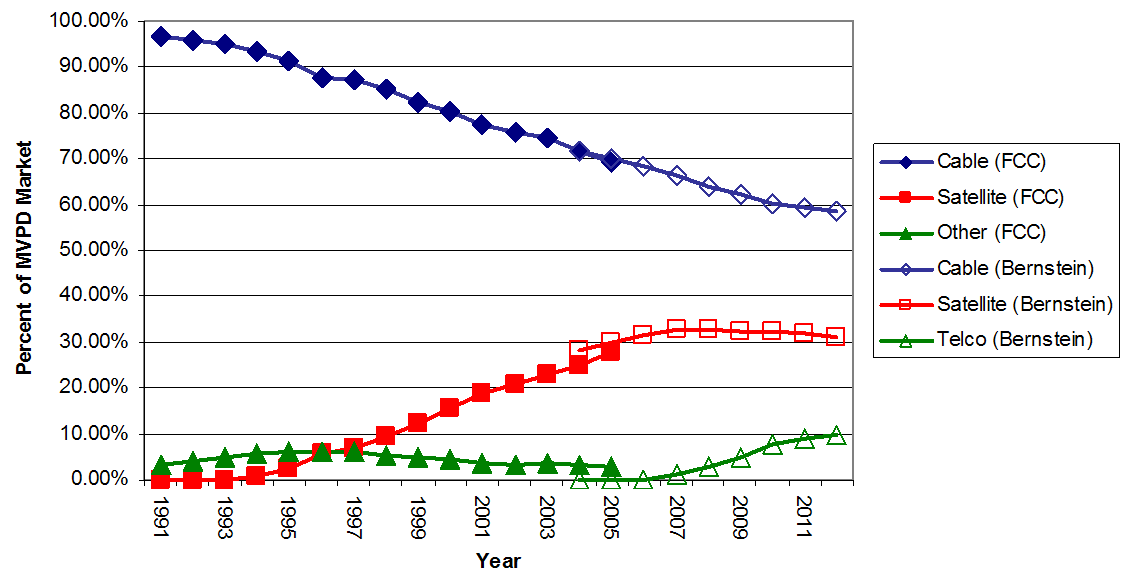
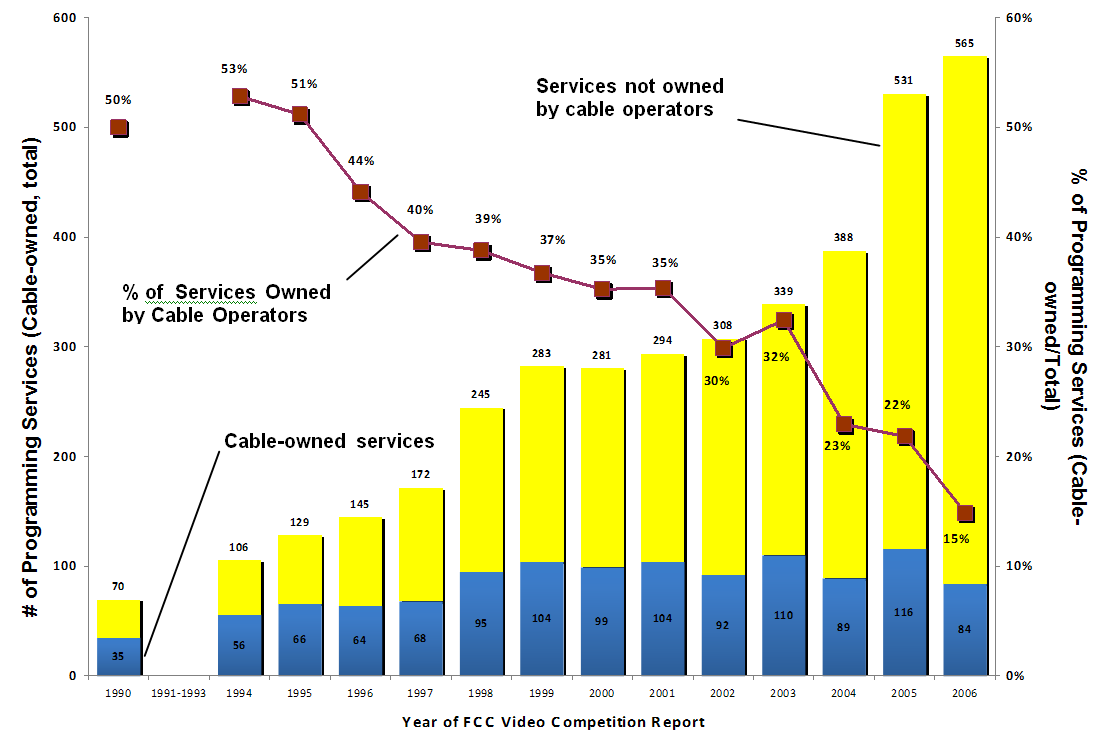
Second, over the same period there has been a dramatic increase both in the number of cable networks and in the programming available to subscribers.
Our chart shows the explosion in the number of programmers (though not the total amount of programming), as well as the falling rate of affiliation between cable operators and programmers, which was among the prime factors motivating Congress when it authorized a cable cap in the 1992 Cable Act:
Continue reading →
 The latest edition (Version 4.0) of my PFF special report on “Parental Controls and Online Child Protection: A Survey of Tools & Methods” is now up. For those not familiar with the report, it explores the market for parental control tools, rating schemes, education and media literacy efforts, and various other tools, methods, and initiatives aimed at promoting online child safety. After evaluating that state of this market, I conclude: “There has never been a time in our nation’s history when parents have had more tools and methods at their disposal to help them decide what constitutes acceptable media content in their homes and in the lives of their children.” Moreover, I believe that the parental controls and content management tools cataloged in the report represent a better, less restrictive alternative to government regulation.
Version 4.0 of the report is now over 250 pages long (up from 200 pages in Version 3.0) and it contains almost 70 exhibits (up from 50), 725 references (up from roughly 500), and numerous updates in all five sections of the book. Major updates have been made to the Internet, social networking, and mobile media sections, reflecting the growing importance of those sectors and issues. Other new sections or appendices have also been added to the report, including:
- a new section examining how many households really need parental control tools;
- a new appendix on the downsides of mandatory parental controls and restrictive default settings;
- a new section on the dangers of “deputizing the online middleman” solution as an approach to solving child safety concerns;
- a new appendix reviewing the findings of 5 past online safety task forces;
- … and much more.
I issue major updates once a year and 1 or 2 minor tweaks during the course of the year to reflect the evolution of the parental control and online child safety marketplace and debate. The report is available free-of-charge on the PFF website, and the previous editions of the report are housed there too in case you want to see how it has evolved over the past couple of years. For those interested in taking a quick look at the report, I have embedded it down below the fold as a Scribd file. Finally, as is always the case, I encourage readers to send me updates and suggestions for how to improve the report and I will incorporate them into future versions.
Continue reading →
Today, the U.S. Department of Commerce’s National Telecommunications and Information Administration (NTIA) announced the members of the new Online Safety and Technology Working Group (OSTWG). I am honored to be among those chosen to participate in this new task force and I look forward to continuing the work started last year with the Harvard Berkman Center’s Internet Safety Technical Task Force (ISTTF), which I also served on. I was very proud of the work done by the ISTTF and the impressive final report that Prof. John Palfrey crafted to reflect our findings. I am eager to investigate these issues further and take a look at the latest research and technologies that can help us better understand how to protect our kids online while also protecting the free speech and privacy rights of Netizens.
The new NTIA working group, which was established under the “Protecting Children in the 21st Century Act,” will report to the Assistant Secretary of Commerce for Communications and Information on industry-implemented online child safety tools and efforts. Within a year of convening its first meeting, the group will submit a report of its findings and make recommendations on how to increase online safety measures.
Below the fold I have listed the complete roster of OSTWG task force members. I very much looking forward to working with this outstanding group. And I’m happy to report that my TLF blogging colleague Braden Cox will be joining me on this task force!
Continue reading →
As anyone who has spent time searching for comments on the FCC’s website can tell you, the agency doesn’t exactly have the most user-friendly website. In the interest of making it easier for others to read the comments that came in last week in the agency’s “Child Safe Viewing Act” Notice of Inquiry, I have compiled all the major comments (those over 3 or 4 pages) and provided links to them below the fold.
Again, this proceeding was required under the “Child Safe Viewing Act of 2007,” which Congress passed last year and President Bush signed last December. The goal of the bill and the FCC’s proceeding (MB 09-26) is to study “advanced blocking technologies” that “may be appropriate across a wide variety of distribution platforms, including wired, wireless, and Internet platforms.” I filed 150+ pages worth of comments in this matter last week, and here’s my analysis of why this bill and the FCC’s proceeding are worth monitoring closely.
Continue reading →
Today I filed comments with the Federal Communications Commission (FCC) in its proceeding examining the marketplace for “advanced blocking technologies.” This proceeding was required under the “Child Safe Viewing Act of 2007,” which Congress passed last year and President Bush signed last December. The goal of the bill and the FCC’s proceeding (MB 09-26) is to study “advanced blocking technologies” that “may be appropriate across a wide variety of distribution platforms, including wired, wireless, and Internet platforms.” My colleagues will no doubt laugh about the fact that I have dropped an absurd 150 pages worth of comments on the FCC in this matter, but I had a lot to say on this topic! Parental controls, child safety, and free speech issues have been the focus of much of my research agenda over the past 10 years.
In my filing, I argue that the FCC should tread carefully in this matter since the agency has no authority over most of the media platforms and technologies described in the Commission’s recent Notice of Inquiry. Moreover, any related mandates or regulatory actions in in this area could diminish future innovation in this field and would violate the First Amendment rights of media creators and consumers alike. The other major conclusions of my filing are as follows:
- There exists an unprecedented abundance of parental control tools to help parents decide what constitutes acceptable media content in their homes and in the lives of their children.
- There is a trade-off between complexity and convenience for both tools and ratings, and no parental control tool is completely foolproof.
- Most homes have no need for parental control technologies because parents rely on other methods or there are no children in the home.
- The role of household media rules and methods is underappreciated and those rules have an important bearing on this debate.
- Parental control technologies work best in combination with educational efforts and parental involvement.
- The search for technological silver-bullets and “universal” solutions represent a quixotic, Holy Grail-like quest and it will destroy innovation in this marketplace.
- Enforcement of “household standards” made possible through use of parental controls and other methods negates the need for “community standards”-based content regulation.
My entire filing can be found here and down below in a Scribd reader. All comments in the matter are due tomorrow and then reply comments are due on May 18th.
Continue reading →
Continuing the “Cutting the (Video) Cord” series started by my PFF colleague Adam Thierer: The WSJ had two great pieces yesterday about the increasing competitive relevance of television distributed by Internet—a trend that was at the heart of an amicus
brief PFF recently filed in support of C omcast’s challenge of the FCC’s 30% cap on cable ownership. The first WSJ piece declares that:
After more than a decade of disappointment, the goal of marrying television and the Internet seems finally to be picking up steam. A key factor in the push are new TV sets that have networking connections built directly into them, requiring no additional set-top boxes for getting online. Meanwhile, many consumers are finding more attractive entertainment and information choices on the Internet — and have already set up data networks for their PCs and laptops that can also help move that content to their TV sets.
The easier it is for consumers to receive traditional television programming (in addition to other kinds of video content) distributed over the Internet on their television, the less “gatekeeper” or “bottleneck” power cable distributors have over programming. So the Netflix-capable and Yahoo-widget-capable televisions described by the WSJ piece go a long way to increasing the substitutability of what we call Internet Video Programming Distributors (IVPDs) for Multichannel Video Programming Distributors (MVPDs), such as cable, satellite television and fiber services offered by telcos such as Verizon’s FiOS.
While such televisions are only expected to reach 14% of all TV sales by 2012, one must remember that a growing number of set-top boxes (
e.g., the Roku Digitial Video Player, game consoles like the Microsoft XBox 360 and Sony PlayStation 3, and TiVo DVRs) allow users to users to receive IVPD programming on their existing televisions.
As we argued in our amicus brief, the immense competitive importance of IVPDs lies not in the potential for some users to “cut the cord” to cable and other MVPDs (though that will surely happen), but in the immediate impact IVPDs have as an alternative distribution channel for programmers. In the pending D.C. Circuit case, we argue that both the FCC’s 30% cap, issued in December 2007, and the underlying portions of the 1992 Cable Act authorizing such a cap should be struck down as unconstitutional because the ready availability of IVPDs as an alternative distribution channel means that cable no longer has the “special characteristic” of gatekeeper/bottleneck power that would justify imposing such a unique burden on the audience size of cable operators. (Of course, Direct Broadcast Satellite and Telco Fiber are also eating away at cable’s share of the MVPD marketplace.)
The second WSJ piece, an op/ed, illustrates beautifully how cable operators are already losing “market power” (or at least negotiating leverage) in a very tangible way: they’re having to pay more for programming. Specifically, the Journal describes how Viacom plaid chicken with Time Warner—and won. Continue reading →
In several of our previous podcasts (see episodes 34, 35,and 37), we’ve discussed what we’ve called the “Comcast Kerfuffle,” which was the controversy surrounding the steps Comcast took to manage BitTorrent traffic on its networks. Critics called it a violation of Net neutrality principles while Comcast and others called it sensible network management.
This week we saw a new kerfuffle of sorts develop over the revelation in a Monday front-page Wall Street Journal story that Google had approached major cable and phone companies and supposedly proposed to create a fast lane for its own content. What exactly is it that Google is proposing, and does it mean – as the Wall Street Journal and some others have suggested – that Google is somehow going back on their support for Net neutrality principles and regulation? More importantly, what does it all mean for the future of the Internet, network management, and consumers. That’s what we discussed on the TLF’s latest “Tech Policy Weekly” podcast.
Today’s 30-minute discussion featured two of our regular contributors at the TLF, who both wrote about this issue multiple times this week.
Cord Blomquist of the Competitive Enterprise Institute wrote about the issue here and here, and Bret Swanson of the Progress & Freedom Foundation wrote about it here and here. To help us wade through some of the more technical networking issues in play, we were also joined on the podcast by Richard Bennett, a computer scientist and network engineer guru who blogs at Broadband Politics as well as Circle ID and he also pens occasional columns for The Register. Also appearing on the show was Adam Marcus, Research Fellow & Senior Technologist at PFF, who wrote a “nuts and bolts” essay full of excellent technical background on edge caching and net neutrality.
You can download the MP3 file here, or use the online player below to start listening to the show right now.
[display_podcast]
Ken Ferree and I just filed an amicus brief with the D.C. Circuit in what could be among the most important First Amendment cases involving economic regulation in years: Comcast’s challenge to the FCC’s cap on the maximum size of a cable operator’s nationwide subscriber-audience. While few may feel righteous indignation at limitations targeted at large corporations such as Comcast or Time Warner, the larger principle at stake here is deeply important: Will the First Amendment provide a meaningful check on what USC law professor Chris Yoo has called “architectural censorship” (i.e., so-called “structural” regulations that “have the unintended consequence of reducing the quantity, quality, and diversity of media content”).
In a nutshell, we argue that that:
- The provisions of the 1992 Cable Act authorizing the FCC to impose a “cable cap” are outdated in world of media abundance and vibrant platform competition.
- Because cable is no longer the unique “bottleneck” or “gatekeeper” that it was in 1992, these statutory provisions (not just the FCC’s 30% rule) must be subject to strict scrutiny under the First Amendment as a limitation on free speech.
- Because there are “less restrictive means” of ensuring cable operators do not impede the flow of video programming to consumers, the court should strike down these provisions.
- Even if the court upholds the statute, it should nonetheless strike down the cap issued by the FCC in December 2007 (30% of all Multichannel Video Programming (MVPD) subscribers as based on an outdated model of the video marketplace.
I encourage you to read our brief (below). I’ve provided a summary below, along with some additional commentary we just couldn’t cover under our 3500 word limit.
Strict Scrutiny. Yoo’s article Architectural Censorship and the FCC is essential reading for anyone who believes that government regulations on the size and shape of the “soapbox” can have huge effects on speech itself. Yoo argues that the First Amendment should check this kind of regulation–however “content-neutral” it might seem–under “strict scrutiny”, which requires that the government show that a regulation is the “least restrictive means” available for advancing a “compelling government interest.” But Yoo ultimately concludes (pp. 713-718, PDF pp. 45-50) that, under existing precedent, most “architectural censorship will be effectively insulated from meaningful judicial review.” Continue reading →

 The Technology Liberation Front is the tech policy blog dedicated to keeping politicians' hands off the 'net and everything else related to technology.