Catherine Holahan of Business Week points out that consumer and children’s advocacy groups are looking to expand their efforts to regulate fatty and sugary food advertising in the name of “protecting the children”:
Having successfully lobbied the government to place limits on junk food ads on TV, they now target marketing to kids via the Web. “While there are some rules for TV, there are no rules when you move online,” says Patti Miller, vice-president of children’s advocacy group Children Now and a member of the Federal Communications Commission’s Task Force on Media & Childhood Obesity. “We don’t want to reduce junk food advertising to kids [on TV] and then find that it has just moved to another platform.”
And so another classic case study in regulatory creep is born and the Net gets a little more regulated in the process as Uncle Sam becomes our Super Nanny. What’s that you say? Parents should take more responsibility for what their kids watch and eat? Silly you. Don’t you know that it takes a village to raise a village idiot? Or something like that.

PFF has just releasing an updated edition of my booklet on “Parental Controls and Online Child Protection: A Survey of Tools & Methods.” The new version, Version 3.0, includes two new appendixes and updates to each section to reflect new parental control tools and programs developed in the last nine months.
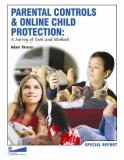
The updated report is timely as it comes on the heels of the recently-announced Internet Safety Technical Task Force, which is being chaired by the Berkman Center for Internet & Society at Harvard Law School. I am privileged to serve as a member of the Task Force, which is evaluating various online safety technologies and strategies and then reporting back to state attorneys general with our findings.
Those issues and much more are covered in the latest edition of my report. The report explores the market for parental control tools, rating schemes, education efforts, and initiatives aimed at promoting online child safety. I believe that the parental controls and content management tools cataloged in the report represent a better, less restrictive alternative to government regulation. As I conclude after evaluating that state of the market: “There has never been a time in our nation’s history when parents have had more tools and methods at their disposal to help them decide what constitutes acceptable media content in their homes and in the lives of their children.”
Version 3.0 of the special report, now over 200 pages, contains over fifty exhibits and numerous updates in all five sections of the book. Major updates have been made to the Internet, social networking, and mobile media sections, reflecting the growing importance of those sectors and issues. A greatly expanded section on video empowerment technologies has also been included. Finally, two appendices have also been added: a comprehensive legislative index cataloging over thirty bills introduced in Congress on these issues (complied with John Morris of Center for Democracy & Technology), and a glossary of 35 relevant terms and cases.
The report is available free-of-charge on the PFF website, as are the previous editions. And I am happy to provide hard copies to those who are interested.
http://documents.scribd.com/ScribdViewer.swf?document_id=2887320&access_key=key-um5xjvf98bfnuu8811v&page=&version=1&auto_size=true
PFF has just released my latest paper entitled “Parental Control Perfection? The Impact of the DVR and VOD Boom on the Debate over TV Content Regulation.” In the report, I focus on the extent to which new video technologies, such as digital video recorders (DVRs) and video on demand (VOD) services, are changing the way households consume media and are helping parents better tailor viewing experiences to their tastes and values. I provide evidence showing the rapid spread of these technologies and discuss how parents are using these tools in their homes. Finally, I argue that these developments will have profound implications for debates over the regulation of video programming. As parents are given the ability to more effectively manage their family’s viewing habits and experiences, it will lessen—if not completely undercut—the need for government intervention on their behalf.
This 16-page report can be found at: http://www.pff.org/issues-pubs/pops/pop14.20DVRboomcontentreg.pdf
This is the final installment of my 10-part series of essays that have coincided with “Internet Safety Month.” Many of these essays have focused on the variety of parental controls tools on the market that can help parents better control, or at least monitor, their children’s Internet usage or online communications. (See parts 1, 2, 3, 4, 5, and 6.) Other essays focused on the importance of education, building public awareness, and the need for stepped-up law enforcement efforts aimed at prosecuting online predators. (See parts 7, 8, and 9).
In this final installment, I want to focus on what I believe is the most important—and most frequently overlooked—part of the parental controls and online safety discussion: Good parenting!
Specifically, it is important to realize that many household-level rules and informal parental control methods exist that represent the most important steps that most parents can take in dealing with potentially objectionable content or teaching their children how to be sensible, savvy media users. Indeed, to the extent that many households never take advantage of the many technical tools I outlined in earlier essays, it is likely because they rely instead on the informal household media rules and strategies discussed below.
Continue reading →
On Monday, October 9th, Sen. Joe Lieberman (D-CT) delivered a major address about Internet content and online child safety that was intended to serve as a sort of call-to-arms for policymakers, parents and industry to get more serious about the issue.
In his wide-ranging remarks, Lieberman bemoaned the relentless pace of technological change and how the Internet and digital media technologies were making it increasingly difficult for parents to protect children from objectionable material or, worse yet, child predators. “The Internet is a wondrous, revolutionary medium,” Lieberman said. “But there is too often a thin line between the awe-inspiring and the simply awful, and with each new technological breakthrough, it seems that the opportunities for our children to fall into that awful gap grow greater and graver.”
In this essay, I will dissect Sen. Lieberman’s manifesto and provide a detailed response to his assertions and proposals. I feel this is necessary because his address touches on many of the major themes and proposals that are framing the debate over Internet regulation that is taking place in America today.
Continue reading →

 The Technology Liberation Front is the tech policy blog dedicated to keeping politicians' hands off the 'net and everything else related to technology.