Wow, I am really blown away by CancelCable.com. Earlier today, I mentioned how I discovered it thanks to Mike Musgrove’s Washington Post story about how more and more people are canceling their cable and satellite subscriptions altogether and using alternative video platforms — Hulu, iTunes, Netflix, XBox, etc. — to watch their favorite shows. Anyway, if you go to CancelCable.com’s “Show Finder” site, you will find a complete inventory of all the major television programs you can find online right now. Go to the site to see the complete list, but down below I cut just the first 15 shows listed to give you a feel for how it works. And that list just continues to grow and grow in both directions — in terms of the number of shows and the number of platforms where you can get them.
OK, so why again do we need to mandate a la carte regulation for cable and satellite?
In an essay I posted here back in October called “Cutting the (Video) Cord: The Shift to Online Video Continues” (part of an ongoing series), I reflected on an interesting piece by the Wall Street Journal’s Nick Wingfield’s entitled “Turn On, Tune Out, Click Here.” Wingfield’s article illustrated how rapidly the online video marketplace is growing and noted that so many shows are now available online that many people are cutting the cord entirely by canceling their cable or satellite subscriptions and just downloading everything they want to watch via sites like Hulu and supplmenting that with services like Netflix. In today’s Washington Post, Mike Musgrove writes about these same trends and developments in a column entitled, “TV Breaks Out of the Box.” Musgrove notes:
This has been a big year for both Netflix and online video services like Hulu.com, where people can watch episodes of popular shows such as “The Office” for free, though users do have to sit through a few commercials. When Tina Fey debuted her impression of Sarah Palin on “Saturday Night Live” last month, more people watched the comedy sketch online at NBC.com or Hulu.com than during the show’s broadcast. Last week, YouTube announced that it would start carrying old TV shows and movies from the film studio MGM.
As for Netflix, it seems that somebody there has been busy this year. While most customers still use the online video rental site mainly for movie deliveries by mail, the company now has a library of online content available for viewing on your TV through a variety of devices. A $99 appliance from Roku that plugs into your TV set and connects to the Web has been popular among some folks dropping their cable subscriptions. A couple of new, Web-connected Blu-ray players from Samsung and LG Electronics also allow Netflix subscribers to instantly watch titles from the company’s online collection.
Musgrove continues and notes that it’s about more than just Hulu and Netflix:
Continue reading →
My colleague Barbara Esbin, a Senior Fellow and Director of the Center for Communications and Competition Policy at The Progress & Freedom Foundation, was asked to pen a short history of the net neutrality wars in the U.S. for a French publication, La Lettre de l’Autorité. Her essay provides an excellent, concise overview of where we’ve come from and where we might be heading on this front. I’ve pasted the entire essay down below, or you can download the PDF here.
Net Neutrality Regulation in the United States
by Barbara Esbin
PFF
Progress Snapshot
Release 4.21 October 2008
The United States moved closer to “Net Neutrality” regulation this year when the Federal Communications Commission found that Comcast, a cable broadband Internet service provider, violated a set of Internet policy principles the FCC adopted in 2005 by limiting peer-to-peer (P2P) traffic. The ruling was the culmination of a ten-year effort that began as a call for wholesale “open access” to the cable platform for third-party Internet service providers. Requests for open access first emerged in 1998 when the FCC considered AT&T’s acquisition of cable operator TCI. The FCC rejected open access, but the issue quickly re-emerged in a subsequent proceeding to determine the appropriate regulatory classification of cable Internet service. Depending on how the FCC categorized cable Internet service, it would either be subject to telecommunications “common carrier” requirements, “cable service” requirements, or treated as a then-unregulated “information service.”
In 2002, the FCC classified cable Internet service as an “information service.” This meant that the telecommunications common carrier requirements — that service be provided upon request, without unreasonable discrimination as to rates, terms and conditions of service — would not apply to cable Internet services. The FCC’s decision was upheld by the U.S. Supreme Court in
NCTA v. Brand X. Afterwards, advocates of open access re-directed their efforts away from advocating wholesale access for third-party ISPs, and towards rules aimed at consumer rights to a “neutral network” or “net neutrality.”
Continue reading →
Back in the mid- and even late 1990s, I was engaged in a lot of dreadfully boring telecom policy debates in which the proponents of regulation flatly refused to accept the argument that the hegemony of wireline communications systems would ever be seriously challenged by wireless networks. Well, we all know how that story is playing out today. People are increasingly “cutting the cord” and opting to live a wireless-only existence. For example, this recent Nielsen Mobile study on wireless substitution reports that, although only 4.2% of homes were wireless-only at the end of 2003…
At the end of 2007, 16.4 percent of U.S. households had abandoned their landline phone for their wireless phone, but by the end of June 2008, just 6 months later, that number had increased to 17.1 percent. Overall, this percentage has grown by 3-4 percentage points per year, and the trend doesn’t seem to be slowing. In fact, a Q4 2007 study by Nielsen Mobile showed that an additional 5 percent of households indicated that they were “likely” to disconnect their landline service in the next 12 months, potentially increasing the overall percentage of wireless-only households to nearly 1 in 5 by year’s end.
And one wonders about how many homes are like mine — we just keep the landline for emergency purposes or to redirect phone spam to that number instead of giving out our mobile numbers. Beyond that, my wife and I are pretty much wireless-only people and I’m sure there’s a lot of others like us out there.
Anyway, I’ve been having a strange feeling of deva vu lately as I’ve been engaging in policy debates about the future of the video marketplace. Like those old telecom debates of the last decade, we are now witnessing a similar debate — and set of denials — playing out in the video arena. Many lawmakers and regulatory advocates (and even some industry folks) are acting as if the old ways of doing business are the only ways that still count. In reality, things are changing rapidly as video content continues to migrate online.
I was reminded of that again this weekend when I was reading Nick Wingfield’s brilliant piece in the
Wall Street Journal entitled “Turn On, Tune Out, Click Here.” It is must-reading for anyone following development in this field. As Wingfield notes:
Continue reading →
Yesterday, the Senate passed S. 602, “The Child Safe Viewing Act of 2007,” which was introduced by Sen. Mark Pryor (D-AR) in February 2007. The bill requires the Federal Communications Commission (FCC) to study the market for “advance blocking technologies” (i.e., parental controls and rating systems) that parents can use to protect their kids from inappropriate content from various sources and platforms. On the surface, the measure seems harmless enough, but in practice, it could have some troubling long-term free speech implications if it leads to more government meddling with parental controls and ratings systems.
The measure requires the FCC to initiate a notice of inquiry to consider measures to examine:
- the existence and availability of advanced blocking technologies that are compatible with various communications devices or platforms;
- methods of encouraging the development, deployment, and use of such technology by parents that do not affect the packaging or pricing of a content provider’s offering; and
- the existence, availability, and use of parental empowerment tools and initiatives already in the market.
That all sounds harmless enough. Indeed, such a study could produce some useful information about the state of the parental controls marketplace. (Of course, I could save them some taxpayer dollars and just send copies of my big
Parental Controls & Online Child Safety report to all FCC officials!)
But it’s what comes next in the bill that causes me some heartburn. As part of the review mandated by the bill, S. 602 commands the FCC to “consider advanced blocking technologies that”:
Continue reading →
Just FYI, the latest update of my booklet on “Parental Controls and Online Child Protection: A Survey of Tools & Methods” is now live. The new version, Version 3.1, provides minor updates to all sections of the book and a new appendix of relevant research in the field. I issue major updates early each year and 1 or 2 tweaks during the course of the year to reflect the evolution of the parental control and online child safety market and debate. 
For those not familiar with the report, it explores the market for parental control tools, rating schemes, education efforts, and initiatives aimed at promoting online child safety. I believe that the parental controls and content management tools cataloged in the report represent a better, less restrictive alternative to government regulation. As I conclude after evaluating that state of the market: “There has never been a time in our nation’s history when parents have had more tools and methods at their disposal to help them decide what constitutes acceptable media content in their homes and in the lives of their children.”
The report is available free-of-charge on the PFF website, and the previous editions of the report are housed there too in case you want to see how it has evolved over the past two years. For those interested in taking a quick look at the report, I have embedded it down below the fold as a Scribd file. Finally, as is always the case, I encourage readers to send me updates and suggestions for how to improve the report and I will incorporate them into future versions.
Continue reading →
So, if Tim Wu’s thesis is correct that the broadband marketplace is “a cartel,” should we be reading headlines in today’s Wall Street Journal and CNET News.com like this: “Price War Erupts For High-Speed Internet Service” and “Broadband Price War Brews“? From the WSJ story:
The battle between cable and phone companies to sign up new customers for high-speed Internet service is heating up, creating fresh opportunities for consumers to cut their bills. […] While the most generous offers are coming from the phone companies, some analysts expect cable companies will also become more aggressive in their own promotions as they compete to retain customers.
Geez, if that’s a cartel, give me more of them!
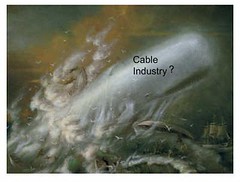 Well, another four months have passed since I last asked this question, but let me pose it again: Where exactly is the FCC’s Video Competition Report and why is it taking so long to get it out the door? It wouldn’t have anything to do with a certain Chairman Ahab still trying to get his cable whale, would it? No, of course not. I’m sure there’s a perfectly rational reason that this 13th Annual report is now something like 18 months past due altogether. Right.
And keep in mind that the data in the 13th report is for a period ending on June 30, 2006, so whenever the report finally comes out the data in it will be well over two years old! That won’t exactly reflect the true state of the video programming market considering the significant changes we have since that time, especially the continued explosive growth of online video, VOD, and DVRs.
The reason that I have been making a big deal out of this issue is because this gets to the question of just how “scientific” and “independent” of an agency the FCC really is. We are talking about facts here. Basic data. This is stuff the FCC should be routinely collecting and reporting on a timely basis — indeed that is what Congress
requires the agency to do in this specific case. And yet the agency can’t do it because its Chairman is on this Moby Dick-like crusade against the cable industry. By the time this 13th annual report finally sees the light of day, the 15th annual report might be due! Outrageous. (And you wonder why many of us here are so skeptical about empowering the FCC regulating the Internet via Net neutrality mandates! If an over-zealous Chairman can politicize this issue, just think what might happen once we give the agency the authority to regulate the Net.)
Anyway, down below you will find the paper that Barbara Esbin and I wrote about the issue four months ago. Perhaps we should place a little ticker somewhere here on the site that counts each day that passes as we wait for the Commission to produce this report. We can take bets on when the agency’s data holdout will end.
Continue reading →
 Faithful readers will recall that, several months ago, I penned a 7-part “Media Metrics” series that took a hard look at the health of the media marketplace. Today, the Progress & Freedom Foundation is releasing a greatly expanded version of these essays that I have put together with my PFF colleague Grant Eskelsen. In this 100-page special report, “Media Metrics: The True State of the Modern Media Marketplace,” we begin by noting that heated debates about the state of the media marketplace continue to rage in Washington, and opinions seem to range from grim to outright apocalyptic. As we note on pg. 1:
Many people—including a large number of legislators and regulators—argue that America’s media marketplace is in a miserable state. Some claim that citizens lack choice in media outlets and that options are just as scarce as ever. Others believe that media “localism” is dead or that many groups or niches go underserved because of a lack of true “diversity” in media. Others argue that the market is hopelessly over-concentrated in the hands of a few evil media barons who are hell-bent on force-feeding us corporate propaganda. And still others say that the quality of news and entertainment in our society has deteriorated because of a combination of all of the above. It all sounds quite troubling, but is any of it true?
After taking an objective look at the true state of America’s media marketplace, we conclude that such pessimism is unwarranted. Indeed, a careful review of the facts reveals that—contrary to what those media critics suggest—we have more media choice, more media competition, and more media diversity than ever before. Indeed, to the extent there was ever a “golden age” of media in America, we are living in it today. The media sky has never been brighter and it is getting brighter with each passing year.
Continue reading →
Jeff Eisenach, Chairman of Criterion Economics, and I have just released a new article about the perils of a la carte regulation in the Federalist Society’s journal Engage. In “A La Carte Regulation of Pay TV: Good Intentions vs. Good Economics,” we argue that: “From a policy perspective, a la carte regulation is worse than a solution in search of a problem; it is a problem waiting to happen.” We show that the pay TV marketplace is functioning quite efficiently and that consumers have more choices and content diversity at their disposal than ever. A la carte mandates, we argue, would destroy that diversity and likely put pressure on prices to go up, contrary to the goals of the backers of a la carte.
We also discuss how a la carte is being proposed a tool of social regulation / speech control, with backers labeling it a way of “cleaning up cable.” We explain why that is not going to work and why, even if it did, it would be a betrayal of the First Amendment.
This new article can be found online here.

 The Technology Liberation Front is the tech policy blog dedicated to keeping politicians' hands off the 'net and everything else related to technology.