Digital video recorders (DVRs) may turn out to be the “last gasp” of cable, satellite and other traditional multichannel subscription video providers. If users can get the same basic functionality (on demand viewing of the shows they want) over the Internet for free or paying for each show rather than a hefty monthly subscription, Who Needs a DVR?, as Nick Wingfield at the WSJ asks:
Among a more narrow band of viewers -– 18- to 34-year-olds -– SRG found that 70% have watched TV online in the past. In contrast, only 36% of that group had watched a show on a TiVo or some other DVR at any time in the past.
That last figure is a fairly remarkable statistic. Remember that DVRs have the advantage of playing video back on a device where the vast majority of television consumption has traditionally occurred –- that is, the TV set. Although it’s also possible to watch shows over the Internet on a TV set through a device like Apple TV and Microsoft’s Xbox 360, most people watch online TV shows through their computers — which have inherent disadvantages, like smaller screens and, in most cases, no remote controls.
Indeed, if users are going to buy a piece of hardware, why buy a DVR when they can buy a Roku box or a game console like the XBox 360 that will put Internet-delivered TV on their programming on their “television” (a term that increasingly simply means the biggest LCD in the house, or the one that faces a couch instead of an office chair)—
and save money?
This is precisely the point Adam Thierer and I have been hammering away at in this ongoing series. The availability of TV through the Internet and the ease with which consumers can display that content on a device, and at a time, of their choosing are quickly breaking down the old “gatekeeper” or “bottleneck” power of cable. Let’s see how long it takes Congress and the FCC to realize that the system of cable regulation created in the analog 1990s no longer makes sense in this truly digital age.
When the history books are finally written, I think it’s clear that outgoing FCC Chairman Kevin Martin will likely go down as one of — if not the — most aggressively pro-regulatory Republican chairman in the agency’s history. Despite his occasional claims of believing in free markets and his support for a couple of legitimately deregulatory decisions, his tenure at the FCC has generally been characterized by a growth of government power, spending, and bureaucracy. But don’t take my word for it; read the report he issued last week called “Moving Forward,” which to some of us looks more like moving backwards (or at least stuck in the same ol’ mud).
Martin, however, touts his regulatory actions and expansion of FCC power as uniformly pro-consumer. Martin is just another in the long line of statists who claims that consumer welfare can only be enhanced by adding layers of government mandates and regulatory red tape. History teaches us a different lesson: That regulation and bureaucracy typically stifle innovation and competition and hurt consumer welfare in the process. Moreover, there are some constitutional considerations and limitations that should trump — or at least limit — the powers of unelected bureaucrats to run roughshod over our rights. But hey, who cares about those meddlesome little things like the First, Fifth, Tenth, or Fourteenth Amendments?! Certainly not Kevin Martin.
What’s equally troubling about Martin’s tenure at the agency is the track record of mismanagement and the bad blood that seemingly surrounds everything and everyone he comes in contact with. The picture painted in the House Energy & Commerce Committee’s 110-page report, “Deception and Distrust: The FCC Under Chairman Kevin J.Martin,” is not a pretty one — although the report failed to mention that waste, mismanagement, and other regulatory shenanigans have been going on at this agency under the days of Democratic rule, too.
Martin’s response to the House report was all too predictable: The evil corporate interests are out to get me! “[M]ost of the criticisms contained in the Majority Staff Report,” Martin says in a letter released a few days ago, “reflect the vehement opposition of the cable and wireless industries to my policies to serve and protect consumers.”
Whatever.
I’m just glad this nightmare is over. Hopefully Martin’s tenure will serve as a cautionary tale for a future Republican administration: If you actually believe in free minds and free markets, try vetting the guy you install at the FCC to make sure he’s a true believer as well.
This ongoing series has explored the increasing ability of consumers to “cut the cord” to traditional video distributors (cable, satellite, etc.) and instead receive a mix of “television” programming and other forms of video programming over the Internet. As I’ve argued, this change not only means lower monthly bills for those “early adopter” consumers who actually do “cut the cord”, but, in the coming years, a total revolution in the traditional system of content creation and distribution on which the FCC’s existing media regulatory regime is premised.
This revolution has two key parts:
- Conduits: The growing inventory—and popularity—of sites such as Hulu, Amazon Unboxed and the XBox 360 Marketplace (or software such as Apple’s iTunes store), that allow users to view or download video content. Drawing an analogy to the FCC’s term “Multichannel Video Programming Distibutor” or MVPD (cable, direct broadcast satellite, telco fiber, etc.), I’ve dubbed these sites “Internet Video Programming Distributors” or IVPDs.
- Interface: The hardware and software that allows users to display that content easily on a device of their choice, especially their home televisions.
While much of the conversation about “interface” has focused on special hardware that brings IVPD content to televisions through set-top boxes such as the Roku box or game consoles like the XBox 360, at least one company is making waves with a software solution. From the NYT:
Boxee bills its software as a simple way to access multiple Internet video and music sites, and to bring them to a large monitor or television that one might be watching from a sofa across the room.
Some of Boxee’s fans also think it is much more: a way to euthanize that costly $100-a-month cable or satellite connection.
“Boxee has allowed me to replace cable with no remorse,” said Jef Holbrook, a 27-year-old actor in Columbus, Ga., who recently downloaded the Boxee software to the $600 Mac Mini he has connected to his television. “Most people my age would like to just pay for the channels they want, but cable refuses to give us that option. Services like Boxee, that allow users choice, are the future of television.” ….
Boxee gives users a single interface to access all the photos, video and music on their hard drives, along with a wide range of television shows, movies and songs from sites like Hulu,Netflix, YouTube, CNN.com and CBS.com.
Continue reading →
Continuing the “Cutting the (Video) Cord” series started by my PFF colleague Adam Thierer: The WSJ had two great pieces yesterday about the increasing competitive relevance of television distributed by Internet—a trend that was at the heart of an amicus
brief PFF recently filed in support of C omcast’s challenge of the FCC’s 30% cap on cable ownership. The first WSJ piece declares that:
After more than a decade of disappointment, the goal of marrying television and the Internet seems finally to be picking up steam. A key factor in the push are new TV sets that have networking connections built directly into them, requiring no additional set-top boxes for getting online. Meanwhile, many consumers are finding more attractive entertainment and information choices on the Internet — and have already set up data networks for their PCs and laptops that can also help move that content to their TV sets.
The easier it is for consumers to receive traditional television programming (in addition to other kinds of video content) distributed over the Internet on their television, the less “gatekeeper” or “bottleneck” power cable distributors have over programming. So the Netflix-capable and Yahoo-widget-capable televisions described by the WSJ piece go a long way to increasing the substitutability of what we call Internet Video Programming Distributors (IVPDs) for Multichannel Video Programming Distributors (MVPDs), such as cable, satellite television and fiber services offered by telcos such as Verizon’s FiOS.
While such televisions are only expected to reach 14% of all TV sales by 2012, one must remember that a growing number of set-top boxes (
e.g., the Roku Digitial Video Player, game consoles like the Microsoft XBox 360 and Sony PlayStation 3, and TiVo DVRs) allow users to users to receive IVPD programming on their existing televisions.
As we argued in our amicus brief, the immense competitive importance of IVPDs lies not in the potential for some users to “cut the cord” to cable and other MVPDs (though that will surely happen), but in the immediate impact IVPDs have as an alternative distribution channel for programmers. In the pending D.C. Circuit case, we argue that both the FCC’s 30% cap, issued in December 2007, and the underlying portions of the 1992 Cable Act authorizing such a cap should be struck down as unconstitutional because the ready availability of IVPDs as an alternative distribution channel means that cable no longer has the “special characteristic” of gatekeeper/bottleneck power that would justify imposing such a unique burden on the audience size of cable operators. (Of course, Direct Broadcast Satellite and Telco Fiber are also eating away at cable’s share of the MVPD marketplace.)
The second WSJ piece, an op/ed, illustrates beautifully how cable operators are already losing “market power” (or at least negotiating leverage) in a very tangible way: they’re having to pay more for programming. Specifically, the Journal describes how Viacom plaid chicken with Time Warner—and won. Continue reading →
[This represents a bit of a departure from the traditional format of my ongoing “Media Deconsolidiation Series,” but you will see how it ties in…]
So, some guy from the (Un)Free Press — the activist group that wants to regulate every facet of the media and broadband universe — has created a scary looking chart about “Information Control” [seen below]. It’s based loosely on the Periodic Table of Elements, you know, to give it the aura of science and fact. In reality, it’s just another silly scare tactic that tells us very little about the true nature of our modern media marketplace.
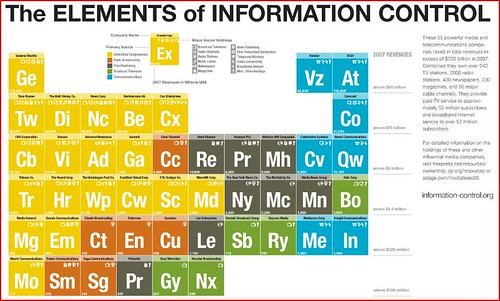
The chart is accompanied by the typical Free Press gloom-and-doom rhetoric about the unfolding media apocalypse. “Nearly everything you see, hear and read that isn’t from a friend — whether on TV, the radio, or even on the Web — comes from a for-profit gatekeeper.” And then comes the obligatory A.J. Liebling quote about how “Freedom of the press belongs to those who own one,” followed quickly by the typical punch line about how just a handful of companies (in this case 55 of ’em) are puppeteering all our thoughts in America today:
Combined, these 55 powerful media and telecommunications companies raked in total revenues in excess of $700 billion in 2007. Together they own over 540 TV stations, 2000 radio stations, 430 newspapers, 230 magazines, and 80 major cable channels in the United States. They provide paid TV service to approximately 52 million subscribers and broadband Internet service to over 57 million subscribers. They’re the bottlenecks through which our news, our entertainment, and our political discourse must travel. What they want to promote becomes prominent; what they suppress stays out of the mainstream. As such, these companies are the elements of information control.
Oh my God! We are all just brainwashed sheep!
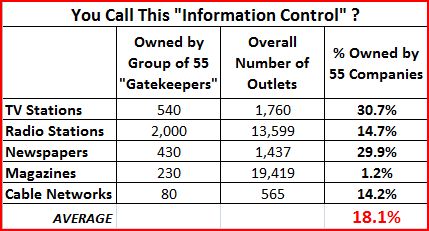
Except we’re not. It amazes me how these “information control” and “media monopoly” myths keep getting widespread circulation. But the first thing to note is how the media reformistas can’t get even their story straight when it comes to how many “monopolists” are supposedly out there today. As I noted in my 2005 book, Media Myths: Making Sense of the Debate over Media Ownership, the critics seem to just pull their numbers out of a hat. Some say as few as 3 companies control everything. Others says 5 or 6. Still others say it might be a few dozen. And now this guy says its 55. Hey, that’s progress that even the Free Press should love!
Regardless of the number, does this really represent the totality of our modern media universe? Do those 55 companies really “own most of the 21st-century presses in America” as the “Info Control” website states? Answer: NOT. EVEN. CLOSE. Here are the facts. [I happened to have compiled them for a PFF special report entitled Media Metrics: The True State of the Modern Media Marketplace to debunk myths just like this.]
Continue reading →
Big news in these parts.
The celebrated openness of the Internet — network providers are not supposed to give preferential treatment to any traffic — is quietly losing powerful defenders.
Google Inc. has approached major cable and phone companies that carry Internet traffic with a proposal to create a fast lane for its own content, according to documents reviewed by The Wall Street Journal. Google has traditionally been one of the loudest advocates of equal network access for all content providers.
TLFers and commenters: Go.
Ken Ferree and I just filed an amicus brief with the D.C. Circuit in what could be among the most important First Amendment cases involving economic regulation in years: Comcast’s challenge to the FCC’s cap on the maximum size of a cable operator’s nationwide subscriber-audience. While few may feel righteous indignation at limitations targeted at large corporations such as Comcast or Time Warner, the larger principle at stake here is deeply important: Will the First Amendment provide a meaningful check on what USC law professor Chris Yoo has called “architectural censorship” (i.e., so-called “structural” regulations that “have the unintended consequence of reducing the quantity, quality, and diversity of media content”).
In a nutshell, we argue that that:
- The provisions of the 1992 Cable Act authorizing the FCC to impose a “cable cap” are outdated in world of media abundance and vibrant platform competition.
- Because cable is no longer the unique “bottleneck” or “gatekeeper” that it was in 1992, these statutory provisions (not just the FCC’s 30% rule) must be subject to strict scrutiny under the First Amendment as a limitation on free speech.
- Because there are “less restrictive means” of ensuring cable operators do not impede the flow of video programming to consumers, the court should strike down these provisions.
- Even if the court upholds the statute, it should nonetheless strike down the cap issued by the FCC in December 2007 (30% of all Multichannel Video Programming (MVPD) subscribers as based on an outdated model of the video marketplace.
I encourage you to read our brief (below). I’ve provided a summary below, along with some additional commentary we just couldn’t cover under our 3500 word limit.
Strict Scrutiny. Yoo’s article Architectural Censorship and the FCC is essential reading for anyone who believes that government regulations on the size and shape of the “soapbox” can have huge effects on speech itself. Yoo argues that the First Amendment should check this kind of regulation–however “content-neutral” it might seem–under “strict scrutiny”, which requires that the government show that a regulation is the “least restrictive means” available for advancing a “compelling government interest.” But Yoo ultimately concludes (pp. 713-718, PDF pp. 45-50) that, under existing precedent, most “architectural censorship will be effectively insulated from meaningful judicial review.” Continue reading →
Last week I discussed Barbara Esbin’s new PFF paper about the FCC’s absurd investigation into how the cable industry is transitioning analog customers over to digital. This is an essential transition is the cable industry is going to free up bandwidth to compete against telco-provided fiber offerings in the future. The faster the cable industry can migrate its old analog TV customers over to the digital platform, the more bandwidth they can re-deploy for high-speed Net access and services. Mark Cuban helps put things in perspective:
1. the only thing that cable companies, and satellite for that matter have to sell is bandwidth and the applications they can run on that bandwith. More bandwidth means more digital everything.
2. For Basic Cable subscribers that get say, 40 analog channels, they are consuming 40 x 38.6mbs or 1.54 Gbs. Let that sink in. 1.54 Gbs of bandwidth. Compare that to how fast your internet access is. That more bandwidth than your entire neighborhood consumes online, by a lot.
Thats also the equivalent of 500 standard def digital channels. If you convert that to revenue per bit for cable companies, or cost per bit for basic cable consumers, the basic cable customers are getting the best deal in town. By a long shot.
Digital cable customers, not so much. Digital customers are paying multiples of analog customers for bandwidth. In reality, analog customers are getting an amazing deal, and the cable companies have been hesitant to convert them only because of the potential FCC backlash.
I’m as cynical as the next guy when it comes to cable rates and motivations, but the reality is that the longer analog remains, the fewer opportunities to leverage the freed up bandwidth to create next generation bandwidth hog applications. Will the cable companies charge us an a lot for that bandwidth, probably. But when we start to see applications built on top of 250mbs per second and more, it will have far more value to society than watching USA Network on your old analog TV. And Net Neutrality? Well if everyone had that 1.54gbs available to them, net neutrality would be a non issue. We wouldn’t be arguing about access or pre-emption, we would be arguing about quality of service.
Once again we are reminded that all regulations have opportunity costs and in this case the FCC’s actions could cost consumers the loss (or at least delay) of higher-speed broadband offerings in the near-term.
In her latest column, Media Post media market guru Diane Mermigas wonders how long it will be before we see a traditional over-the-air (OTA) broadcast TV network (like ABC, NBC, CBS, or Fox) dump their old broadcast business altogether and just move all their properties to cable and satellite TV. And, in response to Mermigas, Cory Bergman of Lost Remote argues, as I did last week, “the real future of TV is not linear cable, but non-linear video delivered seamlessly via IP to multiple devices, including your TV set. But mass adoption of this approach is still several years away.”
Bergman is right. It would be foolish to think any traditional network is going to rely exclusively on IP-based distribution any time soon; they see it as more of a compliment (or another product window). But Mermigas may be on to something in predicting that broadcast networks may soon be looking to get out of the OTA television business altogether and essentially become “a glorified general entertainment cable network.”
The strain on their dysfunctional paradigm is emanating from a devastating recession and the ongoing digital revolution. Both are permanently altering the rules of play for the networks. A case can be made for at least one of the Big 4 broadcast networks emerging as a glorified general entertainment cable network within the next several years. The economic advantages: more steady ad revenues and consistent subscriber fees as content is distributed cross-platform.
It would be a bold move that a free-spirited company such as News Corp. might already be contemplating for its Fox Broadcast TV Network, or NBC Universal for its peacock network. Industry analysts increasingly wonder how an independent CBS can prattle on under the crumbling old rules. In a world of exploding access and choices, the prime-time ratings (even with Live plus 3 configurations) spell diminishing returns. For Disney, ABC’s general entertainment status is on par with ESPN in sports; the new multi-platform model is in place except for formally moving the ABC TV Network to the cable side of the ledger.
Continue reading →
I need not remind anyone here about FCC Chairman Kevin Martin’s ongoing “war on cable.” Even if you hate the cable industry or capitalism in general, there’s just no way I can see how anyone who believes in the rule of law and good government can support Martin’s incessant abuse of power in his Moby Dick-like crusade against the cable industry. A crusade, incidentally, which happens to be motivated by Chairman Ahab’s desire to control speech on cable television, as I’ll note below.
Anyway, the latest chapter in this miserable saga of government-gone-mad is Martin’s recent effort to begin a far-ranging data gathering effort concerning cable prices and analog-to-digital channel movements under the guise of individual complaint enforcement. In a new paper entitled “Der Undue Prozess at the FCC: Part Deux,” my PFF colleague Barbara Esbin shows, once again, how the FCC’s regular processes and procedures are being perverted by Martin to achieve ends not within the agency’s delegated authority. And the results, in this case, will be profoundly anti-consumer.
Esbin documents the four flaws in the FCC’s investigation as follows:
Continue reading →

 The Technology Liberation Front is the tech policy blog dedicated to keeping politicians' hands off the 'net and everything else related to technology.