Posts tagged as:

[I’ve been working on an outline for a book I hope to write surveying technological skepticism throughout history. I first started thinking about this topic two years when I noticed that a great number of recent books about Internet policy could generally be grouped into one of two camps: Internet optimists vs. Internet pessimists. I subsequently penned an essay on the subject that generated a fair bit of attention. So, I figured I must be on to something, and the more Net policy books I read, the more I realized that the divisions between these two camps were growing wider and increasingly heated. Thus, I thought I would share this very rough draft (much of it still in outline form) of the opening chapter of that book I want to write about this great intellectual war over the impact of technology on society. I invite reader input. Update Jan. 2011: I finally published a full-length essay on this topic. You can find it here. ]

__________

The impact of technological change on culture, learning, and morality has long been the subject of intense debate, and every technological revolution brings out a fresh crop of both pessimists and pollyannas. Indeed, a familiar cycle has repeat itself throughout history whenever new modes of production (from mechanized agriculture to assembly-line production), means of transportation (water, rail, road, or air), energy production processes (steam, electric, nuclear), medical breakthroughs (vaccination, surgery, cloning), or communications techniques (telegraph, telephone, radio, television) have appeared on the scene.

The cycle goes something like this. A new technology appears. Those who fear the sweeping changes brought about by this technology see a sky that is about to fall. These “techno-pessimists” predict the death of the old order (which, ironically, is often a previous generation’s hotly-debated technology that others wanted slowed or stopped).  Embracing this new technology, they fear, will result in the overthrow of traditions, beliefs, values, institutions, business models, and much else they hold sacred.

The pollyannas, by contrast, look out at the unfolding landscape and see mostly rainbows in the air. Theirs is a rose-colored world in which the technological revolution du jour is seen as improving the general lot of mankind and bringing about a better order.  If something has to give, then the old ways be damned! For such “techno-optimists,” progress means some norms and institutions must adapt—perhaps even disappear—for society to continue its march forward.

Our current Information Revolution is no different. It too has its share of techno-pessimists and techno-optimists. Indeed, before most of us had even heard of the Internet, people were already fighting about it—or at least debating what the rise of the Information Age meant for our culture, society, and economy. Continue reading →

Last week I commented on a severely one-sided FCC net neutrality hearing that featured a endless parade of horribles being prophesied by virtually every speaker. The litany of spooky stories became tedious and absurd. Everyone foretold of the impending doom that awaits unless government intervenes to save us from various corporate conspiracies to “silence” our voices.  Unsurprisingly, evidence was in short supply. It was pure Chicken Little poppycock.

This got me thinking again about what I have referred to as the “problem of proportionality.” I have discussed the problem of proportionality in the context of public policy debates about online safety and privacy, but it seems equally applicable to debates about net neutrality. Here’s how I explained the “problem of proportionality” in an earlier essay:

let’s think about how some of our lawmakers and media personalities talk about the Internet.  If we were to judge the Internet based upon the daily headlines in various media outlets or from the titles of various Congressional or regulatory agency hearings, then we’d be led to believe that the Internet is a scary, dangerous place. That ’s especially the case when it comes to concerns about online privacy and child safety. Everywhere you turn there’s a bogeyman story about the supposed dangers of cyberspace. But let’s go back to the numbers. While I certainly understand the concerns many folks have about their personal privacy or their child’s safety online, the fact is the vast majority of online transactions that take place online each and every second of the day are of an entirely harmless, even socially beneficial nature.  I refer to this disconnect as the “problem of proportionality” in debates about online safety and privacy. People are not just making mountains out of molehills, in many cases they are just making the molehills up or blowing them massively out of proportion.

Again, much the same is true of net neutrality. Indeed, it is even more true since actual net neutrality “incidents” are so hard to come by.  Continue reading →

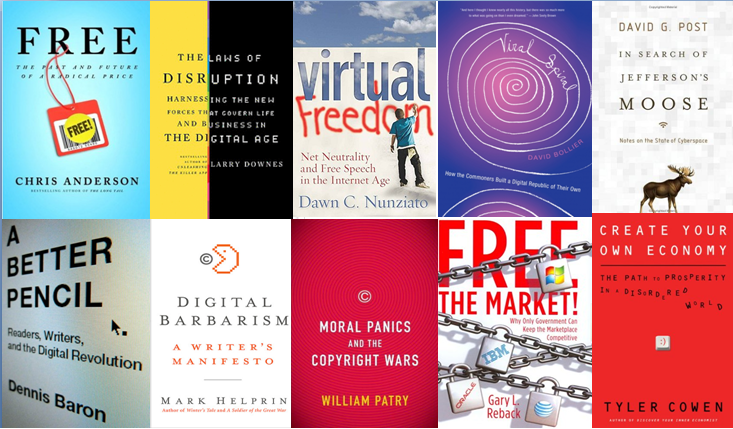
2009 was not as big of a year for Internet and information technology (“info-tech”) policy books as 2008 was, but there were still some notable titles released that offered interesting perspectives about the future of the Net and the impact the Digital Revolution is having on our lives, culture, and economy.  So, like last year, I figured I would throw together my list of the 10 most important info-tech policy books of the year.

book covers collage 2009First, let me repeat a few of the same caveats and disclaimers that I set forth last year.  What qualifies as an “important” info-tech policy book? Simply put, it’s a title that many people are currently discussing and that we will likely be referencing for many years to come.  However, I want to be clear that merely because a book appears on my list it does not necessarily mean I agree with everything said in it. In fact, as was the case in previous years, I found much with which to disagree in my picks for the most important books of 2009 and I find that the cyber-libertarianism I subscribe to has very few fans out there.

Another caveat: Narrowly-focused titles lose a few points on my list. For example, if a book deals mostly with privacy issues, copyright law, or antitrust policy, it does not exactly qualify as the same sort of “tech policy book” as other titles found on this list since it is a narrow exploration of just one set of issues with a bearing on technology policy.

With those caveats in mind, here are my choices for the Most Important Info-Tech Policy Books of 2009. Continue reading →

Rebecca MacKinnon has an important piece in the Wall Street Journal today about China’s “Green Dam Youth Escortfiltering mandate and the danger of this model catching on with other governments. “More and more governments — including democracies like Britain, Australia and Germany — are trying to control public behavior online, especially by exerting pressure on Internet service providers,” she notes. “Green Dam has only exposed the next frontier in these efforts: the personal computer.”

She’s right, and that’s cause for serious concern.  Moreover, there’s the question of how corporations doing business in China should respond to demands and threats related to installing such filters. She notes:

In a world that includes child pornographers and violent hate groups, it is probably not reasonable to oppose all censorship in all situations. But if technical censorship systems are to be put in place, they must be sufficiently transparent and accountable so that they do not become opaque extensions of incumbent power — or get hijacked by politically influential interest groups without the public knowing exactly what is going on. Which brings us back to companies: the ones that build and run Internet and telecoms networks, host and publish speech, and that now make devices via which citizens can go online and create more speech. Companies have a duty as global citizens to do all they can to protect users’ universally recognized right to free expression, and to avoid becoming opaque extensions of incumbent power — be it in China or Britain.

I generally agree with all that but this is a difficult issue and one that I have struggled with personally. (See this “Friendly Conversation about Corporate High-Tech Engagement with China” that Jim Harper and I had three years ago).  But I do hope that more companies take a hard line with the Chinese as well as there own governemnts when it comes to filtering mandates or even restricitve parental control defaults and settings [an issue I wrote more about in this paper: “The Perils of Mandatory Parental Controls and Restrictive Defaults.”]  On that note, kudos to the business groups that already signed on to a joint letter oppossing China’s new filtering mandate.

Over at the Verizon Policy Blog, Link Hoewing has a sharp piece up entitled, “Of Business Models and Innovation.” He makes a point that I have often stressed in my debates with Zittrain and Lessig, namely, that the whole “open vs. closed” debate is typically greatly overstated or misunderstood.   Hoewing correctly argues that:

The point is not that open or managed models are always better or worse.  The point is that there is no one “right” model for promoting innovation.  There are examples of managed and open business models that have been both good for innovation and bad for it. There are also examples of managed and open models that have both succeeded and failed.  The point is in a competitive market to let companies develop business models they believe will serve consumers best and see how things play out.

Exactly right.  Moreover, the really important point here is that there exists a diverse spectrum of innovative digital alternatives from which to choose. Along the “open vs. closed” spectrum, the range of digital technologies and business models continues to grow and grow in both directions.  Do you want wide-open, tinker-friendly devices, sites, or software? You got it. Do you want a more closed, simple, and safe online experience?  You can have that, too.  And there are plenty of choices in between.

This is called progress!