Today, it was my great privilege to guest lecture at Princeton University’s Center for Information Technology Policy. Under the leadership of Ed Felten, who also runs the excellent “Freedom to Tinker” blog, the CITP has quickly become one of America’s premier institutions in the field of IT policy matters. David Robinson, who some of you will remember from his days as an editor at The American, serves as associate director of the CITP program and was kind enough to invite me to speak. And our own Tim Lee is currently studying there as well. I wish I was smart enough to get into that program!
The topic of my talk was “The Future of the First Amendment in an Age of Technological Convergence” and I used the opportunity to create a narrated video of this presentation, which I have made to several other groups through the years. In this presentation, I talk about “America’s First Amendment Twilight Zone,” which refers to the fact that identical words and images are being regulated in completely different ways today depending on the mode of transmission. This illogical and unfair situation could eventually threaten the Internet, video games, and all new media with many of the misguided regulations that have long been imposed on broadcast television and radio operators. In my presentation, which you can watch below, I make the case for changing our First Amendment regime to ensure “bit equality”; all speech and media platforms should be accorded the gold standard of First Amendment protection.
http://www.youtube.com/v/xJo3tVMScyI&hl=en&fs=1
Continue reading →
Ben Edelman of the Harvard Business School has just released an interesting new study in the Journal of Economic Perspectives entitled, “Red Light States: Who Buys Online Adult Entertainment?” Using data he obtained from a top-10 seller of adult entertainment, Edelman examined adult website subscriptions on the zip code level and found that conservatives seem to be every bit as interested in pornography as liberals. In fact, “Subscriptions [to adult entertainment sites] are slightly more prevalent in states that have enacted conservative legislation on sexuality” and “subscriptions are also more prevalent in states where surveys indicate conservative positions on religion, gender roles, and sexuality.” He also finds that:
In states where more people agree that “Even today miracles are performed by the power of God” and “I never doubt the existence of God,” there are more subscriptions to this service. Subscriptions are also more prevalent in states where more people agree that “I have old-fashioned values about family and marriage” and “AIDS might be God’s punishment for immoral sexual behavior.”
Even more interesting is the fact that, on a state-by-state basis, Utah* residents topped all other Americans in terms of subscriptions to online adult entertainment websites. Finally, Edelman concludes:
On the whole, these adult entertainment subscription patterns show a remarkable consistency: all but eleven states have between two and three subscribers to this service per thousand broadband households, and all but four have between 1.5 and 3.5. With interest in online adult entertainment relatively constant across regions, there’s little sign of a major divide.
But it’s not just Internet porn where we see this trend at work. As I noted in my law review article, “Why Regulate Broadcasting?” we’ve seen a similar trend at work with television. When you look at some of the TV shows that conservatives and religious groups gripe most about, you might be surprised to know that it is conservatives who make those shows as popular as they are!
Continue reading →
 When the history books are finally written documenting America’s failed experiment with broadcast industry content regulation, this past week may go down as a critical moment in the story. The obvious reason this week was so important was the Senate’s 87-11 vote on Thursday to prevent the Federal Communications Commission (FCC) from reinstating the Fairness Doctrine. But an equally important development this past week was the release of a new white paper by the radical Leftist activist group Free Press.
The Free Press, which was founded by the socialist media theorist Robert McChesney, doesn’t typically publish many things admitting to the failures of coercive government regulation. Nonetheless, in “The Fairness Doctrine Distraction,” a paper by Josh Silver and Marvin Ammori, the media reformistas at Free Press told their Big Government comrades in Congress and academia that it was finally OK to let go of at least this one old pet project of theirs. In their paper, Silver and Ammori note that, “The Fairness Doctrine put the federal government in the position of judging content and controlling speech” and “Reinstating the Doctrine will not result in greater viewpoint diversity in broadcasting.” They continue:
The Fairness Doctrine, while originally well-intentioned, is not wise public policy. [T]he Doctrine places the FCC in charge of determining what is fair in political speech — a difficult task in the best of circumstances. Placing the government in the role of monitoring and judging political speech will inevitably produce controversy that is impossible to resolve.
I applaud the Free Press for finally fessing up to the Fairness Doctrine’s many failings. This First Amendment-violating abomination should have never been allowed to be enforced by the FCC to begin with, but at least we can now all finally agree it should stay off the books for good.
Of course, the radicals at the (Un)Free Press weren’t about to let one of the Left’s old favorite regulations go so away without asking for something in return. One of the reasons that Silver and Ammori are suddenly willing to give their blessing to the Doctrine’s burial is because they want to get on with the more far-reaching agenda of micro-managing media markets using a variety of less visible regulations.
Continue reading →
My new article on “FCC v. Fox and the Future of the First Amendment” has just been published in the February 2009 edition of Engage, the journal of the Federalist Society. Here’s how it begins:
On November 4th, 2008, the Supreme Court heard oral arguments in the potentially historic free speech case of Federal Communications Commission v. Fox Television Stations, Inc. This case, which originated in the Second Circuit Court of Appeals, deals with the FCC’s new policy for “fleeting expletives” on broadcast television. The FCC lost and appealed to the Supreme Court. By contrast, the so-called “Janet Jackson case” — CBS v. FCC — was heard in the Third Circuit Court of Appeals. The FCC also lost that case and has also petitioned the Supreme Court to review the lower court’s ruling.
These two cases reflect an old and odd tension in American media policy and First Amendment jurisprudence. Words and images presented over one medium-in this case broadcast television-are regulated differently than when transmitted through any other media platform (such as newspapers, cable TV, DVDs, or the Internet). Various rationales have been put forward in support of this asymmetrical regulatory standard. Those rationales have always been weak, however. Worse yet, they have opened the door to an array of other regulatory shenanigans, such as the so-called Fairness Doctrine, and many other media marketplace restrictions.
Whatever sense this arrangement made in the past, technological and marketplace developments are now calling into question the wisdom and efficacy of the traditional broadcast industry regulatory paradigm. This article will explore both the old and new rationales for differential First Amendment treatment of broadcast television and radio operators and conclude that those rationales: (1) have never been justified, and (2) cannot, and should not, survive in our new era of media abundance and technological convergence.
I go on in the piece to make the case against the those rationales and the call for the Supreme Court to use the
Fox and CBS cases to end this historical First Amendment anomaly of differential treatment of broadcast platforms relative to all other media providers.
This article can be downloaded as a PDF here, or viewed down below the fold in the Scribd reader.
Continue reading →
George Will’s weekly Washington Post column focuses on the Fairness Doctrine and calls out those on the Left who would support its reinstatement:
Because liberals have been even less successful in competing with conservatives on talk radio than Detroit has been in competing with its rivals, liberals are seeking intellectual protectionism in the form of regulations that suppress ideological rivals. If liberals advertise their illiberalism by reimposing the fairness doctrine, the Supreme Court might revisit its 1969 ruling that the fairness doctrine is constitutional. The court probably would dismay reactionary liberals by reversing that decision on the ground that the world has changed vastly, pertinently and for the better.
Mr. Will was kind enough to cite my new book with Brian Anderson, A Manifesto for Media Freedom [more info here] on the explosion of media outlets and options since the Supreme Court’s disastrous 1969 Red Lion decision, which blessed the Fairness Doctrine. Some of those stats: today there are about 14,000 radio stations, twice as many as in 1969; 18.9 million subscribers to satellite radio, up 17 percent in 12 months; and that 86 percent of households with either cable or satellite television receive an average of 102 of the 500 available channels.
No need to be putting the “Unfairness Doctrine” back on the books with unprecedented abundance like that.
Last night, I appeared on the Jim Bohannon radio show for 30 minutes and discussed the past, present, and future of the Fairness Doctrine and broadcast industry regulation in general. More specifically, we got into efforts to drive Fairness Doctrine-like regulations back on the books via backdoor efforts like “localism” mandates, community oversight boards, and other public interest requirements. These are issues that Brian Anderson and I discuss in our new book, A Manifesto for Media Freedom, which I blogged about here when it was released in October.
If you’re interested, you can listen to the entire show by clicking here.
Yesterday, the Senate passed S. 602, “The Child Safe Viewing Act of 2007,” which was introduced by Sen. Mark Pryor (D-AR) in February 2007. The bill requires the Federal Communications Commission (FCC) to study the market for “advance blocking technologies” (i.e., parental controls and rating systems) that parents can use to protect their kids from inappropriate content from various sources and platforms. On the surface, the measure seems harmless enough, but in practice, it could have some troubling long-term free speech implications if it leads to more government meddling with parental controls and ratings systems.
The measure requires the FCC to initiate a notice of inquiry to consider measures to examine:
- the existence and availability of advanced blocking technologies that are compatible with various communications devices or platforms;
- methods of encouraging the development, deployment, and use of such technology by parents that do not affect the packaging or pricing of a content provider’s offering; and
- the existence, availability, and use of parental empowerment tools and initiatives already in the market.
That all sounds harmless enough. Indeed, such a study could produce some useful information about the state of the parental controls marketplace. (Of course, I could save them some taxpayer dollars and just send copies of my big
Parental Controls & Online Child Safety report to all FCC officials!)
But it’s what comes next in the bill that causes me some heartburn. As part of the review mandated by the bill, S. 602 commands the FCC to “consider advanced blocking technologies that”:
Continue reading →
In late June, the Federal Communications Commission (FCC) opened a Notice of Inquiry and Notice of Proposed Rulemaking regarding “Sponsorship Identification Rules and Embedded Advertising” (MB Docket No. 08-90). Basically, it’s an inquiry into the product placement and embedded advertising practices on television. Some at the FCC want such practices regulated.
PFF filed comments in the matter today. Ken Ferree and I argue that that FCC regulation of such advertising practices would be unnecessary and unwise. “If the Notice demonstrates anything,” we argue, “it is that a majority of the current Commissioners live in a world wholly alien and unfamiliar to most Americans; indeed, a world long forgotten if it ever existed.” We continue:
The Notice alludes menacingly to new, “subtle and sophisticated means” of commercial messaging, to “sneaky commercials” (quoting a senescent order topped with nearly fifty-years of dust) and to “vindicat[ing]” the policy goals of the Communications Act – as if the FCC must exact vengeance on those who would try – horror of horrors – to sell goods and services to the American public. The melodramatic tone of the Notice is intended, of course, to set the stage for the Commission’s latest effort to micromanage the free marketplace of ideas, i.e., the media. Only by portraying “embedded” advertising as something new and nefarious can the Commission hope to justify a new portfolio of intrusive and burdensome speech regulations in the name of preserving the “public’s right to know who is paying to air commercials or other program matter on broadcast television and radio and cable.”
And, as we make clear in the filing, we don’t buy the argument that the public are nothing more than mindless sheep:
Continue reading →
Just FYI, the latest update of my booklet on “Parental Controls and Online Child Protection: A Survey of Tools & Methods” is now live. The new version, Version 3.1, provides minor updates to all sections of the book and a new appendix of relevant research in the field. I issue major updates early each year and 1 or 2 tweaks during the course of the year to reflect the evolution of the parental control and online child safety market and debate. 
For those not familiar with the report, it explores the market for parental control tools, rating schemes, education efforts, and initiatives aimed at promoting online child safety. I believe that the parental controls and content management tools cataloged in the report represent a better, less restrictive alternative to government regulation. As I conclude after evaluating that state of the market: “There has never been a time in our nation’s history when parents have had more tools and methods at their disposal to help them decide what constitutes acceptable media content in their homes and in the lives of their children.”
The report is available free-of-charge on the PFF website, and the previous editions of the report are housed there too in case you want to see how it has evolved over the past two years. For those interested in taking a quick look at the report, I have embedded it down below the fold as a Scribd file. Finally, as is always the case, I encourage readers to send me updates and suggestions for how to improve the report and I will incorporate them into future versions.
Continue reading →
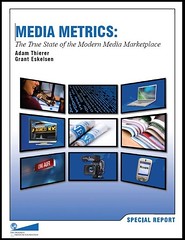 Faithful readers will recall that, several months ago, I penned a 7-part “Media Metrics” series that took a hard look at the health of the media marketplace. Today, the Progress & Freedom Foundation is releasing a greatly expanded version of these essays that I have put together with my PFF colleague Grant Eskelsen. In this 100-page special report, “Media Metrics: The True State of the Modern Media Marketplace,” we begin by noting that heated debates about the state of the media marketplace continue to rage in Washington, and opinions seem to range from grim to outright apocalyptic. As we note on pg. 1:
Many people—including a large number of legislators and regulators—argue that America’s media marketplace is in a miserable state. Some claim that citizens lack choice in media outlets and that options are just as scarce as ever. Others believe that media “localism” is dead or that many groups or niches go underserved because of a lack of true “diversity” in media. Others argue that the market is hopelessly over-concentrated in the hands of a few evil media barons who are hell-bent on force-feeding us corporate propaganda. And still others say that the quality of news and entertainment in our society has deteriorated because of a combination of all of the above. It all sounds quite troubling, but is any of it true?
After taking an objective look at the true state of America’s media marketplace, we conclude that such pessimism is unwarranted. Indeed, a careful review of the facts reveals that—contrary to what those media critics suggest—we have more media choice, more media competition, and more media diversity than ever before. Indeed, to the extent there was ever a “golden age” of media in America, we are living in it today. The media sky has never been brighter and it is getting brighter with each passing year.
Continue reading →

 The Technology Liberation Front is the tech policy blog dedicated to keeping politicians' hands off the 'net and everything else related to technology.