“All this top-40s music sounds the same.” I think we’ve all heard this sentiment. The nature of regional radio broadcasting almost requires a regression to the mean in musical tastes. A radio station cannot be all things to all people. I suspect most people will be surprised to learn that some of the most innovative radio broadcasts are taking place at hundreds of stations across the country—and only few people can listen to them. These stations, known as low power FM (LPFM), carry niche programming like independent folk rock music, fishing shows, political news, reggae, blues, and religious programming. (And one station in Sitka, Alaska consists entirely of a live feed of whale sounds.) Continue reading →
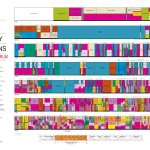
 I’ve written several articles in the last few weeks critical of the dangerously unprincipled turn at the Federal Communications Commission toward a quixotic, political agenda. But as I reflect more broadly on the agency’s behavior over the last few years, I find something deeper and even more disturbing is at work. The agency’s unreconstructed view of communications, embedded deep in the Communications Act and codified in every one of hundreds of color changes on the spectrum map, has become dangerously anachronistic.
The FCC is required by law to see separate communications technologies delivering specific kinds of content over incompatible channels requiring distinct bands of protected spectrum. But that world ceased to exist, and it’s not coming back. It is as if regulators from the Victorian Age were deciding the future of communications in the 21
st century. The FCC is moving from rogue to steampunk.
With the unprecedented release of the staff’s draft report on the AT&T/T-Mobile merger, a turning point seems to have been reached. I wrote on
CNET (see “FCC: Ready for Reform Yet?”) that the clumsy decision to release the draft report without the Commissioners having reviewed or voted on it, for a deal that had been withdrawn, was at the very least ill-timed, coming in the midst of Congressional debate on reforming the agency. Pending bills in the House and Senate, for example, are especially critical of how the agency has recently handled its reports, records, and merger reviews. And each new draft of a spectrum auction bill expresses increased concern about giving the agency “flexibility” to define conditions and terms for the auctions.
The release of the draft report, which edges the independent agency that much closer to doing the unconstitutional bidding not of Congress but the White House, won’t help the agency convince anyone that it can be trusted with any new powers. Let alone the novel authority to hold voluntary incentive auctions to free up underutilized broadcast spectrum.
 Continue reading →
 On NPR’s Marketplace this morning, I talk about net neutrality litigation with host John Moe.
Nearly a year after the FCC passed controversial new “Open Internet” rules by a 3-2 vote, the White House finally gave approval for the rules to be published last week, unleashing lawsuits from both supporters and detractors.
The supporters don’t have any hope or expectation of getting a court to make the rules more comprehensive. So why sue? When lawsuits challenging federal regulations are filed in multiple appellate courts, a lottery determines which court hears a consolidated appeal.
So lawsuits by net neutrality supporters are a procedural gimmick, an effort to take cases challenging the FCC’s authority out of the D.C. Circuit Court of Appeals, which has already made clear the FCC has no legal basis here.
Continue reading →
 Last week the Senate Commerce Committee passed–with deep bi-partisan support–the Public Safety Spectrum and Wireless Innovation Act.
The bill, co-sponsored by Committee Chairman Jay Rockefeller and Ranking Member Kay Bailey Hutchison, is a comprehensive effort to resolve several long-standing stalemates and impending crises having to do with one of the most critical 21st century resources: radio spectrum.
My analysis of the bill appears today on CNET. See “Spectrum reform, public safety network move forward in Senate.”
The proposed legislation is impressive in scope; it offers new and in some cases novel solutions to more than half-a-dozen spectrum-related problems, including: Continue reading →
What I hoped would be a short blog post to accompany the video from Geoff Manne and my appearances this week on PBS’s “Ideas in Action with Jim Glassman” turned out to be a very long article which I’ve published over at Forbes.com.
I apologize to Geoff for taking an innocent comment he made on the broadcast completely out of context, and to everyone else who chooses to read 2,000 words I’ve written in response.
So all I’ll say here is that Geoff Manne and I taped the program in January, as part of the launch of TechFreedom and of “The Next Digital Decade.” Enjoy!
 I’ve written posts today for both CNET and Forbes on legislation introduced yesterday by Senators Olympia Snowe and John Kerry that would require the FCC and NTIA to complete inventories of existing spectrum allocations. These inventories were mandated by President Obama last June (after Congress failed to pass legislation), but got lost at the FCC in the net neutrality armageddon.
Everyone believes that without relatively quick action to make more spectrum available, the mobile Internet could seize up. Given the White House’s showcasing of wireless as a leading source of new jobs, investment, and improved living conditions for all Americans, both Congress and President Obama, along with the FCC and just about everyone else, knows this is a crisis that must be avoided.
Indeed, the National Broadband Plan estimates conservatively that mobile users will need 300-500 mhz of new spectrum over the next 5-10 years. Continue reading →
 Following up on my Congressional testimony last week, I’ve written two articles on how the House and Senate are moving forward with plans to undo the FCC’s December 23,2010 “Open Internet” order, aka net neutrality. For my inaugural post for Forbes, I write about the experience of being a witness before the House Judiciary Committee’s Subcommittee on Intellectual Property, Competition and the Internet, and provide some background on how the FCC found itself backed into a corner that led to the unpopular (on both sides) new rules. See “Deep in the Net Neutrality Trenches.”
On CNET this morning, I review in detail the steps taken last week by Congress. These include two hearings, one featuring all five FCC Commissioners. After the hearings, the House approved an amendment to the on-going budget negotiations that would deny the agency any funding to implement or enforce its rules. Later, both the House and Senate issued a Joint Resolution of Disapproval, which, if passed, would nullify the rule-making and deny the FCC future authority to try again. Continue reading →
Back in 2007 I penned a law review article, “Why Regulate Broadcasting: Toward a Consistent First Amendment Standard for the Information Age” in which I argued that “If America is to have a consistent First Amendment in the Information Age, efforts to extend the broadcast regulatory regime must be halted and that regime must be relegated to the ash heap of history.” I made that argument based not only upon the fundamental bankruptcy of the rationales supporting the old broadcast regulatory regime, or its unfairness to broadcasters relative to other media competitors, but also because such asymmetrical regulations no longer make sense — and are increasingly impractical to enforce — in an age of technological convergence and media abundance.
The good news is that, slowly but surely, the courts are coming around to this logic, at least as it pertains to speech controls. We saw that again today with a ruling by the Second Circuit Court of Appeals that held as unconstitutional $1.2 million in fines that the Federal Communications Commission (FCC) levied on ABC broadcast affiliates seven years ago for airing a brief glimpse of Charlotte Ross’ bare buttocks on the cop drama “NYPD Blue.” As the Wall Street Journal’s
Amy Schatz notes, “Broadcasters have now won a series of court victories against government efforts to police airwaves and fine stations for airing risqué content. The Supreme Court could soon get a chance to review the issue. In the meantime, the FCC’s campaign to enforce indecency rules has ground to a halt.”
It remains to be seen whether the Supreme Court will throw the whole regime out, but I can’t help but think that’s where we are headed. Continue reading →
 When the only tool you have is a hammer, as the old cliché goes, everything looks like a nail.
Net neutrality, as I first wrote in 2006, is a complicated issue at the accident-prone intersection of technology and policy. But some of its most determined—one might say desperate—proponents are increasingly anxious to simplify the problem into political slogans with no melody and sound bites with no nutritional value. Even as—perhaps precisely because—a “win-win-win” compromise seems imminent, the rhetorical excess is being amplified. The feedback is deafening.
In one of the most bizarre efforts yet to make everything be about net neutrality, Public Knowledge issued several statements this week “condemning” Fox’s decision to prohibit access to its online programming from Cablevision internet users. In doing so, the organization claims, Fox has committed “the grossest violations of the open Internet committed by a U.S. company.”
This despite the fact that the open Internet rules (pick whatever version you like) apply only to Internet access providers. Indeed, the rules are understood principally as a protection for content providers. You know, like Fox. Continue reading →
 Better late than never, I’ve finally given a close read to the Notice of Inquiry issued by the FCC on June 17th. (See my earlier comments, “FCC Votes for Reclassification, Dog Bites Man”.) In some sense there was no surprise to the contents; the Commission’s legal counsel and Chairman Julius Genachowski had both published comments over a month before the NOI that laid out the regulatory scheme the Commission now has in mind for broadband Internet access.
Chairman Genachowski’s “Third Way” comments proposed an option that he hoped would satisfy both extremes. The FCC would abandon efforts to find new ways to meet its regulatory goals using “ancillary jurisdiction” under Title I (an avenue the D.C. Circuit had wounded, but hadn’t actually exterminated, in the Comcast decision), but at the same time would not go as far as some advocates urged and put broadband Internet completely under the telephone rules of Title II.
Continue reading →


 The Technology Liberation Front is the tech policy blog dedicated to keeping politicians' hands off the 'net and everything else related to technology.