I’ve just had a new article published by the American Legislative Exchange Council (ALEC) in which I make the case against “techno-panics,” which refers to public and political crusades against the use of new media or technologies by the young. The article is entitled “Parents, Kids & Policymakers in the Digital Age: Safeguarding Against ‘Techno-Panics‘” and it appears in the July 2009 Inside ALEC newsletter. This is something I have spent a lot of time writing about here in recent years (See 1, 2, 3, 4, 5) and I finally got around to putting it altogether in a concise essay here. I have pasted the full text below. [And I just want to send a shout-out to my friend Anne Collier of Net Family News.org, whose work on this topic has been very influential on my thinking.]
“Parents, Kids & Policymakers in the Digital Age: Safeguarding Against ‘Techno-Panics‘”
by Adam Thierer
A cursory review of the history of media and communications technologies reveals a reoccurring cycle of “techno-panics” — public and political crusades against the use of new media or technologies by the young. From the waltz to rock-and-roll to rap music, from movies to comic books to video games, from radio and television to the Internet and social networking websites, every new media format or technology has spawned a fresh debate about the potential negative effects they might have on kids.
Inevitably, fueled by media sensationalism and various activist groups, these social and cultural debates quickly become political debates. Indeed, each of the media technologies or outlets mentioned above was either regulated or threatened with regulation at some point in its history. And the cycle continues today. During recent sessions of Congress, countless hearings were held and bills introduced on a wide variety of media and content-related issues. These proposals dealt with broadcast television and radio programming, cable and satellite television content, video games, the Internet, social networking sites, and much more. State policymakers, especially state Attorneys General (AGs), have also joined in such crusades on occasion. The recent push by AGs for mandatory age verification for all social networking sites is merely the latest example.
What is perhaps most ironic about these techno-panics is how quickly yesterday’s boogeyman becomes tomorrow’s accepted medium, even as the new villains replace old ones. For example, the children of the 1950s and 60s were told that Elvis’s hip shakes and the rock-and-roll revolution would make them all the tools of the devil. They grew up fine and became parents themselves, but then promptly began demonizing rap music and video games in the ‘80s and ‘90s. And now those aging Pac Man-era parents are worried sick about their kids being abducted by predators lurking on MySpace and Facebook. We shouldn’t be surprised if, a decade or two from now, today’s Internet generation will be decrying the dangers of virtual reality.
Continue reading →
Speaking of socializing media, acting FCC Chairman Michael Copps is someone who has devoted much of his life to regulating the media marketplace into the ground. If he had his way, federal bureaucrats would be controlling virtually every aspect of the media universe. Nothing would get done with Big Nanny’s permission.
That’s what makes his recent comments about the impact of media regulation so delicious.. and hypocritical. According to an article Bloomberg ran on Thursday, Copps is now saying that, with newspapers struggling to remain afloat, the FCC should now reconsider regulations that prohibit combined ownership of broadcast stations and newspapers. The agency should “visit this whole problem” before long, Copps apparently told Bloomberg.
“Visit this problem before long”?? Please! Congress and the FCC have had opportunities to “visit” and revisit this problem for many years now, but it has been Michael Copps and his merry band of media reformistas who have stopped every reform effort dead in its tracks. (See my essays “Congress Fiddles, Newspapers Burn” and “Media Deregulation is Dead” for more evidence of how these radicals hijacked media policy in this country.) As I documented in my 2005 Media Myths book, these charlatans have used hyperbolic rhetoric, shameless fear-mongering, and unsubstantiated claims in opposition to each and every sensible effort to reform our nation’s outdated media ownership policies. Those laws and regulations have created artificial market structures and hindered the ability of media operators to find new business models that might throw them a lifeline in difficult times.
Consider the fact that it was just 14 months ago that then-Commissioner Copps issued this gem of a hysteria-ridden statement in response to the agency’s last effort to ever-so-slightly loosen the newspaper-broadcast cross ownership rule:
Continue reading →
I was over at the Federal Communications Commission (FCC) the other day chatting with someone about various regulatory issues and Rush Limbaugh’s WSJ editorial came up. The person I was speaking with made a comment about how conservatives have really been energized and unified in opposition to the re-imposition to the Doctrine. I reminded them, however, that it wasn’t always the case that conservatives stood together in the fight over the Fairness Doctrine. In fact, when I first came to town almost 20 years ago, there were still plenty of conservatives who actually favored it. I was reminded of that fact when reading a new piece in Engage about “Broadcast ‘Fairness’ in the Twenty-First Century” by my friend Robert Corn-Revere. Bob is one America’s great First Amendment defenders and his new essay offers an excellent history of efforts to micro-manage speech on the broadcast airwaves over the years. In it, he reminds us that:
Given the recent vocal opposition to the Fairness Doctrine in the interest of preserving conservative talk radio, it is easy to forget that many prominent conservatives championed the doctrine before its demise. Phyllis Schlafly was a vocal proponent of the Fairness Doctrine because of what she described as “the outrageous and blatant anti-Reagan bias of the TV network newscasts,” and she testified at the FCC in the 1980s in support of the policy “to serve as a small restraint on the monopoly power wielded by Big TV Media.” Senator Jesse Helms was another long-time advocate of the Fairness Doctrine, and conservative groups Accuracy in Media and the American Legal Foundation actively pursued fairness complaints at the FCC against network newscasts.
Likewise, in our book, A Manifesto for Media Freedom, Brian Anderson and I note that some other prominent right-leaning politicians, such as Sen. Trent Lott, favored the Fairness Doctrine. Moreover, even though most of those conservative individuals and groups have now turned against the Fairness Doctrine, some Republicans still defend (or even seek to expand) the same underlying regulatory concepts that served as the foundation of the Fairness Doctrine. As Corn-Revere notes: Continue reading →
[This represents a bit of a departure from the traditional format of my ongoing “Media Deconsolidiation Series,” but you will see how it ties in…]
So, some guy from the (Un)Free Press — the activist group that wants to regulate every facet of the media and broadband universe — has created a scary looking chart about “Information Control” [seen below]. It’s based loosely on the Periodic Table of Elements, you know, to give it the aura of science and fact. In reality, it’s just another silly scare tactic that tells us very little about the true nature of our modern media marketplace.
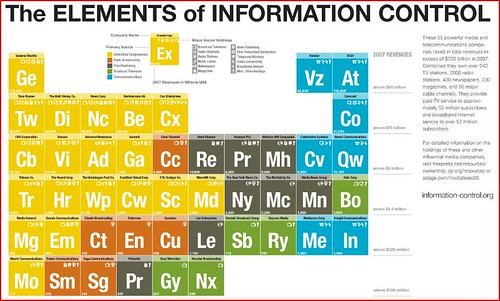
The chart is accompanied by the typical Free Press gloom-and-doom rhetoric about the unfolding media apocalypse. “Nearly everything you see, hear and read that isn’t from a friend — whether on TV, the radio, or even on the Web — comes from a for-profit gatekeeper.” And then comes the obligatory A.J. Liebling quote about how “Freedom of the press belongs to those who own one,” followed quickly by the typical punch line about how just a handful of companies (in this case 55 of ’em) are puppeteering all our thoughts in America today:
Combined, these 55 powerful media and telecommunications companies raked in total revenues in excess of $700 billion in 2007. Together they own over 540 TV stations, 2000 radio stations, 430 newspapers, 230 magazines, and 80 major cable channels in the United States. They provide paid TV service to approximately 52 million subscribers and broadband Internet service to over 57 million subscribers. They’re the bottlenecks through which our news, our entertainment, and our political discourse must travel. What they want to promote becomes prominent; what they suppress stays out of the mainstream. As such, these companies are the elements of information control.
Oh my God! We are all just brainwashed sheep!
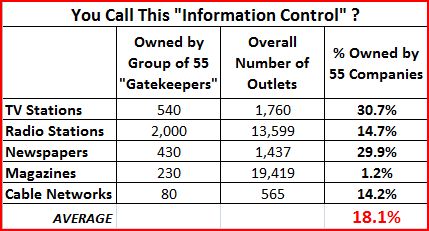
Except we’re not. It amazes me how these “information control” and “media monopoly” myths keep getting widespread circulation. But the first thing to note is how the media reformistas can’t get even their story straight when it comes to how many “monopolists” are supposedly out there today. As I noted in my 2005 book, Media Myths: Making Sense of the Debate over Media Ownership, the critics seem to just pull their numbers out of a hat. Some say as few as 3 companies control everything. Others says 5 or 6. Still others say it might be a few dozen. And now this guy says its 55. Hey, that’s progress that even the Free Press should love!
Regardless of the number, does this really represent the totality of our modern media universe? Do those 55 companies really “own most of the 21st-century presses in America” as the “Info Control” website states? Answer: NOT. EVEN. CLOSE. Here are the facts. [I happened to have compiled them for a PFF special report entitled Media Metrics: The True State of the Modern Media Marketplace to debunk myths just like this.]
Continue reading →
In her latest column, Media Post media market guru Diane Mermigas wonders how long it will be before we see a traditional over-the-air (OTA) broadcast TV network (like ABC, NBC, CBS, or Fox) dump their old broadcast business altogether and just move all their properties to cable and satellite TV. And, in response to Mermigas, Cory Bergman of Lost Remote argues, as I did last week, “the real future of TV is not linear cable, but non-linear video delivered seamlessly via IP to multiple devices, including your TV set. But mass adoption of this approach is still several years away.”
Bergman is right. It would be foolish to think any traditional network is going to rely exclusively on IP-based distribution any time soon; they see it as more of a compliment (or another product window). But Mermigas may be on to something in predicting that broadcast networks may soon be looking to get out of the OTA television business altogether and essentially become “a glorified general entertainment cable network.”
The strain on their dysfunctional paradigm is emanating from a devastating recession and the ongoing digital revolution. Both are permanently altering the rules of play for the networks. A case can be made for at least one of the Big 4 broadcast networks emerging as a glorified general entertainment cable network within the next several years. The economic advantages: more steady ad revenues and consistent subscriber fees as content is distributed cross-platform.
It would be a bold move that a free-spirited company such as News Corp. might already be contemplating for its Fox Broadcast TV Network, or NBC Universal for its peacock network. Industry analysts increasingly wonder how an independent CBS can prattle on under the crumbling old rules. In a world of exploding access and choices, the prime-time ratings (even with Live plus 3 configurations) spell diminishing returns. For Disney, ABC’s general entertainment status is on par with ESPN in sports; the new multi-platform model is in place except for formally moving the ABC TV Network to the cable side of the ledger.
Continue reading →
In a City Journal article earlier this year, I wondered “how long some local papers have left when they are barred from restructuring their businesses or partnering with other local media operators to stem the bleeding and reinvent their business models.” I was responding to the Senate’s smack-down of a half-hearted reform effort that FCC chairman Kevin Martin pushed through in November 2007, which proposed relaxing the FCC’s newspaper/broadcast cross-ownership rule. That rule, unrevised since going into effect in 1975, prohibits a newspaper operator from also owning a radio or television station in the same media market. However, waivers were granted to grandfather in some combined newspaper and broadcast operations that had existed long before the ban took effect. Martin’s proposal was to simply tweak the rule to permit similar combinations in just the nation’s 20 largest media markets.
Martin’s limited liberalization proposal, however, led to howls of disapproval from FCC democrats like Michael Copps and many folks on both side of the aisle in Congress. Supposedly, this was nothing more than a “giveaway” to the newspaper industry, which critics said was doing just fine. It really makes you wonder if any of those critics even both reading the news about newspapers today.
As I have documented here on many occasions, as well as in my big Media Metrics report, the newspaper industry is in huge trouble with every financial variable of importance rapidly heading south. Alan Mutter does a good job here of summarizing “the secular forces dragging down newspapers: Declining readership, shrinking advertising, high fixed costs and growing online competition that makes it increasingly difficult to charge the premium ad rates that were possible prior to the Internet.” As a result of these forces, everyday brings another headline like this one today in the New York Times: “The Star-Ledger of Newark Plans 40% Cut,” or this one in the Wall Street Journal: “Some Newspapers Shed Unprofitable Readers.” The numbers are just miserable, and they just get worse and worse.
Continue reading →
In late June, the Federal Communications Commission (FCC) opened a Notice of Inquiry and Notice of Proposed Rulemaking regarding “Sponsorship Identification Rules and Embedded Advertising” (MB Docket No. 08-90). Basically, it’s an inquiry into the product placement and embedded advertising practices on television. Some at the FCC want such practices regulated.
PFF filed comments in the matter today. Ken Ferree and I argue that that FCC regulation of such advertising practices would be unnecessary and unwise. “If the Notice demonstrates anything,” we argue, “it is that a majority of the current Commissioners live in a world wholly alien and unfamiliar to most Americans; indeed, a world long forgotten if it ever existed.” We continue:
The Notice alludes menacingly to new, “subtle and sophisticated means” of commercial messaging, to “sneaky commercials” (quoting a senescent order topped with nearly fifty-years of dust) and to “vindicat[ing]” the policy goals of the Communications Act – as if the FCC must exact vengeance on those who would try – horror of horrors – to sell goods and services to the American public. The melodramatic tone of the Notice is intended, of course, to set the stage for the Commission’s latest effort to micromanage the free marketplace of ideas, i.e., the media. Only by portraying “embedded” advertising as something new and nefarious can the Commission hope to justify a new portfolio of intrusive and burdensome speech regulations in the name of preserving the “public’s right to know who is paying to air commercials or other program matter on broadcast television and radio and cable.”
And, as we make clear in the filing, we don’t buy the argument that the public are nothing more than mindless sheep:
Continue reading →
 Faithful readers will recall that, several months ago, I penned a 7-part “Media Metrics” series that took a hard look at the health of the media marketplace. Today, the Progress & Freedom Foundation is releasing a greatly expanded version of these essays that I have put together with my PFF colleague Grant Eskelsen. In this 100-page special report, “Media Metrics: The True State of the Modern Media Marketplace,” we begin by noting that heated debates about the state of the media marketplace continue to rage in Washington, and opinions seem to range from grim to outright apocalyptic. As we note on pg. 1:
Many people—including a large number of legislators and regulators—argue that America’s media marketplace is in a miserable state. Some claim that citizens lack choice in media outlets and that options are just as scarce as ever. Others believe that media “localism” is dead or that many groups or niches go underserved because of a lack of true “diversity” in media. Others argue that the market is hopelessly over-concentrated in the hands of a few evil media barons who are hell-bent on force-feeding us corporate propaganda. And still others say that the quality of news and entertainment in our society has deteriorated because of a combination of all of the above. It all sounds quite troubling, but is any of it true?
After taking an objective look at the true state of America’s media marketplace, we conclude that such pessimism is unwarranted. Indeed, a careful review of the facts reveals that—contrary to what those media critics suggest—we have more media choice, more media competition, and more media diversity than ever before. Indeed, to the extent there was ever a “golden age” of media in America, we are living in it today. The media sky has never been brighter and it is getting brighter with each passing year.
Continue reading →
WASHINGTON, March 13, 2007 – The Electronic Frontier Foundation on Tuesday released a paper about the entertainment industry’s move to take copyright controls global.
The report is the result of EFF’s participation in a closed-door session of the Digital Video Broadcasting Project (DVB), the predominant global standard for digital television. (America uses a different digital standard that supports high-definition.)
EFF’s report documents the extent to which the DVB consortium has signaled its assent to copyright control technology. EFF called these a series of “unparalleled restrictions” on consumers’ rights to enjoy lawful digital content. These include “enforcing severe home recording and copying limitation,” “imposing controls on where you watch a program” and “dictating how you get to share shows with your own family,” according to EFF.
Continue reading →

 The Technology Liberation Front is the tech policy blog dedicated to keeping politicians' hands off the 'net and everything else related to technology.