Posts tagged as:

In remarks delivered at the Hudson Institute today, Federal Communications Commissioner Ajit Pai outlined two paths for the Internet Protocol (or IP) transition: One that clings to a legacy of heavily-regulated, monopoly communications networks and another that embraces the future being wrought by the competitive nature of IP communications. He noted that, while the FCC has thus far refused to choose one path or the other, consumers have overwhelming chosen the lightly regulated, competitive IP technologies of the future over the preference for monopoly the government chose in the past. Commissioner Pai has chosen to side with consumers by choosing the future – the path that protects consumers while making it clear that 20th Century economic regulation will not be imported into the IP-world. Continue reading →

Christopher S. Yoo, the John H. Chestnut Professor of Law, Communication, and Computer & Information Science at the University of Pennsylvania and author of the new book, The Dynamic Internet: How Technology, Users, and Businesses are Transforming the Network, explains that the Internet that we knew in its early days—one with a client-server approach, with a small number of expert users, and a limited set of applications and business cases—has radically changed, and so it may be that the architecture underlying the internet may as well.

According to Yoo, the internet we use today barely resembles the original Defense Department and academic network from which it emerged. The applications that dominated the early Internet—e-mail and web browsing—have been joined by new applications such as video and cloud computing, which place much greater demands on the network. Wireless broadband and fiber optics have emerged as important alternatives to transmission services provided via legacy telephone and cable television systems, and mobile devices are replacing personal computers as the dominant means for accessing the Internet. At the same time, the networks comprising the Internet are interconnecting through a wider variety of locations and economic terms than ever before.

These changes are placing pressure on the Internet’s architecture to evolve in response, Yoo says. The Internet is becoming less standardized, more subject to formal governance, and more reliant on intelligence located in the core of the network. At the same time, Internet pricing is becoming more complex, intermediaries are playing increasingly important roles, and the maturation of the industry is causing the nature of competition to change. Moreover, the total convergence of all forms of communications into a single network predicted by many observers may turn out to be something of a myth. Policymakers, Yoo says, should allow room for this natural evolution of the network to take place.

Download

Related Links

Unfortunately, most consumers won’t realize that Netflix is trying to impose its costs on all Internet consumers to gain an anticompetitive price advantage against its over-the-top competitors.

At the Consumer Electronic Show two weeks ago, Netflix announced that it would block consumer access to high definition and 3D movies (HD) for customers of Internet service providers (ISPs) that Netflix disfavors. Netflix’s goal is to coerce ISPs into paying for a free Internet fast lane for Netflix content. If Netflix succeeds, it would harm Internet consumers and competition among video streaming providers. It would also fundamentally alter the economics and openness of the Internet, “where consumers make their own choices about what applications and services to use and are free to decide what content they want to access, create, or share with others.”

Ironically, Netflix’s strategy is a variant of the doomsday narrative spun by net neutrality activists over the last decade. Their narrative assumes ISPs will use their gatekeeper control to block their customers from accessing Internet content distributed by competitors. Of course, ISPs have never blocked consumer access to competitive Internet content. Now that the FCC has distorted the Internet marketplace through the adoption of asymmetric net neutrality rules, Netflix, the dominant streaming video provider, has decided to block consumer access to its content.

This may not seem like a big deal given the relatively limited HD content currently available on Netflix. But that’s about to change in a very big way. Netflix recently announced a new multi-year licensing agreement that makes it the “ exclusive American subscription TV service for first run live-action and animated features from the Walt Disney Studios.” In addition to Disney-branded content (e.g., The Lion King), the deal includes content produced by Pixar (e.g., Brave), Lucasfilm (e.g., Star Wars), and Marvel (e.g., The Avengers). Netflix also announced a multi-year deal with Turner Broadcasting and Warner Bros. that includes the Cartoon Network and exclusive distribution rights to TNT’s television series Dallas. As an analyst recently told Ars Technica, “These movies, if you’ve got young kids—you’ve got to have Netflix.”

Netflix has decided to use this new market power to force ISPs to pay for its own Internet fast lane. In classic double-speak, Netflix calls its fast lane the “Netflix Open Connect” content delivery network (CDN). Though Netflix uses the word “open” to describe its CDN, it is not part of the open Internet. It is only “open” to Netflix for the delivery of its content, and it is only “open” to ISPs who connect to it on terms dictated by Netflix. Continue reading →

Daniel Lyons, assistant professor at Boston College Law School, discusses his new Mercatus Center Working Paper, “The Impact of Data Caps and Other Forms of Usage-Based Pricing for Broadband Access.” Describing the system most of us are used to as an all-you-can-eat version of internet access, Lyons explains why it might make more sense for Internet Service Providers (ISPs) to transition to usage-based pricing, a type of metered model for broadband.

According to Lyons, the fixed costs of building up a broadband network are so great that any attempt to create an equitable cost distribution that can recoup these costs forces lighter users to subsidize heavier users. These types of flat rate payment programs often can be a barrier to low-income users. Instead, Lyons advocates for a usage-based system. In response to concerns about possible anti-competitive behavior by ISPs, Lyons further proposes that enforcement of policy transparency among ISPs might be an appropriate role for government.

Download

Related Links

By Geoffrey Manne & Berin Szoka

As Democrats insist that income taxes on the 1% must go up in the name of fairness, one Democratic Senator wants to make sure that the 1% of heaviest Internet users pay the same price as the rest of us. It’s ironic how confused social justice gets when the Internet’s involved.

Senator Ron Wyden is beloved by defenders of Internet freedom, most notably for blocking the Protect IP bill—sister to the more infamous SOPA—in the Senate. He’s widely celebrated as one of the most tech-savvy members of Congress. But his latest bill, the “Data Cap Integrity Act,” is a bizarre, reverse-Robin Hood form of price control for broadband. It should offend those who defend Internet freedom just as much as SOPA did.

Wyden worries that “data caps” will discourage Internet use and allow “Internet providers to extract monopoly rents,” quoting a New York Times editorial from July that stirred up a tempest in a teapot. But his fears are straw men, based on four false premises.

First, US ISPs aren’t “capping” anyone’s broadband; they’re experimenting with usage-based pricing—service tiers. If you want more than the basic tier, your usage isn’t capped: you can always pay more for more bandwidth. But few users will actually exceed that basic tier. For example, Comcast’s basic tier, 300 GB/month, is so generous that 98.5% of users will not exceed it. That’s enough for 130 hours of HD video each month (two full-length movies a day) or between 300 and 1000 hours of standard (compressed) video streaming.

Second, Wyden sets up a false dichotomy: Caps (or tiers, more accurately) are, according to Wyden, “appropriate if they are carefully constructed to manage network congestion,” but apparently for Wyden the only alternative explanation for usage-based pricing is extraction of monopoly rents. This simply isn’t the case, and propagating that fallacy risks chilling investment in network infrastructure. In fact, usage-based pricing allows networks to charge heavy users more, thereby recovering more costs and actually reducing prices for the majority of us who don’t need more bandwidth than the basic tier permits—and whose usage is effectively subsidized by those few who do. Unfortunately, Wyden’s bill wouldn’t allow pricing structures based on cost recovery—only network congestion. So, for example, an ISP might be allowed to price usage during times of peak congestion, but couldn’t simply offer a lower price for the basic tier to light users.

That’s nuts—from the perspective of social justice as well as basic economic rationality. Even as the FCC was issuing its famous Net Neutrality regulations, the agency rejected proposals to ban usage-based pricing, explaining:

prohibiting tiered or usage-based pricing and requiring all subscribers to pay the same amount for broadband service, regardless of the performance or usage of the service, would force lighter end users of the network to subsidize heavier end users. It would also foreclose practices that may appropriately align incentives to encourage efficient use of networks.

It is unclear why Senator Wyden thinks the FCC—no friend of broadband “monopolists”—has this wrong. Continue reading →

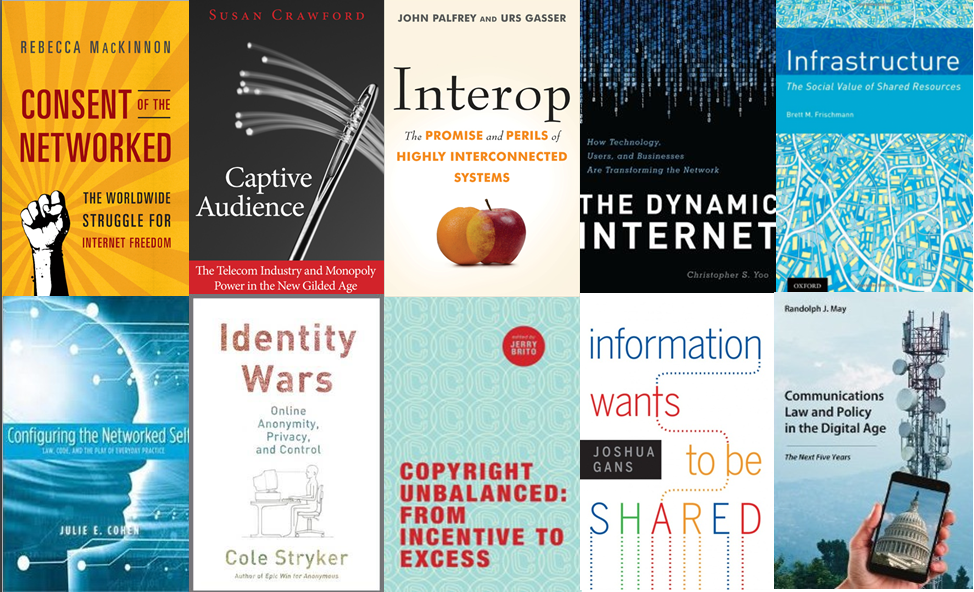
The number of major cyberlaw and information tech policy books being published annually continues to grow at an astonishing pace, so much so that I have lost the ability to read and review all of them. In past years, I put together end-of-year lists of important info-tech policy books (here are the lists for 2008, 2009, 2010, and 2011) and I was fairly confident I had read just about everything of importance that was out there (at least that was available in the U.S.). But last year that became a real struggle for me and this year it became an impossibility. A decade ago, there was merely a trickle of Internet policy books coming out each year. Then the trickle turned into a steady stream. Now it has turned into a flood. Thus, I’ve had to become far more selective about what is on my reading list. (This is also because the volume of journal articles about info-tech policy matters has increased exponentially at the same time.)

So, here’s what I’m going to do. I’m going to discuss what I regard to be the five most important titles of 2012, briefly summarize a half dozen others that I’ve read, and then I’m just going to list the rest of the books out there. I’ve read most of them but I have placed an asterisk next to the ones I haven’t.  Please let me know what titles I have missed so that I can add them to the list. (Incidentally, here’s my compendium of all the major tech policy books from the 2000s and here’s the running list of all my book reviews.)

Continue reading →

When CLECs say “packet mode,” don’t let the doublespeak fool you. They are asking for heavy-handed economic regulation of the Internet itself, just like many countries at the ITU.

Last week, I wrote about the failure of the CLECs to provide consumers with the additional choices in communications services Congress had envisioned in 1996. I noted that, now that the antiquated telephone network is about to sunset, CLECs must bear responsibility for their own decisions to forgo investment in their own infrastructure and rely on lines leased with temporary government subsidies. The desperation of CLECs to avoid this reality is apparent in their use of doublespeak to conceal their true intent: convincing the FCC to regulate the Internet like plain old telephone service. Continue reading →

Rather than invest and deploy new networks offering millions of consumers with additional choices for high speed Internet access, CLECs are investing in the regulatory process in hopes the FCC will save them from the inconvenience and expense of transitioning to all-IP infrastructure. The FCC should not allow the self-interest of CLECs to stand in the way of the IP-transition or the delivery of high speed Internet services to millions of residential consumers who demand more choice.

Shortly after AT&T announced “Project Velocity IP,” its plan to invest an additional $14 billion to provide high-speed Internet access to 99 percent of customer locations in its wireline service area, I blogged about the broad consensus among policymakers, pundits, and industry players in support of the announcement. But, “you can never please all of the people all of the time.” Now that the initial buzz around the announcement has abated, the inevitably unpleased few have gone on the offensive.

The few who cannot be pleased by Internet transformation are “competitive local exchange carriers,” also known as “CLECs.” These companies were created in the mid-1990s to provide both residential and business consumers with an additional choice for telephone service, but after the dot-com bubble burst, CLECs chose to limit their offerings to more lucrative business customers in downtown metro areas. They typically do not offer service to residential consumers or businesses that demand additional options in more suburban and rural areas.

While companies that serve all types of American consumers are investing in the transformation of their outdated telephone systems into the all-Internet protocol (IP) infrastructure of the 21st Century to deliver high-speed Internet services to residential consumers, CLECs claim the IP-transition is a “waste of resources” and a “distraction.” Rather than invest and deploy new networks offering millions of consumers with additional choices for high speed Internet access, CLECs are investing in the regulatory process in hopes the FCC will save them from the inconvenience and expense of transitioning to all-IP infrastructure. The FCC should not allow the self-interest of CLECs to stand in the way of the IP-transition or the delivery of high-speed Internet services to millions of residential consumers who demand more choice. Continue reading →

Yesterday AT&T announced that it would invest an additional $14 billion in the next three years to expand its 4G LTE network to cover 300 million people and expand its wired all-IP broadband infrastructure to 75 percent of its customer locations throughout its 22-state wired service area. For many consumers, this investment will provide their first opportunity for access to high-speed broadband at home. For many others, it will provide their first opportunity to make a choice among competing providers of high-speed broadband services. This impressive commitment to transition outdated communications infrastructure to an all-IP future will benefit millions of consumers and accelerate our Internet transformation nationwide. Continue reading →

If the FCC stops moving forward on Internet transformation, the universal service and intercarrier compensation reform order will become a death warrant for telephone companies.

CLIP hosted an event earlier this month to discuss Internet transformation. What is Internet transformation? In a recent op-ed, FCC Commissioner Ajit Pai noted that it “is really two different things—a technology revolution and a regulatory transition.”

The technology revolution began with the commercialization of the Internet, which enables the delivery of any communications service over any network capable of handling Internet Protocol (IP). According to the National Broadband Plan, the “Internet is transforming the landscape of America more rapidly and more pervasively than earlier infrastructure networks.” In little more than a decade, the Internet destroyed the monopoly structure of the old communications industry from within and replaced it with intermodal competition. Continue reading →