I didn’t have nearly as much time this year to review the steadily growing stream of information policy books that were released. The end-of-year lists I put together in the past were fairly comprehensive (see 2008, 2009, 2010, 2011 and 2012), but I got sidetracked this year with 7 law review articles and an eBook project and had almost no time for book reviews, or even general blogging for that matter.
So, I’ve just listed some of the more notable titles from 2013 even though I didn’t find the time to describe them all. The first couple are the titles that I believe will have the most lasting influence on information technology policy debates. Needless to say, just because I believe that some of these titles will have an impact on policy going forward does not mean I endorse the perspectives or recommendations in any of them. And that would certainly be the case with my choice for most important Net policy book of the year, Ian Brown and Chris Marsden’s
Regulating Code. Their book does a wonderful job mapping the unfolding universe of Internet “co-regulation” and “multi-stakeholderism,” but their defense of a more politicized information policy future leaves lovers of liberty like me utterly demoralized.
The same could be said of many other titles on the list. As I noted in concluding several reviews over the past year, liberty is increasingly a loser in Internet policy circles these days. And it’s not just neo-Marxist rants like McChesney’s
Digital Disconnect or Lanier’s restatement of the Unibomber Manifesto, Who Owns the Future? The sad reality is that pretty much everybody these days has a pet peeve they want addressed through pure power politics because, you know, something must be done! The very term “Internet freedom” has already been grotesquely contorted into something akin to an open mandate for governments to meticulously plan virtually every facet of economic and social activity in the Information Age.
Anyway, despite that caveat, many interesting books were released in 2013 on an ever-expanding array of specific information policy topics. Here’s the list of everything that landed on my desk over the past year. Continue reading →

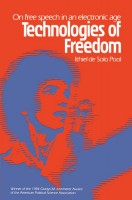 I was honored to be asked by the editors at Reason magazine to be a part of their “Revolutionary Reading” roundup of “The 9 Most Transformative Books of the Last 45 Years.” Reason is celebrating its 45th anniversary and running a wide variety of essays looking back at how liberty has fared over the past half-century. The magazine notes that “Statism has hardly gone away, but the movement to roll it back is stronger than ever.” For this particular feature, Reason’s editors “asked seven libertarians to recommend some of the books in different fields that made [the anti-statist] cultural and intellectual revolution possible.”
When Jesse Walker of
Reason first contacted me about contributing my thoughts about which technology policy books made the biggest difference, I told him I knew exactly what my choices would be: Ithiel de Sola Pool’s Technologies of Freedom (1983) and Virginia Postrel’s The Future and Its Enemies (1998). Faithful readers of this blog know all too well how much I love these two books and how I am constantly reminding people of their intellectual importance all these years later. (See, for example, this and this.) All my thinking and writing about tech policy over the past two decades has been shaped by the bold vision and recommendations set forth by Pool and Postrel in these beautiful books.
As I note in my
Reason write-up of the books: Continue reading →
Richard Brandt, technology journalist and author, discusses his new book, One Click: Jeff Bezos and the Rise of Amazon.Com. Brandt discusses Bezos’ entrepreneurial drive, his business philosophy, and how he’s grown Amazon to become the biggest retailer in the world. This episode also covers the biggest mistake Bezos ever made, how Amazon uses patent laws to its advantage, whether Amazon will soon become a publishing house, Bezos’ idea for privately-funded space exploration and his plan to revolutionize technology with quantum computing.
Download
Related Links
This year marks the 30th anniversary of the publication of Technologies of Freedom: On Free Speech in an Electronic Age by the late communications theorist Ithiel de Sola Pool. It was, and remains, a remarkable book that is well worth your time whether you read it long ago or are just hearing about it for the first time. It was the book that inspired me when I first read in 1994 to abandon my chosen field of study (trade policy) and do a deep dive into the then uncharted waters of information technology policy.
A Technological Nostradamus
Long before most of the world had heard about this thing called “the Internet” or using terms like “cyberspace” or even “electronic superhighway,” Pool was describing this emerging medium, thinking about its ramifications, and articulating the optimal policies that should govern it. In
Technologies of Freedom, Pool set forth both a predictive vision of future communications and “electronic publishing” markets as well as a policy vision for how those markets should be governed. “Networked computers will be the printing presses of the twenty-first century,” Pool argued in a remarkably prescient chapter on the future of electronic publishing. “Soon most published information will disseminated electronically,” and “there will be networks on networks on networks,” he predicted. “A panoply of electronic devices puts at everyone’s hands capacities far beyond anything that the printing press could offer.” As if staring into a crystal ball, Pool predicted: Continue reading →
2013 is shaping up to be another big year for Internet and information technology policy books. Here’s a list of what’s coming out or already on the market. As faithful readers know, I put together end-of-year lists of important info-tech policy books, and here are the lists for 2008, 2009, 2010, 2011 and the most recent one for 2012. And here’s my compendium of all the major tech policy books from the 2000s. So I’ll do my best to get through all these books and whatever else follows throughout the year. Consider this my public service to the Internet policy community: I read nerdy Internet policy books so that you don’t have to!
Let me know what else I may have missed and I will add it to the list.
- Ian Brown & Christopher T. Marsden – Regulating Code: Good Governance and Better Regulation in the Information Age
- Robert W. McChesney – Digital Disconnect: How Capitalism Is Turning the Internet Against Democracy
- Jaron Lanier – Who Owns the Future?
- Marvin Ammori – On Internet Freedom
- Abraham H. Foxman and Christopher Wolf – Viral Hate: Containing Its Spread on the Internet
- Giovanni Ziccardi – Resistance, Liberation Technology and Human Rights in the Digital Age
- John O. McGinnis – Accelerating Democracy: Transforming Governance Through Technology
- Scott Shackelford – Managing Cyber Attacks in International Law, Business and Relations: In Search of Cyber Peace
- Viktor Mayer-Schonberger & Kenneth Cukier – Big Data: A Revolution That Will Transform How We Live, Work, and Think
- Evgeny Morozov – To Save Everything, Click Here: The Folly of Technological Solutionism
- Ronald Deibert – Black Code: Inside the Battle for Cyberspace
- Eric Schmidt & Jared Cohen – The New Digital Age: Reshaping the Future of People, Nations and Business
- Dorothea Kleine – Technologies Of Choice? ICTs, Development, and the Capabilities Approach
- Nicco Mele – The End of Big: How the Internet Makes David the New Goliath
- Thomas Rid – Cyber War Will Not Take Place
- Ethan Zuckerman – Rewire: Digital Cosmopolitans in the Age of Connection
- Nate Anderson – The Internet Police: How Crime Went Online, and the Cops Followed
- Paul Rosenzweig – Cyber Warfare: How Conflicts in Cyberspace Are Challenging America and Changing the World
- Alice E. Marwick – Status Update: Celebrity, Publicity, and Branding in the Social Media Age
- Gautam Shroff – The Intelligent Web: Search, Smart Algorithms, and Big Data
- Anupam Chander – The Electronic Silk Road: How the Web Binds the World Together in Commerce
- Laura DeNardis – The Global War for Internet Governance (likely 2014 launch)
The number of major cyberlaw and information tech policy books being published annually continues to grow at an astonishing pace, so much so that I have lost the ability to read and review all of them. In past years, I put together end-of-year lists of important info-tech policy books (here are the lists for 2008, 2009, 2010, and 2011) and I was fairly confident I had read just about everything of importance that was out there (at least that was available in the U.S.). But last year that became a real struggle for me and this year it became an impossibility. A decade ago, there was merely a trickle of Internet policy books coming out each year. Then the trickle turned into a steady stream. Now it has turned into a flood. Thus, I’ve had to become far more selective about what is on my reading list. (This is also because the volume of journal articles about info-tech policy matters has increased exponentially at the same time.)
So, here’s what I’m going to do. I’m going to discuss what I regard to be the five most important titles of 2012, briefly summarize a half dozen others that I’ve read, and then I’m just going to list the rest of the books out there. I’ve read most of them but I have placed an asterisk next to the ones I haven’t. Please let me know what titles I have missed so that I can add them to the list. (Incidentally, here’s my compendium of all the major tech policy books from the 2000s and here’s the running list of all my book reviews.)
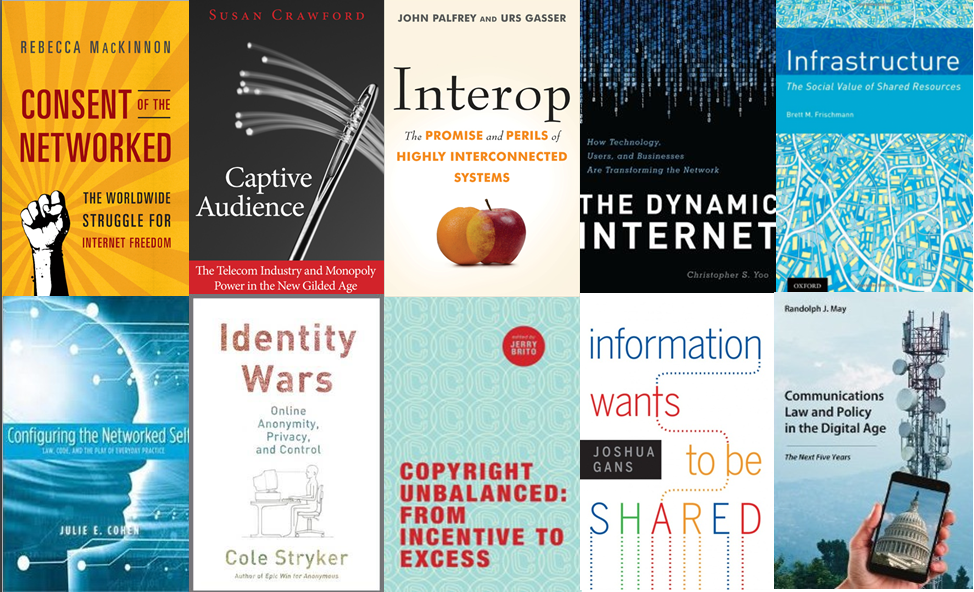
Continue reading →
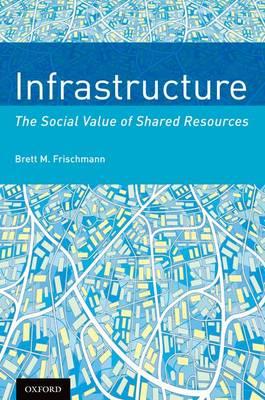 The folks at the Concurring Opinions blog were kind enough to invite me to participate in a 2-day symposium they are holding about Brett Frischmann’s new book, Infrastructure: The Social Value of Shared Resources. In my review, I noted that it’s an important book that offers a comprehensive and highly accessible survey of the key issues and concepts, and outlines much of the relevant literature in the field of infrastructure policy. Frischmann’s book deserves a spot on your shelf whether you are just beginning your investigation of these issues or if you have covered them your entire life. Importantly, readers of this blog will also be interested in the separate chapters Frischmann devotes to communications policy and Net neutrality regulation, as well as his chapter on intellectual property issues.
However, my review focused on a different matter: the book’s almost complete absence of “public choice” insights and Frischmann’s general disregard for thorny “supply-side” questions. Frischmann is so focused on making the “demand-side” case for better appreciating how open infrastructures “generate spillovers that benefit society as a whole” and facilitate various “downstream productive activities,” that he short-changes the supply-side considerations regarding how infrastructure gets funded and managed. I argue that: Continue reading →
It’s time again to look back at the major cyberlaw and information tech policy books of the year. I’ve decided to drop the top 10 list approach I’ve used in past years (see 2008, 2009, 2010) and just use a more thematic listing of major titles released in 2011. This thematic approach gets me out of hot water since I have found that people take numeric lists very seriously, especially when they are the author of one of the books and their title isn’t #1 on the list! Nonetheless, at the end, I will name what I regard as the most important Net policy book of the year.
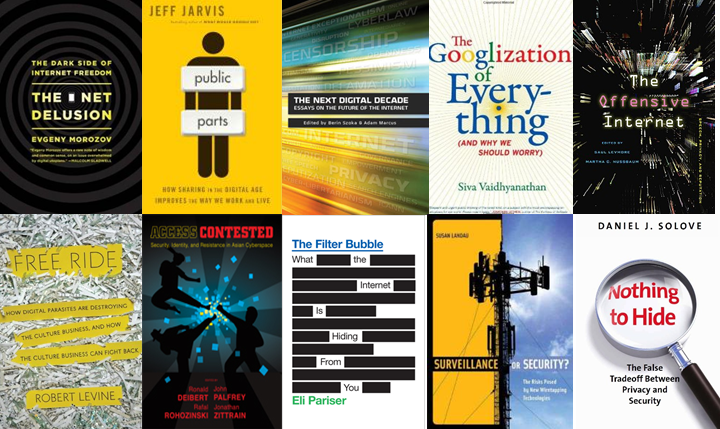
I hope I’ve included all the major titles released during the year, but I ask readers to please let me know what I have missed that belongs on this list. I want this to be a useful resource to future scholars and students in the field. [Reminder: Here’s my compilation of major Internet policy books from the past decade.] Where relevant, I’ve added links to my reviews as well as discussions with the authors that Jerry Brito conducted as part of his “Surprisingly Free” podcast series. Finally, as always, I apologize to international readers for the somewhat U.S.-centric focus of this list.
Continue reading →
Faithful readers know of my geeky love of tech policy books [here are my “best of” lists for 2008 & 2009], and the intriguing battle taking place today between Internet optimists and pessimists in particular. One of the things that I noticed when I was putting together my compendium, “The Digital Decade’s Definitive Reading List: Internet & Info-Tech Policy Books of the 2000s,” is that there are up years and down years. For example, there weren’t a lot of big tech policy titles in 2000 or 2005. By contrast, 2001, 2006 and 2008 were monster years. I suppose that’s the case with any genre, of course.
Anyway, I was beginning to think that 2010 was shaping up to be one of those slow years, with Jaron Lanier’s
You Are Not a Gadget being the only major release so far this year. [See my review of it here.] But there are some very important titles on the way that are worth picking up. I’ve already pre-ordered most of these and am looking forward to reviewing them all soon:
Please let me know others that I may be missing. [Note: Most of the books I’ve been reading this year have more to do with the future of media, the press, journalism, etc. It’s been a big year for books like that. For example, McChesney & Nichols’ The Death and Life of American Journalism; Lee Bollinger’s Uninhibited, Robust, and Wide-Open: A Free Press for a New Century; and Bob Garfield’s The Chaos Scenario. But it’s not clear any of these books belong in the “info-tech policy” genre, although they all have something to say about the impact of the Internet and digital technology on the media and journalism. So, who knows, maybe I will add them to my end of year list.]
 So, did the decade just end or do we have another year to go? Honestly, I’ve never understood when the cut-off is from one decade to the next. (My friend Larry Magid struggles with the same question in his recent column on “The Decade in Technology.”) Nonetheless, I’ve seen a lot of best-of-decade lists published recently, so I thought I would throw my own out there even though it is still a work in progress.
I have been attempting to compile the definitive bibliography for our digital decade—the definitive list of Internet policy books, that is. I started throwing this together two years ago when I was penning my list of “The Most Important Internet Policy Books of 2008” and continued to work on it as I was finishing up my 2009 installment as well. I grabbed every book off my shelf that dealt with the future of the Internet and the impact the Digital Revolution is having on our lives, culture, and economy and threw the title and a link onto this list. (I’m also using the list to help structure my thoughts for a forthcoming book of my own on Internet Optimists vs. Pessimists, something I’ve been writing a lot about here in recent years.)
Below you will find what I’ve got so far. There are around 80 90 books on the list. I’ve divided the list by year, but you may be wondering what determined the order the books appear in. In essence, I’ve listed what I feel are the 1 or 2 most important titles first and then just added others randomly. Eventually, I plan to post a “Most Important Internet Policy Books of the Decade” list outlining which titles I believe have been the most influential. I suspect I’ll name Benkler’s Wealth of Networks to the top slot followed closely by Zittrain’s The Future of the Internet, Lessig’s Free Culture, and Chris Anderson’s The Long Tail. Anyway, that’s for another day.
For now, I would just like to ask for reader suggestions regarding what other titles that should appear on this list. I will add titles as they come in. I want to stress, however, that I am trying to keep this list limited to books that have something to say about
Internet policy (cyber-law, digital economics, information technology politics, etc).
I hope others find this useful. And yes, I have read all most of the books on this list! As I’ve noted here before, I’m a bit of book nerd. (Now that I’ve received so many helpful additions to the list, there are some titles on the list I have not had a chance to read through yet). Continue reading →


 The Technology Liberation Front is the tech policy blog dedicated to keeping politicians' hands off the 'net and everything else related to technology.