Over at TechDirt, Mike Masnick has an interesting post asking “Why Did Apple Approve Spotify?” which builds on an AdAge column asking a similar question: “Did Apple Sacrifice ITunes With Latest Apps?” As the title of that AdAge piece suggests, some folks are wondering if Apple shot itself in the foot by approving Spotify, a music streaming app that some regard as a potential iTunes killer. I don’t really have any comment on the business angle here, rather, I wanted to just comment on Mike’s suggestion that one possible explanation for Apple’s approval of the app is that:
As we noted when the app was approved, Apple appears to be somewhat gunshy, following the FCC inquiry into why it “blocked” Google Voice on the iPhone (and, yes, Apple still insists it didn’t actually block the app, but Google says otherwise). Given the scrutiny, Apple probably realized that it was in for some serious political trouble if it blocked an app like Spotify, which would have received a lot of press attention. Oddly, the AdAge article doesn’t mention this at all.
Indeed, it is odd that
AdAge didn’t bother mentioning that fact. But what I find doubly odd here is that nobody is even blinking an eye at the prospect of such political meddling with — or even possible FCC regulation of — Apple, iTunes, or music streaming market in general! Seriously, have we gotten to the point now in our Bold New World of Neutrality Regulation that innovative high-tech companies must live in fear of constant regulatory intervention even when they completely lack any statutory authority to play these games? Moreover, does anyone think that the a bunch of Beltway bureaucrats can micro-manage music and high-tech application markets and give us more options than we have today?
I know the prospect of such meddling makes some academics and regulatory activists groups happy, but I can’t see how this ends well for consumers or high-tech markets more generally. Regardless, for those of you who laugh when we suggest that the slippery slope of regulation is real, consider this case to be Exhibit A. Or perhaps it’s Exhibit B since the Google Voice spat with Apple was already moving the FCC in the direction of becoming a device regulator and applying “handset neutrality” principles that have no basis in law. It’s your anything-goes government at work.
Forbes.com has just published an editorial that Berin Szoka and I penned about yesterday’s net neutrality announcement from the FCC.
by Adam Thierer & Berin Szoka
There was a time, not so long ago, when the term “Internet Freedom” actually meant what it implied: a cyberspace free from over-zealous legislators and bureaucrats. For a few brief, beautiful moments in the Internet’s history (from the mid-90s to the early 2000s), a majority of Netizens and cyber-policy pundits alike all rallied around the flag of “Hands Off the Net!” From censorship efforts, encryption controls, online taxes, privacy mandates and infrastructure regulations, there was a general consensus as to how much authority government should have over cyber-life and our cyber-liberties. Simply put, there was a “presumption of liberty” in all cyber-matters.
Those days are now gone; the presumption of online liberty is giving way to a presumption of regulation. A massive assault on real Internet freedom has been gathering steam for years and has finally come to a head. Ironically, victory for those who carry the banner of “Internet Freedom” would mean nothing less than the death of that freedom.
We refer to the gradual but certain movement to have the federal government impose “neutrality” regulation for all Internet actors and activities—and in particular, to yesterday’s announcement by Federal Communications Commission (FCC) Chairman Julius Genachowski that new rules will be floated shortly. “But wait,” you say, “You’re mixing things up! All that’s being talked about right now is the application of ‘simple net neutrality,’ regulations for the infrastructure layer of the net.” You might even claim regulations are not really regulation but pro-freedom principles to keep the net “free and open.”
Such thinking is terribly short-sighted. Here is the reality: Because of the steps being taken in Washington right now, real Internet Freedom—for all Internet operators and consumers, and for economic and speech rights alike—is about to start dying a death by a thousand regulatory cuts. Policymakers and activists groups are ramping up the FCC’s regulatory machine for a massive assault on cyber-liberty. This assault rests on the supposed superiority of common carriage regulation and “public interest” mandates over not just free markets and property rights, but over general individual liberties and freedom of speech in particular. Stated differently, cyber-collectivism is back in vogue—and it’s coming very soon to a computer near you! Continue reading →
 Over the past couple of years here, I have relentlessly hammered Harvard’s dynamic duo of digital doom, Jonathan Zittrain (see 1, 2, 3, 4, 5, 6) and Lawrence Lessig (see 1, 2, 3), for their extraordinarily gloomy predictions about the Internet creating a world of “perfect control.” In the hyper-pessimistic Lessig-Zittrain view of things, cyberspace is perpetually haunted by the specter of nefarious corporate schemers out to suffocate innovation, screw consumers, and quash dissent. In the 1990s, Lessig’s big-bad-bogeyman was AOL. Today, Zittrain casts Apple in the lead role of Cyber-Big Brother. The problem with their thesis? In a word: Reality. As Tim Lee has pointed out before, “Lessig’s specific predictions in Code turned out to be… spectacularly wrong”:
Lessig was absolutely convinced that a system of robust user authentication would put an end to the Internet’s free-wheeling, decentralized nature. Not only has that not happened, but I suspect that few would seriously defend Lessig’s specific prediction will come to pass.
Absolutely correct, and the same is true of the fears and predictions Zittrain tosses around in The Future of the Internet. And yet, as we saw most recently during my debate with Lessig and Zittrain over at Cato Unbound upon the occasion of the 10th anniversary of the publication Code, neither of them have relented one bit. Indeed, they have actually been escalating their morose rhetoric recently.
The fact that Zittrain casts Apple as the central villain in his drama is particularly interesting because millions upon millions of people absolutely love the company and its amazingly innovative products — even if I’m not one of them. And there is absolutely no way Zittrain can continue to sell us this story of Apple quashing innovation when, in just one year’s time, there were 1.5 Billion iPhone Store downloads of over 65,000 free and paid apps by consumers in 77 countries. I mean, seriously, is there any application you cannot get for the iPhone these days?
Apparently not, because over at the
Wall Street Journal “Digits” blog, Andrew LaVallee writes of the latest innovative application to pop up in the Apple iPhone Store, iPot — a tool to help you find dope shops in California!!
Continue reading →
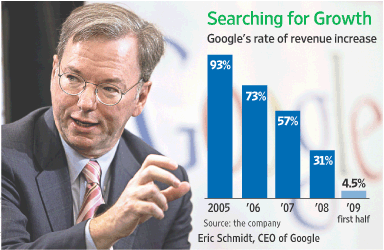 The Google juggernaut’s revenue growth has slowed steadily in the last five years, causing the Wall Street Journal to caution investors about buying Google stock. While much of the slow-down in Google’s revenue may be attributed to the recession, the WSJ cautions that:
- Microsoft is offering stiffer competition in search, which will only intensify once antitrust regulators approve its partnership with Yahoo! and the two companies actually implement their partnership (which could take another year);
- YouTube’s promise as an ad platform remains uncertain;
- Google lags behind Apple and Research in Motion in developing mobile phone operating systems, with Android still unproven;
- It remains unclear how successful the company will be in expanding beyond its existing lead in small text ads into the potentially lucrative realm of banner ads.
Somehow I doubt Google’s fall to Earth will do much to allay the concerns of those who see Google as the kind of evil monopolist Microsoft was made out to be in the 90s.
As the Journal concludes, “It would be foolish to predict that Google won’t have another business success, of course… Google may itself discover the next Google-like business.” As long as someone’s out there working to turn today’s idle fantasies into tomorrow’s multi-billion dollar businesses, consumers win—whoever that bold innovator might be.
 Despite my frequent disagreements with his policy conclusions, Farhad Manjooo of Slate is one of the most gifted tech policy pundits around today and everything he writes is worth reading (and I whole-heartedly agreed with his recent article on the high-tech and antitrust). Alas, I find myself again disagreeing with him again today.
In his latest column, “The Great iPhone Lockdown: Should the FCC force Apple to sell Google’s apps?” Manjoo responds to a recent essay by TLF contributor Ryan Radia (“Newsflash to FCC: The iPhone is a Closed Platform, and Consumers Love It“). In that essay, Ryan generally argued that: (a) a lot of people own and love the iPhone despite some silly restrictions on certain apps; and (b) if they don’t like that, there are plenty of other options from which they can choose. Consequently, regulation seems unwarranted and likely highly misguided in light of the potential unitended consequences in might yield. It’s an argument I very much agree with, of course. Anyway, Manjoo responds:
Radia’s argument isn’t crazy. Just the other day, I argued that the government shouldn’t go after Google for antitrust violations because the tech industry is fluid; companies that are on top today can fall tomorrow. So what if Apple rejects apps capriciously? If its actions are so terrible, consumers will eventually abandon it.
But then Manjoo counters that argument and goes completely off-the-rails with several assertions that I find quite perplexing: Continue reading →
Maybe Obama should invite Google CEO Eric Schmidt and Microsoft CEO Steve Ballmer over to the White House for a beer to settle the two companies’ differences!
http://www.youtube.com/v/Q0umKaGxkkE
While he’s at it, Obama might want to invite Apple CEO Steve Jobs, too, since the common cause Apple and Google once made against Microsoft now seems to be giving way to increased rivalry between the two titans of Internet cool. Or how about Facebook CEO Mark Zuckerberg, given Facebook’s growing challenge to Google? Yahoo!’s Carol Bartz seems to get along much better with everyone than the boys in the group, so she’d probably help Obama keep things under control.
The Internet industry’s war-of-all-against-all is reminiscent of Tom Lehrer‘s classic 1960s satire “National Brotherhood Week”:
http://www.youtube.com/v/aIlJ8ZCs4jY
Continue reading →
Over at Twitter, our TLF blogging colleague Jerry Brito asks a smart question about the Federal Communications Commission’s recently-opened investigation of the Apple-Google spat over Apple’s recent decision to reject the Google Voice app from the iPhone App Store. Jerry asks: “Maybe I should know this, but what authority does the FCC have to demand that Apple explain anything?” Good question, Jerry! But no, I don’t think there’s anything you’re missing. We might consider this merely the latest chapter of the agency’s rogue operator history: If you can’t find the authority to do something, just assert it anyway and go for broke! The idea of living within the confines of the law and paying attention to statutory authority seems like an alien concept to the FCC. As my PFF colleagues Barbara Esbin and Adam Marcus have pointed out in their amazing recent law review article, “The Law Is Whatever the Nobles Do: Undue Process at the FCC,” when all else fails, the agency just asserts “ancillary jurisdiction” and claims that the whole world is their oyster. They argue:
The FCC’s means of asserting regulatory authority over broadband Internet service providers’ (“ISP”) network management practices is unprecedented, sweeping in its breadth, and seemingly unbounded by conventional rules of interpretation and procedure. We should all be concerned, for apparently what we have on our hands is a runaway agency, unconstrained in its vision of its powers.
Of course, even if we ignore the agency’s cavalier attitude about the law and statutory authority, there are other reasons to be concerned about FCC interference in this matter.
Continue reading →
Just when you thought the FCC’s investigation of the wireless industry couldn’t get any stranger, TechCrunch reports that the Commission has sent letters to AT&T, Apple, and Google inquiring about Apple’s recent decision to reject the Google Voice app from the iPhone App Store (as Berin discussed yesterday).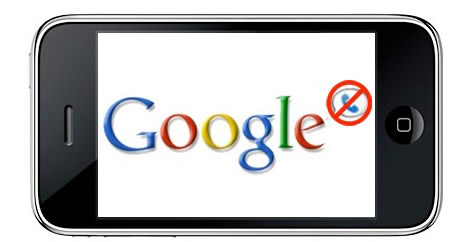
It’s been over two years since the original iPhone was launched, but it seems the FCC still doesn’t get it: the iPhone is very clearly a closed platform — a prototypical walled garden — and Apple has the final say on what applications users can install. When you buy an iPhone, you’re not simply buying a piece of hardware, but actually a package deal that includes software, hardware, and a wireless contract. Is this anti-consumer? 26 million consumers don’t think so. The iPhone 3GS, the latest version of the phone, is selling so fast that Apple’s CFO says they can’t make enough to meet demand!
Of course, the iPhone model isn’t for everyone. I, for one, don’t own one because I’m an obsessive tinkerer and prefer a phone that’s as open as possible. But not everyone shares my preferences. As mentioned above, over 26 million iPhones have been sold since June 2007, so openness clearly isn’t make-or-break for a lot of consumers. Who knows, maybe some people actually trust Apple and like the comfort of knowing that every app they can get comes with a seal of approval from Cupertino.
The FCC’s letter to Apple demands an explanation for why Google Voice was rejected. If Apple’s explanation doesn’t satisfy the FCC’s criteria — which, by the way, are entirely unclear — then what? Will the FCC force Apple to accept Google Voice? Say what you will about Apple’s app store track record, but the prospect of federal regulators having the final word on which applications smartphone owners can install hardly seems pro-consumer. The FCC can’t even figure out how to run its own website!
In some ways, the iPhone has perhaps been too successful for its own good. It’s so popular that many consumers seem to no longer view it as just another product but instead as an item to which they are entitled. Thus, bureaucrats and Congresscritters in search of political points are making a big fuss over the fact that the iPhone isn’t everything to everyone. Why can’t it be wide open? Why isn’t in available on every carrier nationwide? Why is it so expensive to purchase without a service contract?
Continue reading →
The iPhone-obsessed blogosphere is atwitter about the Apple”s exclusion of the Google voice application from the iPhone app store. On Friday, the FCC sent letters of inquiry to the two companies as well as AT&T.
Whatever one thinks about whether Apple and AT&T should be able to operate their own networks as they see fit, this cat-fight should at least demonstrate the pointlessness of the investigation opened by the FTC in May as to whether Apple and Google are violating the antitrust laws by having two members of their boards of directors in common: Google CEO Eric Schmidt and former Genentech CEO Art Levinson. If the two companies were, in fact, trying to collude in an anti-competitive manner, they don’t seem to be doing a very good job of it!
Meanwhile, if you don’t like how Apple runs its app store, don’t get an iPhone! If you already have one, you could follow the lead of TechCrunch’s Michael Arrington and simply cancel your existing iPhone contract to get a more “open” phone—such as one powered by Google’s Android operating system.
Me, I’m just waiting for Google Voice to offer number portability so I can start using the service without having to change the number I’ve had for the last five years—and plan to take to my ashen grave (somewhere beyond low Earth orbit).
A key point that Berin and I try to get across in our Forbes editorial today about the Yahoo!-Microsoft deal is that the high-tech marketplace evolves too rapidly for creaky Analog Era antitrust laws to keep up. We wanted to say more on that point in our piece, but we had a tight deadline (and a strict word limit!) Well, turns out that we really don’t need to do so now because Farhad Manjoo of Slate has done a better job than we ever could have making that point in this essay today entitled, “The Case Against the Case Against Google“:
But if the government was right on the facts [in the Microsoft case], it was wrong on the big picture. The theory behind the prosecution was that Microsoft’s mobster tactics would raise the price of software and slow down innovation. But that didn’t happen. In 2002, Microsoft settled the antitrust case with the Bush administration; it faced no substantial penalties for its years of bad behavior. At that point, it still looked unbeatable—it had the same OS monopoly, office-software monopoly, and Web-browser monopoly. And you know what happened? It got beat anyway. Many of Microsoft’s assets turned out not to matter, because upstarts like Google and old foes like Apple found ways to innovate around them.
Continue reading →

 The Technology Liberation Front is the tech policy blog dedicated to keeping politicians' hands off the 'net and everything else related to technology.