Today’s NYT piece by Brad Stone about Google (Sure, It’s Big. But Is That Bad?) offers a superb example of how to use the rhetorical question in an article headlined to suggest that you might actually be about to write a thoughtful, balanced piece—while actually writing a piece that, while thoughtful and interesting, offers little more than token resistance to your own preconceived judgments. But perhaps I’m being unfair: Perhaps Stone’s editors removed “YES! YES! A THOUSAND TIMES, YES!” from the headline for brevity’s sake?
Anyway, despite its one-sidedness, the piece
is fascinating, offering a well-researched summary of the growing cacophony of cries for regulatory intervention against Google, and also a suggestion of where they might lead in crafting a broader regulatory regime for online services beyond just Google. In short, the crusade against Google and the crusade for net neutrality (in which Google has, IMHO unwisely been a major player) are together leading us down in intellectual slippery slope that, as Adam and I have suggested, will result in “High-Tech Mutually Assured Destruction” and the death of Real Internet Freedom.
Ironically, this push for increased government meddling—a veritable “New Deal 2.0″—is all justified by the need to “protect freedom.” But it would hardly be the first time that this had happened. As the great defender of liberty
Garet Garrett said of the New Deal 1.0 in his 1938 essay The Revolution Was:
There are those who still think they are holding the pass against a revolution that may be coming up the road. But they are gazing in the wrong direction. The revolution is behind them. It went by in the Night of Depression, singing songs to freedom.
That theme lives on in the works of those like antitrust warrior Gary Reback, an anti-Google stalwart whose book Free the Market: Why Only Government Can Keep the Marketplace Competitive
Adam savaged in his review last year. Reback argues:
Google is the “arbiter of every single thing on the Web, and it favors its properties over everyone else’s,” said Mr. Reback, sitting in a Washington cafe with the couple. “What it wants to do is control Internet traffic. Anything that undermines its ability to do that is threatening.”
Move over, ISPs! Search engines are the
real threat! Somehow, I feel fairly confident in predicting that this will be among the chief implications of Tim Wu’s new book, The Master Switch: The Rise and Fall of Information Empires, to be released in November, which his publisher summarizes as follows: Continue reading →
Check out this amazing map of the “Dogs of War” of online competition created by Gizmodo’s Shane Snow (view full size here):
 For all the complaining about these three tech titans, they’re locked in fierce competition with each other. This chart doesn’t even mention other players in the vibrantly competitive online ecosystem, like Facebook, Yahoo!, Twitter, and countless others. Makes you want to go spend a weekend playing an endless game of Risk,
Axis & Allies or Supremacy with your best frenemies, doesn’t it? But of course, the board game analogy only goes so far, because today’s battlelines and players are only a snapshot of a long-term process of dynamic, highly rivalrous competition. But as Adam and I noted in our Forbes.com piece last fall calling for quick approval of Microsoft’s search partnership with Yahoo!:
For all the complaining about these three tech titans, they’re locked in fierce competition with each other. This chart doesn’t even mention other players in the vibrantly competitive online ecosystem, like Facebook, Yahoo!, Twitter, and countless others. Makes you want to go spend a weekend playing an endless game of Risk,
Axis & Allies or Supremacy with your best frenemies, doesn’t it? But of course, the board game analogy only goes so far, because today’s battlelines and players are only a snapshot of a long-term process of dynamic, highly rivalrous competition. But as Adam and I noted in our Forbes.com piece last fall calling for quick approval of Microsoft’s search partnership with Yahoo!:
Alas, regulators seem stuck in the past. European officials in particular seem hell-bent on continuing the antitrust crusade of the ’90s against Microsoft, myopically focused on fading paradigms (desktop operating systems and Web browsers). But instead of narrowly defining high-tech markets based on yesterday’s technologies or market structures, policymakers should embrace the one constant of the Internet economy: dynamic, disruptive and irrepressible change. Continue reading →
Oh yeah, that was me. And a lot of others. Well, we were wrong. The mobile app store market (Apple, Android, etc) is brimming with a bonanza of micro-business opportunities for producers and consumers alike. I am consistently amazing by the range of offerings available today, the vast majority of which remain free of charge. But what is more impressive is the growing array of applications and games available for mere pennies. Sure, some are more than a buck — but not that much more. I was just looking through the 40+ apps that I’ve got on my Droid right now (not really sure how many I’ve downloaded overall since I’ve deleted a lot) and I would guess that I paid for at least 25% of them–many after being “upsold” by first trying the free versions and then buying. Yes, I know there continues to be a debate about what counts as a “micropayment,” but the fact that so many more people are paying just a couple of bucks or less for content in these mobile app stores suggests that its only going to easier for people to pay even smaller sums for content in coming years.
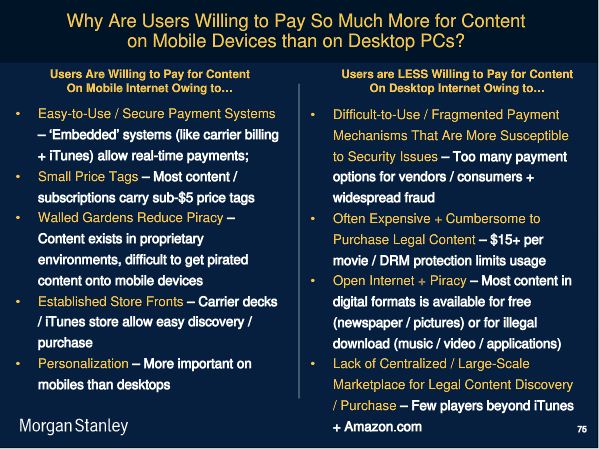
What got me thinking about all this was slide #75 in Mary Meeker’s latest slideshow about Internet trends. The Morgan Stanley web guru notes that users are more willing to pay for content on mobile devices than they are on desktop computers for a number of reasons, but the first of which she listed was: “Easy-to-Use/Secure Payment Systems — embedded systems like carrier billing and iTunes allow real-time payment.” The important point here is that the combination of these slick, well-organized online app stores + secure, super-easy billing systems have combined to overcome the so-called”mental transaction cost problem,” at least to some extent. We’re not nearly as reluctant today to surf away when something says “$0.99” on our screen. Increasingly, we’re hitting the “Buy” button.
 Continue reading →
 I’m quoted briefly in a story today in E-Commerce Times (see “Apple’s Patent Attack: This Too May be Overhyped” by Erika Morphy) about the patent lawsuit filed this week by Apple against rival mobile device maker HTC.
Apple, of course, produces the iPhone, while HTC makes Google’s Nexus One and other devices that run on Google’s Android operating system.
So right from the start this case looks less like a simple patent dispute and more like a warning shot over Google’s bow. The two companies are increasingly becoming rivals. In August of last year, Google CEO Eric Schmidt resigned from Apple’s board. Apple CEO Steve Jobs wrote at the time, “Unfortunately, as Google enters more of Apple’s core businesses, with Android and now Chrome OS, Eric’s effectiveness as an Apple Board member will be significantly diminished….” Continue reading →
Very cool little video here by Jess3 documenting Internet growth and activity. Ironically, Berin sent it to me as Adam Marcus and I were updating the lengthy list of Net & online media stats you’ll find down below. Many of the stats we were compiling are shown in the video. Enjoy!
http://vimeo.com/moogaloop.swf?clip_id=9641036&server=vimeo.com&show_title=1&show_byline=1&show_portrait=1&color=ffffff&fullscreen=1
- 1.73 billion Internet users worldwide as of Sept 2009; an 18% increase from the previous year.
[1]
- 81.8 million .COM domain names at the end of 2009; 12.3 million .NET names & 7.8 million .ORG names.
[2]
- 234 million websites as of Dec 2009; 47 million were added in 2009.
[3] In 2006, Internet users in the United States viewed an average of 120.5 Web pages each day.
[4]
- There are roughly 26 million blogs on the Internet
[5] and even back in 2007, there were over 1.5 million new blog posts every day (17 posts per second).
[6] Continue reading →
So, do I need to remind everyone of my ongoing rants about Jonathan Zittrain’s misguided theory about the death of digital generativity because of the supposed rise of “sterile, tethered” devices? I hope not, because even I am getting sick of hearing myself talk about it. But here again anyway is the obligatory listing of all my tirades: 1, 2, 3, 4, 5, 6, 7, 8 + video and my 2-part debate with Lessig and him last year.
You will recall that the central villain in Zittrain’s drama
The Future of the Internet and How to Stop It is big bad Steve Jobs and his wicked little iPhone. And then, more recently, Jonathan has fretted over those supposed fiends at Facebook. Zittrain’s worries that “we can get locked into these platforms” and that “markets [will] coalesce [around] these tamer gated communities,” making it easier for both corporations and governments to control us. More generally, Zittrain just doesn’t seem to like that some people don’t always opt for the same wide open general purpose PC experience that he exalts as the ideal. As I noted in my original review of his book, Jonathan doesn’t seem to appreciate that it may be perfectly rational for some people to seek stability and security in digital devices and their networking experiences—even if they find those solutions in the form of “tethered appliances” or “sterile” networks, to use his parlance.
Every once and awhile I find a sharp piece by someone out there who is willing to admit that they see nothing wrong with such “closed”
platforms or devices, or they even argue that those approaches can be superior to the more “open” devices and platforms out there. That’s the case with this Harry McCracken rant over at Technologizer today with the entertaining title, “The Verizon Droid is a Loaf of Day-Old Bread.” McCracken goes really hard on the Droid — which hurts because I own one! — and I’m not sure I entirely agree with his complaint about it, but what’s striking is how it represents the antithesis of Zittrainianism: Continue reading →
I posted a rant here over the weekend about those who were engaging in what I believed was excessive whining about Apple’s moves to restrict pornographic content in the Apple Apps Store. (see: “Apple’s App Store, Porn & ‘Censorship‘”) It received a surprising number of comments and featured a back and forth between me and our old TLF blogging colleague Tim Lee. Tim has continued the discussion over on his personal blog and argued that:
[T]he key thing to focus on isn’t the abstract question of whether porn on iPhones is good or bad. The key thing to recognize is how fundamentally broken the process itself is. “Overtly sexual content” is a concept that seems clear in the abstract but gets leaky once you have to actually classify tens of thousands of applications. Apple is going to make mistakes, and when they do hapless developers are going to find their apps blocked, often with little explanation or recourse. Also, Apple is going to change its mind periodically, and when they do the affected developers are going to find their hard-earned apps rendered worthless overnight. This is no way to run a technology platform. It’s unfair to developers and it doesn’t scale. And this is precisely why it would be better for everyone if Apple could come up with an application distribution scheme that didn’t require so much central planning.
I followed up with a comment over there, but just thought I would repost it here, in which I argue that Tim is underestimating how difficult this task of defining acceptable content is and that he is also downplaying Apple’s legitimate editorial discretion to establish standards for the community platform they provide. I’m also uncomfortable with Tim’s constant use of “central planning” rhetoric to describe almost any private, proprietary model of institutional governance or platform development he doesn’t seem to agree with, but I have not elaborated on that point here. Anyway, here’s how I responded over on his blog: Continue reading →

Tim Wu: Not Looking Happy about Being So Wrong
Three years ago this month, Columbia University Law School professor Tim Wu released a controversial white paper in conjunction with the New America Foundation entitled, “Wireless Net Neutrality: Cellular Carterfone and Consumer Choice in Mobile Broadband.” It contained a litany of accusations regarding supposed corporate shenanigans in the mobile marketplace, including: intentional crippling of features and functionality; refusal to allow 3rd party attachments or intentional curtailment of a market for 3rd party application developers; and various concerns about “discrimination” of one sort or another.
Here at the TLF, we responded quite forcefully. I think every one of us piled on this study in one way or another. (ex: Hance, Jerry, James, Tim Lee, me x 2, + a podcast). I called his proposal “a declaration of surrender” since Prof. Wu was essential calling the game early and raising the white flag on mobile competition. Further, I argued he was essentially asking for “the forced commoditization of cellular networks” which “would necessitate at return to the rate-of-return regulatory methods of the past.” Others were a bit more kind to him, but we were all pretty skeptical of his gloomy claims. However, each of us here also argued that the wireless market (especially the applications side of the market) was still developing and that we’d have to check back in a few years to see how well the hands-off approach worked out.
Well, thankfully, we now know for certain that Tim Wu’s was much too lugubrious in his outlook and far too quick to call for regulatory intervention to solve a non-crisis. On the occasion of the 3rd anniversary of the release of Prof. Wu’s paper, CTIA-The Wireless Association filed a short paper with the FCC taking stock of just how far the mobile marketplace has come in just three short years. The results are really quite remarkable, as CTIA’s letter notes: Continue reading →
Until recently, Amazon and its Kindle were the only real e-reader game in town. This allowed them to force on publishers an arguably arbitrary (and low) price of $9.99 for bestsellers. With the introduction of Apple’s iPad, however, publishers now have a viable competitor to which they can defect. The result will likely be higher e-book prices in the near term, and this has prompted some point out that this is a case where more competition resulted in higher prices for consumers.
The key phrase in the previous paragraph, however, is “near term.” It’s interesting to see that five years after it began offering video in the iTunes store, Apple is apparently pushing TV producers to lower their prices by half from $1.99 an episode to 99¢. Market processes–especially those surrounding new technology and distribution channels–can be less than instantaneous, but they have a way of ultimately conforming to economic reality.
Reporting on the ongoing negotiations with Apple, the
New York Times says, “Television production is expensive, and the networks are wary of selling shows for less.” But the economic reality they’re missing is that TV production is a fixed cost, and as my friend Tim Lee has pointed out many times, the marginal cost of digital distribution is basically zero. As a result, I wouldn’t be surprised if five years from now, we’ll see Apple badgering book publishers to cut their prices in half.
Oh my, here we go again with bogus accusations of “censorship” flying about a private company’s efforts to self-regulate its own media platform. Yesterday over at Silicon Alley Insider, Nick Saint penned a piece on how, “Apple’s War On Porn Is Just Getting Started.” And then over at TechCrunch, Jason Kincaid wrote about “Why Apple’s New Ban Against Sexy Apps Is Scary.” That yielded a flurry of similarly-titled rants about Apple’s supposedly totalitarian ways for taking away our new-found inalienable human right to unfettered porn and adult entertainment applications via our iPhones. To Mr. Saint, Mr. Kincaid, and the many others who apparently believe Apple is the reincarnation of Big Brother for self-regulating their own Apps Store, all I can say is: Grow up!
Here are a few things they need to consider:
- What Apple decides to do with its application store, and what it chooses to provide in it, is Apple’s own business—quite literally. Like a traditional bricks-and-mortar retailer, they can make policies about what types of content might be deemed too sensitive for the broad community of customers they serve. WalMart, for example, doesn’t carry certain types of music in their stores. If customers don’t like what those retailers are doing, there’s always another place for them to take their business and find what they are looking for.
- When it comes to the Apple controversy, we are generally talking about porn. Note to Mr. Saint and Mr. Kincaid and other whiners… there are plenty of other places to find porn on the Net! Seriously, have you looked?
- A private company’s decision to self-censor by not carrying something in their store is not even in the same universe as the sort of censorship we see government officials engage in, which blocks all content from all platforms. There is no escape from that sort of all-encompassing censorship. Continue reading →

 The Technology Liberation Front is the tech policy blog dedicated to keeping politicians' hands off the 'net and everything else related to technology.
