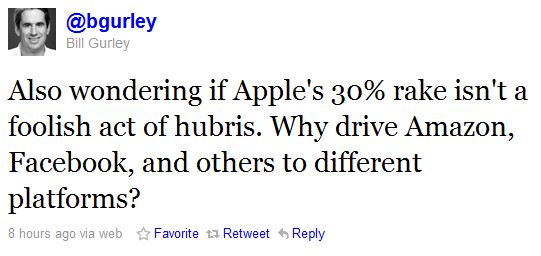
Venture capitalist Bill Gurley asked a good question in a Tweet late last night when he was “wondering if Apple’s 30% rake isn’t a foolish act of hubris. Why drive Amazon, Facebook, and others to different platforms?” As most of you know, Gurley is referring to Apple’s announcement in February that it would require a 30% cut of app developers’ revenues if they wanted a place in the Apple App Store.
 Indeed, why would Apple be so foolish? Of course, some critics will cry “monopoly!” and claim that Apple’s “act of hubris” was simply a logical move by a platform monopolist to exploit its supposedly dominant position in the mobile OS / app store marketplace. But what then are we to make of Amazon’s big announcement yesterday that it was jumping in the ring with its new app store for Android? And what are we to make of the fact that Google immediately responded to Apple’s 30% announcement by offering publishers a more reasonable 10%-of-the-cut deal? And, as Gurley notes, you can’t forget about Facebook. Who knows what they have up their sleeve next. They’ve denied any interest in marketing their own phone and, at least so far, have not announced any intention to offer a competing app store, but why would they need to? Their platform can integrate apps directly into it! Oh, and don’t forget that there’s a little company called Microsoft out there still trying to stake its claim to a patch of land in the mobile OS landscape. Oh, and have you visited the HP-Palm development center lately? Some very interesting things going on there that we shouldn’t ignore.
What these developments illustrate is a point that I have constantly reiterated here: Continue reading →
Here are some quick thoughts on the proposed AT&T – T-Mobile merger, mostly borrowed from my previous writing on the wireless marketplace. First, however, I highly recommend this excellent analysis of the issue by Larry Downes, which cuts through the hysteria we’re already hearing and offers a sober look at the issues at stake here. Anyway, here are a few of my random thoughts on the deal:
-
The deal will likely be approved: First, to cut to the chase.. After much wrangling, the deal will probably be approved primarily because of two factors, both of which help political officials as much as AT&T: (1) The deal delivers upon the National Broadband Plan promise of getting the country blanketed with wireless broadband; and (2) it “brings home” T-Mobile by giving an American company control of a German-held interest. As Larry Dignan of ZNet says, it is tantamount to “playing the patriotism card.”
-
One reason it might not be approved: Some Administration critics, especially from the more liberal part of the Democratic base, could make this a litmus test for Obama administration’s antitrust enforcement efforts. In the wake of the Comcast merger approval — albeit after several pounds of flesh were handed over “voluntarily” to get the deal approved — some of the Administration’s base will be looking for blood. I remember how the Powell FCC was under real heat to “get tough” on mergers back in 2001-02 and during that time blocked the proposed DirecTV-EchoStar deal, possibly as a result of the pressure. The same thing could happen to AT&T – T-Mobile here.
-
It’s all about spectrum: From AT&T’s perspective, this deal is all about getting more high-quality spectrum, which is in increasingly short supply. Indeed, as Jerry Brito noted earlier, this merger should serve as another wake-up call regarding the need to get spectrum reform going again to ensure that existing players can reallocate their spectrum to those who demand it most. (Hint: Incentivize the TV broadcasters to sell... NOW!) But, in the short-term, this deal helps AT&T built out a more robust nationwide wireless network. Over the long-haul, that should help T-Mobile deliver better service to its customers. Continue reading →
[Cross-posted at Truth on the Market]
[UPDATE: Josh links to a WSJ article telling us that EU antitrust enforcers raided several (unnamed) e-book publishers as part of an apparent antitrust investigation into the agency model and whether it is “improperly restrictive.” Whatever that means. Key grafs:
At issue for antitrust regulators is whether agency models are improperly restrictive. Europe, in particular, has strong anticollusion laws that limit the extent to which companies can agree on the prices consumers will eventually be charged.
Amazon, in particular, has vociferously opposed the agency practice, saying it would like to set prices as it sees fit. Publishers, by contrast, resist the notion of online retailers’ deep discounting.
It is unclear whether the animating question is whether the publishers might have agreed to a particular pricing
model, or to particular prices within that model. As a legal matter that distinction probably doesn’t matter at all; as an economic matter it would seem to be more complicated–to be explored further another day . . . .]
A year ago I wrote about the economics of the e-book publishing market in the context of the dispute between Amazon and some publishers (notably Macmillan) over pricing. At the time I suggested a few things about how the future might pan out (never a good idea . . . ):
And that’s really the twist. Amazon is not ready to be a platform in this business. The economic conditions are not yet right and it is clearly making a lot of money selling physical books directly to its users. The Kindle is not ubiquitous and demand for electronic versions of books is not very significant–and thus Amazon does not want to take on the full platform development and distribution risk. Where seller control over price usually entails a distribution of inventory risk away from suppliers and toward sellers, supplier control over price correspondingly distributes platform development risk toward sellers. Under the old system Amazon was able to encourage the distribution of the platform (the Kindle) through loss-leader pricing on e-books, ensuring that publishers shared somewhat in the costs of platform distribution (from selling correspondingly fewer physical books) and allowing Amazon to subsidize Kindle sales in a way that helped to encourage consumer familiarity with e-books. Under the new system it does not have that ability and can only subsidize Kindle use by reducing the price of Kindles–which impedes Amazon from engaging in effective price discrimination for the Kindle, does not tie the subsidy to increased use, and will make widespread distribution of the device more expensive and more risky for Amazon.
This “agency model,” if you recall, is one where, essentially, publishers, rather than Amazon, determine the price for electronic versions of their books sold via Amazon and pay Amazon a percentage. The problem from Amazon’s point of view, as I mention in the quote above, is that without the ability to control the price of the books it sells, Amazon is limited essentially to fiddling with the price of the reader–the platform–itself in order to encourage more participation on the reader side of the market. But I surmised (again in the quote above), that fiddling with the price of the platform would be far more blunt and potentially costly than controlling the price of the books themselves, mainly because the latter correlates almost perfectly with usage, and the former does not–and in the end Amazon may end up subsidizing lots of Kindle purchases from which it is then never able to recoup its losses because it accidentally subsidized lots of Kindle purchases by people who had no interest in actually using the devices very much (either because they’re sticking with paper or because Apple has leapfrogged the competition).
It appears, nevertheless, that Amazon has indeed been pursuing this pricing strategy. According to this post from Kevin Kelly,
John Walkenbach noticed that the price of the Kindle was falling at a consistent rate, lowering almost on a schedule. By June 2010, the rate was so unwavering that he could easily forecast the date at which the Kindle would be free: November 2011.
Continue reading →
This is the second of two essays making “The Case for Internet Optimism.” This essay was included in the book, The Next Digital Decade: Essays on the Future of the Internet (2011), which was edited by Berin Szoka and Adam Marcus of TechFreedom. In my previous essay, which I discussed here yesterday, I examined the first variant of Internet pessimism: “Net Skeptics,” who are pessimistic about the Internet improving the lot of mankind. In this second essay, I take on a very different breed of Net pessimists: “Net Lovers” who, though they embrace the Net and digital technologies, argue that they are “dying” due to a lack of sufficient care or collective oversight. In particular, they fear that the “open” Internet and “generative” digital systems are giving way to closed, proprietary systems, typically run by villainous corporations out to erect walled gardens and quash our digital liberties. Thus, they are pessimistic about the long-term survival of the Internet that we currently know and love.
Leading exponents of this theory include noted cyberlaw scholars Lawrence Lessig, Jonathan Zittrain, and Tim Wu. I argue that these scholars tend to significantly overstate the severity of this problem (the supposed decline of openness or generativity, that is) and seem to have very little faith in the ability of such systems to win out in a free market. Moreover, there’s nothing wrong with a hybrid world in which some “closed” devices and platforms remain (or even thrive) alongside “open” ones. Importantly, “openness” is a highly subjective term, and a constantly evolving one. And many “open” systems or devices are as perfectly open as these advocates suggest.
Finally, I argue that it’s likely that the “openness” advocated by these advocates will devolve into expanded government control of cyberspace and digital systems than that unregulated systems will become subject to “perfect control” by the private sector, as they fear. Indeed, the implicit message in the work of all these hyper-pessimistic critics is that markets must be steered in a more sensible direction by those technocratic philosopher kings (although the details of their blueprint for digital salvation are often scarce). Thus, I conclude that the dour, depressing “the-Net-is-about-to-die” fear that seems to fuel this worldview is almost completely unfounded and should be rejected before serious damage is done to the evolutionary Internet through misguided government action.
I’ve embedded the entire essay down below in Scribd reader, but it can also be found on TechFreedom’s Next Digital Decade book website and SSRN.
Continue reading →
 At the last possible moment before the Christmas holiday, the FCC published its Report and Order on “Preserving the Open Internet,” capping off years of largely content-free “debate” on the subject of whether or not the agency needed to step in to save the Internet.
In the end, only FCC Chairman Julius Genachowski fully supported the final solution. His two Democratic colleagues concurred in the vote (one approved in part and concurred in part), and issued separate opinions indicating their belief that stronger measures and a sounder legal foundation were required to withstand likely court challenges. The two Republican Commissioners vigorously dissented, which is not the norm in this kind of regulatory action. Independent regulatory agencies, like the U.S. Courts of Appeal, strive for and generally achieve consensus in their decisions. Continue reading →
Tim Wu was kind enough to comment on my general overview and critique of his new book, The Master Switch:
The Rise and Fall of Information Empires. That essay will be the first of many I plan to pen about Wu’s important book. I appreciate Prof. Wu being willing to engage me in a debate over some of these issues since I’m sure he has better things to do with his time. Some of the points he raised in his comment will be addressed in subsequent posts.
In this post, I want to respond briefly to his assertion that I was “missing the point of the book” which is “to describe the world we live in.” He says that his book, “suggests that we tend to go through open and closed cycles in the Information Industries, and that, roughly, both have their strengths and weaknesses, and both become popular at different times for various reasons.” But he fears there are “greater risks in the closed periods.”
Contrary to what he suggests, I certainly understand that’s the point of his book, it’s just that I don’t fully agree with his analysis or conclusions. Let me be clear about a crucial point, however: I accept that almost every industry goes through “cycles” of some sort and that, typically, after a “Wild West” period of greater “openness” and more atomistic competition, some degree of “consolidation” or more “closed” (or proprietary) models often sets in. (A somewhat different and far more descriptive interpretation of such cycles can be found in Deborah Spar’s 2001 book, Ruling the Waves: Cycles of Discovery, Chaos, and Wealth from Compass to the Internet. She outlines a more refined 4-part cycle of: Innovation, Commercialization, Creative Anarchy, and Rules.)
My primary beef with Prof. Wu is that, contrary to his assertion yesterday in commenting on my post, his book seems to regard the progression of “the Cycle” as mostly linear and one-directional: straight down toward a perfectly closed, corporate-controlled, anti-consumer Hell. By my reading of his book – much like Lessig and Zittrain’s work – Wu is painting an overly pessimistic portrait of technologies being subjected to the “perfect control” of largely unfettered markets.
I believe history – especially recent history — teaches us something very different. Continue reading →
 I dashed off a piece for CNET today on the Copyright Office’s cell phone “jailbreaking” rulemaking earlier this week. Though there has already been extensive coverage (including solid pieces in The Washington Post, a New York Times editorial, CNET, and Techdirt), there were a few interesting aspects to the decision I thought were worth highlighting.
Most notably, I was interested that no one had discussed the possibility and process by which Apple or other service providers could appeal the rulemaking. Ordinarily, parties who object to rules enrolled by administrative agencies can file suit in federal district court under the Administrative Procedures Act. Such suits are difficult to win, as courts give deference to administrative determinations and review them only for errors of law. But a win for the agency is by no means guaranteed. Continue reading →
 Better late than never, I’ve finally given a close read to the Notice of Inquiry issued by the FCC on June 17th. (See my earlier comments, “FCC Votes for Reclassification, Dog Bites Man”.) In some sense there was no surprise to the contents; the Commission’s legal counsel and Chairman Julius Genachowski had both published comments over a month before the NOI that laid out the regulatory scheme the Commission now has in mind for broadband Internet access.
Chairman Genachowski’s “Third Way” comments proposed an option that he hoped would satisfy both extremes. The FCC would abandon efforts to find new ways to meet its regulatory goals using “ancillary jurisdiction” under Title I (an avenue the D.C. Circuit had wounded, but hadn’t actually exterminated, in the Comcast decision), but at the same time would not go as far as some advocates urged and put broadband Internet completely under the telephone rules of Title II.
Continue reading →
NY venture capitalist Fred Wilson notes eight advantages of using the iPhone’s Safari browser over iPhone apps to access content. Fred’s arguments seem pretty sound to me and help to illustrate the point I was trying to make a few months ago in a heated exchange over Adam’s post on Apple’s App Store, Porn & “Censorship”: Although Apple restricts pornographic apps, it does not restrict what iPhone (or iPad or iTouch) users can access on their browsers. (And it’s not censorship, anyway, because that’s what governments do!)
As I noted in that exchange, the main practical advantage of apps right now over the browser seems to be the ability to play videos from websites that require Flash—which is especially useful for porn! Apple has rejected using Flash on the iPhone on technical grounds, in favor of HTML5, which will allow websites to display video without Flash—including on mobile devices. But once HTML5 is implemented (large scale adoption expected in 2012), this primary advantage of apps over mobile Safari will disappear: Users will be able to view porn on their browsers without needing to rely on apps—and Apple’s control over apps based on their content will no longer matter so much, if at all.
Of course, it may take several more years for HTML5 to really become
the standard, but what matters is that all Apple products, including mobile Safari, already support HTML5. So it’s just a question of when porn sites move from Flash to HTML5. That seems already to be happening, with major porn publishers already starting the transition. The main stumbling block seems to be HTML5 support from the other browser makers. But Internet Explorer 9 supports HTML5, and is expected out early in 2011 with a beta version due out this August. Mozilla’s Firefox 4.0 (formerly 3.7) also promises HTML5 support and is due out this November. Since porn publishers have always been on the cutting edge of implementing new web technologies, I’d bet we’ll start seeing many porn sites move to HTML5 by this Christmas. And by Christmas 2011, as we all sit around the fire with Grandma sipping eggnog and enjoying our favorite adult websites on our overpriced-but-elegant Apple products loading in HTML5 in the Safari browser, we’ll all look back and wonder why anyone made such a big deal about Apple restricting porn apps.
Oh, and if you get tired of waiting,
get an Android phone! Anyway, here are my comments on Adam’s February post: Continue reading →
Since Jonathan Zittrain’s ideas about the “generativity” have permeated the intellectual climate of technology policy almost as thoroughly as those of Larry Lessig, scarcely a month passes without a new Chicken Little shouting about how the digital sky is falling in a major publication. The NYT has had not one, but two such articles in the course of a week: first, Brad Stone’s piece about Google, Sure, It’s Big. But Is That Bad? (his answer? an unequivocal yes! as I noted), followed by Virginia Heffernan’s piece “The Death of the Open Web,” which bemoans the growing popularity of smart phone apps—which she analogizes to “white flight” (a stretched analogy that, I suppose, would make Steve Jobs the digital Bull Connor).
What really ticks me off about these arguments (besides the fact that Apple critics like Zittrain use iPhones themselves without a hint of bourgeois irony) is Heffernan’s suggestion that, “By choosing machines that come to life only when tricked out with apps from the App Store, users of Apple’s radical mobile devices increasingly commit themselves to a more remote and inevitably antagonistic relationship with the Web.” To hear people like Heffernan (and others who have complained about Apple’s policies for its app store) talk, you might think that modern smart phones don’t come with a web browser at all, or that browser software is next to useless, so the fact that browsers can access any content on the web (subject to certain specific technical limitations, such as sites that use Flash) is irrelevant, and users are simply at the mercy of the “gatekeepers” that control access to app stores.
In fact, the iPhone and Android mobile browsers are amazingly agile, generally rendering pages originally designed for desktop reading in a way that makes them very easy to read on the phone—such as by wrapping text into a single column maximized to fit either the landscape or portrait view of the phone, depending on which way it’s pointed. In fact, I do most of my news reading on my Droid, and using its browser rather than through any app—although there are a few good news apps to choose from. In fact, I probably spend about 10 times as much time using my phone’s browser as I spend using all other 3rd party apps (i.e., not counting the phone, e-mail, calendar, camera and map “native” apps). So I can get any content I want using the phone’s browser, I certainly don’t lose any sleep at night over what I can or can’t do in apps I get through the app store. I’d love to see actual statistics on the percent of time that smartphone users spend using their mobile browser, as compared to third-party apps. Do they exist?
But however high that percentage might be, the important thing is that the smartphone browser offers an uncontrolled tool for accessing content, even if apps on that mobile OS do not. Continue reading →

 The Technology Liberation Front is the tech policy blog dedicated to keeping politicians' hands off the 'net and everything else related to technology.