 Tim Wu’s new book, The Master Switch: The Rise and Fall of Information Empires, will be released next week and it promises to make quite a splash in cyberlaw circles. It will almost certainly go down as one of the most important info-tech policy books of 2010 and will probably win the top slot in my next end-of-year list.
Of course, that doesn’t mean I agree with everything in it. In fact, I disagree vehemently with Wu’s general worldview and recommendations, and even much of his retelling of the history of information sectors and policy. Nonetheless, for reasons I will discuss in this first of many critiques, the book’s impact will be significant because Wu is a rock star in this academic arena as well as a committed activist in his role as chair of the radical regulatory activist group, Free Press. Through his work at Free Press as well as the New America Foundation, Professor Wu is attempting to craft a plan of action to reshape the Internet and cyberspace.
I stand in opposition to almost everything that Wu and those groups stand for, thus, I will be spending quite a bit of time addressing his perspectives and proposals here in coming months, just as I did when Jonathan Zittrain’s hugely important The Future of the Internet & How to Stop It was released two years ago (my first review is here and my latest critique is here). In today’s essay, I’ll provide a general overview and foreshadow my critiques to come. (Note: Tim was kind enough to have his publisher send me an advance uncorrected proof of the book a few months ago, so I’ll be using that version to construct these critiques. Please consult the final version for cited material and page numbers.) Continue reading →
“It was then, and is now, the largest merger in American business history,” notes Tim Arango of the New York Times about the AOL-Time Warner mega-merger, which happen ten years this month. And yet, as he points out in his essay, “How the AOL-Time Warner Merger Went So Wrong,” things didn’t end up going so well for this marriage:
The trail of despair in subsequent years included countless job losses, the decimation of retirement accounts, investigations by the Securities and Exchange Commission and the Justice Department, and countless executive upheavals. Today, the combined values of the companies, which have been separated, is about one-seventh of their worth on the day of the merger.
To call the transaction the worst in history, as it is now taught in business schools, does not begin to tell the story of how some of the brightest minds in technology and media collaborated to produce a deal now regarded by many as a colossal mistake.
Arango goes on to interview several of the principals involved in the deal to get their take on why things unfolded so miserably and, ultimately, came to an end this year. I highly recommend the essay because it should serve as a cautionary tale to those worrywarts who are constantly predicting that the sky is going to fall if we allow a truly free media marketplace–including freedom for firms to structure themselves as they wish. Reality usually plays out quite differently. As I argued in my recent paper, “A Brief History of Media Merger Hysteria: From AOL-Time Warner to Comcast-NBC,”
The point here is not that media mergers are inherently good or always make sense. Indeed.. mergers sometimes prove to be huge blunders. But the hysteria sometimes heard before media mergers are consummated rarely bears any relationship to reality once the deals move forward. Media markets are extremely dynamic and prone to disruptive change and technological leap-frogging. Mergers are often one response to that turbulence… Given how difficult it is to predict the future course of events in this chaotic sector, humility—not hubris—is the sensible disposition when it comes to media merger policy.
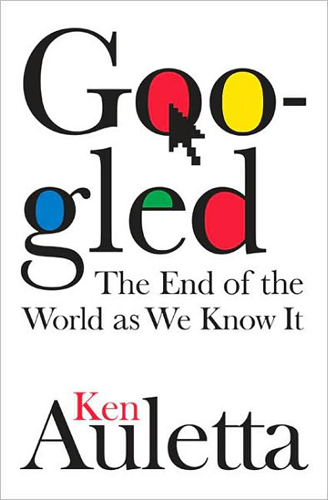 I just finished Ken Auletta’s latest book,
Googled: The End of the World As We Know It, and I highly recommend it. Auletta is an amazingly gifted journalist and knows how put together a hell of good story. It helps in this case that he was granted unprecedented access to the Google team and their day-to-day workings at the Googleplex. I’m really shocked by the level of access he was granted to important meetings and officials–over 150 interviews with Googlers, including 11 with CEO Eric Schmidt and several with founders Sergey Brin and Larry Page. That’s impressive.
I just finished Ken Auletta’s latest book,
Googled: The End of the World As We Know It, and I highly recommend it. Auletta is an amazingly gifted journalist and knows how put together a hell of good story. It helps in this case that he was granted unprecedented access to the Google team and their day-to-day workings at the Googleplex. I’m really shocked by the level of access he was granted to important meetings and officials–over 150 interviews with Googlers, including 11 with CEO Eric Schmidt and several with founders Sergey Brin and Larry Page. That’s impressive.
The book shares much in common with Randall Stross’s excellent Planet Google: One Company’s Audacious Plan to Organize Everything We Know, which I reviewed here earlier this year. Both books recount the history of Google from its early origins to present. And both survey a great deal of ground in terms of the challenges that Google faces as it matures and the policy issues that are relevant to the company (privacy, free speech, copyright law, etc).
What makes Auletta’s book unique is the way we taps his extensive “old media” world contacts and integrates such a diverse cast of characters into the narrative — Mel Karmazin (former Viacom, now Sirius XM), Bob Iger (Disney), Howard Stringer (Sony), Martin Sorrrell (WPP), Irwin Gotlieb (Group M), and even the Internet’s “inventor”–Al Gore! Auletta interviews them or recounts stories about their interactions with Google to show the growing tensions being created by this disruptive company and its highly disruptive technologies. There are some terrifically entertaining anecdotes in the book, but the bottom line is clear: Google has made a lot of enemies in a very short time.
Indeed, the book is as much about the decline of old media as it is about Google’s ascendancy. What Auletta has done so brilliantly here is to tell their stories together and ask how much old media’s recent woes can be blamed on Google and digital disintermediation in general. “If Google is destroying or weakening old business models,” Auletta argues, “it is because the Internet inevitably destroys old ways of doing things, spurs ‘creative destruction.’ This does not mean that Google is not ambitious to grow, and will not grow at the expense of others. But the rewards, and the pain, are unavoidable,” he concludes. Continue reading →
As I noted in my recent paper, “A Brief History of Media Merger Hysteria: From AOL-Time Warner to Comcast-NBC,” every time a media merger is proposed we hear all sorts of silly Chicken Little predictions of impending doom. Among the more entertaining claims we hear are conspiracy theories about supposed nefarious schemes to take over the media universe and control our minds, predictions of the death of journalism or democracy, or just good ol’ fashion screw-the-consumer price hikes. But, as I showed in my paper, those predictions have always proven to be bunk once the historical record is in–which usually only takes a few years. While most media mergers do end in misery–it’s for the merging firms and their shareholders, not the public. Unforeseen technological innovations and expanding media marketplace options typically doom most media mergers, while the viewing and listening public enjoys the fruits of continued marketplace evolution.
But the critics never acknowledge any of this. And, sadly, history repeats. The media worrywarts just keep mouthing the same lines and conveniently avoid any reference to their past predictions. No one bothers looking back and trying to match up those past predictions with present day facts. I’m out to change that. I am going to attempt to keep a running inventory all the Chicken Little predictions about the Comcast-NBC Universal deal so that, a few years from now, we can look back and see how well those predictions match up with reality. I suspect that, as was true of those earlier case studies, reality will look quite different than the rhetoric we are hearing today.
To kick things off, here are some rather outlandish comments from someone who should know better — Dan Gillmor, author of the excellent 2006 book,
We the Media: Grassroots Journalism by the People, for the People, which I have cited quite favorably in much of my own work through the years. But when it comes to the Comcast-NBCU deal, Gillmor has gone off the deep end in an essay entitled, “Comcast-NBC: The Road Toward Control Over What We Create.” He argues:
A Comcast-NBC combination is brazenly anti-competitve and anti-democratic. It would give one company far too much ownership over not just professionally produced media but also the ways media consumers can receive it.
Worse, if approved, it could mark the tipping point in Big Media’s push to
take control over the Internet itself. That’s where we need to focus our attention.
But wait, there’s more… Continue reading →
I’ve just released a new PFF white paper looking at the hysteria that has often accompanied major media mergers and then taking a look at the marketplace reality years after the fact. Here‘s the PDF, but I have also pasted the entire thing down below.
_____________________________
A Brief History of Media Merger Hysteria:
From AOL-Time Warner to Comcast-NBC
by Adam Thierer
Although the pending union of Comcast and NBC Universal has not yet made it to the altar, Chicken Little-esque wails about the marriage have already begun in earnest. For example, the pro-regulatory media organization Free Press has already set up a website to complain about the deal.[1] And Jeff Chester, executive director of the Center for Digital Democracy, has called it “an unholy marriage.”[2] The fever only promises to spread once the deal is formally announced, and a lengthy fight over the deal is expected at the Federal Communications Commission (FCC) and whichever antitrust agency reviews the deal.[3]
But reality tends to play out somewhat less dramatically than the script penned by the media worrywarts. It’s worth looking back at some of the more prominent examples of media merger hysteria in recent years to understand why such panic is unwarranted, and why a deal between Comcast and NBC Universal is unlikely to lead to the sort of problems that the pessimists suggest.[4] Continue reading →
I was just digging through some old files and came across a quote that I found entertaining. Back in 2003, when he was still president and chief operating officer of Viacom, Mel Karmazin said with reference to Microsoft, AOL-Time Warner, and Comcast: “I can’t imagine being a competitor with any of these guys.” At the time, some media worrywarts made great hay of Mel’s quip and claimed, as Gene Kimmelman of Consumers Union argued at the time, that it proved how “Media moguls themselves admit their desire to avoid real competition within their industry.”
Utter rubbish. In fact, just six years after Karmazin spoke those words, Microsoft finds itself in a heated war with Google on all fronts, AOL-Time Warner has crumbled (even Time Warner Cable and Time Warner Entertainment got divorced!), and Comcast is now squaring off against telco and online video competitors that were unfathomable at the time (not to mention traditional satellite TV competitors.) In the meanwhile, Karmazin abandoned Viacom and today, as CEO of Sirius XM, is struggling to find a way to make the satellite radio universe survive the ongoing digital music bloodbath thanks to unforeseen competition from online music services and a little thing called the iPod!
It’s proof positive that media markets and digital technologies
always evolve faster than most people — even smart industry titans like Karmazin — anticipate.
 Over the past couple of years here, I have relentlessly hammered Harvard’s dynamic duo of digital doom, Jonathan Zittrain (see 1, 2, 3, 4, 5, 6) and Lawrence Lessig (see 1, 2, 3), for their extraordinarily gloomy predictions about the Internet creating a world of “perfect control.” In the hyper-pessimistic Lessig-Zittrain view of things, cyberspace is perpetually haunted by the specter of nefarious corporate schemers out to suffocate innovation, screw consumers, and quash dissent. In the 1990s, Lessig’s big-bad-bogeyman was AOL. Today, Zittrain casts Apple in the lead role of Cyber-Big Brother. The problem with their thesis? In a word: Reality. As Tim Lee has pointed out before, “Lessig’s specific predictions in Code turned out to be… spectacularly wrong”:
Lessig was absolutely convinced that a system of robust user authentication would put an end to the Internet’s free-wheeling, decentralized nature. Not only has that not happened, but I suspect that few would seriously defend Lessig’s specific prediction will come to pass.
Absolutely correct, and the same is true of the fears and predictions Zittrain tosses around in The Future of the Internet. And yet, as we saw most recently during my debate with Lessig and Zittrain over at Cato Unbound upon the occasion of the 10th anniversary of the publication Code, neither of them have relented one bit. Indeed, they have actually been escalating their morose rhetoric recently.
The fact that Zittrain casts Apple as the central villain in his drama is particularly interesting because millions upon millions of people absolutely love the company and its amazingly innovative products — even if I’m not one of them. And there is absolutely no way Zittrain can continue to sell us this story of Apple quashing innovation when, in just one year’s time, there were 1.5 Billion iPhone Store downloads of over 65,000 free and paid apps by consumers in 77 countries. I mean, seriously, is there any application you cannot get for the iPhone these days?
Apparently not, because over at the
Wall Street Journal “Digits” blog, Andrew LaVallee writes of the latest innovative application to pop up in the Apple iPhone Store, iPot — a tool to help you find dope shops in California!!
Continue reading →
Adam Thierer & I have just released a detailed examination (PDF) of brewing efforts to expand the Children’s Online Privacy Protection Act of 1998 to cover adolescents and potentially all social networking sites—an approach we call “COPPA 2.0.”
As Adam explained on Larry Magid’s CNET podcast, COPPA mandates certain online privacy protections for children under 13, most importantly that websites obtain the “verifiable consent” of a child’s parent before collecting personal information about that child or giving that child access to interactive functionality that might allow the child to share their personal information with others. The law was intended primarily to “enhance parental involvement in a child’s online activities” as a means of protecting the online privacy and safety of children.
Yet advocates of expanding COPPA—or “COPPA 2.0″—see COPPA’s verifiable parental consent framework as a means for imposing broad regulatory mandates in the name of online child safety and concerns about social networking, cyber-harassment,
etc. Two COPPA 2.0 bills are currently pending in New Jersey and Illinois. The accelerated review of COPPA to be conducted by the FTC next year (five years ahead of schedule) is likely to bring to Washington serious talk of expanding COPPA—even though Congress clearly rejected covering adolescents age 13-16 when COPPA was first proposed back in 1998.
We’ll discuss some of the key points of our paper in a series of blog posts, but here are the top nine reasons for rejecting COPPA 2.0, in that such an approach would:
- Burden the free speech rights of adults by imposing age verification mandates on many sites used by adults, thus restricting anonymous speech and essentially converging—in terms of practical consequences—with the unconstitutional Children’s Online Protection Act (COPA), another 1998 law sometimes confused with COPPA;
- Burden the free speech rights of adolescents to speak freely on—or gather information from—legal and socially beneficial websites;
- Hamper routine and socially beneficial communication between adolescents and adults;
- Reduce, rather than enhance, the privacy of adolescents, parents and other adults because of the massive volume of personal information that would have to be collected about users for authentication purposes (likely including credit card data);
Continue reading →
Today, the U.S. Department of Commerce’s National Telecommunications and Information Administration (NTIA) announced the members of the new Online Safety and Technology Working Group (OSTWG). I am honored to be among those chosen to participate in this new task force and I look forward to continuing the work started last year with the Harvard Berkman Center’s Internet Safety Technical Task Force (ISTTF), which I also served on. I was very proud of the work done by the ISTTF and the impressive final report that Prof. John Palfrey crafted to reflect our findings. I am eager to investigate these issues further and take a look at the latest research and technologies that can help us better understand how to protect our kids online while also protecting the free speech and privacy rights of Netizens.
The new NTIA working group, which was established under the “Protecting Children in the 21st Century Act,” will report to the Assistant Secretary of Commerce for Communications and Information on industry-implemented online child safety tools and efforts. Within a year of convening its first meeting, the group will submit a report of its findings and make recommendations on how to increase online safety measures.
Below the fold I have listed the complete roster of OSTWG task force members. I very much looking forward to working with this outstanding group. And I’m happy to report that my TLF blogging colleague Braden Cox will be joining me on this task force!
Continue reading →
What would it take to create a more secure Internet? That’s what John Markoff explores in his latest New York Times article, “Do We Need a New Internet?” Echoing some of the same fears Jonathan Zittrain articulates in his new book The Future of the Internet, Markoff wonders if online viruses and other forms of malware have gotten so out-of-control that extreme measures may be necessary to save the Net. Compared to when cyber-security attacks first started growing over 20 years ago, Markoff argues that:
[T]hings have gotten much, much worse. Bad enough that there is a growing belief among engineers and security experts that Internet security and privacy have become so maddeningly elusive that the only way to fix the problem is to start over.
Like many others, Markoff fingers anonymity as one potential culprit:
The Internet’s current design virtually guarantees anonymity to its users. (As a New Yorker cartoon noted some years ago, “On the Internet, nobody knows that you’re a dog.”) But that anonymity is now the most vexing challenge for law enforcement. An Internet attacker can route a connection through many countries to hide his location, which may be from an account in an Internet cafe purchased with a stolen credit card. “As soon as you start dealing with the public Internet, the whole notion of trust becomes a quagmire,” said Stefan Savage, an expert on computer security at the University of California, San Diego.
Consequently, Markoff suggests that:
A more secure network is one that would almost certainly offer less anonymity and privacy. That is likely to be the great tradeoff for the designers of the next Internet. One idea, for example, would be to require the equivalent of drivers’ licenses to permit someone to connect to a public computer network. But that runs against the deeply held libertarian ethos of the Internet.
Indeed, not only does it run counter to the ethos of the Net, but as Markoff rightly notes, “Proving identity is likely to remain remarkably difficult in a world where it is trivial to take over someone’s computer from half a world away and operate it as your own. As long as that remains true, building a completely trustable system will remain virtually impossible.” I’ve spent a lot of time writing about that fact here and won’t belabor the point other than to say that efforts to eliminate anonymity for the entire Internet would prove extraordinarily intrusive and destructive — of both the Internet’s current architecture and the rights of its users. There’s just something about a “show-us-you-papers,” national ID card-esque system of online identification that creeps most of us out. That’s why I spend so much time fighting age verification mandates for social networking sites and other websites; it’s the first step down a very dangerous road.
But what if we could apply such solutions in a narrower sense? That is, could we create more secure communities within the overarching Internet superstructure that might provide greater security? Markoff starts thinking along those lines when he suggests…
Continue reading →
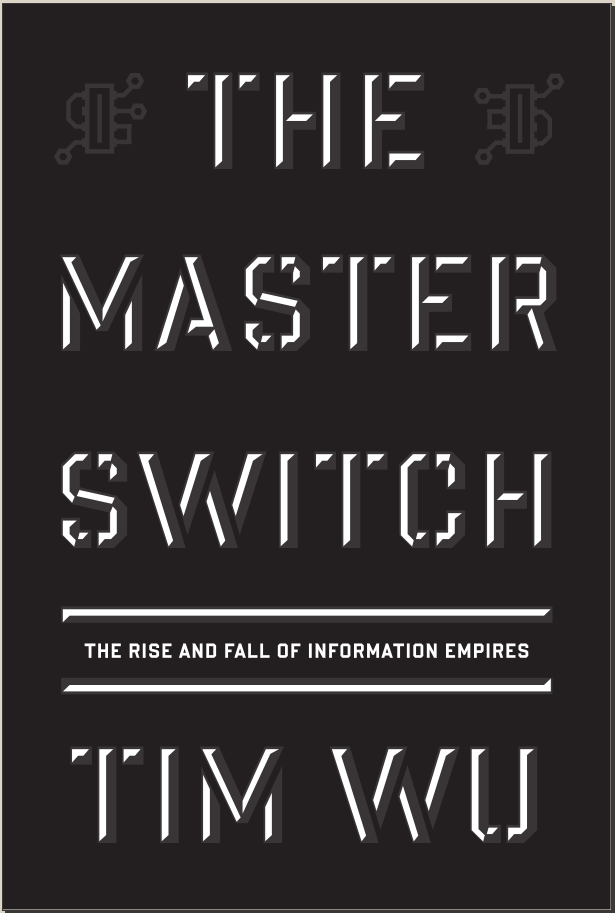 Tim Wu’s new book, The Master Switch: The Rise and Fall of Information Empires, will be released next week and it promises to make quite a splash in cyberlaw circles. It will almost certainly go down as one of the most important info-tech policy books of 2010 and will probably win the top slot in my next end-of-year list.
 The Technology Liberation Front is the tech policy blog dedicated to keeping politicians' hands off the 'net and everything else related to technology.