Posts tagged as:

crossroadsTuesday was a big day for the FCC.  The Senate Commerce, Science and Transportation Committee held an oversight hearing with all five Commissioners, the same day that reply comments were due on the design of eventual “incentive auctions” for over-the-air broadcast spectrum.  And the proposed merger of T-Mobile USA and MetroPCS was approved.

All this activity reflects the stark reality that the Commission stands at a crossroads.  As once-separate wired and wireless communications networks for voice, video, and data converge on the single IP standard, and as mobile users continue to demonstrate insatiable demand for bandwidth for new apps, the FCC can serve as midwife in the transition to next-generation networks.  Or, the agency can put on the blinkers and mechanically apply rules and regulations designed for a by-gone era. Continue reading →

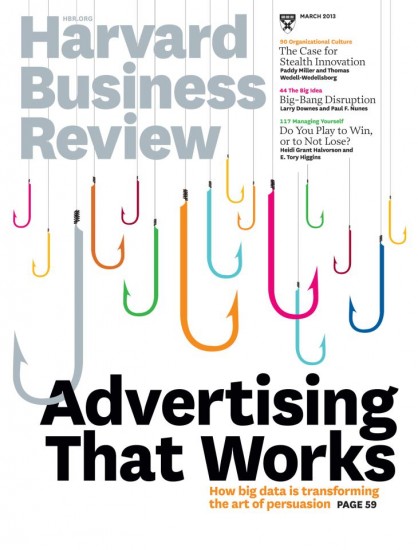
In the upcoming issue of Harvard Business Review, my colleague Paul Nunes at Accenture’s Institute for High Performance and I are publishing the first of many articles from an on-going research project on what we are calling “Big Bang Disruption.”

The project is looking at the emerging ecosystem for innovation based on disruptive technologies.  It expands on work we have done separately and now together over the last fifteen years.

Our chief finding is that the nature of innovation has changed dramatically, calling into question much of the conventional wisdom on business strategy and competition, especially in information-intensive industries–which is to say, these days, every industry.

The drivers of this new ecosystem are ever-cheaper, faster, and smaller computing devices, cloud-based virtualization, crowdsourced financing, collaborative development and marketing, and the proliferation of mobile everything.  There will soon be more smartphones sold than there are people in the world.  And before long, each of over one trillion items in commerce will be added to the network.

The result is that new innovations now enter the market cheaper, better, and more customizable than products and services they challenge.  (For example, smartphone-based navigation apps versus standalone GPS devices.)  In the strategy literature, such innovation would be characterized as thoroughly “undiscplined.”  It shouldn’t succeed.  But it does. Continue reading →

I finally got around to reading this interesting little paper by Justus Haucap and Ulrich Heimeshoff published by the Düsseldorf Institute for Competition Economics entitled, “Google, Facebook, Amazon, eBay: Is the Internet Driving Competition or Market Monopolization?”  It offers a nice snapshot of the current state of play in several online sectors and surveys much of the relevant economic literature on the issue of antitrust and information technology markets. The authors also familiarize readers with the basic economic concepts that are hotly debated in the field of digital economics, including: network effects, switching costs, multi-homing, and economies of scale.

What I particularly like about their paper is that it struggles with the two competing narratives that dominate debates over digital age economics. Here’s how Haucap and Heimeshoff put it in the introduction:

On the one hand, it is rather obvious that many very successful Internet-based companies are nearly monopolists. Google, Youtube, Facebook, and Skype are typical examples for Internet firms who dominate their relevant markets and who leave only limited space for a relatively small competitive fringe. Furthermore, most of these providers do not generate content themselves, but “only” provide access to different content on the Internet. On the other hand, the crucial question from a competition policy perspective is not so much whether these firms have such a dominant position today, but rather why they have such a large market share and whether this is a temporary or non-temporary phenomenon. Do these Internet monopolies enjoy a dominant position because they are protected from competition though barriers to entry or do they just enjoy the profits of superior technology and innovation? Are we observing some sort of Schumpeterian competition where one temporary monopoly is followed by another, with innovation as the driving competitive force, or are we dealing with monopoly firms that mainly try to foreclose their markets through anticompetitive behavior?

Faithful readers know from my past rantings here on this blog, in Forbes columns, and in various working papers, that I am firmly in the latter (“Schumpeterian competition”) camp. Continue reading →

Matt Yglesias today responded with a post of his own to a NYT article about sports channels and cable pricing by Brian Stelter that Yglesias believed had “bad analysis.” I’m here to defend Stelter a little bit because I think Yglesias was too harsh and that Yglesias erred in his own post about the nature of cable bundling. Yglesias’ posts on cable bundling are good, and especially valuable because his Slate and ThinkProgress audiences are not the most receptive to economic justifications for perceived unfair corporate pricing schemes. In part due to him I suspect, you rarely hear econ and business bloggers calling for a la carte pricing of cable channels.

And Yglesias is certainly right that you can’t really complain about the price of your cable package, which includes the few channels you watch plus the sports channels you don’t watch, because you obviously value the channels more than the price you pay per month, even if the sports are a “waste.” He falters when he says

So since those channels are worth $60 to you, even if unbundling happens your cable provider is going to find a way to charge you approximately $60 for them. Because at the end of the day, you’re paying your cable provider for access to the channels you do watch—not for access to the channels you don’t watch. The channels you don’t watch are just there. If the channels you do watch are worth $60 to you, then $60 is what you’ll pay for them.

Continue reading →

When the smoke cleared and I found myself half caught-up on sleep, the information and sensory overload that was CES 2013 had ended.

There was a kind of split-personality to how I approached the event this year. Monday through Wednesday was spent in conference tracks, most of all the excellent Innovation Policy Summit put together by the Consumer Electronics Association. (Kudos again to Gary Shapiro, Michael Petricone and their team of logistics judo masters.)

The Summit has become an important annual event bringing together legislators, regulators, industry and advocates to help solidify the technology policy agenda for the coming year and, in this case, a new Congress.

I spent Thursday and Friday on the show floor, looking in particular for technologies that satisfy what I coined the The Law of Disruption: social, political, and economic systems change incrementally, but technology changes exponentially.

What I found, as I wrote in a long post-mortem for Forbes, is that such technologies are well-represented at CES, but are mostly found at the edges of the show–literally. Continue reading →

By Geoffrey Manne & Berin Szoka

As Democrats insist that income taxes on the 1% must go up in the name of fairness, one Democratic Senator wants to make sure that the 1% of heaviest Internet users pay the same price as the rest of us. It’s ironic how confused social justice gets when the Internet’s involved.

Senator Ron Wyden is beloved by defenders of Internet freedom, most notably for blocking the Protect IP bill—sister to the more infamous SOPA—in the Senate. He’s widely celebrated as one of the most tech-savvy members of Congress. But his latest bill, the “Data Cap Integrity Act,” is a bizarre, reverse-Robin Hood form of price control for broadband. It should offend those who defend Internet freedom just as much as SOPA did.

Wyden worries that “data caps” will discourage Internet use and allow “Internet providers to extract monopoly rents,” quoting a New York Times editorial from July that stirred up a tempest in a teapot. But his fears are straw men, based on four false premises.

First, US ISPs aren’t “capping” anyone’s broadband; they’re experimenting with usage-based pricing—service tiers. If you want more than the basic tier, your usage isn’t capped: you can always pay more for more bandwidth. But few users will actually exceed that basic tier. For example, Comcast’s basic tier, 300 GB/month, is so generous that 98.5% of users will not exceed it. That’s enough for 130 hours of HD video each month (two full-length movies a day) or between 300 and 1000 hours of standard (compressed) video streaming.

Second, Wyden sets up a false dichotomy: Caps (or tiers, more accurately) are, according to Wyden, “appropriate if they are carefully constructed to manage network congestion,” but apparently for Wyden the only alternative explanation for usage-based pricing is extraction of monopoly rents. This simply isn’t the case, and propagating that fallacy risks chilling investment in network infrastructure. In fact, usage-based pricing allows networks to charge heavy users more, thereby recovering more costs and actually reducing prices for the majority of us who don’t need more bandwidth than the basic tier permits—and whose usage is effectively subsidized by those few who do. Unfortunately, Wyden’s bill wouldn’t allow pricing structures based on cost recovery—only network congestion. So, for example, an ISP might be allowed to price usage during times of peak congestion, but couldn’t simply offer a lower price for the basic tier to light users.

That’s nuts—from the perspective of social justice as well as basic economic rationality. Even as the FCC was issuing its famous Net Neutrality regulations, the agency rejected proposals to ban usage-based pricing, explaining:

prohibiting tiered or usage-based pricing and requiring all subscribers to pay the same amount for broadband service, regardless of the performance or usage of the service, would force lighter end users of the network to subsidize heavier end users. It would also foreclose practices that may appropriately align incentives to encourage efficient use of networks.

It is unclear why Senator Wyden thinks the FCC—no friend of broadband “monopolists”—has this wrong. Continue reading →

by Larry Downes and Geoffrey A. Manne

Now that the election is over, the Federal Communications Commission is returning to the important but painfully slow business of updating its spectrum management policies for the 21st century. That includes a process the agency started in September to formalize its dangerously unstructured role in reviewing mergers and other large transactions in the communications industry.

This followed growing concern about “mission creep” at the FCC, which, in deals such as those between Comcast and NBCUniversal, AT&T and T-Mobile USA, and Verizon Wireless and SpectrumCo, has repeatedly been caught with its thumb on the scales of what is supposed to be a balance between private markets and what the Communications Act refers to as the “public interest.” Continue reading →

Why do mobile carriers sell phones with a subscription?  My roommate and I were debating this the other night.  Most other popular electronics devices aren’t sold this way.  Cable and satellite companies don’t sell televisions with their video service.  ISPs don’t sell laptops and desktops with their Internet service.  Bundling phones with mobile service subscriptions is pretty unique.  (The only mass-market analogs I can think of are satellite radio and GPS service.)

Why might this be?   Continue reading →

Earlier today on Twitter, I listed what I thought were the Top 5 “Biggest Internet Policy Issues of 2012.” In case you don’t follow me on Twitter — and shame on you if you don’t! — here were my choices:

  1. Copyright wars reinvigorated post-SOPA; tide starting to turn in favor of copyright reform. [TLF posts on copyright.]
  2. Privacy still red-hot w ECPA reform, online advertising regs & kids’ privacy issues all pending. [TLF posts on privacy.]
  3. WCIT makes Internet governance / NetFreedom a major issue worldwide. [TLF posts on Net governance.]
  4. Antitrust threat looms larger w pending Google case + Apple books investigation. [TLF posts on antitrust.]
  5. Cybersecurity regulatory push continues in both legislative (CISPA) & executive branch. [TLF posts on cybersecurity.]

Lists like these are entirely subjective, of course, but I am basing my list on the general amount of chatter I tended to see and hear about each topic over the course of the year.

What do you think the top tech policy issues of the year were?

Here’s a presentation I delivered on “The War on Vertical Integration in the Digital Economy” at the latest meeting of the Southern Economic Association this weekend. It outlines concerns about vertical integration in the tech economy and specifically addresses regulatory proposals set forth by Tim Wu (arguing for a “separations principle” for the tech economy) & Jonathan Zittrain (arguing for “API neutrality” for social media and digital platforms). This presentation is based on two papers published by the Mercatus Center at George Mason University: “Uncreative Destruction: The Misguided War on Vertical Integration in the Information Economy” (with Brent Skorup) & “The Perils of Classifying Social Media Platforms as Public Utilities.”