2009 was not as big of a year for Internet and information technology (“info-tech”) policy books as 2008 was, but there were still some notable titles released that offered interesting perspectives about the future of the Net and the impact the Digital Revolution is having on our lives, culture, and economy. So, like last year, I figured I would throw together my list of the 10 most important info-tech policy books of the year.
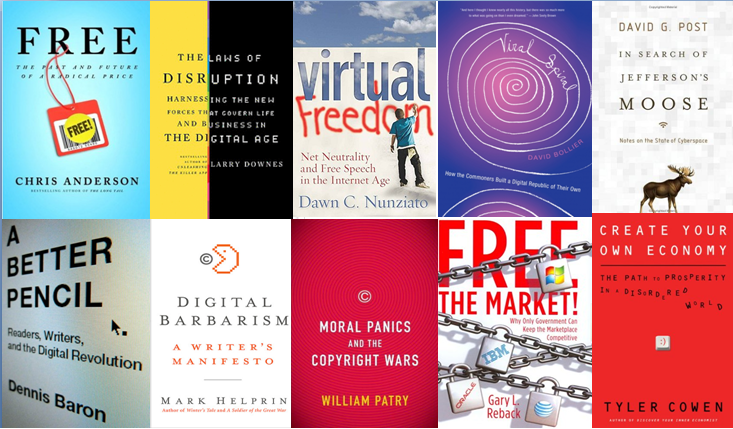 First, let me repeat a few of the same caveats and disclaimers that I set forth last year. What qualifies as an “important” info-tech policy book? Simply put, it’s a title that many people are currently discussing and that we will likely be referencing for many years to come. However, I want to be clear that merely because a book appears on my list it does not necessarily mean I agree with everything said in it. In fact, as was the case in previous years, I found much with which to disagree in my picks for the most important books of 2009 and I find that the cyber-libertarianism I subscribe to has very few fans out there.
Another caveat: Narrowly-focused titles lose a few points on my list. For example, if a book deals mostly with privacy issues, copyright law, or antitrust policy, it does not exactly qualify as the same sort of “tech policy book” as other titles found on this list since it is a narrow exploration of just one set of issues with a bearing on technology policy.
With those caveats in mind, here are my choices for the Most Important Info-Tech Policy Books of 2009. Continue reading →
 ACT represents the interests of software companies, but today we’ve released a new paper trumpeting the virtues of hardware.
We highlight how software developers and computer chip makers increasingly depend on one another for better products. This symbiotic hardware/software relationship is crucial for the sort of exponential innovation we’ve grown accustomed to in the IT industry. And it is something ACT recently highlighted in a letter to the FTC signed by 37 software developers.
The old days of understanding computer processors and its effect on software was easy. Chips increased in clock speed (first in MHz, then in GHz) and this made software run faster. This worked well for years, but then it became apparent that high clock speed processors often ran idle because other system components couldn’t keep up. These processors also ran very hot, consuming lots of power and creating heat problems.
Today’s chips take a different approach. Chips now have processors with multiple cores (or CPUs) to separately but simultaneously handle independent tasks. In a survey of ACT members that we conducted for the paper, 58% of the respondents identified multicore technology as the processor advancement that has most improved their software products. One member said “multicore makes programming harder, but when my apps leverage it, they can do more.”
But how do programmers know what to do so they can better leverage processor designs such as multicore? Every major chip manufacturer worth a grain of sand has established support programs and created tools for the developer community. Sun has its Sun Developer Network, Intel has a Software Partner Program (and just announced a new software development kit (SDK) for its mobile Atom processor), and AMD has the CodeAnalyst Performance Analyzer to analyze software performance and help developers optimize applications.
In some ways it seems like chip manufacturers are sucking up to software developers. Continue reading →
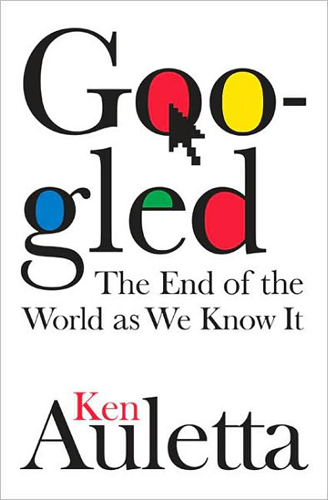 I just finished Ken Auletta’s latest book,
Googled: The End of the World As We Know It, and I highly recommend it. Auletta is an amazingly gifted journalist and knows how put together a hell of good story. It helps in this case that he was granted unprecedented access to the Google team and their day-to-day workings at the Googleplex. I’m really shocked by the level of access he was granted to important meetings and officials–over 150 interviews with Googlers, including 11 with CEO Eric Schmidt and several with founders Sergey Brin and Larry Page. That’s impressive.
I just finished Ken Auletta’s latest book,
Googled: The End of the World As We Know It, and I highly recommend it. Auletta is an amazingly gifted journalist and knows how put together a hell of good story. It helps in this case that he was granted unprecedented access to the Google team and their day-to-day workings at the Googleplex. I’m really shocked by the level of access he was granted to important meetings and officials–over 150 interviews with Googlers, including 11 with CEO Eric Schmidt and several with founders Sergey Brin and Larry Page. That’s impressive.
The book shares much in common with Randall Stross’s excellent Planet Google: One Company’s Audacious Plan to Organize Everything We Know, which I reviewed here earlier this year. Both books recount the history of Google from its early origins to present. And both survey a great deal of ground in terms of the challenges that Google faces as it matures and the policy issues that are relevant to the company (privacy, free speech, copyright law, etc).
What makes Auletta’s book unique is the way we taps his extensive “old media” world contacts and integrates such a diverse cast of characters into the narrative — Mel Karmazin (former Viacom, now Sirius XM), Bob Iger (Disney), Howard Stringer (Sony), Martin Sorrrell (WPP), Irwin Gotlieb (Group M), and even the Internet’s “inventor”–Al Gore! Auletta interviews them or recounts stories about their interactions with Google to show the growing tensions being created by this disruptive company and its highly disruptive technologies. There are some terrifically entertaining anecdotes in the book, but the bottom line is clear: Google has made a lot of enemies in a very short time.
Indeed, the book is as much about the decline of old media as it is about Google’s ascendancy. What Auletta has done so brilliantly here is to tell their stories together and ask how much old media’s recent woes can be blamed on Google and digital disintermediation in general. “If Google is destroying or weakening old business models,” Auletta argues, “it is because the Internet inevitably destroys old ways of doing things, spurs ‘creative destruction.’ This does not mean that Google is not ambitious to grow, and will not grow at the expense of others. But the rewards, and the pain, are unavoidable,” he concludes. Continue reading →
I’ve just released a new PFF white paper looking at the hysteria that has often accompanied major media mergers and then taking a look at the marketplace reality years after the fact. Here‘s the PDF, but I have also pasted the entire thing down below.
_____________________________
A Brief History of Media Merger Hysteria:
From AOL-Time Warner to Comcast-NBC
by Adam Thierer
Although the pending union of Comcast and NBC Universal has not yet made it to the altar, Chicken Little-esque wails about the marriage have already begun in earnest. For example, the pro-regulatory media organization Free Press has already set up a website to complain about the deal.[1] And Jeff Chester, executive director of the Center for Digital Democracy, has called it “an unholy marriage.”[2] The fever only promises to spread once the deal is formally announced, and a lengthy fight over the deal is expected at the Federal Communications Commission (FCC) and whichever antitrust agency reviews the deal.[3]
But reality tends to play out somewhat less dramatically than the script penned by the media worrywarts. It’s worth looking back at some of the more prominent examples of media merger hysteria in recent years to understand why such panic is unwarranted, and why a deal between Comcast and NBC Universal is unlikely to lead to the sort of problems that the pessimists suggest.[4] Continue reading →
If you read nothing else this year about dynamic competition theory and antitrust, check out this recently-released paper by J. Gregory Sidak and David J. Teece, available from SSRN. Sidak and Teece explain why the current economic framework that formally underpins antitrust insufficiently accounts for “Schumpeterian,” “innovative,” or “dynamic” competition. They provide a good discussion of the insights from behavioral economics, evolutionary economics, Austrian economics, and corporate strategy that would be useful in remaking the economic foundations of antitrust. Then they explain implications for specific topics, such as market definition, defining potential competitors, mergers, and intellectual property.
Most intriguing is their claim that the antitrust agencies have been drifting toward dynamic competition analysis without always acknowledging that’s what they’re doing:
If a lesson can be generalized, it is that one should approach with considerable skepticism the august pronouncements of the suppleness of existing antitrust doctrine to accommodate consideration of dynamic efficiency. It is time for the antitrust enforcement agencies and the courts to address forthrightly the challenge of developing more dynamically efficient merger guidelines. Achievement of that goal would lay the foundation for an analogous refinement of substantive rules of liability, defenses, and remedies across antitrust law generally. (pp. 43-44)
Sidak and Teece note that the Federal Trade Commission and Antitrust Division’s recent solicitation of comments on their merger guidelines could provide an opportunity to articulate some new economic foundations for antitrust. After reading the list of things the FTC and DOJ do not intend to change, it looks to me like the agencies will cling pretty fiercely to many traditional static concepts used in antitrust analysis. But two questions they raise provide glimmers of hope:
8. Should the Guidelines be revised to explain more fully … how market shares and market concentration are measured and interpreted in dynamic markets, including markets experiencing significant technological change?
15. Should the Guidelines be updated to address more explicitly the non-price effects of mergers, especially the effects of mergers on innovation?
Still, this seems narrow to me. “Normal” markets will remain subject to static analysis, while those special markets experiencing significant technological change might be analyzed differently. That seems to define dynamic competition awfully narrowly.
It seems the whole web is incorporating social networking functionality. Microsoft recently led the way in incorporating functionality to search, allowing users to share search results they like with their social networking contacts directly from the search results page through Twitter and Facebook. I’ve also noted that it’s just a matter of time before the same thing happens with advertising—and that Facebook will likely lead the way.
 Websites have long used social networking buttons to encourage visitors to join their Facebook group, follow them on Twitter, etc. Facebook recently made this even easier by creating a widget for pages that can easily be embedded on any site. So why is Facebook blocking advertisers from including social networking functionality in ads like this one? Facebook’s terms of service using the new Fan Box widget in ads. Facebook’s spokesperson told InsideFacebook.com:
We want Page owners to have an easy way to connect with fans both on and off of Facebook. In order to protect the the Fan Box widget from being used for the wrong reasons, we do not allow it to be used in third party advertising.
InsideFacebook.com speculates:
it’s safe to assume that Facebook wants to protect the “Become a Fan” experience from becoming too intertwined with aggressive online ads that it hasn’t approved. One can imagine the variety of ways advertisers could (potentially misleadingly) push users to become a fan in an ad unit on a web site, then pollute their Facebook stream later. Facebook wants more control over that experience, even if it means partially restricting growth for Facebook Pages.
So why might policymakers be interested in this? Because, as Fred Vogelstein predicted in Wired this June, Facebook will likely someday soon expand beyond selling ads on its own site to selling ads on the wider Internet that incorporate social networking functionality like the “Become a fan” button above. There is a vast untapped market for online advertising, and if Facebook’s going to get a piece of it, they’ll have to offer something no other ad network can. If and when this happens, Facebook will likely get a lot of grief from the anti-advertising zealots, but this would actually be a good thing for consumers for five reasons: Continue reading →
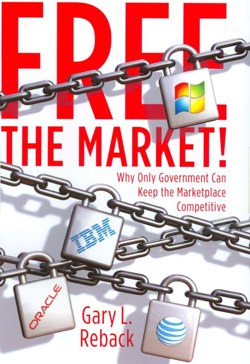 I recently finished reading Free the Market: Why Only Government Can Keep the Marketplace Competitive, a new book by noted antitrust agitator Gary L. Reback. Unsurprisingly, Reback, who led the antitrust jihad against Microsoft during the 1990s, has written a book that reads like an extended love letter to antitrust law. This man loves antitrust the way teenage girls love the Jonas Brothers — gushing, teary-eyed, ‘I-would-just-die-for-you’ sort of love. In Reback’s world, antitrust seemingly has no costs, no downsides, no trade-offs. It is our salvation and he serves as its high prophet. Everything good that happened in the world of high-tech over the past few decades? Oh, you can thank Almighty Antitrust for that. Anything bad that happened? Well, then, clearly there just wasn’t enough antitrust enforcement! That’s this book in a nutshell.
Think I’m kidding? How about this gem of quote from pg. 247: “Antitrust enforcement spawned Silicon Valley’s software industry as well.” Wow, who knew! Of course, that’s utter poppycock and should be somewhat insulting to the many entrepreneurial men and women in the high-tech world who risked everything in an attempt to build a better mousetrap. In Reback’s view of things, however, none of those mousetraps would have ever gotten built without antitrust there to supposedly shelter them from wicked “monopolists” (read: any large company) already operating in the marketplace. I’m sure many in Silicon Valley will also be surprised to hear Reback’s assertion that, “On closer examination, the Valley looks like one big public welfare project.” (p. 54) Ah yes, the old myth that government gave us the Net we know and love today. Please. Like many others, Reback spins a revisionist history of how early ARPANET involvement and seed money somehow made the Internet great when, in reality, the Net was stuck in the digital dark ages until it was finally allowed to be commercialized in 1992.
What irks me most about this book, however, is Reback’s perpetuation of the myth that antitrust is somehow not a form of economic regulation. I hear this tired old argument trotted out time and time again, even by many conservatives. Reback says, for example, that “Antitrust sets the rules of the road, so to speak, but doesn’t tell people where to drive.” By contrast, he argues, “Advocates of regulation want[] continuing government oversight and rule making to produce what would be the beneficial results of a free market… Neither approach works all the time, and decided between them remains difficult.” (p. 19) Again, this “choice” is largely a fiction since, for many industries, we end up getting both! Continue reading →
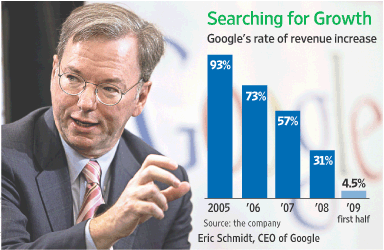 The Google juggernaut’s revenue growth has slowed steadily in the last five years, causing the Wall Street Journal to caution investors about buying Google stock. While much of the slow-down in Google’s revenue may be attributed to the recession, the WSJ cautions that:
- Microsoft is offering stiffer competition in search, which will only intensify once antitrust regulators approve its partnership with Yahoo! and the two companies actually implement their partnership (which could take another year);
- YouTube’s promise as an ad platform remains uncertain;
- Google lags behind Apple and Research in Motion in developing mobile phone operating systems, with Android still unproven;
- It remains unclear how successful the company will be in expanding beyond its existing lead in small text ads into the potentially lucrative realm of banner ads.
Somehow I doubt Google’s fall to Earth will do much to allay the concerns of those who see Google as the kind of evil monopolist Microsoft was made out to be in the 90s.
As the Journal concludes, “It would be foolish to predict that Google won’t have another business success, of course… Google may itself discover the next Google-like business.” As long as someone’s out there working to turn today’s idle fantasies into tomorrow’s multi-billion dollar businesses, consumers win—whoever that bold innovator might be.
 by Adam Thierer & Berin Szoka — (Ver. 1.0 — Summer 2009)
We are attempting to articulate the core principles of cyber-libertarianism to provide the public and policymakers with a better understanding of this alternative vision for ordering the affairs of cyberspace. We invite comments and suggestions regarding how we should refine and build-out this outline. We hope this outline serves as the foundation of a book we eventually want to pen defending what we regard as “Real Internet Freedom.” [Note: Here’s a printer-friendly version, which we also have embedded down below as a Scribd document.]
I. What is Cyber-Libertarianism?
Cyber-libertarianism refers to the belief that individuals—acting in whatever capacity they choose (as citizens, consumers, companies, or collectives)—should be at liberty to pursue their own tastes and interests online.
Generally speaking, the cyber-libertarian’s motto is “Live & Let Live” and “Hands Off the Internet!” The cyber-libertarian aims to minimize the scope of state coercion in solving social and economic problems and looks instead to voluntary solutions and mutual consent-based arrangements.
Cyber-libertarians believe true “Internet freedom” is freedom
from state action; not freedom for the State to reorder our affairs to supposedly make certain people or groups better off or to improve some amorphous “public interest”—an all-to convenient facade behind which unaccountable elites can impose their will on the rest of us.
Continue reading →
Microsoft and Yahoo’s proposed deal faces a tough antitrust gauntlet. In today’s The Seattle Times, Jonathan Hillel and I have an op-ed in which we argue that trustbusters should let the deal go through:
 MICROSOFT and Yahoo want to join forces in Internet search to better compete against Google. But first, they need the blessing of government antitrust enforcers. Senate Antitrust Subcommittee Chairman Herb Kohl, D-Wis., already has threatened “careful scrutiny” of the deal. But trustbusters should not go fishing for problems in the Internet search market. In the relentlessly fast-moving digital economy, government intervention contorts the market and ultimately harms consumers.
Under their proposed decade-long pact, Yahoo searches will be powered by Microsoft’s Bing search engine, which launched this June. The two search firms will maintain separate Web sites, but Microsoft will administer the technical side of both. Microsoft will also gain access to Yahoo’s vast volume of searches and query data. In exchange, Yahoo will receive 88 percent of ad revenues from searches performed on its own site.
MICROSOFT and Yahoo want to join forces in Internet search to better compete against Google. But first, they need the blessing of government antitrust enforcers. Senate Antitrust Subcommittee Chairman Herb Kohl, D-Wis., already has threatened “careful scrutiny” of the deal. But trustbusters should not go fishing for problems in the Internet search market. In the relentlessly fast-moving digital economy, government intervention contorts the market and ultimately harms consumers.
Under their proposed decade-long pact, Yahoo searches will be powered by Microsoft’s Bing search engine, which launched this June. The two search firms will maintain separate Web sites, but Microsoft will administer the technical side of both. Microsoft will also gain access to Yahoo’s vast volume of searches and query data. In exchange, Yahoo will receive 88 percent of ad revenues from searches performed on its own site.
Continue reading →

 The Technology Liberation Front is the tech policy blog dedicated to keeping politicians' hands off the 'net and everything else related to technology.