It seems the whole web is incorporating social networking functionality. Microsoft recently led the way in incorporating functionality to search, allowing users to share search results they like with their social networking contacts directly from the search results page through Twitter and Facebook. I’ve also noted that it’s just a matter of time before the same thing happens with advertising—and that Facebook will likely lead the way.
 Websites have long used social networking buttons to encourage visitors to join their Facebook group, follow them on Twitter, etc. Facebook recently made this even easier by creating a widget for pages that can easily be embedded on any site. So why is Facebook blocking advertisers from including social networking functionality in ads like this one? Facebook’s terms of service using the new Fan Box widget in ads. Facebook’s spokesperson told InsideFacebook.com:
We want Page owners to have an easy way to connect with fans both on and off of Facebook. In order to protect the the Fan Box widget from being used for the wrong reasons, we do not allow it to be used in third party advertising.
InsideFacebook.com speculates:
it’s safe to assume that Facebook wants to protect the “Become a Fan” experience from becoming too intertwined with aggressive online ads that it hasn’t approved. One can imagine the variety of ways advertisers could (potentially misleadingly) push users to become a fan in an ad unit on a web site, then pollute their Facebook stream later. Facebook wants more control over that experience, even if it means partially restricting growth for Facebook Pages.
So why might policymakers be interested in this? Because, as Fred Vogelstein predicted in Wired this June, Facebook will likely someday soon expand beyond selling ads on its own site to selling ads on the wider Internet that incorporate social networking functionality like the “Become a fan” button above. There is a vast untapped market for online advertising, and if Facebook’s going to get a piece of it, they’ll have to offer something no other ad network can. If and when this happens, Facebook will likely get a lot of grief from the anti-advertising zealots, but this would actually be a good thing for consumers for five reasons: Continue reading →
I really appreciate the venture capitalists (VCs) in Silicon Valley subsidizing my soapbox at Twitter. Seriously, it is an absolutely awesome platform for getting a message out to the masses. But at some point I worry that the gravy train will come to an end and that users will have to start picking up part of the tab. After all, will those VCs continue to subsidize Twitter if it never turns a profit? According to the Wikipedia entry about Twitter:
In total, Twitter has raised over US$57 million from venture capitalists. The exact amounts of funding have not been publicly released. Twitter’s first round of funding was for an undisclosed amount that is rumored to have been between $1 million and $5 million. Its B round of funding in 2008 was for $22 million and its C round of funding in 2009 was for $35 million from Institutional Venture Partners and Benchmark Capital along with an undisclosed amount from other investors including Union Square Ventures and Spark Capital. Twitter is backed by Union Square Ventures, Digital Garage, Spark Capital, and Bezos Expeditions.
Again, thank you VCs! But, like them, I do wonder when and how Twitter will bring in some cash. Is there a “freemium” model that could work? Perhaps. “Pro” or corporate accounts have been rumored to be in the works. Getting someone else to pick up the tab that way might bring in enough cash for Twitter to allow the free ride to continue for the rest of us. But what about advertising? It’s been the “mother’s milk” of most online media and platforms for some time now, and Twitter seems perfectly suited to insert a few banner ads or contextual ads here and there. It could be happening sooner than you think. Austin Modine of The Register notes in a new piece, “Twitter ‘Leaves Door Open’ for Targeted Ads,” that: Continue reading →
 Sometimes the most revealing conversations about policy issues happen with our loved ones at the breakfast table. Although loyal TLF readers may remember my partner Michael as my “Posterboy for Advertising’s Pro-Consumer Quid Pro Quo,” he doesn’t usually get into the policy issues I cover. But this morning, we fell into a conversation about the bitterly contentious issue of marketing to kids:
Michael: Growing up in South Korea, on a military base, we didn’t have any commercials on television. We had three channels and all they showed was public service announcements.
Sounds like paradise for anti-advertising zealots like Jeff Chester and the media reformistas who want to re-create the old media scarcity in the name of “media democracy“! Anyway:
We moved back to the U.S. when I was nine, and suddenly, during all my favorite cartoons, there were ads for toys. It was exciting—and more than a little bit overwhelming! It wasn’t just that I wanted these toys; it was that felt this incredible sense of urgency: I thought we had to go get the toys right now or they’d be gone!
What did Rousseau call his innocent man, the Noble Savage? That’s what we were: The noble savage, coming into this world of sophisticated toy advertisements.
But it didn’t take long for me to get over this initial bewilderment. My parents explained to me that we didn’t really have to go to the store
right away. (They also explained to me that I couldn’t haggle with the staff at Toys ‘R Us the same way I’d haggled with street vendors back in Korea—something that utterly mystified the staff.) After one trip to Toys Toys ‘R Us, I got the toys I wanted most and, over the next few months, realized that they weren’t anywhere near as exciting as I had imagined.
After that, I enjoyed the toy ads on TV, but I lost interest in many of the toys I already had, preferring to create my own toys or play outside.
I explained that advertising of toys to kids has long been the
cause celebre of anti-advertising crusaders:
Michael: But kids are acquisitive, too! How are they supposed to know about the latest toys if you can’t advertise to them? And what’s the big deal, anyway? I got used to toy ads and I think most kids would, too. The thing that’s different is incentive programs at stores.
Continue reading →
Microsoft is making a major push to integrate social networking tools like Facebook and Twitter into its Bing search engine: users will soon be able to “Ping” search results they like to their friends directly from Bing. Back in January, in “Google, the Innovator’s Dilemma and the Future of Search & Web Ads,” I talked about the implications of this history of search from the WSJ):
Microsoft missed its opportunities to get into paid search not because it was “dumb,” “uninnovative” or a “bad” company, but for the same sorts of reasons that big, highly successful and even particularly innovative companies fail. The reasons companies generally succeed in mastering “adaptive” innovation of the technologies behind their established business models are the very reasons why such great companies struggle to encourage or channel the “disruptive” innovation that renders their core technologies and business models obsolete. This dynamic was described brilliantly in Harvard Business School professor Clayton Christensen’s classic 1997 book The Innovator’s Dilemma: When New Technologies Cause Great Firms to Fail…
Let’s hope that Microsoft—as well as Yahoo!—have carefully studied the vast literature produced by business schools in the wake of Christensen’s book about how big companies can avoid the Innovator’s Dilemma by promoting—and capitalizing on—radical innovation from within. Indeed, this seems to be precisely what has guided Google’s own strategy as it has grown from “disruptive innovator” to become the very sort of behemoth that cannot easily escape the Dilemma, even if corporate managers are fully aware of the problem on a theoretical level. If Google can do it, Microsoft should be able to, too. But let’s also not discount the possibility that, no matter how hard Google’s management might try to retain the innovative culture of a start-up, the giant
can’t do that well enough to prevent its own apparent market dominance from being disrupted by new upstart innovators in search and advertising technologies.
My prediction seems to be coming true: Microsoft, with less to lose and without a huge installed user base to worry about annoying by violating Google’s “Prime Directive” of elegant simplicity, may have an easier time introducing “disruptive” innovations to search than Google. Of course, it’s unlikely that any
one feature will prove the “killer app” that suddenly causes Bing’s market share to explode—and Google’s to plummet—but a steady stream of such nifty features could convince many users to switch to Bing.
At 29, I’m old enough to remember when Microsoft seemed as cool as Google does today. Hell, I remember being thrilled as a sophomore in high school by Bill Gates’ 1995 book
The Road Ahead and the accompanying CD-ROM (which included, as I recall, a tour of Gates’s ultra-futuristic home). If Microsoft can “get its mojo back,” the company could truly become a web services provider to rival Google. We’d all benefit from having more choices in search engines, advertising platforms and related tools. And, driving each other to “build a better mousetrap,” the two companies could lead us down the “Road Ahead” from Search 2.0 to Search 3.0 and beyond. So here’s to hoping that Redmond can solve the “Innovator’s Dilemma” with tools like Google’s “20 percent” time that free engineers to innovate!
The Tennis Channel and ESPN have teamed up to offer live coverage of the US Open online. Not only is this a wonderful thing for consumers, but it also demonstrates just how easily content creators (including traditional television programming networks) can completely bypass cable companies, who once supposedly used their “bottleneck” power to act as “gatekeepers” over the content Americans could receive. If this was ever true, it certainly isn’t true in the era of Internet video!
The venture will, of course, be ad-supported. But just how much content such a model can support will depend heavily on whether Internet video programming distributors like this venture (or Hulu.com) will be able to personalize the ads shown on their videos based on the likely interests of users. Ad industry observer David Hallerman has predicted that spending on behavioral advertising:
is projected to reach $1.1 billion in 2009 and $4.4 billion in 2012 [a quarter of U.S. display advertising].The prime mover behind this rapid increase will be the mainstream adoption of online video advertising, which will increasingly require targeting to make it cost-effective.
The problem isn’t just the expense involved in streaming online video, it’s that contextually targeting advertising (based on keywords) is easy when the content is text but far more difficult when the content is video.
So if you’re hoping to cut the cord to cable and save the expense of a monthly cable subscription, you’d better hope the privacy zealots don’t wipe out advertising model necessary to make Internet video a true substitute for traditional subscription video sources!
A coalition of ten self-described “consumer and privacy advocacy organizations” today demanded legislation that would restrict the collection and use of data online for customizing advertising based on Internet users’ interests. I’ll have more to say on this but here are my initial comments:
These so-called “consumer advocates” are actually anti-consumer elitists. Not only do they presume that consumers are too stupid or lazy to make their own decisions about privacy, but they ignore the benefits to consumers: more relevant advertising plus more and better content.
Advertising has been the “mother’s milk” of media in America since colonial times and the future of media depends on the ability of publishers to replicate that revenue model online. Micropayments, donations, subscriptions alone simply can’t fund a vibrant marketplace of ideas. Only personalized advertising can sustain publishers through the Digital Revolution.
Regulatory advocates haven’t demonstrated any harm to consumers that would justify such sweeping preemptive regulation. By strangling funding for new media, such regulations would amount to an “Industrial Policy” for the Internet. Instead, policymakers should focus on educating consumers and empowering them by promoting development of better privacy management tools.
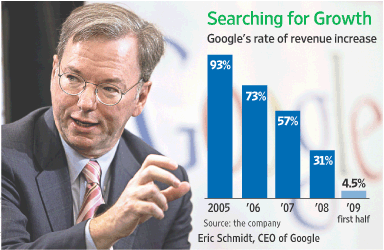 The Google juggernaut’s revenue growth has slowed steadily in the last five years, causing the Wall Street Journal to caution investors about buying Google stock. While much of the slow-down in Google’s revenue may be attributed to the recession, the WSJ cautions that:
- Microsoft is offering stiffer competition in search, which will only intensify once antitrust regulators approve its partnership with Yahoo! and the two companies actually implement their partnership (which could take another year);
- YouTube’s promise as an ad platform remains uncertain;
- Google lags behind Apple and Research in Motion in developing mobile phone operating systems, with Android still unproven;
- It remains unclear how successful the company will be in expanding beyond its existing lead in small text ads into the potentially lucrative realm of banner ads.
Somehow I doubt Google’s fall to Earth will do much to allay the concerns of those who see Google as the kind of evil monopolist Microsoft was made out to be in the 90s.
As the Journal concludes, “It would be foolish to predict that Google won’t have another business success, of course… Google may itself discover the next Google-like business.” As long as someone’s out there working to turn today’s idle fantasies into tomorrow’s multi-billion dollar businesses, consumers win—whoever that bold innovator might be.
Mediapost has published an interview I gave to Omar Tawakol, founder of the BlueKai registry entitled “User Empowerment, Not Regulation, Is The Answer to Privacy Concerns About Targeted Ads” in which I summarize the arguments Adam Thierer and I have been making since our “Principles to Guide the Debate” piece last September.
We argue for user empowerment over restrictive defaults (like “opt-in”) for data use and collection because, as the Supreme Court held in 2000: “Technology expands the capacity to choose; and it denies the potential of this revolution if we assume the Government is best positioned to make these choices for us.”
We promote tools that let users make their own decisions about privacy, not only because those decisions are fundamentally subjective, but because regulatory mandates could stifle the development of online content and commerce.
I also note the parallels between speech controls and privacy regulation, and call for a consistent, principled approach to both:
Since 1997, the Supreme Court has struck down multiple legislative attempts to censor online and offline content [especially the CDA] because there were “less restrictive alternatives” that would not so heavily burden free speech rights. In a 2000 cable-related decision, the Court held that “targeted blocking [by users] is less restrictive than banning, and the Government cannot ban speech if targeted blocking is a feasible and effective means of furthering its compelling interests.”
Courts have struck down other federal and state speech controls because parents had the tools to filter their kids’ access to information online, in video games, etc., as described in my PFF colleague Adam Thierer’s ongoing catalog of these tools…
Many who oppose industry self-regulation are not really “consumer advocates” because they don’t recognize that consumers have many, competing values. Those regulatory advocates are more interested in their preferred one-size-fits-all mandates than in empowering users to determine their own privacy preferences.
Like advocates of censorship, privacy zealots assert great dangers to which citizens are supposedly oblivious but which urgently require government intervention-dismissing arguments to the contrary as either uninformed or irresponsible.
The comments on the interview are equally worth reading. Jeff Chester, who has made a career out of attacking advertising, quickly posted a comment dismissing, but ignoring, my arguments about consumer welfare as corporate propaganda—just as he did with his comment on the post Adam and I wrote in June about congressional hearings on the issue featuring Chester (and Scott Cleland, the right-wing “Bizarro Chester“). I’ve had it with Chester’s ad hominem attacks on the motives of those who disagree with him, as I explained in my reply to Chester: Continue reading →
 by Adam Thierer & Berin Szoka — (Ver. 1.0 — Summer 2009)
We are attempting to articulate the core principles of cyber-libertarianism to provide the public and policymakers with a better understanding of this alternative vision for ordering the affairs of cyberspace. We invite comments and suggestions regarding how we should refine and build-out this outline. We hope this outline serves as the foundation of a book we eventually want to pen defending what we regard as “Real Internet Freedom.” [Note: Here’s a printer-friendly version, which we also have embedded down below as a Scribd document.]
I. What is Cyber-Libertarianism?
Cyber-libertarianism refers to the belief that individuals—acting in whatever capacity they choose (as citizens, consumers, companies, or collectives)—should be at liberty to pursue their own tastes and interests online.
Generally speaking, the cyber-libertarian’s motto is “Live & Let Live” and “Hands Off the Internet!” The cyber-libertarian aims to minimize the scope of state coercion in solving social and economic problems and looks instead to voluntary solutions and mutual consent-based arrangements.
Cyber-libertarians believe true “Internet freedom” is freedom
from state action; not freedom for the State to reorder our affairs to supposedly make certain people or groups better off or to improve some amorphous “public interest”—an all-to convenient facade behind which unaccountable elites can impose their will on the rest of us.
Continue reading →
What Unites Advocates of Speech Controls & Privacy Regulation? [pdf]
by Adam Thierer & Berin Szoka
The Progress & Freedom Foundation,
Progress on Point No. 16.19
Anyone who has spent time following debates about speech and privacy regulation comes to recognize the striking parallels between these two policy arenas. In this paper we will highlight the common rhetoric, proposals, and tactics that unite these regulatory movements. Moreover, we will argue that, at root, what often animates calls for regulation of both speech and privacy are two remarkably elitist beliefs:
- People are too ignorant (or simply too busy) to be trusted to make wise decisions for themselves (or their children); and/or,
- All or most people share essentially the same values or concerns and, therefore, “community standards” should trump household (or individual) standards.
While our use of the term “elitism” may unduly offend some understandably sensitive to populist demagoguery, our aim here is not to launch a broadside against elitism as
Time magazine culture critic William H. Henry once defined it: “The willingness to assert unyieldingly that one idea, contribution or attainment is better than another.”[1] Rather, our aim here is to critique that elitism which rises to the level of political condescension and legal sanction. We attack not so much the beliefs of some leaders, activists, or intellectuals that they have a better idea of what it in the public’s best interest than the public itself does, but rather the imposition of those beliefs through coercive, top-down mandates.
That sort of elitism—elitism enforced by law—is often the objective of speech and privacy regulatory advocates. Our goal is to identify the common themes that unite these regulatory movements, explain why such political elitism is unwarranted, and make it clear how it threatens individual liberty as well as the future of free and open Internet. As an alternative to this elitist vision, we advocate an empowerment agenda: fostering an environment in which users have the tools and information they need to make decisions for themselves and their families. Continue reading →

 The Technology Liberation Front is the tech policy blog dedicated to keeping politicians' hands off the 'net and everything else related to technology.